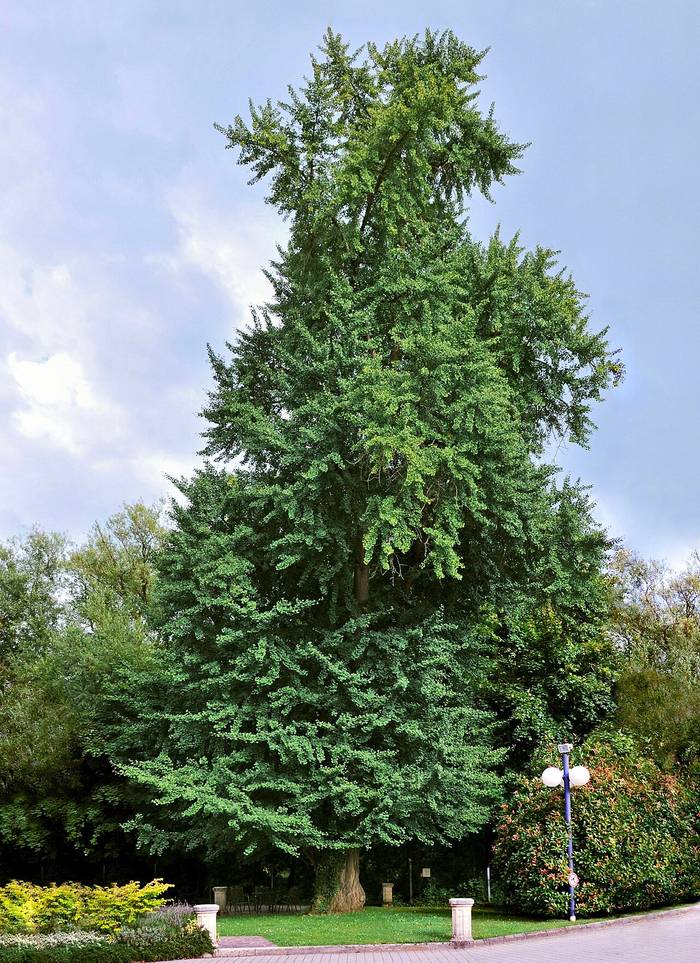
EecherplazGinkgo06.jpg : Cayambe derivative work: Ginkgotree ( talk ) · CC BY-SA 3.0
Maidenhair tree
Tree·Ginkgo biloba
Full sun
Sun
Dry to moist soil
Water
Well-drained soil
Drainage
Zones 3–9
Hardiness
Coverage · 135 fields
- Parser flag (climate_tolerance_low_confidence): Climate tolerance values are LLM-extracted (no authoritative EcoCrop match found). EcoCrop covers ~2,568 food-crop taxa; ornamental/native/medicinal species rely on LLM extraction.
Growth and size11 fields
Plant type
Deciduous tree“Ginkgo biloba is a deciduous Tree growing to 30 m (98ft) by 9 m (29ft) at a slow rate.”
Height
3,000 cm · the source gives 2,000–3,500 cm“They are large trees, normally reaching a height of 20–35 m (66–115 ft), with some specimens in China being over 40 m (130 ft).”PFAF“Ginkgo biloba is a deciduous Tree growing to 30 m (98ft) by 9 m (29ft) at a slow rate.”
Spread
900 cm“Ginkgo biloba is a deciduous Tree growing to 30 m (98ft) by 9 m (29ft) at a slow rate.”
Height at age
—
empty
Size after planting
4 yrs: 5 m tall, 1 m crown · 11 yrs: 5.8 m tall, 1.6 m crown · 16 yrs: 4 m tall, 1 m crown · 35 yrs: 11 m tall, 4 m crown · 70 yrs: 18 m tall, 9.8 m crown“Berlin tree register: 1319 trees of this species measured with years since planting, height and crown diameter; median crown 9.8 m and height 18.0 m at 60–100 years after planting (30 trees).”Median of 1,319 measured trees in Berlin. Years count from planting nursery stock, so a small tree reaches each size later.
Spacing
1,200 cm (at least 900 cm)
AI estimate55 % agree
Growth rate
Slow“Ginkgo biloba is a deciduous Tree growing to 30 m (98ft) by 9 m (29ft) at a slow rate.”
Habit
Columnar
AI estimate50 % agree
Root depth
Deep“The tree has an angular crown and long, somewhat erratic branches, and is usually deep-rooted and resistant to wind and snow damage.”
Forest garden layer
Canopy
AI estimate90 % agree
Lifespan
~1,000 years
AI estimatenot measured yet
Roots6 fields
Root form
—
empty
Storage organ
—
empty
Lateral spread in cm
—
empty
Root depth in cm
—
empty
Mycorrhiza
—
empty
Light, water and soil9 fields
Sun
Full sun“Ginkgo prefers full sun and grows best in environments that are well-watered and well-drained.”
Hours of sun
6 h
AI estimatenot measured yet
Tolerates waterlogging
—
empty
Soil type
Sand, loam, clay · best: loam“Succeeds in most soil types so long as they are well-drained, though it prefers a rather dry loam in a position sheltered from strong winds.”PFAF“Suitable for: light (sandy), medium (loamy) and heavy (clay) soils and prefers well-drained soil.”
Drainage
Well drained“Suitable for: light (sandy), medium (loamy) and heavy (clay) soils and prefers well-drained soil.”
Compacted soil
Copes well“Plants can grow in poor hard-packed soil, making the male forms good candidates for street planting.”
Climate5 fields
Hardiness
Zone 3–9
AI estimatenot measured yet
Killing frost
-30 °C
AI estimatenot measured yet
Growing temperature
5–35 °C · optimal 15–30 °C
AI estimatenot measured yet
Chill hours
400 h
AI estimatenot measured yet
Care (becomes tasks in Manage)3 fields
Watering
July · lasts 60 days
AI estimatenot measured yet
Mulching
April · lasts 30 days
AI estimatenot measured yet
Pruning
February · lasts 28 days · dead, damaged, or crossing branches
AI estimatenot measured yet
Through the year7 fields
Harvest
After the previous stage · lasts 30 days“Seeds are typically harvested in Autumn when they are ripe.”
Dying back
After the first frost · lasts 30 days“During autumn, the leaves turn a bright yellow and then fall”
Wikipediapartly
Dormant
After the first frost · 30 days after · lasts 150 days
AI estimatenot measured yet
First harvest
6–10 years after plantingThis is for grafted (nursery-propagated) trees, which is how the species is sold. Ungrafted seed-grown trees take much longer: RHS says the sex of a seedling 'will not be evident until approximately 20 years when they first flower,' and Clemson HGIC (hgic.clemson.edu) says 'it takes 20 to 30 years for a seed-grown ginkgo to reach reproductive maturity.' Grimo Nut Nursery (grimonut.com) is a fruit/nut nursery, not an extension service.
Edible parts and pollination5 fields
The seeds
Boiled, baked, or added to soups and porridges · October–November“others warn that large quantities of raw seeds are toxic”PFAF“They are boiled, baked, or added to soups and porridges.”PFAF“It is in flower from April to May, and the seeds ripen from October to November.”PFAFpartly“Seed - raw (in small quantities), or cooked.”
Seed oil
Extracted for culinary use“Edible Parts: Oil Oil Seed”PFAF“The seeds are also a good source of niacin and contain some edible oils extracted for culinary use.”
Pollination
Needs a partner · a male plant · dioecious“The species is dioecious (individual flowers are either male or female, but only one sex is to be found on any one plant so both male and female plants must be grown if seed is required).”PFAF“and is pollinated by Wind.”PFAF“The plant is not self-fertile.”PFAF“both male and female plants must be grown if seed is required”PFAF“Plants are either male or female, one male plant can pollinate up to 5 females.”
Ecology6 fields
Pests
—
empty
Diseases
—
empty
Takes up
—
empty
Fixes nitrogen
No
AI estimatenot measured yet
Mycorrhiza
Yes
AI estimatenot measured yet
Propagation and names4 fields
Methods
Seed sown as soon as ripe in a cold frame or sheltered outdoor bed, Softwood cuttings in a frame in spring, Half-ripe wood cuttings in July/August in a frame, Mature wood cuttings in December in a frame, Grafting of male cultivars onto seedling rootstock“Seed - best sown as soon as it is ripe in a cold frame or in a sheltered outdoor bed.”PFAF“Softwood cuttings in a frame in spring.”PFAF“Cuttings of half-ripe wood, July/August in a frame.”PFAF“Cuttings of mature wood, December in a frame.”Wikipediapartly“Many intentionally planted ginkgos are male cultivars grafted onto plants propagated from seed”
Difficulty
3 / 5
AI estimatenot measured yet
Seed
Disputed: one report says stratification is required, another says it is not required“The seed requires stratification according to one report whilst another says that stratification is not required and that the seed can be sown in spring but that it must not have been allowed to dry out.”
Not sorted yet79 fields
Fields the parser stores that this page has no row for yet. They show up here automatically, so nothing is hidden.
forage.DK.local_name
Ginkgo
AI estimatenot measured yet
forage.DK.warnings_da
Brug handsker, når du rører ved frøenes kødfulde yderlag.
AI estimatenot measured yet
forage.DK.warnings_en
Wear gloves when handling the fleshy outer covering of the seeds.
AI estimatenot measured yet
forage.DK.prep_cautions
Wear gloves when handling the fleshy outer covering of the seeds., Heat seeds thoroughly before eating., Eaten in large quantities or over a long period, seeds may cause poisoning by ginkgotoxin.“It needs to be heated before being eaten in order to destroy a mildly acrimonious principle.”Wikipedia“When eaten in large quantities or over a long period, the seeds may cause poisoning by ginkgotoxin (4'-O-methylpyridoxine, MPN), as found in a few case reports.”PFAFpartly“The fleshy outer covering of the seeds can produce an unpleasant odour and may cause skin irritation in some people, so gloves are recommended.”
forage.DK.edibility_basis
inferred
AI estimatenot measured yet
forage.DK.foraging_months.notes
Leaves are best collected when green and vibrant. Seeds are collected after falling in autumn.
AI estimatenot measured yet
forage.DK.foraging_months.months
10, 11“It is in flower from April to May, and the seeds ripen from October to November.”
forage.DK.foraging_months.year_round
false
AI estimatenot measured yet
forage.DK.habitat_affinity
disturbed_ground“The species shows a preference for disturbed sites”
forage.US.local_name
Ginkgo
AI estimatenot measured yet
forage.US.edible_parts
[{"part":"seed","caution":"Large quantities of raw seeds are toxic","preparation":"boiled, baked, or added to soups and porridges","season_months":[10,11]},{"part":"oil","caution":null,"preparation":"extracted for cul…
AI estimatenot measured yet
forage.US.prep_cautions
Heat seeds before eating to destroy a mildly acrimonious principle, Wear gloves when handling the fleshy outer covering of the seeds, Large quantities of raw seeds are toxic, Health risks with excessive or improper use, including ginkgotoxin poisoning
AI estimatenot measured yet
forage.US.edibility_basis
inferred
AI estimatenot measured yet
forage.US.foraging_months.notes
Leaves are best collected when green and vibrant. Seeds are collected after falling in autumn.
AI estimatenot measured yet
forage.US.foraging_months.months
10, 11
AI estimatenot measured yet
forage.US.foraging_months.year_round
false
AI estimatenot measured yet
forage.US.habitat_affinity
disturbed_ground
AI estimatenot measured yet
forage.TROPICAL.local_name
Ginkgo
AI estimatenot measured yet
forage.TROPICAL.edible_parts
[{"part":"seeds","caution":"raw seeds contain ginkgotoxin and should not be consumed in large quantities","preparation":"roasted or boiled","season_months":[9,10]},{"part":"leaves","caution":null,"preparation":"tea or…
AI estimatenot measured yet
forage.TROPICAL.prep_cautions
Raw seeds contain ginkgotoxin and should be consumed in moderation after proper preparation (roasting or boiling).
AI estimatenot measured yet
forage.TROPICAL.edibility_basis
inferred
AI estimatenot measured yet
forage.TROPICAL.foraging_months.notes
Leaves are best collected when green and vibrant. Seeds are collected after falling in autumn.
AI estimatenot measured yet
forage.TROPICAL.foraging_months.months
5, 6, 7, 8, 9, 10
AI estimatenot measured yet
forage.TROPICAL.foraging_months.year_round
false
AI estimatenot measured yet
forage.TROPICAL.habitat_affinity
disturbed_ground
AI estimatenot measured yet
ornamental.basis
documented
AI estimatenot measured yet
ornamental.fragrance.source
fruit“Male trees are preferred for planting since female trees produce fruit with a strong odour when ripe.”
PFAFpartly
ornamental.fragrance.intensity
strong“Male trees are preferred for planting since female trees produce fruit with a strong odour when ripe.”
ornamental.confidence
high
AI estimatenot measured yet
ornamental.fall_interest
true“Ginkgos are prized for their autumn foliage, which is a deep saffron yellow.”
Wikipediapartly
ornamental.flower_colour
green, insignificant“Bloom Color: Green.”PFAF“Ginkgo trees flower in Spring, although the flowers are not very showy and are often overlooked.”
ornamental.evidence_quote
Ginkgo biloba is known for its distinctive fan-shaped green leaves that turn a brilliant yellow in autumn. The flowers are inconspicuous, and the tree has a strong architectural form in winter.
AI estimatenot measured yet
ornamental.foliage_colour
green“Leaves are green both on the top and bottom and have stomata on both sides.”
ornamental.foliage_texture
medium
AI estimatenot measured yet
ornamental.winter_structure
architectural_skeleton
AI estimatenot measured yet
ornamental.autumn_foliage_colour
yellow_green
AI estimatenot measured yet
care_regime
none
AI estimatenot measured yet
propagation.self_seeding
none
AI estimate20 % agree
propagation.division_season
not applicable
AI estimatenot measured yet
propagation.establishment_years
3
AI estimate40 % agree
size_at_age.v
1
AI estimatenot measured yet
size_at_age.basis
years_after_planting
AI estimatenot measured yet
spatial_profile.canopy_density
medium
AI estimatenot measured yet
sun_requirement.best
full_sun“Ginkgo prefers full sun and grows best in environments that are well-watered and well-drained.”
sun_requirement.best_for
fruit
AI estimatenot measured yet
forage_proposals.DK.edibility_tier.tier
caution
AI estimatenot measured yet
forage_proposals.DK.edibility_tier.confidence
high
AI estimatenot measured yet
forage_proposals.DK.edibility_tier.evidence_quote
Ginkgo seeds are edible when cooked, but raw seeds contain ginkgotoxin, which can cause seizures if consumed in large amounts. Proper preparation is essential.
AI estimatenot measured yet
forage_proposals.US.edibility_tier.tier
caution
AI estimatenot measured yet
forage_proposals.US.edibility_tier.confidence
high
AI estimatenot measured yet
forage_proposals.US.edibility_tier.evidence_quote
Ginkgo seeds are edible when cooked, but raw seeds contain ginkgotoxin, which can cause seizures if consumed in large amounts. Proper preparation is essential.
AI estimatenot measured yet
forage_proposals.TROPICAL.edibility_tier.tier
caution
AI estimatenot measured yet
forage_proposals.TROPICAL.edibility_tier.confidence
high
AI estimatenot measured yet
forage_proposals.TROPICAL.edibility_tier.evidence_quote
Ginkgo seeds are edible when cooked, but raw seeds contain ginkgotoxin, which can cause seizures if consumed in large amounts. Proper preparation is essential.
AI estimatenot measured yet
function_profile.biomass_return.confidence
medium“During autumn, the leaves turn a bright yellow and then fall, sometimes within a short space of time (one to fifteen days).”
Wikipediapartly
function_profile.nutrient_flows.consumes
[{"basis":"inferred","demand":"moderate","nutrient":"nitrogen","confidence":"medium"},{"basis":"inferred","demand":"moderate","nutrient":"phosphorus","confidence":"medium"},{"basis":"inferred","demand":"moderate","nut…“Plants can grow in poor hard-packed soil, making the male forms good candidates for street planting.”
PFAFpartly
function_profile.nutrient_flows.provides
[{"basis":"inferred","nutrient":"nitrogen","mechanism":"biomass_return","confidence":"low","evidence_quote":null}]
AI estimatenot measured yet
function_profile.biotic_interactions
[{"taxa":["wildlife"],"basis":"documented","valence":"beneficial","relation":"attracts","confidence":"medium","evidence_quote":"It is noted for attracting wildlife.","organism_group":"wildlife"}]“It is noted for attracting wildlife.”
function_profile.aromatic_pest_effect.value
false
AI estimate80 % agree
function_profile.aromatic_pest_effect.confidence
high
AI estimatenot measured yet
function_profile.structural_interfaces.provides_shelter.basis
taxonomic
AI estimatenot measured yet
function_profile.structural_interfaces.provides_shelter.kinds
shade“This species is highly tolerant to pollution and serves as a visually appealing, shade-providing tree in many cities and gardens.”
function_profile.structural_interfaces.provides_shelter.confidence
high
AI estimatenot measured yet
function_profile.structural_interfaces.provides_shelter.evidence_quote
This species is highly tolerant to pollution and serves as a visually appealing, shade-providing tree in many cities and gardens.
AI estimatenot measured yet
function_profile.structural_interfaces.requires_shelter.basis
taxonomic
AI estimatenot measured yet
function_profile.structural_interfaces.requires_shelter.kinds
wind“Succeeds in most soil types so long as they are well-drained, though it prefers a rather dry loam in a position sheltered from strong winds.”
function_profile.structural_interfaces.requires_shelter.stage
permanent
AI estimatenot measured yet
function_profile.structural_interfaces.requires_shelter.confidence
high
AI estimatenot measured yet
function_profile.structural_interfaces.requires_shelter.evidence_quote
Succeeds in most soil types so long as they are well-drained, though it prefers a rather dry loam in a position sheltered from strong winds.
AI estimatenot measured yet
function_profile.structural_interfaces.provides_physical_support.form
trunk
AI estimatenot measured yet
function_profile.structural_interfaces.provides_physical_support.basis
taxonomic
AI estimatenot measured yet
function_profile.structural_interfaces.provides_physical_support.confidence
high
AI estimatenot measured yet
function_profile.structural_interfaces.requires_physical_support.basis
taxonomic
AI estimatenot measured yet
function_profile.structural_interfaces.requires_physical_support.confidence
high
AI estimatenot measured yet
climate_tolerance.photoperiod_response
day_neutral
AI estimatenot measured yet
soil_interactions.organic_matter_contribution
medium
AI estimatenot measured yet
component_metadata.growth_cycle
perennial
AI estimate100 % agree
resource_interfaces.inputs
[{"resource":"light","quantity_description":"full sun"},{"resource":"water","quantity_description":"prefers dry or moist soil; tolerates drought"},{"resource":"pollination","quantity_description":"one male plant can p…“Ginkgo prefers full sun and grows best in environments that are well-watered and well-drained.”PFAF“It prefers dry or moist soil and can tolerate drought.”PFAF“Plants are either male or female, one male plant can pollinate up to 5 females.”PFAF“Succeeds in most soil types so long as they are well-drained, though it prefers a rather dry loam in a position sheltered from strong winds.”
resource_interfaces.outputs
[{"resource":"shade","quantity_description":"shade-providing tree in cities and gardens"},{"resource":"leaf_litter","quantity_description":"leaves turn yellow and fall in autumn"},{"resource":"seeds","quantity_descrip…“This species is highly tolerant to pollution and serves as a visually appealing, shade-providing tree in many cities and gardens.”Wikipedia“During autumn, the leaves turn a bright yellow and then fall, sometimes within a short space of time (one to fifteen days).”PFAF“The main edible part is its seeds; They have a soft, oily texture and a sweet flavour, often compared to pine nuts.”Wikipedia“The disadvantage of male Ginkgo biloba trees is that their pollen is highly allergenic.”Wikipedia“G. biloba wood is valued for its durability and used in crafts and sake-making”PFAF“The fruit contains butanoic acid, it has the aroma of rancid butter.”PFAF“It is noted for attracting wildlife.”