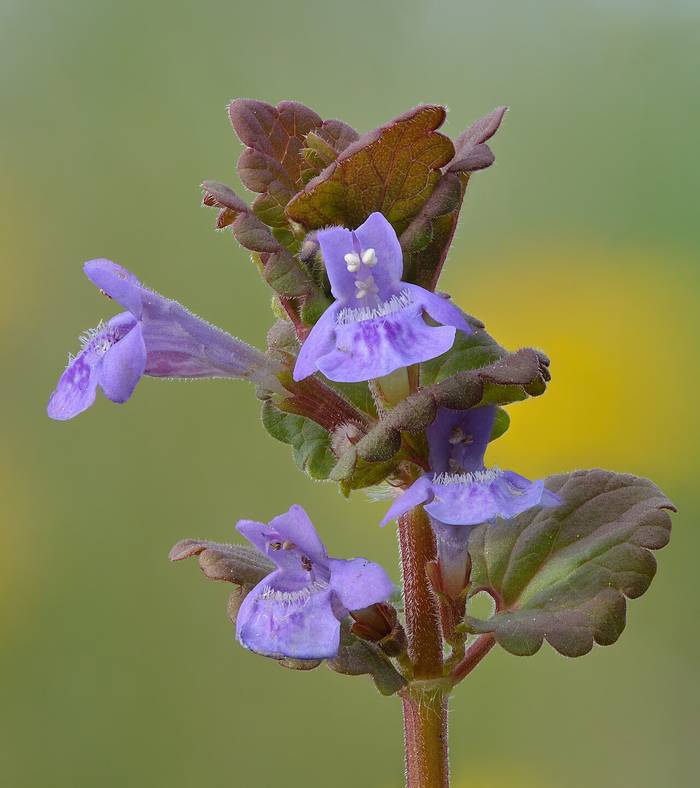
Ivar Leidus · CC BY-SA 4.0
Ground ivy
Plant·Glechoma hederacea
Shade to full sun
Sun
Moist soil
Water
Not recorded
Drainage
Zones 3–9
Hardiness
Coverage · 101 fields
No obvious inconsistencies found.
Growth and size10 fields
Height
20 cm“Glechoma hederacea is an evergreen Perennial growing to 0.2 m (0ft 8in) by 1 m (3ft 3in) at a fast rate.”
Spread
100 cm“Glechoma hederacea is an evergreen Perennial growing to 0.2 m (0ft 8in) by 1 m (3ft 3in) at a fast rate.”
Height at age
—
empty
Spacing
30 cm (at least 15 cm)
AI estimate55 % agree
Growth rate
Fast“Glechoma hederacea is an evergreen Perennial growing to 0.2 m (0ft 8in) by 1 m (3ft 3in) at a fast rate.”
Root depth
Shallow
AI estimate63 % agree
Forest garden layer
Ground cover
AI estimate90 % agree
Lifespan
~3 years
AI estimatenot measured yet
Roots6 fields
Root form
Fibrous roots
AI estimate43 % agree
Storage organ
None
AI estimate100 % agree
Spreads
By runners“It spreads by runners: horizontal stems creeping over the ground that root at the nodes.”
Root depth in cm
—
empty
Mycorrhiza
Arbuscular (AM)
AI estimatenot measured yet
Light, water and soil9 fields
Sun
Hours of sun
2–6 h
AI estimatenot measured yet
Water
Moist · best: moist · Medium · 1–2 l/day“Prefers a moist well-drained soil, succeeding in sun or shade.”PFAF“It prefers moist soil.”
Drought tolerant
—
empty
Tolerates waterlogging
—
empty
Soil type
Loam, clay · best: clay“Suitable for: medium (loamy) and heavy (clay) soils and can grow in heavy clay soil.”PFAFpartly“Prefers a heavy soil and dappled shade.”
Compacted soil
Copes fairly well
AI estimatenot measured yet
Climate5 fields
Hardiness
Zone 3–9
AI estimatenot measured yet
Killing frost
-25 °C
AI estimatenot measured yet
Growing temperature
0–30 °C · optimal 10–25 °C
AI estimatenot measured yet
Chill hours
0 h
AI estimatenot measured yet
Native range
AD, AL, AM, AT, AZ, BA, BE, BG, BY, CH, CN, CZ, DE, DK, EE, ES, FI, FR, GB, GE, GG, GI, GR, HR, HU, IE, IT, JE, KG, KZ, LI, LT, LU, LV, MC, MD, ME, MK, NL, NO, PL, PT, RO, RS, RU, SE, SI, SK, SM, TR, UA, VA, XK
Through the year1 fields
Edible parts and pollination4 fields
The leaves
The leaves
Herb tea made from fresh or dried leaves“A herb tea is made from the fresh or dried leaves.”
Ecology5 fields
Attracts
Bees, wild bees, many types of insects, wildlife“The species is hermaphrodite (has both male and female organs) and is pollinated by Bees.”Wikipedia“A number of wild bees collect pollen from this plant, including Anthophora furcata, Anthidum manicatum, Anthophora plumipes, Anthophora quadrimaculata, Osmia aurulenta, Osmia caerulentes, and Osmia uncinata.”Wikipedia“It produces flowers between April and July, which are visited by many types of insects, and can be characterized by a generalized pollination syndrome.”PFAF“It is noted for attracting wildlife.”
Pests
Rondaniola bursaria (lighthouse gall), liposthenes glechomae (gall wasp)“The plant is also galled by several insects, including Rondaniola bursaria (lighthouse gall), Liposthenes glechomae or Liposthenes latreillei (Kieffer, 1898) (a gall wasp).”
Diseases
—
empty
Takes up
Potassium, magnesium
AI estimatenot measured yet
Fixes nitrogen
No
AI estimatenot measured yet
Propagation and names4 fields
Methods
Seed sown in situ, division, natural rooting of creeping stems at the nodes“Seed - we have no information for this species but suggest sowing the seed in situ as soon as it is ripe, or in the spring.”PFAF“Division in spring or autumn.”Wikipedia“The plant can also reproduce clonally, with the stems bending down to the earth and allowing roots to attach themselves.”
Difficulty
1 / 5“Very easy, larger clumps can be replanted direct into their permanent positions”
Seed
—
empty
Not sorted yet57 fields
Fields the parser stores that this page has no row for yet. They show up here automatically, so nothing is hidden.
forage.DK.local_name
Almindelig Korsknap
AI estimatenot measured yet
forage.DK.warnings_da
Bør ikke spises under graviditet.
AI estimatenot measured yet
forage.DK.warnings_en
Don't eat during pregnancy.
AI estimatenot measured yet
forage.DK.prep_cautions
forage.DK.edibility_basis
inferred
AI estimatenot measured yet
forage.DK.foraging_months.notes
Available very early in the year.“Available very early in the year.”
forage.DK.foraging_months.months
3, 4, 5, 6, 7, 8, 9, 10
AI estimatenot measured yet
forage.DK.foraging_months.year_round
false
AI estimatenot measured yet
forage.DK.habitat_affinity
hedgerow, woodland, disturbed_ground“Damp waste ground, hedgerows and woodland margins.”
forage.US.local_name
Ground Ivy
AI estimatenot measured yet
forage.US.edible_parts
[{"part":"leaves","caution":"A report in the medicinal uses says the plant should be used with caution, no reason is given.","preparation":"young leaves raw in salads, or cooked like spinach or added to soups"},{"part…“Edible Parts: Leaves”PFAF“A report in the medicinal uses says the plant should be used with caution, no reason is given.”PFAF“A herb tea is made from the fresh or dried leaves.”PFAFpartly“Young leaves - raw or cooked.”
forage.US.prep_cautions
forage.US.edibility_basis
inferred
AI estimatenot measured yet
forage.US.foraging_months.notes
Available very early in the year.“Available very early in the year.”
forage.US.foraging_months.months
3, 4, 5, 6, 7, 8, 9, 10
AI estimatenot measured yet
forage.US.foraging_months.year_round
false
AI estimatenot measured yet
forage.US.habitat_affinity
hedgerow, woodland, disturbed_ground“Damp waste ground, hedgerows and woodland margins.”
forage.TROPICAL.edibility_basis
inferred
AI estimatenot measured yet
forage.TROPICAL.foraging_months.year_round
false
AI estimatenot measured yet
ornamental.basis
documented
AI estimatenot measured yet
ornamental.fragrance.source
foliage“In addition, ground ivy emits a distinctive odor when damaged, being a member of the mint family.”
ornamental.fragrance.intensity
strong
AI estimatenot measured yet
ornamental.confidence
high
AI estimatenot measured yet
ornamental.fall_interest
false
AI estimatenot measured yet
ornamental.flower_colour
blue, purple“The flowers of G. hederacea are bilaterally symmetrical, funnel shaped, blue or bluish-violet to lavender, and grow in opposed clusters of two or three flowers in the leaf axils on the upper part of the stem or near the tip.”
ornamental.evidence_quote
Glechoma hederacea, commonly known as ground ivy, has small, purplish-blue flowers and aromatic foliage with a strong, minty scent. It is a low-growing perennial that typically remains green throughout the growing season and does not exhibit significant autumn foliage color.
AI estimatenot measured yet
ornamental.foliage_colour
green
AI estimate82 % agree
ornamental.foliage_texture
medium
AI estimatenot measured yet
ornamental.winter_structure
evergreen_form“Glechoma hederacea is an aromatic, perennial, evergreen creeper of the mint family Lamiaceae.”
ornamental.autumn_foliage_colour
none
AI estimatenot measured yet
care_regime
none
AI estimatenot measured yet
propagation.self_seeding
aggressive
AI estimate20 % agree
propagation.establishment_years
1
AI estimate40 % agree
forage_proposals.DK.edibility_tier.tier
caution
AI estimatenot measured yet
forage_proposals.DK.edibility_tier.confidence
high
AI estimatenot measured yet
forage_proposals.DK.edibility_tier.evidence_quote
Ground ivy has a long history of use as a medicinal herb and potherb, but it contains compounds that can be mildly toxic in large quantities, particularly to livestock. Human consumption in moderation is generally considered safe, but caution is advised.
AI estimatenot measured yet
forage_proposals.US.edibility_tier.tier
caution
AI estimatenot measured yet
forage_proposals.US.edibility_tier.confidence
high
AI estimatenot measured yet
forage_proposals.US.edibility_tier.evidence_quote
Ground ivy has a long history of use as a medicinal herb and potherb, but it contains compounds that can be mildly toxic in large quantities, particularly to livestock. Human consumption in moderation is generally considered safe, but caution is advised.
AI estimatenot measured yet
forage_proposals.TROPICAL.edibility_tier.confidence
low
AI estimatenot measured yet
function_profile.biomass_return.confidence
high
AI estimatenot measured yet
function_profile.nutrient_flows.consumes
[{"basis":"documented","demand":"moderate","nutrient":"nitrogen","confidence":"high"},{"basis":"documented","demand":"moderate","nutrient":"potassium","confidence":"high"}]
AI estimatenot measured yet
function_profile.nutrient_flows.provides
[{"basis":"inferred","nutrient":"potassium","mechanism":"biomass_return","confidence":"low"},{"basis":"inferred","nutrient":"magnesium","mechanism":"biomass_return","confidence":"low"}]
AI estimatenot measured yet
function_profile.biotic_interactions
[{"taxa":["bees","wild bees (Anthophora, Anthidium, Osmia)","many types of insects"],"basis":"documented","valence":"beneficial","relation":"attracts","confidence":"high","evidence_quote":"The species is hermaphrodite…“The species is hermaphrodite (has both male and female organs) and is pollinated by Bees.”PFAF“It is noted for attracting wildlife.”Wikipedia“Wild pigs, however, are reported to feed on it.”Wikipedia“The plant is also galled by several insects, including Rondaniola bursaria (lighthouse gall), Liposthenes glechomae or Liposthenes latreillei (Kieffer, 1898) (a gall wasp).”Wikipedia“A number of wild bees collect pollen from this plant, including Anthophora furcata, Anthidum manicatum, Anthophora plumipes, Anthophora quadrimaculata, Osmia aurulenta, Osmia caerulentes, and Osmia uncinata.”Wikipedia“It produces flowers between April and July, which are visited by many types of insects, and can be characterized by a generalized pollination syndrome.”Wikipedia“Some accounts report it is toxic to rodents, while bank voles in Great Britain have been observed to use it as a food source.”
function_profile.aromatic_pest_effect.value
true
AI estimate80 % agree
function_profile.aromatic_pest_effect.confidence
medium
AI estimatenot measured yet
function_profile.structural_interfaces.provides_shelter.basis
documented
AI estimatenot measured yet
function_profile.structural_interfaces.provides_shelter.kinds
shade
AI estimatenot measured yet
function_profile.structural_interfaces.provides_shelter.confidence
high
AI estimatenot measured yet
function_profile.structural_interfaces.provides_shelter.evidence_quote
Ground ivy forms a dense mat, providing ground cover and some shade to the soil.
AI estimatenot measured yet
climate_tolerance.photoperiod_response
long_day
AI estimatenot measured yet
soil_interactions.organic_matter_contribution
medium
AI estimatenot measured yet
component_metadata.growth_cycle
perennial“Glechoma hederacea is an evergreen Perennial growing to 0.2 m (0ft 8in) by 1 m (3ft 3in) at a fast rate.”
resource_interfaces.inputs
[{"resource":"light","quantity_description":"tolerates full sun well; grows in semi-shade or no shade"},{"resource":"water","quantity_description":"moist soil preferred"},{"resource":"shade","quantity_description":"da…“It prefers moist soil.”PFAF“Prefers a heavy soil and dappled shade.”Wikipediapartly“G. hederacea thrives in moist shaded areas, but also tolerates sun very well.”
resource_interfaces.outputs
[{"resource":"ground_cover","quantity_description":"a good ground cover for shady places"},{"resource":"pollinator_services","quantity_description":"a good bee plant"},{"resource":"pollen","quantity_description":"coll…“A good ground cover plant for shady places.”PFAF“A good bee plant.”Wikipedia“A number of wild bees collect pollen from this plant, including Anthophora furcata, Anthidum manicatum, Anthophora plumipes, Anthophora quadrimaculata, Osmia aurulenta, Osmia caerulentes, and Osmia uncinata.”Wikipedia“Like other members of the Lamiaceae, G. hederacea contains bioactive volatile oils, including terpenoids and pulegone; these are responsible for the characteristic "minty" odor and taste of plants in the mint family.”Wikipedia“Each pollinated flower can produce up to four seeds, which are dispersed by the stem bending over and depositing the ripe seeds in the ground adjacent to the parent plant, although ants may carry the seeds further.”PFAF“It is noted for attracting wildlife.”