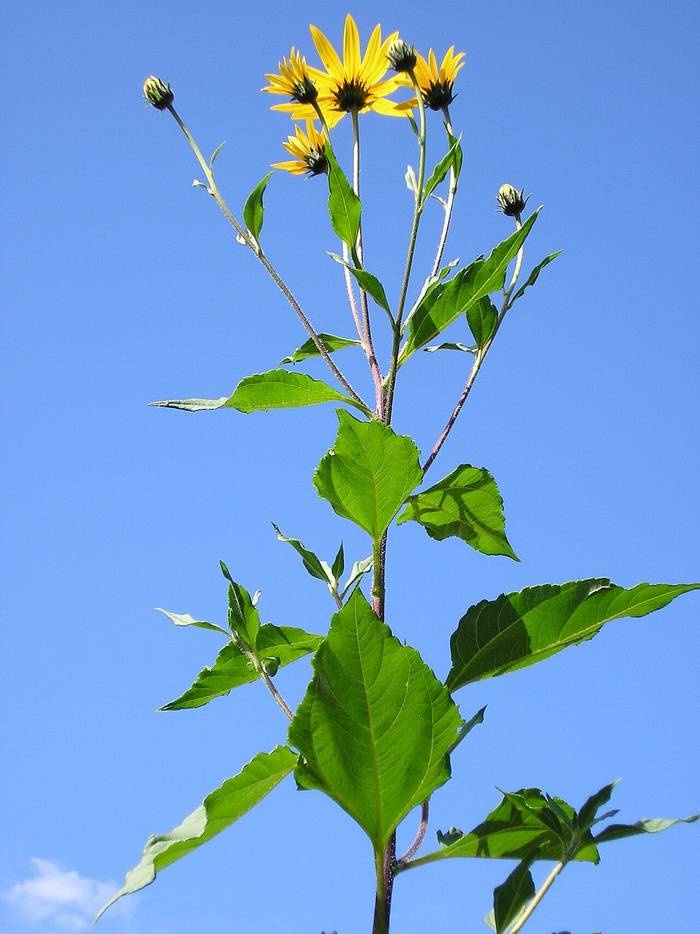
PJF · CC BY-SA 3.0
Jerusalem artichoke
Plant·Helianthus tuberosus
Full sun
Sun
Dry to moist soil
Water
Well-drained soil
Drainage
Zones 3–9
Hardiness
Coverage · 122 fields
Growth and size10 fields
Height
240 cm · the source gives 150–300 cm“Helianthus tuberosus is a herbaceous perennial plant growing to 1.5–3 m (4 ft 11 in – 9 ft 10 in) tall with opposite leaves on the lower part of the stem but alternate towards the top.”PFAF“Helianthus tuberosus is a PERENNIAL growing to 2.4 m (7ft) by 0.6 m (2ft in) at a fast rate.”
Spread
60 cm“Helianthus tuberosus is a PERENNIAL growing to 2.4 m (7ft) by 0.6 m (2ft in) at a fast rate.”
Height at age
—
empty
Spacing
60 cm (at least 30 cm)
AI estimate55 % agree
Growth rate
Fast“Helianthus tuberosus is a PERENNIAL growing to 2.4 m (7ft) by 0.6 m (2ft in) at a fast rate.”
Habit
Spreading“The plant growth habit is a runner spreading indefinitely by rhizomes or stolons [1-2].”
Root depth
Shallow
AI estimate63 % agree
Forest garden layer
Herb layer“Helianthus tuberosus is a herbaceous perennial plant growing to 1.5–3 m (4 ft 11 in – 9 ft 10 in) tall with opposite leaves on the lower part of the stem but alternate towards the top.”
Lifespan
~10 years
AI estimatenot measured yet
Roots6 fields
Root form
Fibrous roots
AI estimate43 % agree
Storage organ
Stem tuber“Its storage organ is a stem tuber; it multiplies by offspring stem tubers.”
Spreads
By rhizomes“The plant growth habit is a runner spreading indefinitely by rhizomes or stolons [1-2].”
Lateral spread in cm
11.4 cm“Its clonal growth organs spread 11.4 cm sideways.”
Root depth in cm
—
empty
Mycorrhiza
Arbuscular (AM)
AI estimatenot measured yet
Light, water and soil9 fields
Hours of sun
6–12 h
AI estimatenot measured yet
Water
Dry, moist · best: moist · Medium · 2–4 l/day“However, Jerusalem artichoke prefers moist habitats and seems to be less tolerant of dry conditions.”PFAF“It prefers dry or moist soil.”
Drought tolerant
—
empty
Tolerates waterlogging
—
empty
Soil type
Sand, loam, clay · best: loam“A very easily grown plant, it grows best in a loose circumneutral loam but succeeds in most soils and conditions in a sunny position.”PFAF“Suitable for: light (sandy), medium (loamy) and heavy (clay) soils, prefers well-drained soil and can grow in nutritionally poor soil.”
Drainage
Well drained“Suitable for: light (sandy), medium (loamy) and heavy (clay) soils, prefers well-drained soil and can grow in nutritionally poor soil.”
Compacted soil
Copes fairly well
AI estimatenot measured yet
Climate5 fields
Hardiness
Zone 3–9
Killing frost (0 °C) doesn't fit hardiness zone 3, which survives far lower temperatures.
AI estimatenot measured yet
Killing frost
0 °C“The first frost kills the stems and leaves, but the tubers can withstand freezing for months.”
Killing frost (0 °C) doesn't fit hardiness zone 3, which survives far lower temperatures.
Growing temperature
7–30 °C · optimal 15–27 °C“Temperature absolute min: 7 · Temperature absolute max: 30 · Temperature optimal min: 15 · Temperature optimal max: 27”
Chill hours
0 h
AI estimatenot measured yet
Care (becomes tasks in Manage)7 fields
Sowing
After the last frost · lasts 30 days“Whole tubers or pieces about 50 g (2 oz.) should be planted like potatoes and covered to a depth of 10 cm.”
PFAFpartly
Planting out
After the last frost · lasts 30 days“Plant them out into their permanent positions in late spring or early summer, after the last expected frosts.”
Dividing
After the last frost · After the first frost · lasts 30 days“Division in spring or autumn.”
Dividing appears 2 times with different timing.
Dividing
After the last frost · lasts 30 days
Dividing appears 2 times with different timing.
AI estimatenot measured yet
Watering
July · lasts 60 days
AI estimatenot measured yet
Support
After the previous stage · 60 days after · lasts 30 days
AI estimatenot measured yet
Mulching
November · lasts 30 days
AI estimatenot measured yet
Through the year7 fields
Fruiting
November · lasts 30 days“It is in flower in October, and the seeds ripen in November.”
PFAFpartly
Dying back
After the first frost · lasts 30 days“The first frost kills the stems and leaves, but the tubers can withstand freezing for months.”
Harvest
After the first frost · lasts 120 days“Harvest the tubers in late autumn or the winter and either replant the tubers immediately or store them in a cool but frost-free place and plant them out in early spring.”
Dormant
After the first frost · lasts 150 days“Tubers remaining in the ground lie dormant over winter and can handle temperatures as low as −30 °C (−22 °F).”
Leafing out
After the last frost · lasts 30 days“It is almost impossible to find all the tubers at harvest time, any left in the soil will grow away vigorously in the spring.”
Edible parts and pollination4 fields
The tubers
Pollination
Self-fertile · hermaphrodite“The species is hermaphrodite (has both male and female organs) and is pollinated by Bees, flies.”
Pollinated by
Bees, flies“The species is hermaphrodite (has both male and female organs) and is pollinated by Bees, flies.”
Ecology5 fields
Attracts
Bees, flies“The species is hermaphrodite (has both male and female organs) and is pollinated by Bees, flies.”
Pests
Slugs“The young growth is extremely attractive to slugs, plants can be totally destroyed by them[K].”
Diseases
Agroathelia rolfsii“Stem rot disease is caused by the fungus Agroathelia rolfsii (aka Sclerotium rolfsii or Athelia rolfsii), which is one of the most important pathogens causing tuber and stem rot and up to 60% loss in Jerusalem artichoke yield.”
Takes up
Potassium, phosphorus
AI estimatenot measured yet
Fixes nitrogen
No
AI estimatenot measured yet
Propagation and names4 fields
Methods
Difficulty
1 / 5
AI estimatenot measured yet
Seed
cold_moist_stratification
AI estimatenot measured yet
Not sorted yet65 fields
Fields the parser stores that this page has no row for yet. They show up here automatically, so nothing is hidden.
forage.DK.local_name
Jordskok
AI estimatenot measured yet
forage.DK.prep_cautions
tubers bruise easily and lose moisture rapidly, tend to become soft and mushy if boiled; retain texture better when steamed“The tubers bruise easily and lose moisture rapidly so are best left in the ground and harvested as required.”Wikipedia“Their inulin form of carbohydrates give the tubers a tendency to become soft and mushy if boiled, but they retain their texture better when steamed.”
forage.DK.edibility_basis
inferred
AI estimatenot measured yet
forage.DK.foraging_months.notes
Harvest in late autumn or winter; tubers can be left in the ground over winter and lifted as needed.“The tubers are very cold-tolerant and can be safely left in the ground in the winter to be harvested as required.”
forage.DK.foraging_months.months
9, 10, 11, 12, 1, 2, 3“Harvest the tubers in late autumn or the winter and either replant the tubers immediately or store them in a cool but frost-free place and plant them out in early spring.”
PFAFpartly
forage.DK.foraging_months.year_round
false
AI estimatenot measured yet
forage.DK.habitat_affinity
riverbank“The vegetative propagules can be transported via rivers and water streams and begin a new population on riverbanks.”
forage.US.local_name
Jerusalem artichoke
AI estimatenot measured yet
forage.US.edible_parts
forage.US.prep_cautions
tubers bruise easily and lose moisture rapidly, tend to become soft and mushy if boiled; retain texture better when steamed“The tubers bruise easily and lose moisture rapidly so are best left in the ground and harvested as required.”Wikipedia“Their inulin form of carbohydrates give the tubers a tendency to become soft and mushy if boiled, but they retain their texture better when steamed.”
forage.US.edibility_basis
inferred
AI estimatenot measured yet
forage.US.foraging_months.notes
Harvest in late autumn or winter; tubers can be left in the ground over winter and lifted as needed.“The tubers are very cold-tolerant and can be safely left in the ground in the winter to be harvested as required.”
forage.US.foraging_months.months
9, 10, 11, 12, 1, 2, 3“Harvest the tubers in late autumn or the winter and either replant the tubers immediately or store them in a cool but frost-free place and plant them out in early spring.”
PFAFpartly
forage.US.foraging_months.year_round
false
AI estimatenot measured yet
forage.US.habitat_affinity
riverbank“The vegetative propagules can be transported via rivers and water streams and begin a new population on riverbanks.”
forage.TROPICAL.edible_parts
[{"part":"tuber (root)","caution":"Inulin can ferment in the gut and cause quite severe wind in some people","preparation":"Raw or cooked; used in all the ways potatoes are used"}]
AI estimatenot measured yet
forage.TROPICAL.prep_cautions
Can cause flatulence if eaten in large quantities or raw.
AI estimatenot measured yet
forage.TROPICAL.edibility_basis
inferred
AI estimatenot measured yet
forage.TROPICAL.foraging_months.notes
Can be harvested year-round in tropical climates, though best after flowering.
AI estimatenot measured yet
forage.TROPICAL.foraging_months.months
9, 10, 11, 12, 1, 2, 3, 4
AI estimatenot measured yet
forage.TROPICAL.foraging_months.year_round
true
AI estimatenot measured yet
forage.TROPICAL.habitat_affinity
disturbed_ground
AI estimatenot measured yet
ornamental.basis
documented
AI estimatenot measured yet
ornamental.fragrance.source
flower“The flowers are briefly fragrant, giving off a light, vanilla-chocolate scent.”
ornamental.fragrance.intensity
subtle“The flowers are briefly fragrant, giving off a light, vanilla-chocolate scent.”
ornamental.confidence
high
AI estimatenot measured yet
ornamental.fall_interest
true
AI estimatenot measured yet
ornamental.flower_colour
yellow“The flowers are yellow and produced in capitate flowerheads, which are 5–10 cm (2–4 in) in diameter, with 10–20 ray florets and 60 or more small disc florets.”
ornamental.evidence_quote
Helianthus tuberosus, commonly known as Jerusalem artichoke, produces bright yellow flowers in late summer to early autumn. Its foliage is green throughout the growing season, turning a yellow-green in the fall before senescing. The plant provides architectural interest in winter with its persistent stems.
AI estimatenot measured yet
ornamental.foliage_colour
green
AI estimate82 % agree
ornamental.foliage_texture
medium
AI estimatenot measured yet
ornamental.winter_structure
architectural_skeleton
AI estimatenot measured yet
ornamental.autumn_foliage_colour
yellow_green
AI estimatenot measured yet
care_regime
light
AI estimatenot measured yet
propagation.self_seeding
moderate“Plants only produce flowers in Britain after a long hot summer and seed is rarely formed.”
PFAFpartly
propagation.establishment_years
1
AI estimate40 % agree
spatial_profile.canopy_density
dense“The plant is good weed eradicator, it makes so dense a shade that few other plants can compete.”
forage_proposals.DK.edibility_tier.evidence_quote
Tubers - raw or cooked.“Tubers - raw or cooked.”
forage_proposals.US.edibility_tier.evidence_quote
Tubers - raw or cooked.“Tubers - raw or cooked.”
forage_proposals.TROPICAL.edibility_tier.tier
edible
AI estimatenot measured yet
forage_proposals.TROPICAL.edibility_tier.confidence
high
AI estimatenot measured yet
forage_proposals.TROPICAL.edibility_tier.evidence_quote
Helianthus tuberosus tubers are consumed in many parts of the world, including tropical regions, as a food source. The edibility is well-established.
AI estimatenot measured yet
function_profile.nutrient_flows.consumes
[{"basis":"documented","demand":"low","nutrient":"nitrogen","confidence":"high","evidence_quote":"Jerusalem artichoke has low nutrient requirements and needs less nitrogen than other energy crops."}]“Jerusalem artichoke has low nutrient requirements and needs less nitrogen than other energy crops.”
function_profile.nutrient_flows.provides
[{"basis":"documented","nutrient":"potassium","mechanism":"biomass_return","confidence":"high"},{"basis":"inferred","nutrient":"phosphorus","mechanism":"biomass_return","confidence":"medium"}]
AI estimatenot measured yet
function_profile.biotic_interactions
[{"taxa":["bees","flies"],"basis":"documented","valence":"beneficial","relation":"attracts","confidence":"high","evidence_quote":"The species is hermaphrodite (has both male and female organs) and is pollinated by Bee…“The species is hermaphrodite (has both male and female organs) and is pollinated by Bees, flies.”PFAF“The young growth is extremely attractive to slugs, plants can be totally destroyed by them[K].”Wikipedia“Stem rot disease is caused by the fungus Agroathelia rolfsii (aka Sclerotium rolfsii or Athelia rolfsii), which is one of the most important pathogens causing tuber and stem rot and up to 60% loss in Jerusalem artichoke yield.”
function_profile.aromatic_pest_effect.value
false
AI estimate80 % agree
function_profile.aromatic_pest_effect.confidence
high
AI estimatenot measured yet
function_profile.structural_interfaces.provides_shelter.basis
inferred
AI estimatenot measured yet
function_profile.structural_interfaces.provides_shelter.kinds
wind, shade
AI estimatenot measured yet
function_profile.structural_interfaces.provides_shelter.confidence
medium
AI estimatenot measured yet
function_profile.structural_interfaces.provides_shelter.evidence_quote
The tall, dense growth of Jerusalem artichokes can provide wind shelter and shade for other plants.
AI estimatenot measured yet
function_profile.structural_interfaces.provides_physical_support.form
stout_stem
AI estimatenot measured yet
function_profile.structural_interfaces.provides_physical_support.basis
taxonomic
AI estimatenot measured yet
function_profile.structural_interfaces.provides_physical_support.confidence
medium
AI estimatenot measured yet
climate_tolerance.photoperiod_response
short_day
AI estimatenot measured yet
soil_interactions.organic_matter_contribution
high“The plants are a good source of biomass.”
PFAFpartly
component_metadata.growth_cycle
perennial“Helianthus tuberosus is a PERENNIAL growing to 2.4 m (7ft) by 0.6 m (2ft in) at a fast rate.”
resource_interfaces.inputs
[{"resource":"light","quantity_description":"sunny position; cannot grow in shade"},{"resource":"pollination","quantity_description":"pollinated by bees and flies"},{"resource":"water","quantity_description":"tolerate…“A very easily grown plant, it grows best in a loose circumneutral loam but succeeds in most soils and conditions in a sunny position.”PFAF“The species is hermaphrodite (has both male and female organs) and is pollinated by Bees, flies.”
resource_interfaces.outputs
[{"resource":"shade","quantity_description":"dense canopy that few other plants can compete under"},{"resource":"mulch_biomass","quantity_description":"18-28 tonnes per hectare green weight for foliage"}]“The plant is good weed eradicator, it makes so dense a shade that few other plants can compete.”Wikipedia“Crop yields are high, typically 16–20 tonnes per hectare (7–9 short ton/acre) for tubers, and 18–28 tonnes per hectare (8–12 short ton/acre) green weight for foliage.”PFAFpartly“The plants are a good source of biomass.”