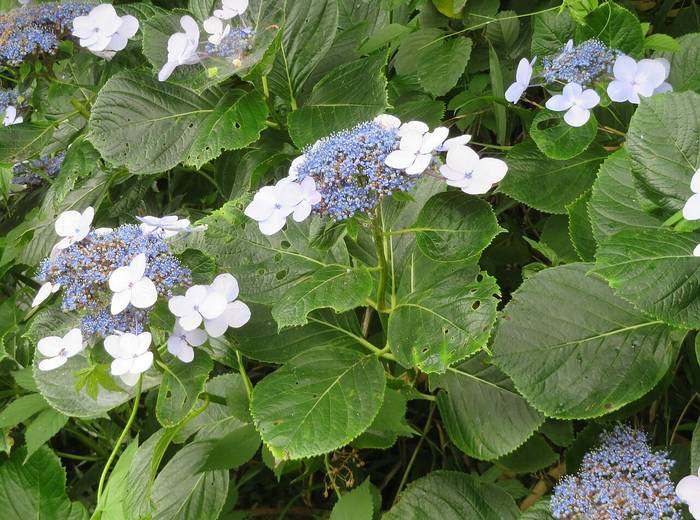
belvedere04 · CC BY 4.0
Bigleaf hydrangea
Shrub·Hydrangea macrophylla
Part shade to full sun
Sun
Moist soil
Water
Well-drained soil
Drainage
Zones 5–9
Hardiness
Coverage · 120 fields
- Parser flag (climate_tolerance_low_confidence): Climate tolerance values are LLM-extracted (no authoritative EcoCrop match found). EcoCrop covers ~2,568 food-crop taxa; ornamental/native/medicinal species rely on LLM extraction.
- Killing frost (-10 °C) doesn't fit hardiness zone 5, which survives far lower temperatures.
- Only one country is recorded as native range (JP).
- Pruning appears 2 times with different timing.
Growth and size10 fields
Plant type
Deciduous shrub“Hydrangea macrophylla is a deciduous Shrub growing to 3 m (9ft) by 3 m (9ft) at a medium rate.”
Height
300 cm“Hydrangea macrophylla is a deciduous Shrub growing to 3 m (9ft) by 3 m (9ft) at a medium rate.”
Spread
300 cm · other sources: 250 cm“Hydrangea macrophylla is a deciduous Shrub growing to 3 m (9ft) by 3 m (9ft) at a medium rate.”Wikipedia“It is a deciduous shrub growing to 3 m (10 ft) tall by 2.5 m (8 ft) or more broad with large heads of pink or blue flowers in summer and autumn.”
Height at age
—
empty
Spacing
120 cm (at least 90 cm)
AI estimate55 % agree
Growth rate
Medium“Hydrangea macrophylla is a deciduous Shrub growing to 3 m (9ft) by 3 m (9ft) at a medium rate.”
Root depth
Medium
AI estimate63 % agree
Forest garden layer
Shrub layer“Hydrangea macrophylla is a deciduous Shrub growing to 3 m (9ft) by 3 m (9ft) at a medium rate.”
Lifespan
~50 years
AI estimatenot measured yet
Roots6 fields
Root form
Fibrous roots
AI estimate43 % agree
Storage organ
None
AI estimate100 % agree
Spreads
No
AI estimate75 % agree
Lateral spread in cm
—
empty
Root depth in cm
—
empty
Mycorrhiza
Arbuscular (AM)
AI estimatenot measured yet
Light, water and soil9 fields
Sun
Full sun, light shade, part shade · best: part shade“Succeeds in full sun or semi-shade”PFAF“It can grow in semi-shade (light woodland) or no shade.”
Hours of sun
4–6 h
AI estimatenot measured yet
Drought tolerant
—
empty
Tolerates waterlogging
—
empty
Soil type
Sand, loam, clay · best: loam“Tolerates most soil, thriving in a well-drained loamy soil, but resenting dryness at the roots.”PFAF“Suitable for: light (sandy), medium (loamy) and heavy (clay) soils and prefers well-drained soil.”
pH
4.5–8.5 · best 4.5“Does well on very acid soils with a pH around 4.5.”PFAF“Suitable pH: mildly acid, neutral and basic (mildly alkaline) soils and can grow in very acid soils.”
Drainage
Well drained“Suitable for: light (sandy), medium (loamy) and heavy (clay) soils and prefers well-drained soil.”
Compacted soil
Copes badly
AI estimatenot measured yet
Climate5 fields
Hardiness
Zone 5–9
Killing frost (-10 °C) doesn't fit hardiness zone 5, which survives far lower temperatures.
AI estimatenot measured yet
Killing frost
-10 °C“Dormant plants are hardy to about -10°c, though the young growth in spring is frost-tender[K].”
Killing frost (-10 °C) doesn't fit hardiness zone 5, which survives far lower temperatures.
Growing temperature
5–30 °C · optimal 18–25 °C
AI estimatenot measured yet
Chill hours
0 h
AI estimatenot measured yet
Care (becomes tasks in Manage)9 fields
Pruning
After the previous stage“Plants are very tolerant of pruning and can be cut back into old wood if required.”
Pruning appears 2 times with different timing.
PFAFpartly
Pruning
After the previous stage · back into old wood, if needed
Pruning appears 2 times with different timing.
AI estimatenot measured yet
Planting out
After the last frost
AI estimatenot measured yet
Pruning
July · lasts 30 days · spent flowers
AI estimatenot measured yet
Pruning
March · lasts 30 days · dead or weak stems
AI estimatenot measured yet
Feeding
April · lasts 30 days · a balanced slow-release fertiliser
AI estimatenot measured yet
Mulching
May · lasts 30 days
AI estimatenot measured yet
Watering
June · lasts 90 days
AI estimatenot measured yet
Protection
After the first frost · -14 days after · lasts 30 days · frost
AI estimatenot measured yet
Through the year4 fields
Leafing out
After the last frost · lasts 60 days“Dormant plants are hardy to about -10°c, though the young growth in spring is frost-tender[K].”
PFAFpartly
Dying back
After the first frost
AI estimatenot measured yet
Dormant
After the first frost · 30 days after · lasts 150 days
AI estimatenot measured yet
Edible parts and pollination5 fields
Young leaves
Dried and rubbed between the hands to make a sweet tea“The young leaves, when dried and rubbed between the hands, become very sweet and are used to make a sweet tea called 'tea of heaven', it is used in Buddhist ceremonies.”PFAFpartly“Young leaves contain the toxin hydrocyanic acid, this reduces as the leaves grow older, often to zero levels.”
Older leaves
Dried, powdered and used as a flavouring on foods“The older leaves can be dried, powdered and used as a flavouring on foods.”
Pollination
Self-fertile · hermaphrodite“The species is hermaphrodite (has both male and female organs) and is pollinated by Bees.”
Pollinated by
Bees“The species is hermaphrodite (has both male and female organs) and is pollinated by Bees.”
Ecology5 fields
Attracts
Bees, pollinators“The species is hermaphrodite (has both male and female organs) and is pollinated by Bees.”Wikipediapartly“with a few large sterile showy bract-like flowers that act as targets for pollinators, surrounding a central cluster of small fertile flowers.”
Pests
Aphids, spider_mites, scale_insects
AI estimatenot measured yet
Takes up
Potassium, aluminum
AI estimatenot measured yet
Fixes nitrogen
No
AI estimatenot measured yet
Propagation and names4 fields
Methods
Seed, half-ripe wood cuttings, mature wood cuttings, mound layering, leaf-bud cuttings“Seed - surface sow in a greenhouse in spring.”PFAF“Cuttings of half-ripe wood, 8cm long, July/August in a frame.”PFAF“Cuttings of mature wood in late autumn in a frame.”PFAF“Mound layering in spring.”PFAF“Leaf-bud cuttings of the current seasons growth in a frame.”
Difficulty
2 / 5
AI estimatenot measured yet
Seed
cold stratification recommended for 60-90 days
AI estimatenot measured yet
Not sorted yet63 fields
Fields the parser stores that this page has no row for yet. They show up here automatically, so nothing is hidden.
forage.DK.warnings_da
Hele planten eller dele af den er giftige.
AI estimatenot measured yet
forage.DK.warnings_en
All or parts of this plant are poisonous.
AI estimatenot measured yet
forage.DK.prep_cautions
Young leaves contain the toxin hydrocyanic acid, which falls as the leaves grow older., All or parts of this plant are poisonous.“Young leaves contain the toxin hydrocyanic acid, this reduces as the leaves grow older, often to zero levels.”PFAF“All or parts of this plant are poisonous”
forage.DK.edibility_basis
inferred
AI estimatenot measured yet
forage.DK.foraging_months.notes
Not typically foraged in Denmark.
AI estimatenot measured yet
forage.DK.foraging_months.year_round
false
AI estimatenot measured yet
forage.DK.habitat_affinity
coast“Hydrangea macrophylla is endemic to Japan, where it occurs in coastal habitats from Honshu southwards.”
forage.US.edibility_basis
inferred
AI estimatenot measured yet
forage.US.foraging_months.notes
Not typically foraged in the US.
AI estimatenot measured yet
forage.US.foraging_months.year_round
false
AI estimatenot measured yet
forage.TROPICAL.edibility_basis
inferred
AI estimatenot measured yet
forage.TROPICAL.foraging_months.notes
Not typically foraged in tropical regions.
AI estimatenot measured yet
forage.TROPICAL.foraging_months.year_round
false
AI estimatenot measured yet
ornamental.basis
documented
AI estimatenot measured yet
ornamental.fragrance.source
none
AI estimate100 % agree
ornamental.confidence
high
AI estimatenot measured yet
ornamental.fall_interest
true“with large heads of pink or blue flowers in summer and autumn.”
Wikipediapartly
ornamental.flower_colour
blue, purple, pink, red, white“Bloom Color: Blue, Lavender, Pink, Purple, Red, White.”
ornamental.evidence_quote
Hydrangea macrophylla, commonly known as Bigleaf Hydrangea, produces large flower clusters that can be pink, blue, white, red, or purple, depending on soil pH. The foliage is typically green, turning to shades of red and bronze in autumn. The plant offers fall interest with its changing foliage and maintains an architectural skeleton in winter.
AI estimatenot measured yet
ornamental.foliage_colour
green
AI estimate82 % agree
ornamental.foliage_texture
medium
AI estimatenot measured yet
ornamental.winter_structure
architectural_skeleton
AI estimatenot measured yet
ornamental.autumn_foliage_colour
red, bronze
AI estimatenot measured yet
care_regime
light
AI estimatenot measured yet
propagation.self_seeding
none
AI estimate20 % agree
propagation.division_season
spring
AI estimatenot measured yet
propagation.establishment_years
1
AI estimate40 % agree
spatial_profile.canopy_density
medium
AI estimatenot measured yet
forage_proposals.DK.edibility_tier.confidence
high
AI estimatenot measured yet
forage_proposals.DK.edibility_tier.evidence_quote
Hydrangea macrophylla is generally considered toxic if ingested, with symptoms including nausea, vomiting, diarrhea, and lethargy. The leaves and flower buds are the most toxic parts.
AI estimatenot measured yet
forage_proposals.US.edibility_tier.tier
toxic
AI estimatenot measured yet
forage_proposals.US.edibility_tier.confidence
high
AI estimatenot measured yet
forage_proposals.US.edibility_tier.evidence_quote
Hydrangea macrophylla contains cyanogenic glycosides, which can release hydrogen cyanide upon ingestion. All parts of the plant are considered toxic, especially the leaves and flower buds.
AI estimatenot measured yet
forage_proposals.TROPICAL.edibility_tier.tier
toxic
AI estimatenot measured yet
forage_proposals.TROPICAL.edibility_tier.confidence
high
AI estimatenot measured yet
forage_proposals.TROPICAL.edibility_tier.evidence_quote
Ingestion of Hydrangea macrophylla can lead to gastrointestinal upset, vomiting, and diarrhea due to the presence of cyanogenic glycosides. It is not considered edible.
AI estimatenot measured yet
function_profile.biomass_return.confidence
medium
AI estimatenot measured yet
function_profile.nutrient_flows.consumes
[{"basis":"documented","demand":"moderate","nutrient":"nitrogen","confidence":"high"},{"basis":"documented","demand":"moderate","nutrient":"phosphorus","confidence":"high"},{"basis":"documented","demand":"high","nutri…
AI estimatenot measured yet
function_profile.nutrient_flows.provides
[{"basis":"inferred","nutrient":"potassium","mechanism":"biomass_return","confidence":"low"},{"basis":"inferred","nutrient":"aluminum","mechanism":"biomass_return","confidence":"low"}]
AI estimatenot measured yet
function_profile.biotic_interactions
[{"taxa":["bees"],"basis":"documented","valence":"beneficial","relation":"attracts","confidence":"high","evidence_quote":"The species is hermaphrodite (has both male and female organs) and is pollinated by Bees.","org…“The species is hermaphrodite (has both male and female organs) and is pollinated by Bees.”PFAF“This species is notably susceptible to honey fungus.”Wikipediapartly“with a few large sterile showy bract-like flowers that act as targets for pollinators, surrounding a central cluster of small fertile flowers.”
function_profile.aromatic_pest_effect.value
false
AI estimate80 % agree
function_profile.aromatic_pest_effect.confidence
high
AI estimatenot measured yet
function_profile.structural_interfaces.provides_shelter.basis
documented
AI estimatenot measured yet
function_profile.structural_interfaces.provides_shelter.kinds
shade
AI estimatenot measured yet
function_profile.structural_interfaces.provides_shelter.confidence
high
AI estimatenot measured yet
function_profile.structural_interfaces.provides_shelter.evidence_quote
The dense foliage of Hydrangea macrophylla provides shade for understory plants.
AI estimatenot measured yet
function_profile.structural_interfaces.requires_shelter.basis
documented
AI estimatenot measured yet
function_profile.structural_interfaces.requires_shelter.kinds
frost, shade“Dormant plants are hardy to about -10°c, though the young growth in spring is frost-tender[K].”PFAF“Succeeds in full sun or semi-shade, but if it is grown in a low rainfall area then it requires shade at the hottest part of the day.”
function_profile.structural_interfaces.requires_shelter.stage
establishment
AI estimatenot measured yet
function_profile.structural_interfaces.requires_shelter.confidence
high
AI estimatenot measured yet
function_profile.structural_interfaces.requires_shelter.evidence_quote
Young Hydrangea macrophylla plants benefit from protection from strong winds and late spring frosts.
AI estimatenot measured yet
function_profile.structural_interfaces.provides_physical_support.form
dense_thicket
AI estimatenot measured yet
function_profile.structural_interfaces.provides_physical_support.basis
inferred
AI estimatenot measured yet
function_profile.structural_interfaces.provides_physical_support.confidence
low
AI estimatenot measured yet
function_profile.structural_interfaces.requires_physical_support.basis
inferred
AI estimatenot measured yet
function_profile.structural_interfaces.requires_physical_support.confidence
low
AI estimatenot measured yet
climate_tolerance.photoperiod_response
day_neutral
AI estimatenot measured yet
soil_interactions.organic_matter_contribution
medium
AI estimatenot measured yet
component_metadata.growth_cycle
perennial
AI estimate100 % agree
resource_interfaces.inputs
[{"resource":"light","quantity_description":"full sun or semi-shade"},{"resource":"water","quantity_description":"prefers moist soil"},{"resource":"shade","quantity_description":"prefers a shady position"},{"resource"…“Succeeds in full sun or semi-shade, but if it is grown in a low rainfall area then it requires shade at the hottest part of the day.”PFAF“It prefers moist soil.”PFAF“Prefers a shady position.”PFAF“The species is hermaphrodite (has both male and female organs) and is pollinated by Bees.”
resource_interfaces.outputs
[{"resource":"pollinator_services","quantity_description":"bee-pollinated; large sterile showy flowers act as targets for pollinators"},{"resource":"leaf_litter","quantity_description":"annual leaf fall (deciduous)"}]“with a few large sterile showy bract-like flowers that act as targets for pollinators, surrounding a central cluster of small fertile flowers.”
Wikipediapartly