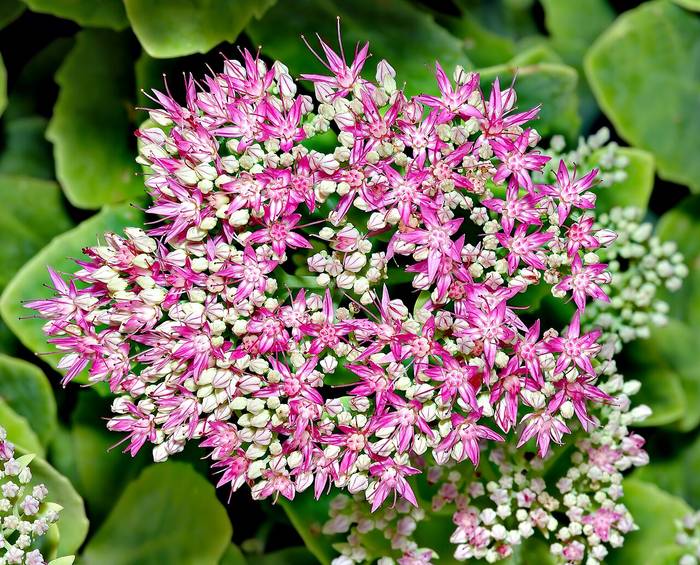
André Karwath aka Aka · CC BY-SA 2.5
Showy stonecrop
Plant·Hylotelephium spectabile
Full sun
Sun
Dry to moist soil
Water
Well-drained soil
Drainage
Zones 3–9
Hardiness
Coverage · 107 fields
- Parser flag (climate_tolerance_low_confidence): Climate tolerance values are LLM-extracted (no authoritative EcoCrop match found). EcoCrop covers ~2,568 food-crop taxa; ornamental/native/medicinal species rely on LLM extraction.
- Killing frost (-20 °C) doesn't fit hardiness zone 3, which survives far lower temperatures.
Growth and size10 fields
Plant type
Deciduous plant“Hylotelephium spectabile (syn. Sedum spectabile) is a species of flowering plant in the stonecrop family Crassulaceae, native to China and Korea.”
Height
40 cm · other sources: 45 cm“Hylotelephium spectabile is a PERENNIAL growing to 0.4 m (1ft 4in) by 0.4 m (1ft 4in).”Wikipedia“Growing to 45 cm (18 in) tall and broad, it is an herbaceous perennial with alternate, simple, toothed leaves on erect, unbranched succulent stems and has a tuber root rhizome.”
Spread
40 cm · other sources: 45 cm“Hylotelephium spectabile is a PERENNIAL growing to 0.4 m (1ft 4in) by 0.4 m (1ft 4in).”Wikipedia“Growing to 45 cm (18 in) tall and broad, it is an herbaceous perennial with alternate, simple, toothed leaves on erect, unbranched succulent stems and has a tuber root rhizome.”
Height at age
—
empty
Growth rate
—
empty
Habit
Mounding
AI estimate50 % agree
Root depth
Shallow
AI estimate63 % agree
Lifespan
~10 years
AI estimatenot measured yet
Roots6 fields
Root form
—
empty
Spreads
—
empty
Lateral spread in cm
—
empty
Root depth in cm
—
empty
Mycorrhiza
—
empty
Light, water and soil9 fields
Sun
Full sun“It is a full sun, drought tolerant, cold- tolerant honeycomb plant”PFAF“It cannot grow in the shade.”
Hours of sun
6–12 h
AI estimatenot measured yet
Tolerates waterlogging
—
empty
Soil type
Sand, loam, clay“Suitable for: light (sandy), medium (loamy) and heavy (clay) soils, prefers well-drained soil and can grow in nutritionally poor soil.”
Drainage
Well drained“A very easily grown and tolerant plant, it succeeds in most soils but prefers a fertile well-drained soil in a sunny position.”
Compacted soil
Copes fairly well
AI estimatenot measured yet
Climate5 fields
Hardiness
Zone 3–9
Killing frost (-20 °C) doesn't fit hardiness zone 3, which survives far lower temperatures.
AI estimatenot measured yet
Killing frost
-20 °C“Plants are hardy to about -20°c.”
Killing frost (-20 °C) doesn't fit hardiness zone 3, which survives far lower temperatures.
Growing temperature
5–30 °C · optimal 15–25 °C
AI estimatenot measured yet
Chill hours
0 h
AI estimatenot measured yet
Care (becomes tasks in Manage)2 fields
Pruning
March · lasts 30 days · old flower stalks and dead foliage
AI estimatenot measured yet
Dividing
March · lasts 30 days · lift and split with a spade
AI estimatenot measured yet
Through the year4 fields
Flowering
September · lasts 61 days“It is in flower from September to October, and the seeds ripen from October to November.”
Fruiting
October · lasts 61 days“It is in flower from September to October, and the seeds ripen from October to November.”
Leafing out
After the last frost
AI estimatenot measured yet
Dying back
After the first frost
AI estimatenot measured yet
Edible parts and pollination3 fields
Ecology6 fields
Attracts
Bees, lepidoptera, wildlife“The flowers are very attractive to bees and lepidoptera.”PFAF“It is noted for attracting wildlife.”
Pests
—
empty
Diseases
—
empty
Takes up
—
empty
Fixes nitrogen
No
AI estimatenot measured yet
Mycorrhiza
No
AI estimatenot measured yet
Propagation and names4 fields
Methods
Seed, division, cuttings“Seed - surface sow in spring in well-drained soil in a sunny position in a greenhouse.”PFAF“Division is very easy and can be carried out at almost any time in the growing season, though is probably best done in spring or early summer.”PFAF“Cuttings at almost any time in the growing season.”
Seed
cold_stratification
AI estimatenot measured yet
Not sorted yet58 fields
Fields the parser stores that this page has no row for yet. They show up here automatically, so nothing is hidden.
forage.DK.local_name
kinesisk stenurt
AI estimatenot measured yet
forage.DK.edibility_basis
inferred
AI estimatenot measured yet
forage.DK.foraging_months.notes
Young leaves and stems are best in spring and early summer.
AI estimatenot measured yet
forage.DK.foraging_months.months
4, 5, 6, 7, 8, 9
AI estimatenot measured yet
forage.DK.foraging_months.year_round
false
AI estimatenot measured yet
forage.US.local_name
showy stonecrop
AI estimatenot measured yet
forage.US.edible_parts
[{"part":"leaves","caution":null,"preparation":"raw or cooked"}]“Leaves - raw or cooked.”
forage.US.edibility_basis
inferred
AI estimatenot measured yet
forage.US.foraging_months.notes
Young leaves and stems are best in spring and early summer.
AI estimatenot measured yet
forage.US.foraging_months.months
4, 5, 6, 7, 8, 9
AI estimatenot measured yet
forage.US.foraging_months.year_round
false
AI estimatenot measured yet
forage.TROPICAL.edible_parts
[{"part":"leaves","caution":null,"preparation":"raw or cooked","season_months":[1,2,3,4,5,6,7,8,9,10,11,12]},{"part":"stems","caution":null,"preparation":"raw or cooked","season_months":[1,2,3,4,5,6,7,8,9,10,11,12]}]
AI estimatenot measured yet
forage.TROPICAL.edibility_basis
inferred
AI estimatenot measured yet
forage.TROPICAL.foraging_months.notes
Grows year-round in tropical climates.
AI estimatenot measured yet
forage.TROPICAL.foraging_months.year_round
true
AI estimatenot measured yet
forage.TROPICAL.habitat_affinity
disturbed_ground
AI estimatenot measured yet
ornamental.basis
documented
AI estimatenot measured yet
ornamental.confidence
high
AI estimatenot measured yet
ornamental.fall_interest
true“It is in flower from September to October, and the seeds ripen from October to November.”
PFAFpartly
ornamental.evidence_quote
Hylotelephium spectabile, commonly known as Showy Stonecrop, features attractive pink flowers in late summer to autumn. Its foliage is blue-green and remains so until it dies back in winter, offering no significant autumn color change. The spent flower heads provide winter interest.
AI estimatenot measured yet
ornamental.foliage_colour
blue_green“The leaves are usually arranged opposite or in threes, simple and more or less wedge-shaped at the base, and frosted blue above”
ornamental.foliage_texture
medium
AI estimatenot measured yet
ornamental.winter_structure
seed_heads
AI estimatenot measured yet
ornamental.autumn_foliage_colour
none
AI estimatenot measured yet
care_regime
none“Established plants are drought tolerant, they can also tolerate considerable neglect, surviving even in the dense growth of weeds[K].”
PFAFpartly
propagation.self_seeding
light
AI estimate20 % agree
propagation.division_season
spring or early summer“Division is very easy and can be carried out at almost any time in the growing season, though is probably best done in spring or early summer.”
propagation.establishment_years
1
AI estimate40 % agree
sun_requirement.best
full_sun“A very easily grown and tolerant plant, it succeeds in most soils but prefers a fertile well-drained soil in a sunny position.”
PFAFpartly
forage_proposals.DK.edibility_tier.evidence_quote
Leaves - raw or cooked.“Leaves - raw or cooked.”
forage_proposals.US.edibility_tier.evidence_quote
Leaves - raw or cooked.“Leaves - raw or cooked.”
forage_proposals.TROPICAL.edibility_tier.confidence
low
AI estimatenot measured yet
function_profile.biomass_return.confidence
medium
AI estimatenot measured yet
function_profile.nutrient_flows.consumes
[{"basis":"documented","demand":"low","nutrient":"nitrogen","confidence":"high"},{"basis":"documented","demand":"low","nutrient":"phosphorus","confidence":"high"},{"basis":"documented","demand":"low","nutrient":"potas…
AI estimatenot measured yet
function_profile.biotic_interactions
[{"taxa":["bees","lepidoptera","insects"],"basis":"documented","valence":"beneficial","relation":"attracts","confidence":"high","evidence_quote":"The flowers are very attractive to bees and lepidoptera.","organism_gro…“The flowers are very attractive to bees and lepidoptera.”PFAF“It is noted for attracting wildlife.”Wikipediapartly“This self-fertile species is pollinated by insects.”
function_profile.aromatic_pest_effect.value
false
AI estimate80 % agree
function_profile.aromatic_pest_effect.confidence
high
AI estimatenot measured yet
function_profile.structural_interfaces.provides_shelter.basis
inferred
AI estimatenot measured yet
function_profile.structural_interfaces.provides_shelter.confidence
low
AI estimatenot measured yet
function_profile.structural_interfaces.requires_shelter.basis
inferred
AI estimatenot measured yet
function_profile.structural_interfaces.requires_shelter.confidence
medium
AI estimatenot measured yet
function_profile.structural_interfaces.provides_physical_support.basis
inferred
AI estimatenot measured yet
function_profile.structural_interfaces.provides_physical_support.confidence
low
AI estimatenot measured yet
function_profile.structural_interfaces.requires_physical_support.basis
inferred
AI estimatenot measured yet
function_profile.structural_interfaces.requires_physical_support.confidence
medium
AI estimatenot measured yet
climate_tolerance.photoperiod_response
short_day
AI estimatenot measured yet
soil_interactions.organic_matter_contribution
low
AI estimatenot measured yet
component_metadata.growth_cycle
perennial“Hylotelephium spectabile is a PERENNIAL growing to 0.4 m (1ft 4in) by 0.4 m (1ft 4in).”
resource_interfaces.inputs
[{"resource":"light","quantity_description":"full sun; cannot grow in shade"},{"resource":"water","quantity_description":"dry or moist soil; tolerates drought"}]“It cannot grow in the shade.”PFAF“It prefers dry or moist soil and can tolerate drought.”
resource_interfaces.outputs
[{"resource":"ground_cover","quantity_description":"planted about 30 cm apart each way"},{"resource":"pollinator_services","quantity_description":"flowers very attractive to bees and lepidoptera"},{"resource":"habitat…“Plants can be grown as a ground cover when planted about 30cm apart each way.”PFAF“The flowers are very attractive to bees and lepidoptera.”PFAF“It is noted for attracting wildlife.”PFAF“It is in flower from September to October, and the seeds ripen from October to November.”