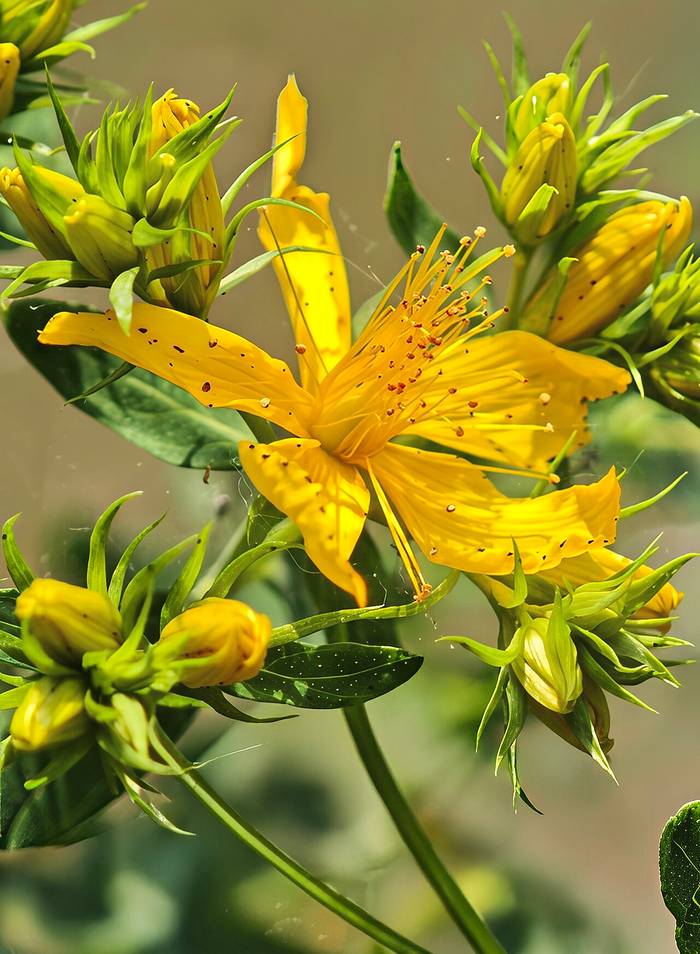
Didier Descouens · CC BY-SA 4.0
St. John's wort
Plant·Hypericum perforatum
Part shade to full sun
Sun
Dry to moist soil
Water
Well-drained soil
Drainage
Zones 3–9
Hardiness
Coverage · 108 fields
No obvious inconsistencies found.
Growth and size10 fields
Height
90 cm“Hypericum perforatum is a PERENNIAL growing to 0.9 m (3ft) by 0.6 m (2ft in) at a medium rate.”
Spread
60 cm“Hypericum perforatum is a PERENNIAL growing to 0.9 m (3ft) by 0.6 m (2ft in) at a medium rate.”
Height at age
—
empty
Spacing
45 cm (at least 30 cm)
AI estimate55 % agree
Growth rate
Medium“Hypericum perforatum is a PERENNIAL growing to 0.9 m (3ft) by 0.6 m (2ft in) at a medium rate.”
Habit
Mounding
AI estimate50 % agree
Root depth
Taproot“The central root grows to a depth of 0.6–1.5 metres (2 ft 0 in – 4 ft 11 in) into the soil depending on conditions.”
Forest garden layer
Herb layer“Hypericum perforatum is an herbaceous perennial plant with hairless (glabrous) stems and leaves.”
Lifespan
~5 years
AI estimatenot measured yet
Roots6 fields
Root form
Taproot“The central root grows to a depth of 0.6–1.5 metres (2 ft 0 in – 4 ft 11 in) into the soil depending on conditions.”
Storage organ
Rhizome“The root of each plant is slender and woody with many small, fibrous small side roots and also extensive, creeping rhizomes.”
Root depth in cm
Deepest 150 cm“The central root grows to a depth of 0.6–1.5 metres (2 ft 0 in – 4 ft 11 in) into the soil depending on conditions.”
Mycorrhiza
—
empty
Light, water and soil9 fields
Sun
Full sun, light shade, part shade · best: full sun“It grows well in both full sun and semi-shade and produces more flowers when positioned in a sunny spot.”PFAF“It can grow in semi-shade (light woodland) or no shade.”
Hours of sun
6–12 h
AI estimatenot measured yet
Water
Dry, moist · best: dry · Low · 1–3 l/day“It prefers dry habitats or areas with strong drainage.”PFAF“It prefers dry or moist soil.”
Drought tolerant
Yes“St. John's Wort thrives in well-drained soils and tolerates dry conditions.”
Tolerates waterlogging
—
empty
Soil type
Sand, loam, clay“Suitable for: light (sandy), medium (loamy) and heavy (clay) soils and prefers well-drained soil.”
Drainage
Well drained“Suitable for: light (sandy), medium (loamy) and heavy (clay) soils and prefers well-drained soil.”
Compacted soil
Copes fairly well
AI estimatenot measured yet
Climate5 fields
Hardiness
Zone 3–9
AI estimatenot measured yet
Killing frost
-25 °C
AI estimatenot measured yet
Growing temperature
-3–24 °C · optimal 15–25 °C“Altitudes greater than 1,500 m (4,900 ft), rainfall less than 500 mm (20 in), and daily mean temperatures greater than 24 °C (75 °F) are also considered limiting thresholds.”Wikipedia“an absolute minimum of −3 °C or an annual average of 9 °C”
Chill hours
0 h
AI estimatenot measured yet
Native range
AD, AL, AT, BA, BE, BG, BY, CH, CN, CY, CZ, DE, DK, EE, ES, FI, FR, GB, GG, GI, GR, HK, HR, IE, IT, JE, KG, KZ, LB, LI, LT, LU, LV, MA, MC, MD, ME, MK, MO, NL, NO, PL, PT, RO, RS, RU, SE, SI, SK, SM, SY, TR, TW, UA, VA, XK
Through the year4 fields
Flowering
May · lasts 123 days“It is in flower from May to August, and the seeds ripen from July to September.”
Fruiting
July · lasts 92 days“It is in flower from May to August, and the seeds ripen from July to September.”
Harvest
After the previous stage“The flowering tops are typically harvested in mid-summer when the flowers are in full bloom.”
Leafing out
After the last frost
AI estimatenot measured yet
Edible parts and pollination5 fields
The fruit
Tea substitute · July–September“The herb and the fruit are sometimes used as a tea substitute.”PFAFpartly“It is in flower from May to August, and the seeds ripen from July to September.”
PFAFpartly
Pollination
Self-fertile · hermaphrodite“The species is hermaphrodite (has both male and female organs) and is pollinated by Bees, flies.”PFAF“The plant is self-fertile.”
Pollinated by
Bees, flies“The species is hermaphrodite (has both male and female organs) and is pollinated by Bees, flies.”
Ecology6 fields
Attracts
Bees, flies, beneficial insects, wildlife, birds“The species is hermaphrodite (has both male and female organs) and is pollinated by Bees, flies.”PFAF“The plant also attracts beneficial insects, enhancing the garden's ecosystem.”PFAF“The seeds are eaten by some birds, and the plant can provide some habitat and cover for wildlife.”
Pests
Aplocera plagiata, agrilus hyperici“A moth, Aplocera plagiata, feeds heavily upon the leaves of H. perforatum as a caterpillar”Wikipedia“Another Hyericum specialist beetle is Agrilus hyperici, the St John's wort root borer, whose larvae feed on the roots of H. perforatum while the adults feed on the foliage.”
Diseases
Candidatus phytoplasma fraxini, colletotrichum gloeosporioides (anthracnose)“H. perforatum is affected by phytoplasma diseases, and when infected with Candidatus phytoplasma fraxini it shows visible symptoms, including yellowing and deformities called witch's broom.”Wikipedia“Dieback among populations of St John's wort is also caused by fungal anthracnose, such as Colletotrichum gloeosporioides.”
Takes up
Potassium, calcium, magnesium
AI estimatenot measured yet
Fixes nitrogen
No
AI estimatenot measured yet
Mycorrhiza
Yes
AI estimatenot measured yet
Propagation and names4 fields
Methods
Seed, division“Seed - sow in a greenhouse as soon as it is ripe in the autumn or in the spring.”PFAF“Division in spring or autumn.”
Difficulty
1 / 5“Very easy, larger clumps can be replanted direct into their permanent positions, though it is best to pot up smaller clumps and grow them on in a cold frame until they are rooting well.”
Seed
cold stratification recommended for improved germination
AI estimatenot measured yet
Not sorted yet59 fields
Fields the parser stores that this page has no row for yet. They show up here automatically, so nothing is hidden.
forage.DK.local_name
Perikon
AI estimatenot measured yet
forage.DK.warnings_da
Planten og saften kan give udslæt på huden i sollys.
AI estimatenot measured yet
forage.DK.warnings_en
The plant and its sap can cause a skin rash in sunlight.
AI estimatenot measured yet
forage.DK.prep_cautions
Skin contact with the sap, or ingestion of the plant, can cause photosensitivity in some people., St John's wort can reduce the effectiveness of prescription medicine inc: contraceptive pill, antidepressants, immune suppressants, HIV medications, warfarin, digoxin .“Skin contact with the sap, or ingestion of the plant, can cause photosensitivity in some people.”PFAF“St John's wort can reduce the effectiveness of prescription medicine inc: contraceptive pill, antidepressants, immune suppressants, HIV medications, warfarin, digoxin .”
forage.DK.edibility_basis
inferred
AI estimatenot measured yet
forage.DK.foraging_months.notes
The flowering tops are typically harvested in mid-summer when the flowers are in full bloom.“The flowering tops are typically harvested in mid-summer when the flowers are in full bloom.”
forage.DK.foraging_months.months
6, 7, 8
AI estimatenot measured yet
forage.DK.foraging_months.year_round
false
AI estimatenot measured yet
forage.DK.habitat_affinity
hedgerow, woodland, verge, riverbank“Open woods, hedgebanks and grassland, in dry sunny places, usually on calcareous soils.”Wikipediapartly“The species can be found in a variety of habitats including open woods, meadows, grasslands, steppe, riverbanks, and stony or grassy hillsides and roadsides.”
PFAFpartly
forage.US.local_name
St. John's Wort
AI estimatenot measured yet
forage.US.edible_parts
[{"part":"herb","caution":null,"preparation":"tea substitute"},{"part":"fruit","caution":null,"preparation":"tea substitute","season_months":[7,8,9]},{"part":"flowers","caution":null,"preparation":"mead"}]“The herb and the fruit are sometimes used as a tea substitute.”PFAF“The flowers can be used in making mead.”PFAFpartly“It is in flower from May to August, and the seeds ripen from July to September.”
forage.US.prep_cautions
Skin contact with the sap, or ingestion of the plant, can cause photosensitivity in some people., St John's wort can reduce the effectiveness of prescription medicine inc: contraceptive pill, antidepressants, immune suppressants, HIV medications, warfarin, digoxin .“Skin contact with the sap, or ingestion of the plant, can cause photosensitivity in some people.”PFAF“St John's wort can reduce the effectiveness of prescription medicine inc: contraceptive pill, antidepressants, immune suppressants, HIV medications, warfarin, digoxin .”
forage.US.edibility_basis
inferred
AI estimatenot measured yet
forage.US.foraging_months.notes
The flowering tops are typically harvested in mid-summer when the flowers are in full bloom.“The flowering tops are typically harvested in mid-summer when the flowers are in full bloom.”
forage.US.foraging_months.months
6, 7, 8
AI estimatenot measured yet
forage.US.foraging_months.year_round
false
AI estimatenot measured yet
forage.US.habitat_affinity
hedgerow, woodland, verge, riverbank“Open woods, hedgebanks and grassland, in dry sunny places, usually on calcareous soils.”Wikipediapartly“The species can be found in a variety of habitats including open woods, meadows, grasslands, steppe, riverbanks, and stony or grassy hillsides and roadsides.”
PFAFpartly
forage.TROPICAL.edibility_basis
inferred
AI estimatenot measured yet
forage.TROPICAL.foraging_months.notes
Not typically found in tropical climates.
AI estimatenot measured yet
forage.TROPICAL.foraging_months.year_round
false
AI estimatenot measured yet
ornamental.basis
documented
AI estimatenot measured yet
ornamental.fragrance.source
none“The odor of the plant is faint, but aromatic, resembling that of resins like balsam.”
Wikipediapartly
ornamental.fragrance.intensity
subtle“The odor of the plant is faint, but aromatic, resembling that of resins like balsam.”
ornamental.confidence
high
AI estimatenot measured yet
ornamental.fall_interest
false
AI estimatenot measured yet
ornamental.flower_colour
yellow“The flowers are conspicuous and showy, measuring about 1.5–2.5 cm (0.59–0.98 in) across, and are bright yellow with black dots along the edges of the petals.”
ornamental.evidence_quote
Hypericum perforatum, commonly known as St. John's wort, produces bright yellow flowers. Its foliage is green throughout the growing season and does not typically display significant autumn color change. After flowering, it develops small seed capsules that can persist into winter.
AI estimatenot measured yet
ornamental.foliage_colour
yellow_green“The leaves are yellow-green in color, with scattered translucent dots of glandular tissue.”
ornamental.foliage_texture
medium
AI estimatenot measured yet
ornamental.winter_structure
coloured_stems“The stems of H. perforatum are rusty-yellow to rosy in color with two distinct edges and usually have bark that sheds near the base.”
Wikipediapartly
ornamental.autumn_foliage_colour
none
AI estimatenot measured yet
care_regime
none
AI estimatenot measured yet
propagation.self_seeding
moderate
AI estimate20 % agree
propagation.establishment_years
1“Common St. John’s Wort grows moderately quickly, reaching maturity within one growing season.”
PFAFpartly
sun_requirement.best
full_sun“Plants grow well in sun or semi-shade but they flower better when in a sunny position.”
sun_requirement.best_for
flowers“It grows well in both full sun and semi-shade and produces more flowers when positioned in a sunny spot.”
PFAFpartly
forage_proposals.DK.edibility_tier.tier
caution“Skin contact with the sap, or ingestion of the plant, can cause photosensitivity in some people.”
forage_proposals.DK.edibility_tier.confidence
medium“Skin contact with the sap, or ingestion of the plant, can cause photosensitivity in some people.”
forage_proposals.DK.edibility_tier.evidence_quote
Skin contact with the sap, or ingestion of the plant, can cause photosensitivity in some people.“Skin contact with the sap, or ingestion of the plant, can cause photosensitivity in some people.”
forage_proposals.US.edibility_tier.tier
caution“Skin contact with the sap, or ingestion of the plant, can cause photosensitivity in some people.”
forage_proposals.US.edibility_tier.confidence
medium“Skin contact with the sap, or ingestion of the plant, can cause photosensitivity in some people.”
forage_proposals.US.edibility_tier.evidence_quote
Skin contact with the sap, or ingestion of the plant, can cause photosensitivity in some people.“Skin contact with the sap, or ingestion of the plant, can cause photosensitivity in some people.”
forage_proposals.TROPICAL.edibility_tier.confidence
low
AI estimatenot measured yet
function_profile.biomass_return.confidence
high
AI estimatenot measured yet
function_profile.nutrient_flows.consumes
[{"basis":"inferred","demand":"moderate","nutrient":"nitrogen","confidence":"medium"},{"basis":"inferred","demand":"moderate","nutrient":"phosphorus","confidence":"medium"},{"basis":"inferred","demand":"moderate","nut…
AI estimatenot measured yet
function_profile.nutrient_flows.provides
[{"basis":"documented","nutrient":"potassium","mechanism":"mineral_extraction","confidence":"medium"},{"basis":"documented","nutrient":"calcium","mechanism":"mineral_extraction","confidence":"medium"},{"basis":"docume…
AI estimatenot measured yet
function_profile.biotic_interactions
[{"taxa":["bees","flies"],"basis":"documented","valence":"beneficial","relation":"attracts","confidence":"high","evidence_quote":"The species is hermaphrodite (has both male and female organs) and is pollinated by Bee…
AI estimatenot measured yet
function_profile.aromatic_pest_effect.value
false“No – St. John’s Wort does not have a strong or distinctive smell that would effectively confuse or deter pests.”
function_profile.aromatic_pest_effect.confidence
low
AI estimatenot measured yet
function_profile.structural_interfaces.provides_shelter.basis
inferred
AI estimatenot measured yet
function_profile.structural_interfaces.provides_shelter.kinds
shade
AI estimatenot measured yet
function_profile.structural_interfaces.provides_shelter.confidence
low
AI estimatenot measured yet
function_profile.structural_interfaces.provides_shelter.evidence_quote
The plant forms a bushy habit that can provide some minor shade to the immediate understory.
AI estimatenot measured yet
climate_tolerance.photoperiod_response
long_day
AI estimatenot measured yet
soil_interactions.organic_matter_contribution
medium
AI estimatenot measured yet
component_metadata.growth_cycle
perennial“Hypericum perforatum is a PERENNIAL growing to 0.9 m (3ft) by 0.6 m (2ft in) at a medium rate.”
resource_interfaces.inputs
[{"resource":"light","quantity_description":"full sun or semi-shade; flowers better in a sunny position"},{"resource":"water","quantity_description":"dry or moist soil"}]“Plants grow well in sun or semi-shade but they flower better when in a sunny position.”PFAF“It prefers dry or moist soil.”
resource_interfaces.outputs
[{"resource":"pollinator_services","quantity_description":"bright yellow flowers attract various pollinators"},{"resource":"nectar","quantity_description":"flowers provide nectar"},{"resource":"pollen","quantity_descr…“The bright yellow flowers of St. John’s Wort attract various pollinators, providing nectar and pollen.”Wikipedia“The fruit of Hypericum perforatum is a capsule 7–8 mm (0.28–0.31 in) in length containing the seeds in three valved chambers.”Wikipedia“Each plant may produce an average of 15,000 to 34,000 seeds.”PFAF“The seeds are eaten by some birds, and the plant can provide some habitat and cover for wildlife.”Wikipedia“The odor of the plant is faint, but aromatic, resembling that of resins like balsam.”