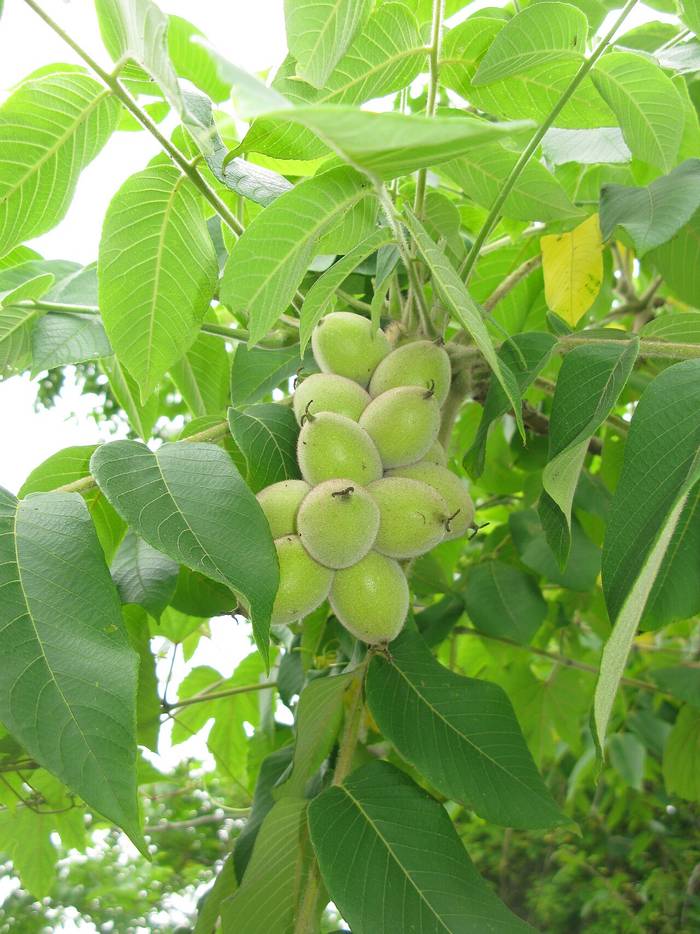
Qwert1234 · CC BY-SA 3.0
Japanese walnut
Tree·Juglans ailantifolia
Full sun
Sun
Moist soil
Water
Well-drained soil
Drainage
Zones 4–8
Hardiness
Coverage · 114 fields
- Parser flag (climate_tolerance_low_confidence): Climate tolerance values are LLM-extracted (no authoritative EcoCrop match found). EcoCrop covers ~2,568 food-crop taxa; ornamental/native/medicinal species rely on LLM extraction.
Growth and size10 fields
Plant type
Deciduous tree“It is a deciduous tree growing to 20 m (66 ft) tall, rarely 30 m (98 ft), and 40–80 centimetres (16–31 in) stem diameter, with light grey bark.”
Height
2,000 cm“It is a deciduous tree growing to 20 m (66 ft) tall, rarely 30 m (98 ft), and 40–80 centimetres (16–31 in) stem diameter, with light grey bark.”
Spread
1,500 cm
AI estimate58 % agree
Height at age
—
empty
Spacing
1,200 cm (at least 900 cm)
AI estimate55 % agree
Growth rate
—
empty
Habit
Spreading
AI estimate50 % agree
Root depth
Deep
AI estimate63 % agree
Forest garden layer
Canopy“It is a deciduous tree growing to 20 m (66 ft) tall, rarely 30 m (98 ft), and 40–80 centimetres (16–31 in) stem diameter, with light grey bark.”
Lifespan
~70 years
AI estimatenot measured yet
Roots6 fields
Root form
Taproot
AI estimate43 % agree
Storage organ
—
empty
Spreads
—
empty
Lateral spread in cm
—
empty
Root depth in cm
—
empty
Mycorrhiza
—
empty
Light, water and soil9 fields
Sun
Full sun
AI estimate71 % agree
Hours of sun
6 h
AI estimatenot measured yet
Water
Moist · Medium
AI estimate74 % agree
Drought tolerant
—
empty
Tolerates waterlogging
—
empty
Drainage
Well drained
AI estimatenot measured yet
Compacted soil
Copes fairly well
AI estimatenot measured yet
Climate5 fields
Hardiness
Zone 4–8
AI estimatenot measured yet
Killing frost
-29 °C
AI estimatenot measured yet
Growing temperature
7–35 °C · optimal 18–27 °C
AI estimatenot measured yet
Chill hours
400 h
AI estimatenot measured yet
Native range
—
empty
Care (becomes tasks in Manage)4 fields
Pruning
January · lasts 30 days · main structural branches · dead, damaged, or crossing branches
AI estimatenot measured yet
Feeding
March · lasts 30 days · a balanced granular fertiliser
AI estimatenot measured yet
Mulching
April · lasts 30 days
AI estimatenot measured yet
Watering
June · lasts 90 days
AI estimatenot measured yet
Through the year6 fields
Leafing out
After the last frost · lasts 21 days“The male flowers are inconspicuous yellow-green catkins produced in spring at the same time as the new leaves appear.”
Wikipediapartly
Flowering
After the previous stage · lasts 14 days“The male flowers are inconspicuous yellow-green catkins produced in spring at the same time as the new leaves appear.”
Wikipediapartly
Fruiting
October · lasts 30 days“The fruit is a nut, produced in bunches of 4–10 together; the nut is spherical, 3–5 cm long and broad, surrounded by a green husk before maturity in mid-autumn.”
Dormant
After the first frost · lasts 150 days
AI estimatenot measured yet
Dying back
After the first frost · lasts 30 days
AI estimatenot measured yet
First harvest
1–3 years after plantingSource is the Society of Ontario Nut Growers (SONG). Figure is for grafted trees (the normal nursery stock) counted from planting; full commercial-volume production is reached later, at 6-8 years, per the same source. Corroborated by Perennia (Nova Scotia government agricultural extension), Heartnut Production fact sheet: "Heartnuts grown from seed will begin to bear within 3-5 years of planting while grafted trees generally begin cropping earlier... It may be 6-8 years before trees are producing enough nuts to make harvesting worthwhile." (https://www.perennia.ca/wp-content/uploads/2018/06/Heartnut-Fact-Sheet.pdf) -- that source gives the seed-grown range explicitly but only says grafted trees begin "earlier" without a number.
Edible parts and pollination4 fields
The nuts
Eat the kernel · October“The fruit is a nut, produced in bunches of 4–10 together; the nut is spherical, 3–5 cm long and broad, surrounded by a green husk before maturity in mid-autumn.”Wikipediapartly“The edible nuts have an oily texture.”
Pollinated by
—
empty
Ecology6 fields
Attracts
Squirrels, birds
AI estimatenot measured yet
Pests
Walnut husk fly, codling moth
AI estimatenot measured yet
Diseases
Walnut bunch disease“The only significant disease Japanese walnuts are susceptible to is the walnut bunch disease.”
Takes up
Potassium, calcium, magnesium
AI estimatenot measured yet
Fixes nitrogen
No
AI estimatenot measured yet
Mycorrhiza
Yes
AI estimatenot measured yet
Propagation and names4 fields
Methods
Seed, grafting
AI estimatenot measured yet
Difficulty
2 / 5
AI estimatenot measured yet
Seed
cold_moist
AI estimatenot measured yet
Not sorted yet60 fields
Fields the parser stores that this page has no row for yet. They show up here automatically, so nothing is hidden.
forage.DK.local_name
Hjertenød
AI estimatenot measured yet
forage.DK.edibility_basis
inferred
AI estimatenot measured yet
forage.DK.foraging_months.notes
Nuts reach maturity in mid-autumn.
AI estimatenot measured yet
forage.DK.foraging_months.months
10“The fruit is a nut, produced in bunches of 4–10 together; the nut is spherical, 3–5 cm long and broad, surrounded by a green husk before maturity in mid-autumn.”
forage.DK.foraging_months.year_round
false
AI estimatenot measured yet
forage.DK.habitat_affinity
woodland, riverbank
AI estimatenot measured yet
forage.US.local_name
Heartnut
AI estimatenot measured yet
forage.US.edible_parts
[{"part":"nut","caution":null,"preparation":"eat the kernel","season_months":[10]}]“The fruit is a nut, produced in bunches of 4–10 together; the nut is spherical, 3–5 cm long and broad, surrounded by a green husk before maturity in mid-autumn.”Wikipediapartly“The edible nuts have an oily texture.”
forage.US.edibility_basis
inferred
AI estimatenot measured yet
forage.US.foraging_months.notes
Nuts ripen in early autumn.
AI estimatenot measured yet
forage.US.foraging_months.months
10“The fruit is a nut, produced in bunches of 4–10 together; the nut is spherical, 3–5 cm long and broad, surrounded by a green husk before maturity in mid-autumn.”
forage.US.foraging_months.year_round
false
AI estimatenot measured yet
forage.US.habitat_affinity
woodland, disturbed_ground
AI estimatenot measured yet
forage.TROPICAL.edibility_basis
inferred
AI estimatenot measured yet
forage.TROPICAL.foraging_months.notes
Not typically found in tropical regions.
AI estimatenot measured yet
forage.TROPICAL.foraging_months.year_round
false
AI estimatenot measured yet
ornamental.basis
documented
AI estimatenot measured yet
ornamental.fragrance.source
none
AI estimate100 % agree
ornamental.confidence
high
AI estimatenot measured yet
ornamental.fall_interest
true
AI estimatenot measured yet
ornamental.flower_colour
yellow, pink, red“The female flowers have pink/red pistils.”Wikipediapartly“The male flowers are inconspicuous yellow-green catkins produced in spring at the same time as the new leaves appear.”
ornamental.evidence_quote
Juglans ailantifolia, commonly known as Heartnut, has green foliage that turns yellow-green in autumn. Its flowers are insignificant, and it offers architectural skeleton in winter.
AI estimatenot measured yet
ornamental.foliage_colour
green“The whole leaf is downy-pubescent, and a somewhat brighter, yellower green than many other tree leaves.”
Wikipediapartly
ornamental.foliage_texture
bold“The bold, decorative leaves and catkins produced in spring make it a popular ornamental tree in parks and large gardens.”
ornamental.winter_structure
architectural_skeleton
AI estimatenot measured yet
ornamental.autumn_foliage_colour
yellow_green
AI estimatenot measured yet
care_regime
none
AI estimatenot measured yet
propagation.self_seeding
light
AI estimate20 % agree
propagation.division_season
not_applicable
AI estimatenot measured yet
propagation.establishment_years
3
AI estimate40 % agree
spatial_profile.canopy_density
medium
AI estimatenot measured yet
forage_proposals.DK.edibility_tier.evidence_quote
The edible nuts have an oily texture.“The edible nuts have an oily texture.”
forage_proposals.US.edibility_tier.evidence_quote
The edible nuts have an oily texture.“The edible nuts have an oily texture.”
forage_proposals.TROPICAL.edibility_tier.confidence
low
AI estimatenot measured yet
function_profile.biomass_return.confidence
high
AI estimatenot measured yet
function_profile.nutrient_flows.consumes
[{"basis":"documented","demand":"high","nutrient":"nitrogen","confidence":"high"},{"basis":"documented","demand":"moderate","nutrient":"phosphorus","confidence":"high"},{"basis":"documented","demand":"high","nutrient"…
AI estimatenot measured yet
function_profile.nutrient_flows.provides
[{"basis":"documented","nutrient":"potassium","mechanism":"biomass_return","confidence":"high"},{"basis":"documented","nutrient":"calcium","mechanism":"biomass_return","confidence":"high"},{"basis":"inferred","nutrien…
AI estimatenot measured yet
function_profile.biotic_interactions
[{"taxa":["walnut bunch disease"],"basis":"documented","valence":"harmful","relation":"hosts","confidence":"high","evidence_quote":"The only significant disease Japanese walnuts are susceptible to is the walnut bunch …“The only significant disease Japanese walnuts are susceptible to is the walnut bunch disease.”
function_profile.aromatic_pest_effect.value
false
AI estimate80 % agree
function_profile.aromatic_pest_effect.confidence
low
AI estimatenot measured yet
function_profile.structural_interfaces.provides_shelter.basis
taxonomic
AI estimatenot measured yet
function_profile.structural_interfaces.provides_shelter.kinds
shade
AI estimatenot measured yet
function_profile.structural_interfaces.provides_shelter.confidence
high
AI estimatenot measured yet
function_profile.structural_interfaces.requires_shelter.basis
inferred
AI estimatenot measured yet
function_profile.structural_interfaces.requires_shelter.confidence
low
AI estimatenot measured yet
function_profile.structural_interfaces.provides_physical_support.form
trunk
AI estimatenot measured yet
function_profile.structural_interfaces.provides_physical_support.basis
taxonomic
AI estimatenot measured yet
function_profile.structural_interfaces.provides_physical_support.confidence
high
AI estimatenot measured yet
function_profile.structural_interfaces.provides_physical_support.evidence_quote
It is a deciduous tree growing to 20 m (66 ft) tall, rarely 30 m (98 ft), and 40–80 centimetres (16–31 in) stem diameter, with light grey bark.
AI estimatenot measured yet
function_profile.structural_interfaces.requires_physical_support.basis
inferred
AI estimatenot measured yet
function_profile.structural_interfaces.requires_physical_support.confidence
medium
AI estimatenot measured yet
climate_tolerance.photoperiod_response
day_neutral
AI estimatenot measured yet
soil_interactions.organic_matter_contribution
high
AI estimatenot measured yet
component_metadata.growth_cycle
perennial
AI estimate100 % agree
resource_interfaces.inputs
[{"resource":"light","quantity_description":"full sun to partial shade"},{"resource":"water","quantity_description":"medium to high"}]“The bold, decorative leaves and catkins produced in spring make it a popular ornamental tree in parks and large gardens.”
Wikipediapartly
resource_interfaces.outputs
[{"resource":"fruit","quantity_description":"nuts produced in bunches of 4–10 together"},{"resource":"timber","quantity_description":"light wood that takes polish well, used for furniture"},{"resource":"leaf_litter","…“The fruit is a nut, produced in bunches of 4–10 together”Wikipediapartly“The wood is light and takes polish well, but is of much lower quality than Persian walnut wood.”