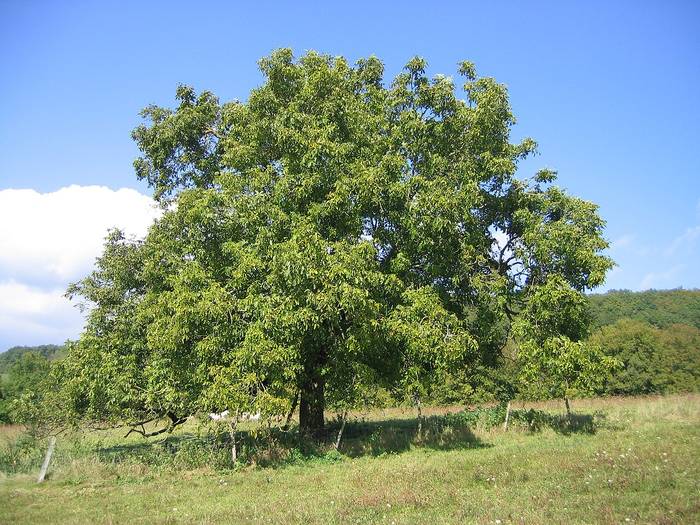
Thesupermat · CC BY-SA 3.0
English walnut
Tree·Juglans regia
Part shade to full sun
Sun
Moist soil
Water
Well-drained soil
Drainage
Zones 4–9
Hardiness
Coverage · 140 fields
No obvious inconsistencies found.
Growth and size12 fields
Plant type
Deciduous tree“Juglans regia is a deciduous Tree growing to 20 m (65ft) by 20 m (65ft) at a medium rate.”
Height
1,500 cm · the source gives 1,000–2,500 cm · other sources: 2,000 cm“Juglans regia is a large deciduous tree, attaining heights of 10–25 metres (35–80 feet), and a trunk up to 2 m (6+1⁄2 ft) in diameter, commonly with a short trunk and broad crown.”Wikipedia“Mature trees may reach 15 m (50 ft) in height and width, and live more than 200 years, developing massive trunks more than 2.4 m (8 ft) thick.”PFAF“Juglans regia is a deciduous Tree growing to 20 m (65ft) by 20 m (65ft) at a medium rate.”
Spread
1,500 cm · other sources: 2,000 cm“Mature trees may reach 15 m (50 ft) in height and width, and live more than 200 years, developing massive trunks more than 2.4 m (8 ft) thick.”PFAF“Juglans regia is a deciduous Tree growing to 20 m (65ft) by 20 m (65ft) at a medium rate.”
Height at age
—
empty
Size after planting
3 yrs: 5 m tall, 2 m crown · 7 yrs: 5 m tall, 2 m crown · 17 yrs: 7 m tall, 4 m crown · 46 yrs: 12 m tall, 8 m crown · 68 yrs: 14 m tall, 10 m crown“Berlin tree register: 1629 trees of this species measured with years since planting, height and crown diameter; median crown 10.0 m and height 14.0 m at 60–100 years after planting (97 trees).”Median of 1,629 measured trees in Berlin. Years count from planting nursery stock, so a small tree reaches each size later.
Rootstock trials
own-rooted original selection tree (patent describes own-rooted tree; clones grafted on Paradox): 7.2 m after 8 yrs“4 published rootstock trials (own-rooted original selection tree (patent describes own-rooted tree; clones grafted on Paradox)) measured height and crown width at known years after planting.”
Rootstock trials
Spacing
1,500 cm (at least 1,000 cm)
AI estimate55 % agree
Growth rate
Medium“Juglans regia is a deciduous Tree growing to 20 m (65ft) by 20 m (65ft) at a medium rate.”
Habit
Spreading“Juglans regia is a large deciduous tree, attaining heights of 10–25 metres (35–80 feet), and a trunk up to 2 m (6+1⁄2 ft) in diameter, commonly with a short trunk and broad crown.”
Wikipediapartly
Forest garden layer
Canopy
AI estimate90 % agree
Lifespan
~200 years“Mature trees may reach 15 m (50 ft) in height and width, and live more than 200 years, developing massive trunks more than 2.4 m (8 ft) thick.”
Roots6 fields
Storage organ
None“No clonal growth organ is recorded: it does not spread vegetatively (no suckers, no rhizomes).”
Spreads
No“No clonal growth organ is recorded: it does not spread vegetatively (no suckers, no rhizomes).”
Lateral spread in cm
—
empty
Root depth in cm
—
empty
Mycorrhiza
—
empty
Light, water and soil9 fields
Sun
Full sun, part shade, light shade · best: full sun“Walnuts take light shade in the early stages of development, but full sun is ideal.”Wikipedia“It is a light-demanding species, requiring full sun to grow well.”
Hours of sun
6 h
AI estimatenot measured yet
Drought tolerant
—
empty
Tolerates waterlogging
—
empty
Soil type
Sand, loam, clay · best: loam“Prefers a slightly alkaline heavy loam but succeeds in most soils.”PFAF“Suitable for: light (sandy), medium (loamy) and heavy (clay) soils and prefers well-drained soil.”
pH
4.5–8.2 · best 6–7.5“The walnut tree is reported to tolerate an annual precipitation of 31 to 147cm, an annual temperature in the range of 7.0 to 21.1°C and a pH in the range of 4.5 to 8.2.”JRC forest tree atlas“It also prefers deep and rich soils, with pH values of between 6 and 7.51.”PFAF“Suitable pH: mildly acid, neutral and basic (mildly alkaline) soils.”
Drainage
Well drained“Suitable for: light (sandy), medium (loamy) and heavy (clay) soils and prefers well-drained soil.”
Compacted soil
Copes badly
AI estimatenot measured yet
Climate5 fields
Hardiness
Zone 4–9
AI estimatenot measured yet
Killing frost
-2 °C“Killing temp. early growth: -2”EcoCrop's figure is frost during early growth (spring frost on new shoots), not winter cold.
Growing temperature
7–40 °C · optimal 15–30 °C“Temperature absolute min: 7 · Temperature absolute max: 40 · Temperature optimal min: 15 · Temperature optimal max: 30”
Chill hours
400 h
AI estimatenot measured yet
Care (becomes tasks in Manage)9 fields
Protection
After the first frost · frost“Seedlings should be planted out into their permanent positions as soon as possible and given some protection for their first winter or two since they are somewhat tender when young.”
Pruning
After the previous stage“Any pruning should only be carried out in late summer to early autumn or when the plant is fully dormant otherwise wounds will bleed profusely and this will severely weaken the tree.”
Sowing
After the previous stage“The seed is best sown as soon as it is ripe in individual deep pots in a cold frame.”
Protection
After the previous stage · rodents“You need to protect it from mice, birds, squirrels etc.”
Protection
After the previous stage · birds“You need to protect it from mice, birds, squirrels etc.”
Pruning
January · lasts 30 days · main structural branches · dead, diseased, or crossing branches
AI estimatenot measured yet
Feeding
March · lasts 15 days · a balanced granular fertiliser
AI estimatenot measured yet
Watering
June · lasts 90 days
AI estimatenot measured yet
Mulching
April · lasts 30 days
AI estimatenot measured yet
Through the year7 fields
Leafing out
May · lasts 30 days“The leaves open fairly late in the spring (typically mid May in Britain), and are red-brown at first, becoming their mature dark yellow-toned green by mid June.”
Harvest
After the previous stage“Walnuts are usually harvested in autumn when the husks begin to split and turn brown.”
PFAFpartly
Dormant
After the first frost
AI estimatenot measured yet
Dying back
After the first frost · Set by day length · lasts 30 days
AI estimatenot measured yet
First harvest
10–12 years after plantingTable 1 column header … row, cells as the page text runs them; last number = "Approximate years to bearing".
Edible parts and pollination9 fields
Seed (nut kernel)
Eaten raw, or ground into a meal for sweet and savoury dishes · October“Walnuts and other tree nuts are food allergen sources having potential to cause life-threatening, IgE-mediated allergic reactions in some individuals.”PFAF“The seed can also be ground into a meal and used as a flavouring in sweet and savoury dishes.”PFAF“It is in flower in June, and the seeds ripen in October.”PFAFpartly“Seed - eaten raw or used in confections, cakes, ice cream etc. A delicious flavour.”
Oil (pressed from seed)
Used in salads or for cooking · October–November“The nut oil is edible but goes rancid quickly.”PFAFpartly“The oil has a pleasant flavour and is used in salads or for cooking.”
The sap
Boiled down to a syrup or sugar · March–April“The sap is tapped in spring and used to make a sugar.”
Unripe nut
Pickled in vinegar · July–August“For more extended storage, unripe nuts are pickled in vinegar.”
Green husk
Dried; vitamin C source · September–October“The dried green husks contain 2.5 - 5% ascorbic acid (vitamin C) - this can be extracted and used as a vitamin supplement.”Wikipedia“As with all species of walnut, the green outer husk of the fruit is rich in a yellow-brown to dark brown dye; harvesting the nuts often leaves the fingers strongly stained brown, and an extract from the husks can be used for dyeing cloth.”
The leaves
Steeped as a tea · May–September“Horses that eat walnut leaves may develop laminitis, a hoof ailment.”PFAFpartly“The leaves are used as a tea.”
Pollination
Self-fertile · monoecious“The species is monoecious (individual flowers are either male or female, but both sexes can be found on the same plant) and is pollinated by Wind.”PFAF“The plant is self-fertile.”
Pollinated by
Wind“The species is monoecious (individual flowers are either male or female, but both sexes can be found on the same plant) and is pollinated by Wind.”
Ecology6 fields
Pests
Walnut husk fly (rhagoletis juglandis), walnut worm (cydia pomonella), navel orangeworm (amyelois transitella)“Juglans regia is infested by Rhagoletis juglandis, commonly known as the walnut husk fly, which lays its eggs in the husks of walnut fruit.”JRC forest tree atlas“A number of pests target the nuts, reducing the value of the crop; these include the walnut worm (Cydia pomonella) and navel orangeworm (Amyelois transitella).”
Diseases
Honey fungus (armillaria mellea), phytophthora cinnamomi, phytophthora cambivora, anthracnose (gnomonia leptostyla), walnut blight (xanthomonas campestris pv. juglandis)“This species is notably susceptible to honey fungus.”JRC forest tree atlas“The main fungal agents are Armillaria mellea, Phytophthora cinamomii and P. cambivora which affect the root system, and antracnosis (Gnomonia leptostyla) which causes summer leaf fall.”JRC forest tree atlas“Walnut blight (Xanthomonas campestris pv. juglandis) is also a serious disease, sometimes causing mortality in young trees.”
Takes up
Potassium, phosphorus
AI estimatenot measured yet
Fixes nitrogen
No
AI estimatenot measured yet
Mycorrhiza
Yes
AI estimatenot measured yet
Propagation and names4 fields
Methods
Seed, budding“The seed is best sown as soon as it is ripe in individual deep pots in a cold frame.”PFAF“Named varieties are propagated by budding.”
Difficulty
3 / 5
AI estimatenot measured yet
Seed
may require a period of cold stratification if seed is stored over winter and sown in early spring“The seed can also be stored in cool moist conditions (such s the salad compartment of a fridge) over the winter and sown in early spring but it may then require a period of cold stratification before it will germinate.”
Not sorted yet73 fields
Fields the parser stores that this page has no row for yet. They show up here automatically, so nothing is hidden.
forage.DK.local_name
Valnød
AI estimatenot measured yet
forage.DK.prep_cautions
Tree nuts are a food allergen and can cause life-threatening allergic reactions in some individuals, Nuts eaten fresh at ripeness have a rubbery texture; drying them is better and helps them keep, Usually, dry the nuts before storing, as it is better to dry them“Walnuts and other tree nuts are food allergen sources having potential to cause life-threatening, IgE-mediated allergic reactions in some individuals.”PFAF“The nuts ripen in autumn and can be eaten at this stage, but tend to have a rubbery texture.”PFAF“Usually, it is better to dry them which will also mean they keep well.”
forage.DK.edibility_basis
inferred
AI estimatenot measured yet
forage.DK.foraging_months.notes
Autumn harvest when husks split; seeds ripen in October“Walnuts are usually harvested in autumn when the husks begin to split and turn brown.”
forage.DK.foraging_months.months
9, 10, 11“Walnuts are usually harvested in autumn when the husks begin to split and turn brown.”
forage.DK.foraging_months.year_round
false“Walnuts are usually harvested in autumn when the husks begin to split and turn brown.”
forage.DK.habitat_affinity
woodland, disturbed_ground“Forests in the Himalayas, preferring a northerly aspect in the west but a southerly or westerly aspect in the east of the range.”
PFAFpartly
forage.US.local_name
English Walnut
AI estimatenot measured yet
forage.US.edible_parts
[{"part":"seed (nut kernel)","caution":"Tree nut allergen; can cause serious allergic reactions in some people","preparation":"Eaten raw, or ground into a meal for sweet and savoury dishes","season_months":[10]},{"par…“The sap is tapped in spring and used to make a sugar.”PFAF“For more extended storage, unripe nuts are pickled in vinegar.”PFAF“The dried green husks contain 2.5 - 5% ascorbic acid (vitamin C) - this can be extracted and used as a vitamin supplement.”Wikipedia“Walnuts and other tree nuts are food allergen sources having potential to cause life-threatening, IgE-mediated allergic reactions in some individuals.”PFAF“The nut oil is edible but goes rancid quickly.”Wikipedia“As with all species of walnut, the green outer husk of the fruit is rich in a yellow-brown to dark brown dye; harvesting the nuts often leaves the fingers strongly stained brown, and an extract from the husks can be used for dyeing cloth.”Wikipedia“Horses that eat walnut leaves may develop laminitis, a hoof ailment.”PFAF“The seed can also be ground into a meal and used as a flavouring in sweet and savoury dishes.”PFAF“It is in flower in June, and the seeds ripen in October.”PFAFpartly“Seed - eaten raw or used in confections, cakes, ice cream etc. A delicious flavour.”PFAFpartly“The oil has a pleasant flavour and is used in salads or for cooking.”PFAFpartly“The leaves are used as a tea.”
forage.US.prep_cautions
Tree nuts are a food allergen and can cause life-threatening allergic reactions in some individuals, Nuts eaten fresh at ripeness have a rubbery texture; drying them is better and helps them keep, Usually, dry the nuts before storing, as it is better to dry them“Walnuts and other tree nuts are food allergen sources having potential to cause life-threatening, IgE-mediated allergic reactions in some individuals.”PFAF“The nuts ripen in autumn and can be eaten at this stage, but tend to have a rubbery texture.”PFAF“Usually, it is better to dry them which will also mean they keep well.”
forage.US.edibility_basis
inferred
AI estimatenot measured yet
forage.US.foraging_months.notes
Autumn harvest when husks split; seeds ripen in October“Walnuts are usually harvested in autumn when the husks begin to split and turn brown.”
forage.US.foraging_months.months
9, 10, 11“Walnuts are usually harvested in autumn when the husks begin to split and turn brown.”
forage.US.foraging_months.year_round
false“Walnuts are usually harvested in autumn when the husks begin to split and turn brown.”
forage.US.habitat_affinity
woodland, disturbed_ground“Forests in the Himalayas, preferring a northerly aspect in the west but a southerly or westerly aspect in the east of the range.”
PFAFpartly
forage.TROPICAL.edible_parts
[{"part":"nuts","caution":null,"preparation":"raw or cooked","season_months":[9,10]},{"part":"leaves","caution":"use young leaves, older leaves can be bitter","preparation":"tea","season_months":[5,6]}]
AI estimatenot measured yet
forage.TROPICAL.prep_cautions
nuts can stain hands and clothing, leaves can be bitter if not young
AI estimatenot measured yet
forage.TROPICAL.edibility_basis
inferred
AI estimatenot measured yet
forage.TROPICAL.foraging_months.notes
Juglans regia is not typically found in tropical climates.
AI estimatenot measured yet
forage.TROPICAL.foraging_months.months
9, 10
AI estimatenot measured yet
forage.TROPICAL.foraging_months.year_round
false
AI estimatenot measured yet
forage.TROPICAL.habitat_affinity
woodland, disturbed_ground
AI estimatenot measured yet
ornamental.basis
documented
AI estimatenot measured yet
ornamental.fragrance.source
foliage“The bruised leaves have a pleasant sweet though resinous smell.”
ornamental.fragrance.intensity
subtle
AI estimatenot measured yet
ornamental.confidence
high
AI estimatenot measured yet
ornamental.fall_interest
true
AI estimatenot measured yet
ornamental.evidence_quote
The foliage is green, turning yellow-green in autumn. The flowers are inconspicuous. The tree has a medium foliage texture and provides winter interest through its architectural skeleton. The leaves have a subtle fragrance when crushed.
AI estimatenot measured yet
ornamental.foliage_colour
green“The leaves open fairly late in the spring (typically mid May in Britain), and are red-brown at first, becoming their mature dark yellow-toned green by mid June.”
ornamental.foliage_texture
medium
AI estimatenot measured yet
ornamental.winter_structure
architectural_skeleton“The bark is silver-grey and smooth between deep, wide fissures.”
JRC forest tree atlaspartly
ornamental.autumn_foliage_colour
yellow_green
AI estimatenot measured yet
care_regime
light
AI estimatenot measured yet
propagation.self_seeding
light
AI estimate20 % agree
propagation.division_season
not applicable
AI estimatenot measured yet
propagation.establishment_years
5“Seedling trees are said to take from 6 to 15 years to come into fruit from seed, but these cultivars usually start cropping within 5 years.”
size_at_age.v
1
AI estimatenot measured yet
size_at_age.basis
years_after_planting
AI estimatenot measured yet
spatial_profile.canopy_density
dense“Trees have a dense canopy which tends to reduce plant growth below them.”
sun_requirement.best
full_sun“Walnuts take light shade in the early stages of development, but full sun is ideal.”
forage_proposals.DK.edibility_tier.tier
choice“The raw edible seed is a rich source of protein, dietary fibre, B vitamins and several dietary minerals, particularly manganese.”
PFAFpartly
forage_proposals.DK.edibility_tier.confidence
high“The raw edible seed is a rich source of protein, dietary fibre, B vitamins and several dietary minerals, particularly manganese.”
PFAFpartly
forage_proposals.DK.edibility_tier.evidence_quote
The nuts of Juglans regia are widely consumed and highly prized for their flavor and nutritional value.“The raw edible seed is a rich source of protein, dietary fibre, B vitamins and several dietary minerals, particularly manganese.”
PFAFpartly
forage_proposals.US.edibility_tier.tier
choice“The raw edible seed is a rich source of protein, dietary fibre, B vitamins and several dietary minerals, particularly manganese.”
PFAFpartly
forage_proposals.US.edibility_tier.confidence
high“The raw edible seed is a rich source of protein, dietary fibre, B vitamins and several dietary minerals, particularly manganese.”
PFAFpartly
forage_proposals.US.edibility_tier.evidence_quote
English walnuts are a common and popular edible nut, used in various culinary applications.“The raw edible seed is a rich source of protein, dietary fibre, B vitamins and several dietary minerals, particularly manganese.”
PFAFpartly
forage_proposals.TROPICAL.edibility_tier.confidence
low
AI estimatenot measured yet
function_profile.biomass_return.confidence
high
AI estimatenot measured yet
function_profile.nutrient_flows.consumes
[{"basis":"documented","demand":"high","nutrient":"nitrogen","confidence":"high"},{"basis":"documented","demand":"moderate","nutrient":"phosphorus","confidence":"high"},{"basis":"documented","demand":"high","nutrient"…
AI estimatenot measured yet
function_profile.nutrient_flows.provides
[{"basis":"documented","nutrient":"potassium","mechanism":"biomass_return","confidence":"high"},{"basis":"documented","nutrient":"phosphorus","mechanism":"biomass_return","confidence":"high"}]
AI estimatenot measured yet
function_profile.biotic_interactions
[{"taxa":["wildlife"],"basis":"documented","valence":"beneficial","relation":"attracts","confidence":"medium","evidence_quote":"It is noted for attracting wildlife.","organism_group":"wildlife","ecological_function":"…“It is noted for attracting wildlife.”Wikipedia“Juglans regia is infested by Rhagoletis juglandis, commonly known as the walnut husk fly, which lays its eggs in the husks of walnut fruit.”JRC forest tree atlas“A number of pests target the nuts, reducing the value of the crop; these include the walnut worm (Cydia pomonella) and navel orangeworm (Amyelois transitella).”PFAF“This species is notably susceptible to honey fungus.”JRC forest tree atlas“The main fungal agents are Armillaria mellea, Phytophthora cinamomii and P. cambivora which affect the root system, and antracnosis (Gnomonia leptostyla) which causes summer leaf fall.”JRC forest tree atlas“Walnut blight (Xanthomonas campestris pv. juglandis) is also a serious disease, sometimes causing mortality in young trees.”
function_profile.aromatic_pest_effect.value
false
AI estimate80 % agree
function_profile.aromatic_pest_effect.confidence
low
AI estimatenot measured yet
function_profile.structural_interfaces.provides_shelter.basis
documented“Trees have a dense canopy which tends to reduce plant growth below them.”
function_profile.structural_interfaces.provides_shelter.kinds
shade“Trees have a dense canopy which tends to reduce plant growth below them.”
function_profile.structural_interfaces.provides_shelter.confidence
medium“Trees have a dense canopy which tends to reduce plant growth below them.”
function_profile.structural_interfaces.provides_shelter.evidence_quote
Trees have a dense canopy which tends to reduce plant growth below them.“Trees have a dense canopy which tends to reduce plant growth below them.”
function_profile.structural_interfaces.requires_shelter.basis
documented“Seedlings should be planted out into their permanent positions as soon as possible and given some protection for their first winter or two since they are somewhat tender when young.”
function_profile.structural_interfaces.requires_shelter.kinds
frost“Seedlings should be planted out into their permanent positions as soon as possible and given some protection for their first winter or two since they are somewhat tender when young.”
function_profile.structural_interfaces.requires_shelter.stage
establishment“Seedlings should be planted out into their permanent positions as soon as possible and given some protection for their first winter or two since they are somewhat tender when young.”
function_profile.structural_interfaces.requires_shelter.confidence
high“Seedlings should be planted out into their permanent positions as soon as possible and given some protection for their first winter or two since they are somewhat tender when young.”
function_profile.structural_interfaces.requires_shelter.evidence_quote
Seedlings should be planted out into their permanent positions as soon as possible and given some protection for their first winter or two since they are somewhat tender when young.“Seedlings should be planted out into their permanent positions as soon as possible and given some protection for their first winter or two since they are somewhat tender when young.”
function_profile.structural_interfaces.provides_physical_support.form
trunk
AI estimatenot measured yet
function_profile.structural_interfaces.provides_physical_support.basis
taxonomic
AI estimatenot measured yet
function_profile.structural_interfaces.provides_physical_support.confidence
high
AI estimatenot measured yet
function_profile.structural_interfaces.requires_physical_support.basis
taxonomic
AI estimatenot measured yet
function_profile.structural_interfaces.requires_physical_support.confidence
high
AI estimatenot measured yet
climate_tolerance.photoperiod_response
day_neutral
AI estimatenot measured yet
soil_interactions.organic_matter_contribution
high
AI estimatenot measured yet
component_metadata.growth_cycle
perennial
AI estimate100 % agree
resource_interfaces.inputs
[{"resource":"light","quantity_description":"full sun ideal; light shade only in early growth; cannot grow in shade"},{"resource":"water","quantity_description":"prefers moist soil"},{"resource":"wind_shelter","quanti…“Walnuts take light shade in the early stages of development, but full sun is ideal.”PFAF“It prefers moist soil.”PFAF“Requires a deep well-drained loam and a sunny position sheltered from strong winds.”PFAF“Some cultivars are self-fertile, though it is generally best to grow at least two different cultivars to assist in cross-pollination.”
resource_interfaces.outputs
[{"resource":"shade","quantity_description":"dense canopy reduces plant growth below"},{"resource":"seeds","quantity_description":"edible nuts"},{"resource":"fruit","quantity_description":"nuts harvested in autumn"},{…“Trees have a dense canopy which tends to reduce plant growth below them.”PFAF“Walnuts are usually harvested in autumn when the husks begin to split and turn brown.”JRC forest tree atlas“The wood of the walnut is highly prized, being strong, attractive and easy to work.”Wikipedia“Other plants often will not grow under walnut trees because the fallen leaves and husks contain juglone, a chemical which acts as a natural herbicide.”PFAF“It is noted for attracting wildlife.”PFAF“The bruised leaves have a pleasant sweet though resinous smell.”PFAFpartly“The raw edible seed is a rich source of protein, dietary fibre, B vitamins and several dietary minerals, particularly manganese.”