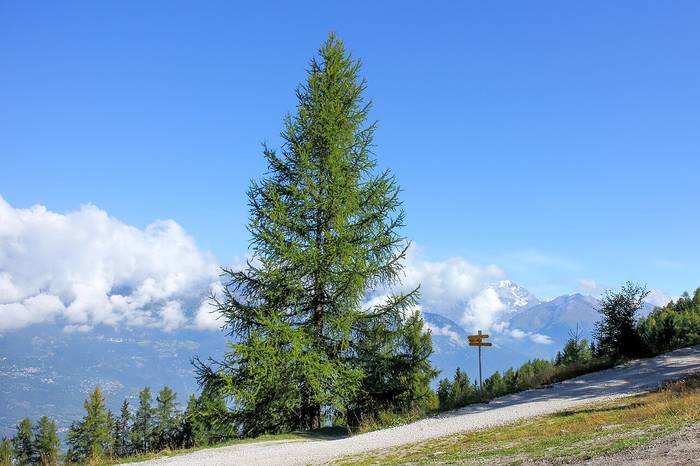
Dominicus Johannes Bergsma · CC BY-SA 4.0
European larch
Tree·Larix decidua
Full sun
Sun
Dry to moist soil
Water
Not recorded
Drainage
Zones 2–7
Hardiness
Coverage · 115 fields
No obvious inconsistencies found.
Growth and size11 fields
Plant type
Deciduous tree“Larix decidua is a deciduous Tree growing to 45 m (147ft) by 15 m (49ft) at a fast rate.”
Height
4,500 cm · the source gives 2,500–4,500 cm“reaching 25–45 metres (82–148 ft) tall”PFAF“Larix decidua is a deciduous Tree growing to 45 m (147ft) by 15 m (49ft) at a fast rate.”
Spread
1,500 cm“Larix decidua is a deciduous Tree growing to 45 m (147ft) by 15 m (49ft) at a fast rate.”
Height at age
—
empty
Size after planting
16 yrs: 7 m tall, 4 m crown · 35 yrs: 15 m tall, 6 m crown · 72 yrs: 20 m tall, 8 m crown“Berlin tree register: 787 trees of this species measured with years since planting, height and crown diameter; median crown 8.0 m and height 20.0 m at 60–100 years after planting (291 trees).”Median of 787 measured trees in Berlin. Years count from planting nursery stock, so a small tree reaches each size later.
Spacing
1,000 cm (at least 800 cm)
AI estimate55 % agree
Growth rate
Fast“Larix decidua is a deciduous Tree growing to 45 m (147ft) by 15 m (49ft) at a fast rate.”
Habit
Columnar
AI estimate50 % agree
Root depth
Deep
AI estimate63 % agree
Forest garden layer
Canopy
AI estimate90 % agree
Lifespan
~1,000 years“Its life span has been confirmed to be close to 1000 years, with ages of around 2000 years likely.”
Roots6 fields
Root form
—
empty
Storage organ
None“No clonal growth organ is recorded: it does not spread vegetatively (no suckers, no rhizomes).”
Spreads
No“No clonal growth organ is recorded: it does not spread vegetatively (no suckers, no rhizomes).”
Lateral spread in cm
—
empty
Root depth in cm
—
empty
Mycorrhiza
Ectomycorrhizal (EcM)
AI estimatenot measured yet
Light, water and soil9 fields
Hours of sun
6 h
AI estimatenot measured yet
Water
Moist, dry · best: moist · Medium“It prefers moist soil.”Wikipedia“European larch can grow on drier soils and tolerate warmer climates than tamarack (Larix laricina) or Siberian larch (Larix sibirica), being better suited to non-boreal climates.”
Drought tolerant
—
empty
Tolerates waterlogging
No“It grows on well-drained soils, not tolerating waterlogging, with a pH range from neutral to acid.”
Soil type
Sand, loam · best: sand“Suitable for: light (sandy) and medium (loamy) soils, prefers well-drained soil and can grow in nutritionally poor soil.”PFAFpartly“Prefers an open airy position in a light or gravelly well-drained soil.”
pH
4–7.8 · best 4.5–7.5“Suitable pH: mildly acid, neutral and basic (mildly alkaline) soils and can grow in very acid soils.”
Drainage
Well-drained, avoids waterlogged ground“It only grows on well-drained soils, avoiding waterlogged ground and is not shade tolerant.”
Compacted soil
Copes fairly well
AI estimatenot measured yet
Climate5 fields
Hardiness
Zone 2–7
AI estimatenot measured yet
Killing frost
-1 °C“Killing temp. early growth: -1”EcoCrop's figure is frost during early growth (spring frost on new shoots), not winter cold.
Growing temperature
5–30 °C · optimal 8–22 °C“Temperature absolute min: 5 · Temperature absolute max: 30 · Temperature optimal min: 8 · Temperature optimal max: 22”
Chill hours
1,000 h
AI estimatenot measured yet
Native range
AT, BA, BE, CH, CZ, DE, FR, HR, IT, LI, MC, MD, ME, MK, NL, PL, RO, RS, SI, SK, SM, UA, VA, XK
Care (becomes tasks in Manage)2 fields
Pruning
November · lasts 60 days · dead, damaged, or crossing branches
AI estimatenot measured yet
Mulching
April · lasts 30 days
AI estimatenot measured yet
Through the year5 fields
Flowering
April · lasts 61 days“It is in flower from April to May, and the seeds ripen from October to November.”
Fruiting
October · lasts 61 days“It is in flower from April to May, and the seeds ripen from October to November.”
Dying back
After the first frost · lasts 30 days“The leaves are needle-like, light green, 2–4 centimetres (3⁄4–1+5⁄8 in) long which turn bright yellow before they fall in the autumn, leaving the pale yellow-buff shoots bare until the next spring.”
Wikipediapartly
Leafing out
After the last frost · Above 5 °C · lasts 14 days
AI estimatenot measured yet
Dormant
After the first frost · 30 days after · lasts 150 days
AI estimatenot measured yet
Edible parts and pollination4 fields
Inner bark
Eaten raw, or dried, ground into a powder and used with cereal flours in bread“Edible Parts: Inner bark Manna”PFAF“Oral intake of bark or oil application over large skin areas may cause kidney damage .”PFAF“Inner bark - it can be eaten raw or can be dried, ground into a powder and used with cereal flours in making bread etc.”
Manna (sweet exudate from the trunk)
Pollination
Self-fertile · monoecious“The species is monoecious (individual flowers are either male or female, but both sexes can be found on the same plant) and is pollinated by Wind.”
Pollinated by
Wind“The species is monoecious (individual flowers are either male or female, but both sexes can be found on the same plant) and is pollinated by Wind.”
Ecology5 fields
Attracts
Siskin, redpoll, citril finch“The seeds are an important food for some birds, notably siskin, redpoll, and citril finch, while the buds and immature cones are eaten by capercaillie.”
Pests
Larch bud moth (zeiraphera diniana), case-bearer moth (coleophora sibiricella), tortrix moth (cydia illutana)“Outbreaks of insect defoliators, principally caused by the larch bud moth (Zeiraphera diniana), can limit tree development, with economic losses in plantations, but they rarely lead to the death of the trees.”Wikipedia“Larch needles (including L. decidua and L. sibirica) are the only known food for caterpillars of the case-bearer moth Coleophora sibiricella”Wikipedia“its cone scales are used as food by the caterpillars of the tortrix moth Cydia illutana”
Diseases
Larch canker (lachnellula willkommii)“It is susceptible to larch canker Lachnellula willkommii.”
Takes up
—
empty
Fixes nitrogen
No
AI estimatenot measured yet
Propagation and names4 fields
Methods
Seed sown in pots in a cold frame in late winter, seed sown in an outdoor seedbed in late winter“Seed - sow late winter in pots in a cold frame.”PFAF“If you are growing larger quantities of plants, you can sow the seed in an outdoor seedbed in late winter.”
Difficulty
3 / 5
AI estimatenot measured yet
Not sorted yet64 fields
Fields the parser stores that this page has no row for yet. They show up here automatically, so nothing is hidden.
forage.DK.local_name
Europæisk lærk
AI estimatenot measured yet
forage.DK.prep_cautions
Possible allergies (e.g. hives, rashes, contact dermatitis)“Possible allergies (e.g. hives, rashes, contact dermatitis)”
forage.DK.edibility_basis
inferred
AI estimatenot measured yet
forage.DK.foraging_months.notes
Young needles are best in spring; inner bark can be harvested in spring when sap is flowing.
AI estimatenot measured yet
forage.DK.foraging_months.months
3, 4, 5
AI estimatenot measured yet
forage.DK.foraging_months.year_round
false
AI estimatenot measured yet
forage.DK.habitat_affinity
woodland, disturbed_ground“forming open forests or pasture woods at the upper tree limits”JRC forest tree atlas“colonising disturbed soils (avalanches, landslide, livestock grazing, etc.)”
forage.US.edible_parts
[{"part":"young needles","caution":null,"preparation":"raw or brewed as tea","season_months":[4,5]},{"part":"inner bark (cambium)","caution":"Only in survival situations, as harvesting can harm the tree.","preparation…
AI estimatenot measured yet
forage.US.edibility_basis
inferred
AI estimatenot measured yet
forage.US.foraging_months.notes
Young needles are best in spring; inner bark can be harvested in spring when sap is flowing.
AI estimatenot measured yet
forage.US.foraging_months.months
3, 4, 5
AI estimatenot measured yet
forage.US.foraging_months.year_round
false
AI estimatenot measured yet
forage.US.habitat_affinity
woodland
AI estimatenot measured yet
forage.TROPICAL.edibility_basis
inferred
AI estimatenot measured yet
forage.TROPICAL.foraging_months.notes
Not typically found in tropical regions.
AI estimatenot measured yet
forage.TROPICAL.foraging_months.year_round
false
AI estimatenot measured yet
ornamental.basis
documented
AI estimatenot measured yet
ornamental.fragrance.source
foliage“The young shoots have a delicate mossy fragrance as the leaves unfold.”
ornamental.fragrance.intensity
subtle“The young shoots have a delicate mossy fragrance as the leaves unfold.”
ornamental.confidence
high
AI estimatenot measured yet
ornamental.fall_interest
true“appreciated for airy foliage turning to bright yellow in autumn”
ornamental.evidence_quote
The European larch (Larix decidua) is a deciduous conifer with soft green needles that turn a brilliant golden-yellow in autumn before falling. Its cones are small and persistent, adding winter interest to the tree's architectural form. Flowers are inconspicuous, with male flowers yellow and female flowers reddish.
AI estimatenot measured yet
ornamental.foliage_colour
green“The colour is light green and turns yellow in autumn before falling.”
ornamental.foliage_texture
fine
AI estimatenot measured yet
ornamental.winter_structure
architectural_skeleton“persist in the plant up to 10 years”
JRC forest tree atlaspartly
ornamental.autumn_foliage_colour
yellow_green, yellow_green
AI estimatenot measured yet
care_regime
none
AI estimatenot measured yet
propagation.self_seeding
light
AI estimate20 % agree
propagation.division_season
not applicable
AI estimatenot measured yet
propagation.establishment_years
3
AI estimate40 % agree
size_at_age.v
1
AI estimatenot measured yet
size_at_age.basis
years_after_planting
AI estimatenot measured yet
forage_proposals.DK.edibility_tier.tier
edible
AI estimatenot measured yet
forage_proposals.DK.edibility_tier.confidence
high
AI estimatenot measured yet
forage_proposals.DK.edibility_tier.evidence_quote
The young needles can be eaten raw or brewed into a tea, and the inner bark can be dried and ground into flour in survival situations.
AI estimatenot measured yet
forage_proposals.US.edibility_tier.tier
edible
AI estimatenot measured yet
forage_proposals.US.edibility_tier.confidence
high
AI estimatenot measured yet
forage_proposals.US.edibility_tier.evidence_quote
The young needles can be eaten raw or brewed into a tea, and the inner bark can be dried and ground into flour in survival situations.
AI estimatenot measured yet
forage_proposals.TROPICAL.edibility_tier.confidence
low
AI estimatenot measured yet
function_profile.biomass_return.confidence
high
AI estimatenot measured yet
function_profile.nutrient_flows.consumes
[{"basis":"inferred","demand":"moderate","nutrient":"nitrogen","confidence":"medium"},{"basis":"inferred","demand":"moderate","nutrient":"phosphorus","confidence":"medium"},{"basis":"inferred","demand":"moderate","nut…“Suitable for: light (sandy) and medium (loamy) soils, prefers well-drained soil and can grow in nutritionally poor soil.”
PFAFpartly
function_profile.nutrient_flows.provides
[{"basis":"inferred","nutrient":"calcium","mechanism":"biomass_return","confidence":"medium"},{"basis":"inferred","nutrient":"potassium","mechanism":"biomass_return","confidence":"medium"}]
AI estimatenot measured yet
function_profile.biotic_interactions
[{"taxa":["siskin","redpoll","citril finch"],"basis":"documented","valence":"neutral","relation":"attracts","confidence":"high","evidence_quote":"The seeds are an important food for some birds, notably siskin, redpoll…“The seeds are an important food for some birds, notably siskin, redpoll, and citril finch, while the buds and immature cones are eaten by capercaillie.”JRC forest tree atlas“Outbreaks of insect defoliators, principally caused by the larch bud moth (Zeiraphera diniana), can limit tree development, with economic losses in plantations, but they rarely lead to the death of the trees.”Wikipedia“Larch needles (including L. decidua and L. sibirica) are the only known food for caterpillars of the case-bearer moth Coleophora sibiricella”Wikipedia“its cone scales are used as food by the caterpillars of the tortrix moth Cydia illutana”Wikipedia“It is susceptible to larch canker Lachnellula willkommii.”
function_profile.aromatic_pest_effect.value
false
AI estimate80 % agree
function_profile.aromatic_pest_effect.confidence
low
AI estimatenot measured yet
function_profile.structural_interfaces.provides_shelter.basis
taxonomic
AI estimatenot measured yet
function_profile.structural_interfaces.provides_shelter.kinds
wind, shade
AI estimatenot measured yet
function_profile.structural_interfaces.provides_shelter.confidence
high
AI estimatenot measured yet
function_profile.structural_interfaces.requires_shelter.basis
documented“Although only a few centimetres tall, they can be planted out into their permanent positions in the summer providing you give them an effective weed-excluding mulch and preferably some winter protection for their first year.”
PFAFpartly
function_profile.structural_interfaces.requires_shelter.kinds
frost“Although only a few centimetres tall, they can be planted out into their permanent positions in the summer providing you give them an effective weed-excluding mulch and preferably some winter protection for their first year.”
PFAFpartly
function_profile.structural_interfaces.requires_shelter.stage
establishment“Although only a few centimetres tall, they can be planted out into their permanent positions in the summer providing you give them an effective weed-excluding mulch and preferably some winter protection for their first year.”
PFAFpartly
function_profile.structural_interfaces.requires_shelter.confidence
medium“Although only a few centimetres tall, they can be planted out into their permanent positions in the summer providing you give them an effective weed-excluding mulch and preferably some winter protection for their first year.”
PFAFpartly
function_profile.structural_interfaces.requires_shelter.evidence_quote
Although only a few centimetres tall, they can be planted out into their permanent positions in the summer providing you give them an effective weed-excluding mulch and preferably some winter protection for their first year.“Although only a few centimetres tall, they can be planted out into their permanent positions in the summer providing you give them an effective weed-excluding mulch and preferably some winter protection for their first year.”
PFAFpartly
function_profile.structural_interfaces.provides_physical_support.form
trunk
AI estimatenot measured yet
function_profile.structural_interfaces.provides_physical_support.basis
taxonomic
AI estimatenot measured yet
function_profile.structural_interfaces.provides_physical_support.confidence
high
AI estimatenot measured yet
function_profile.structural_interfaces.requires_physical_support.basis
taxonomic
AI estimatenot measured yet
function_profile.structural_interfaces.requires_physical_support.confidence
high
AI estimatenot measured yet
climate_tolerance.photoperiod_response
long_day
AI estimatenot measured yet
soil_interactions.organic_matter_contribution
high
AI estimatenot measured yet
component_metadata.growth_cycle
perennial
AI estimate100 % agree
resource_interfaces.inputs
[{"resource":"light","quantity_description":"needs light at all stages of development"},{"resource":"water","quantity_description":"prefers moist soil, avoids waterlogged ground"}]“It needs light in all stages of development, colonising disturbed soils (avalanches, landslide, livestock grazing, etc.) and forming open woodlands.”PFAFpartly“It prefers moist soil.”
resource_interfaces.outputs
[{"resource":"leaf_litter","quantity_description":"needles turn yellow in autumn and fall (deciduous)"},{"resource":"timber","quantity_description":"durable, tough wood used in construction, sleepers and cabinet work"…“It is widely used in construction, for railway sleepers, cabinet work etc.”JRC forest tree atlas“The larch essential oil is still used in aromatherapy and as perfume.”JRC forest tree atlaspartly“The colour is light green and turns yellow in autumn before falling.”Wikipediapartly“The seeds are an important food for some birds, notably siskin, redpoll, and citril finch, while the buds and immature cones are eaten by capercaillie.”