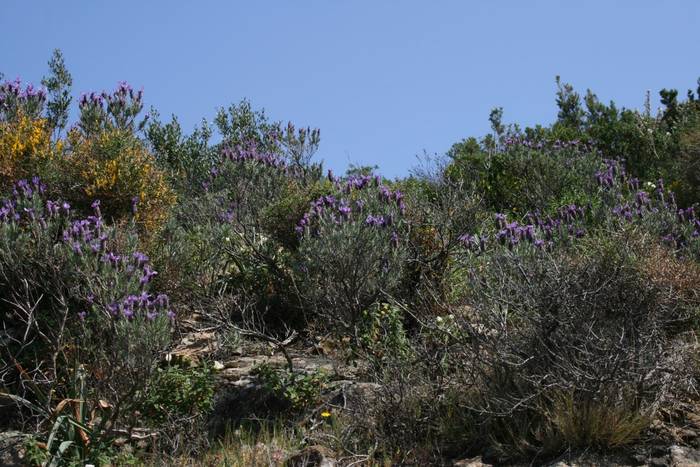
Sten Porse · CC BY-SA 3.0
Spanish lavender
Shrub·Lavandula stoechas
Full sun
Sun
Dry to moist soil
Water
Well-drained soil
Drainage
Zones 7–10
Hardiness
Coverage · 110 fields
- Parser flag (climate_tolerance_low_confidence): Climate tolerance values are LLM-extracted (no authoritative EcoCrop match found). EcoCrop covers ~2,568 food-crop taxa; ornamental/native/medicinal species rely on LLM extraction.
Growth and size10 fields
Plant type
Evergreen shrub“Lavandula stoechas is an evergreen Shrub growing to 0.8 m (2ft 7in) by 0.8 m (2ft 7in) at a medium rate.”
Height
80 cm · other sources: 100 cm“Lavandula stoechas is an evergreen Shrub growing to 0.8 m (2ft 7in) by 0.8 m (2ft 7in) at a medium rate.”Wikipedia“It is an evergreen shrub that usually grows to between 30–100 centimetres (12–39 in) tall, but occasionally up to 2 metres (6.6 ft) tall in the subspecies L. stoechas subsp. luisieri.”
Spread
80 cm“Lavandula stoechas is an evergreen Shrub growing to 0.8 m (2ft 7in) by 0.8 m (2ft 7in) at a medium rate.”
Height at age
—
empty
Spacing
60 cm (at least 45 cm)
AI estimate55 % agree
Growth rate
Medium“Lavandula stoechas is an evergreen Shrub growing to 0.8 m (2ft 7in) by 0.8 m (2ft 7in) at a medium rate.”
Habit
Mounding
AI estimate50 % agree
Forest garden layer
Shrub layer“Lavandula stoechas is an evergreen Shrub growing to 0.8 m (2ft 7in) by 0.8 m (2ft 7in) at a medium rate.”
Lifespan
~5 years
AI estimatenot measured yet
Roots6 fields
Root form
—
empty
Storage organ
None
AI estimate100 % agree
Spreads
No
AI estimate75 % agree
Lateral spread in cm
—
empty
Root depth in cm
—
empty
Mycorrhiza
Arbuscular (AM)
AI estimatenot measured yet
Light, water and soil9 fields
Hours of sun
6–12 h
AI estimatenot measured yet
Tolerates waterlogging
—
empty
Soil type
Sand, loam, clay · best: sand“will do best in a light sandy soil”PFAF“Suitable for: light (sandy), medium (loamy) and heavy (clay) soils and prefers well-drained soil.”
pH
6–8.5“Suitable pH: mildly acid, neutral and basic (mildly alkaline) soils and can grow in very alkaline soils.”
Compacted soil
Copes fairly well
AI estimatenot measured yet
Climate5 fields
Hardiness
Zone 7–10
AI estimatenot measured yet
Killing frost
-10 °C“Hardy to between -5 and -10°c, it is often killed in severe winters in Britain.”
Growing temperature
5–35 °C · optimal 18–28 °C
AI estimatenot measured yet
Chill hours
0 h
AI estimatenot measured yet
Native range
AD, CY, DZ, ES, FR, GG, GI, GR, IL, IT, JE, JO, LB, MA, MC, MT, PT, SM, SY, TN, TR, VA
Care (becomes tasks in Manage)5 fields
Pruning
After the last frost“Any trimming of the plant is best done in spring and should not be done in the autumn since this can encourage new growth that will not be very cold-hardy.”
PFAFpartly
Pruning
After the previous stage · 10 days after · lasts 7 days
AI estimatenot measured yet
Pruning
September · lasts 14 days · flowered stems
AI estimatenot measured yet
Protection
After the first frost · -30 days after · lasts 60 days · frost
AI estimatenot measured yet
Watering
After rain · lasts 180 days
AI estimatenot measured yet
Through the year3 fields
Flowering
May · lasts 123 days“It is in leaf all year, in flower from May to August, and the seeds ripen from July to September.”
Fruiting
July · lasts 92 days“It is in leaf all year, in flower from May to August, and the seeds ripen from July to September.”
Harvest
July · 15 days after · lasts 48 days“Lavender is typically harvested in mid to late summer when the flowers are in full bloom.”
Edible parts and pollination3 fields
Plant (part not stated)
Rarely used for cooking“Spanish Lavender (L. stoechas) and French Lavender (L. dentata) have a pungent, resinous, and medicinal flavour due to their higher camphor content.”PFAF“They are edible but rarely used for cooking.”
Pollination
Self-fertile · hermaphrodite“The species is hermaphrodite (has both male and female organs) and is pollinated by Bees, Lepidoptera (Moths & Butterflies).”PFAF“The plant is self-fertile.”
Pollinated by
Bees, moths, butterflies“The species is hermaphrodite (has both male and female organs) and is pollinated by Bees, Lepidoptera (Moths & Butterflies).”
Ecology5 fields
Attracts
Bees, butterflies, moths, beneficial insects“The species is hermaphrodite (has both male and female organs) and is pollinated by Bees, Lepidoptera (Moths & Butterflies).”PFAF“A good bee plant, also attracting butterflies and moths.”PFAF“Lavender is excellent for attracting pollinators and beneficial insects.”
Pests
—
empty
Diseases
—
empty
Takes up
—
empty
Fixes nitrogen
No
AI estimatenot measured yet
Propagation and names4 fields
Methods
Seed, cuttings, layering“Seed - sow spring in a greenhouse and only just cover the seed.”PFAF“Cuttings of half-ripe wood 7 - 10cm with a heel, July/August in a frame.”
Difficulty
2 / 5
AI estimatenot measured yet
Seed
cold stratification for 4-6 weeks
AI estimatenot measured yet
Not sorted yet60 fields
Fields the parser stores that this page has no row for yet. They show up here automatically, so nothing is hidden.
forage.DK.local_name
Sommerfuglelavendel
AI estimatenot measured yet
forage.DK.prep_cautions
Use in moderation due to strong flavor and potential for essential oil concentration.
AI estimatenot measured yet
forage.DK.edibility_basis
inferred
AI estimatenot measured yet
forage.DK.foraging_months.notes
mid to late summer, when the flowers are in full bloom“Lavender is typically harvested in mid to late summer when the flowers are in full bloom.”
forage.DK.foraging_months.months
7, 8“Lavender is typically harvested in mid to late summer when the flowers are in full bloom.”
forage.DK.foraging_months.year_round
false
AI estimatenot measured yet
forage.DK.habitat_affinity
disturbed_ground
AI estimatenot measured yet
forage.US.edible_parts
[{"part":"plant (part not stated)","caution":"pungent, resinous flavour from higher camphor content","preparation":"rarely used for cooking"}]“Spanish Lavender (L. stoechas) and French Lavender (L. dentata) have a pungent, resinous, and medicinal flavour due to their higher camphor content.”PFAF“They are edible but rarely used for cooking.”
forage.US.prep_cautions
Use in moderation due to strong flavor and potential for essential oil concentration.
AI estimatenot measured yet
forage.US.edibility_basis
inferred
AI estimatenot measured yet
forage.US.foraging_months.notes
mid to late summer, when the flowers are in full bloom“Lavender is typically harvested in mid to late summer when the flowers are in full bloom.”
forage.US.foraging_months.months
7, 8“Lavender is typically harvested in mid to late summer when the flowers are in full bloom.”
forage.US.foraging_months.year_round
false
AI estimatenot measured yet
forage.US.habitat_affinity
disturbed_ground
AI estimatenot measured yet
forage.TROPICAL.edible_parts
[{"part":"flowers","caution":null,"preparation":"infused in drinks, baked goods","season_months":[1,2,3,4,5,6,7,8,9,10,11,12]},{"part":"leaves","caution":"strong flavor, use in moderation","preparation":"herbal tea, s…
AI estimatenot measured yet
forage.TROPICAL.prep_cautions
Use in moderation due to strong flavor and potential for essential oil concentration.
AI estimatenot measured yet
forage.TROPICAL.edibility_basis
inferred
AI estimatenot measured yet
forage.TROPICAL.foraging_months.notes
May flower and produce leaves year-round in suitable tropical climates.
AI estimatenot measured yet
forage.TROPICAL.foraging_months.year_round
true
AI estimatenot measured yet
forage.TROPICAL.habitat_affinity
disturbed_ground
AI estimatenot measured yet
ornamental.basis
documented
AI estimatenot measured yet
ornamental.fragrance.intensity
strong“Lavender’s strong scent is often used as a natural pest deterrent”
ornamental.confidence
high
AI estimatenot measured yet
ornamental.fall_interest
false
AI estimatenot measured yet
ornamental.flower_colour
pink, purple, white“The flowers, which appear in late spring and early summer, are pink to purple”Wikipedia“At the top of the spike are a number of much larger, sterile bracts (no flowers between them), 10–50 mm long and bright lavender purple (rarely white).”
ornamental.evidence_quote
French lavender (Lavandula stoechas) is known for its fragrant purple flowers and fine, grey-green foliage. It is an evergreen shrub with no significant autumn colour.
AI estimatenot measured yet
ornamental.foliage_texture
fine
AI estimatenot measured yet
ornamental.winter_structure
evergreen_form“Lavandula stoechas is an evergreen Shrub growing to 0.8 m (2ft 7in) by 0.8 m (2ft 7in) at a medium rate.”
ornamental.autumn_foliage_colour
none
AI estimatenot measured yet
care_regime
light
AI estimatenot measured yet
propagation.self_seeding
light
AI estimate20 % agree
propagation.division_season
spring
AI estimatenot measured yet
propagation.establishment_years
1
AI estimate40 % agree
spatial_profile.canopy_density
medium
AI estimatenot measured yet
sun_requirement.best
full_sun“Prefers a sunny position in a neutral to alkaline soil, growing well on chalk.”
forage_proposals.DK.edibility_tier.confidence
high
AI estimatenot measured yet
forage_proposals.DK.edibility_tier.evidence_quote
French lavender flowers and leaves are commonly used in culinary applications, particularly in Mediterranean cuisine for flavoring desserts, drinks, and savory dishes.
AI estimatenot measured yet
forage_proposals.US.edibility_tier.confidence
high
AI estimatenot measured yet
forage_proposals.US.edibility_tier.evidence_quote
French lavender is widely recognized as an edible herb in the United States, used in various culinary preparations for its aromatic qualities.
AI estimatenot measured yet
forage_proposals.TROPICAL.edibility_tier.tier
edible
AI estimatenot measured yet
forage_proposals.TROPICAL.edibility_tier.confidence
medium
AI estimatenot measured yet
forage_proposals.TROPICAL.edibility_tier.evidence_quote
While less common in tropical culinary traditions, French lavender is considered edible and can be used in similar ways as in temperate regions.
AI estimatenot measured yet
function_profile.biomass_return.confidence
low
AI estimatenot measured yet
function_profile.nutrient_flows.consumes
[{"basis":"documented","demand":"low","nutrient":"nitrogen","confidence":"high"},{"basis":"documented","demand":"low","nutrient":"phosphorus","confidence":"high"},{"basis":"documented","demand":"low","nutrient":"potas…
AI estimatenot measured yet
function_profile.biotic_interactions
[{"taxa":["bees","butterflies","moths"],"basis":"documented","valence":"beneficial","relation":"attracts","confidence":"high","evidence_quote":"A good bee plant, also attracting butterflies and moths.","organism_group…“A good bee plant, also attracting butterflies and moths.”PFAF“Lavender’s dense, woody stems and leaf litter can offer shelter and overwintering sites for invertebrates, especially beneficial insects”PFAF“Lavender’s strong scent is often used as a natural pest deterrent, confusing and repelling pests such as moths, mosquitoes, and flies.”
function_profile.aromatic_pest_effect.value
true“Its essential oils have pest-repellent properties, making it valuable in organic farming.”
function_profile.aromatic_pest_effect.confidence
high
AI estimatenot measured yet
function_profile.structural_interfaces.provides_shelter.basis
inferred
AI estimatenot measured yet
function_profile.structural_interfaces.provides_shelter.kinds
shade
AI estimatenot measured yet
function_profile.structural_interfaces.provides_shelter.confidence
low
AI estimatenot measured yet
climate_tolerance.photoperiod_response
day_neutral
AI estimatenot measured yet
soil_interactions.organic_matter_contribution
low
AI estimatenot measured yet
component_metadata.growth_cycle
perennial
AI estimate100 % agree
resource_interfaces.inputs
[{"resource":"light","quantity_description":"full sun; prefers a sunny position"},{"resource":"water","quantity_description":"prefers dry or moist soil; drought tolerant once established"},{"resource":"pollination","q…“Prefers a sunny position in a neutral to alkaline soil, growing well on chalk.”PFAFpartly“Established plants are drought tolerant.”PFAFpartly“The species is hermaphrodite (has both male and female organs) and is pollinated by Bees, Lepidoptera (Moths & Butterflies).”
resource_interfaces.outputs
[{"resource":"pollinator_services","quantity_description":"attracts bees, butterflies and moths"},{"resource":"nectar","quantity_description":"flowers rich in nectar"},{"resource":"pollen","quantity_description":"flow…“A good bee plant, also attracting butterflies and moths.”PFAF“Lavender flowers are well-known for being rich in nectar and pollen”PFAF“An essential oil is obtained from the flowers”PFAF“Lavender’s dense, woody stems and leaf litter can offer shelter and overwintering sites for invertebrates, especially beneficial insects”PFAF“It can also be used as a ground cover, hedge, or ornamental plant.”PFAF“the seeds ripen from July to September”
biotic_relationships.repels
moths, mosquitoes, flies“Lavender’s strong scent is often used as a natural pest deterrent, confusing and repelling pests such as moths, mosquitoes, and flies.”