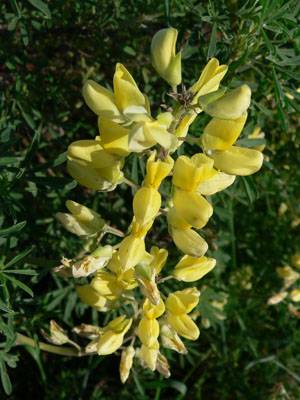
Clickie ( talk ) ( Uploads ) · CC BY 2.5
Tree lupin
Shrub·Lupinus arboreus
Full sun
Sun
Dry to moist soil
Water
Well-drained soil
Drainage
Zones 9–11
Hardiness
Coverage · 118 fields
- Parser flag (climate_tolerance_low_confidence): Climate tolerance values are LLM-extracted (no authoritative EcoCrop match found). EcoCrop covers ~2,568 food-crop taxa; ornamental/native/medicinal species rely on LLM extraction.
Growth and size10 fields
Plant type
Evergreen shrub“Lupinus arboreus is an evergreen Shrub growing to 1.5 m (5ft) by 1.2 m (4ft in) at a fast rate.”
Height
150 cm · the source gives 100–150 cm · other sources: 200 cm“but more typically 1–1.5 m (3–5 ft) tall.”PFAF“Lupinus arboreus is an evergreen Shrub growing to 1.5 m (5ft) by 1.2 m (4ft in) at a fast rate.”Wikipedia“Lupinus arboreus is an evergreen shrub growing to 2 m (7 ft) tall (hence the alternative common name, tree lupine) in sheltered situations, but more typically 1–1.5 m (3–5 ft) tall.”
Spread
120 cm“Lupinus arboreus is an evergreen Shrub growing to 1.5 m (5ft) by 1.2 m (4ft in) at a fast rate.”
Height at age
270 cm after 4 years“Plants have reached 2.7 metres tall and wide within 4 years from seed in a rich soil, flowering and producing seed prolifically.”
Spacing
150 cm (at least 100 cm)
AI estimate55 % agree
Growth rate
Fast“Lupinus arboreus is an evergreen Shrub growing to 1.5 m (5ft) by 1.2 m (4ft in) at a fast rate.”
Habit
Mounding
AI estimate50 % agree
Root depth
Medium
AI estimate63 % agree
Forest garden layer
Shrub layer“Lupinus arboreus is an evergreen Shrub growing to 1.5 m (5ft) by 1.2 m (4ft in) at a fast rate.”
Lifespan
~7 years“It is capable of tolerating temperatures down to −12 °C and living for up to seven years.”
Roots6 fields
Root form
—
empty
Storage organ
None
AI estimate100 % agree
Spreads
No
AI estimate75 % agree
Lateral spread in cm
—
empty
Root depth in cm
—
empty
Mycorrhiza
Arbuscular (AM)
AI estimatenot measured yet
Light, water and soil9 fields
Hours of sun
6 h
AI estimatenot measured yet
Tolerates waterlogging
—
empty
Soil type
Sand, loam“Suitable for: light (sandy) and medium (loamy) soils, prefers well-drained soil and can grow in nutritionally poor soil.”
Compacted soil
Copes badly
AI estimatenot measured yet
Climate5 fields
Hardiness
Zone 9–11
AI estimatenot measured yet
Growing temperature
5–30 °C · optimal 15–25 °C
AI estimatenot measured yet
Chill hours
0 h
AI estimatenot measured yet
Care (becomes tasks in Manage)2 fields
Pruning
After the previous stage · 90 days after · lasts 30 days
AI estimatenot measured yet
Pruning
March · lasts 30 days · dead or damaged stems
AI estimatenot measured yet
Through the year4 fields
Leafing out
After the last frost · Above 10 °C · lasts 30 days“It is in leaf all year, in flower from May to August.”
PFAFpartly
Flowering
After the previous stage · Set by day length · 90 days after · lasts 120 days
AI estimatenot measured yet
Fruiting
After the previous stage · 30 days after · lasts 90 days
AI estimatenot measured yet
Dying back
After the first frost · lasts 30 days
AI estimatenot measured yet
Edible parts and pollination3 fields
The seeds
Cooked, leached · August–September
AI estimatenot measured yet
Pollination
Self-fertile · hermaphrodite“The species is hermaphrodite (has both male and female organs) and is pollinated by Bees.”
Pollinated by
Bees“The species is hermaphrodite (has both male and female organs) and is pollinated by Bees.”
Ecology5 fields
Attracts
Bees“The species is hermaphrodite (has both male and female organs) and is pollinated by Bees.”
Pests
Aphids
AI estimatenot measured yet
Diseases
Lupin anthracnose
AI estimatenot measured yet
Takes up
Nitrogen
AI estimatenot measured yet
Propagation and names4 fields
Methods
Seed pre-soaked 24 hours in warm water, then sown in early spring in a greenhouse, Seed sown in situ in mid to late spring, Cuttings of short side-shoots with a heel taken in July/August and grown in a frame“Pre-soak the seed for 24 hours in warm water and then sow in early spring in a greenhouse.”PFAF“It should also be possible to sow the seed in situ in mid to late spring.”PFAF“Cuttings of short side-shoots with a heel, July/August in a frame.”
Difficulty
2 / 5
AI estimatenot measured yet
Seed
scarification
AI estimatenot measured yet
Not sorted yet70 fields
Fields the parser stores that this page has no row for yet. They show up here automatically, so nothing is hidden.
forage.DK.local_name
Træ-lupin
AI estimatenot measured yet
forage.DK.warnings_da
Giftig for hunde og katte.
AI estimatenot measured yet
forage.DK.warnings_en
Poisonous to dogs and cats.
AI estimatenot measured yet
forage.DK.prep_cautions
Leaching required to remove toxic alkaloids from seeds.“The seed of many lupin species contain bitter-tasting toxic alkaloids, though there are often sweet varieties within that species that are completely wholesome.”PFAFpartly“These toxic alkaloids can be leeched out of the seed by soaking it overnight and discarding the soak water.”
PFAFpartly
forage.DK.edibility_basis
inferred
AI estimatenot measured yet
forage.DK.foraging_months.notes
No specific foraging information for Denmark found.
AI estimatenot measured yet
forage.DK.foraging_months.months
8, 9
AI estimatenot measured yet
forage.DK.foraging_months.year_round
false
AI estimatenot measured yet
forage.DK.habitat_affinity
coast“Stable sand dunes, coastal scrub and pine forest close to the coast.”
forage.US.local_name
Tree lupine
AI estimatenot measured yet
forage.US.edible_parts
[{"part":"seeds","caution":"Must be leached thoroughly to remove bitter alkaloids. Raw seeds are toxic.","preparation":"cooked, leached","season_months":[8,9]}]
AI estimatenot measured yet
forage.US.prep_cautions
Leaching required to remove toxic alkaloids from seeds.“The seed of many lupin species contain bitter-tasting toxic alkaloids, though there are often sweet varieties within that species that are completely wholesome.”PFAFpartly“These toxic alkaloids can be leeched out of the seed by soaking it overnight and discarding the soak water.”
PFAFpartly
forage.US.edibility_basis
inferred
AI estimatenot measured yet
forage.US.foraging_months.notes
No specific foraging information for the US found.
AI estimatenot measured yet
forage.US.foraging_months.months
8, 9
AI estimatenot measured yet
forage.US.foraging_months.year_round
false
AI estimatenot measured yet
forage.US.habitat_affinity
coast“The shrub is indigenous to California, US, where it is widely distributed among coastal sage scrub and sand dunes.”
forage.TROPICAL.local_name
Tree lupine
AI estimatenot measured yet
forage.TROPICAL.edible_parts
[{"part":"seeds","caution":"Must be leached thoroughly to remove bitter alkaloids. Raw seeds are toxic.","preparation":"cooked, leached","season_months":[8,9]}]
AI estimatenot measured yet
forage.TROPICAL.prep_cautions
Leaching required to remove toxic alkaloids from seeds.
AI estimatenot measured yet
forage.TROPICAL.edibility_basis
inferred
AI estimatenot measured yet
forage.TROPICAL.foraging_months.notes
No specific foraging information for tropical regions found.
AI estimatenot measured yet
forage.TROPICAL.foraging_months.months
8, 9
AI estimatenot measured yet
forage.TROPICAL.foraging_months.year_round
false
AI estimatenot measured yet
forage.TROPICAL.habitat_affinity
coast, disturbed_ground
AI estimatenot measured yet
ornamental.basis
documented
AI estimatenot measured yet
ornamental.fragrance.intensity
strong
AI estimatenot measured yet
ornamental.confidence
high
AI estimatenot measured yet
ornamental.fall_interest
false
AI estimatenot measured yet
ornamental.flower_colour
yellow, purple“In spring it bears many racemes, 30 cm (12 in) long, of fragrant, soft yellow, pea-like flowers.”Wikipedia“Both yellow and lilac to purple flowering forms are known.”
ornamental.evidence_quote
Lupinus arboreus, commonly known as tree lupin, produces fragrant yellow flowers and has grey-green foliage. It is an evergreen shrub, so it does not exhibit autumn foliage colour.
AI estimatenot measured yet
ornamental.foliage_colour
green, grey_green“It has green to gray-green palmate leaves, with 5–12 leaflets per leaf.”
ornamental.foliage_texture
medium
AI estimatenot measured yet
ornamental.winter_structure
evergreen_form“Lupinus arboreus is an evergreen shrub growing to 2 m (7 ft) tall (hence the alternative common name, tree lupine) in sheltered situations, but more typically 1–1.5 m (3–5 ft) tall.”
Wikipediapartly
ornamental.autumn_foliage_colour
none
AI estimatenot measured yet
care_regime
none
AI estimatenot measured yet
propagation.division_season
spring
AI estimatenot measured yet
propagation.establishment_years
1
AI estimate40 % agree
forage_proposals.DK.edibility_tier.tier
caution
AI estimatenot measured yet
forage_proposals.DK.edibility_tier.confidence
high
AI estimatenot measured yet
forage_proposals.DK.edibility_tier.evidence_quote
The seeds of Lupinus arboreus are edible after thorough leaching to remove bitter and potentially toxic alkaloids. Raw seeds are toxic.
AI estimatenot measured yet
forage_proposals.US.edibility_tier.tier
caution
AI estimatenot measured yet
forage_proposals.US.edibility_tier.confidence
high
AI estimatenot measured yet
forage_proposals.US.edibility_tier.evidence_quote
The seeds of Lupinus arboreus are edible after thorough leaching to remove bitter and potentially toxic alkaloids. Raw seeds are toxic.
AI estimatenot measured yet
forage_proposals.TROPICAL.edibility_tier.tier
caution
AI estimatenot measured yet
forage_proposals.TROPICAL.edibility_tier.confidence
high
AI estimatenot measured yet
forage_proposals.TROPICAL.edibility_tier.evidence_quote
The seeds of Lupinus arboreus are edible after thorough leaching to remove bitter and potentially toxic alkaloids. Raw seeds are toxic.
AI estimatenot measured yet
function_profile.biomass_return.confidence
medium
AI estimatenot measured yet
function_profile.nutrient_flows.consumes
[{"basis":"inferred","demand":"moderate","nutrient":"phosphorus","confidence":"medium"},{"basis":"inferred","demand":"moderate","nutrient":"potassium","confidence":"medium"}]
AI estimatenot measured yet
function_profile.nutrient_flows.provides
[{"basis":"documented","nutrient":"nitrogen","mechanism":"fixation","confidence":"high","evidence_quote":"It can fix Nitrogen."}]“It can fix Nitrogen.”
function_profile.biotic_interactions
[{"taxa":["bees"],"basis":"documented","valence":"beneficial","relation":"attracts","confidence":"high","evidence_quote":"The species is hermaphrodite (has both male and female organs) and is pollinated by Bees.","org…“The species is hermaphrodite (has both male and female organs) and is pollinated by Bees.”PFAFpartly“Protect the seed from mice.”
function_profile.aromatic_pest_effect.value
false
AI estimate80 % agree
function_profile.aromatic_pest_effect.confidence
low
AI estimatenot measured yet
function_profile.structural_interfaces.provides_shelter.basis
documented“even in exposed areas it grows rapidly to its maximum height of about 1.5 metres and will give shelter to enable other less tolerant plants to become established.”
function_profile.structural_interfaces.provides_shelter.kinds
wind“even in exposed areas it grows rapidly to its maximum height of about 1.5 metres and will give shelter to enable other less tolerant plants to become established.”
function_profile.structural_interfaces.provides_shelter.confidence
medium“even in exposed areas it grows rapidly to its maximum height of about 1.5 metres and will give shelter to enable other less tolerant plants to become established.”
function_profile.structural_interfaces.provides_shelter.evidence_quote
even in exposed areas it grows rapidly to its maximum height of about 1.5 metres and will give shelter to enable other less tolerant plants to become established.“even in exposed areas it grows rapidly to its maximum height of about 1.5 metres and will give shelter to enable other less tolerant plants to become established.”
function_profile.structural_interfaces.requires_shelter.basis
inferred
AI estimatenot measured yet
function_profile.structural_interfaces.requires_shelter.confidence
low
AI estimatenot measured yet
function_profile.structural_interfaces.provides_physical_support.basis
inferred
AI estimatenot measured yet
function_profile.structural_interfaces.provides_physical_support.confidence
low
AI estimatenot measured yet
function_profile.structural_interfaces.requires_physical_support.basis
inferred
AI estimatenot measured yet
function_profile.structural_interfaces.requires_physical_support.confidence
low
AI estimatenot measured yet
climate_tolerance.photoperiod_response
long_day
AI estimatenot measured yet
soil_interactions.organic_matter_contribution
medium
AI estimatenot measured yet
component_metadata.growth_cycle
perennial
AI estimate100 % agree
resource_interfaces.inputs
[{"resource":"light","quantity_description":"sunny position"},{"resource":"water","quantity_description":"dry or moist soil; tolerates drought"},{"resource":"pollination","quantity_description":"bees"}]“Requires a well-drained dry or moist soil in a sunny position.”PFAF“It prefers dry or moist soil and can tolerate drought.”PFAF“The species is hermaphrodite (has both male and female organs) and is pollinated by Bees.”
resource_interfaces.outputs
[{"resource":"wind_shelter","quantity_description":"shelter for less tolerant plants in exposed sites"},{"resource":"seeds","quantity_description":"prolific seed production; self-sows"},{"resource":"aromatic_compounds…“even in exposed areas it grows rapidly to its maximum height of about 1.5 metres and will give shelter to enable other less tolerant plants to become established.”Wikipedia“In spring it bears many racemes, 30 cm (12 in) long, of fragrant, soft yellow, pea-like flowers.”PFAFpartly“Plants have reached 2.7 metres tall and wide within 4 years from seed in a rich soil, flowering and producing seed prolifically.”