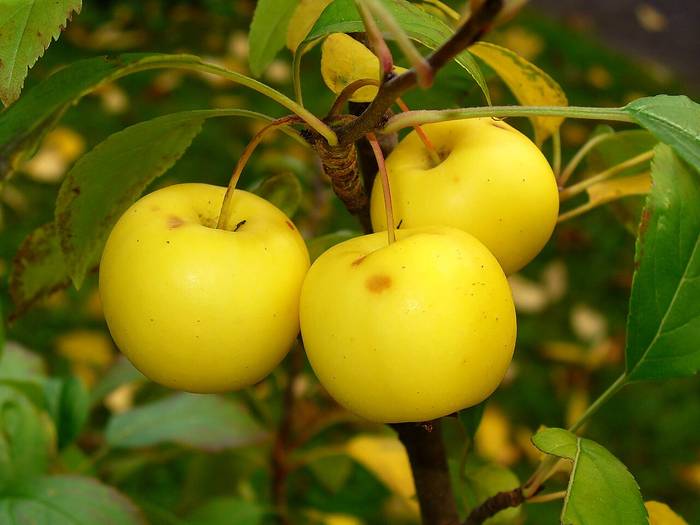
H. Zell · CC BY-SA 3.0
European crab apple
Tree·Malus sylvestris
Part shade to full sun
Sun
Moist soil
Water
Not recorded
Drainage
Zones 4–8
Hardiness
Coverage · 119 fields
No obvious inconsistencies found.
Growth and size11 fields
Height
1,000 cm · other sources: 1,400 cm“Malus sylvestris is a deciduous Tree growing to 10 m (32ft 10in).”Wikipedia“It can live 80–100 years and grow up to 14 metres (46 feet) tall with trunk diameters of usually 23–45 centimetres (9–17+1⁄2 inches), although diameters exceeding 90 cm (35 in) have been recorded.”
Spread
800 cm
AI estimate58 % agree
Height at age
—
empty
Size after planting
6 yrs: 3 m tall, 1 m crown · 12 yrs: 5 m tall, 3 m crown · 19 yrs: 5 m tall, 4 m crown · 43 yrs: 5 m tall, 4 m crown“Berlin tree register: 233 trees of this species measured with years since planting, height and crown diameter; median crown 4.0 m and height 5.0 m at 40–60 years after planting (46 trees).”Median of 233 measured trees in Berlin. Years count from planting nursery stock, so a small tree reaches each size later.
Spacing
600 cm (at least 400 cm)
AI estimate55 % agree
Growth rate
—
empty
Habit
Spreading
AI estimate50 % agree
Root depth
Medium
AI estimate63 % agree
Forest garden layer
Lower tree layer
AI estimate90 % agree
Lifespan
~50 years
AI estimatenot measured yet
Roots6 fields
Root form
—
empty
Storage organ
None
AI estimate100 % agree
Lateral spread in cm
—
empty
Root depth in cm
—
empty
Mycorrhiza
Arbuscular (AM)
AI estimatenot measured yet
Light, water and soil9 fields
Sun
Full sun, light shade, part shade · best: full sun“It can grow in semi-shade (light woodland) or no shade.”
Hours of sun
6 h
AI estimatenot measured yet
Drought tolerant
—
empty
Tolerates waterlogging
—
empty
Soil type
Sand, loam, clay · best: loam“An easily grown plant, it succeeds in most fertile soils, including heavy ones, preferring a moisture retentive well-drained loamy soil.”PFAF“Suitable for: light (sandy), medium (loamy) and heavy (clay) soils, prefers well-drained soil and can grow in heavy clay soil.”
pH
4.5–8.2 · best 6.2–7“Suitable pH: mildly acid, neutral and basic (mildly alkaline) soils.”PFAFpartly“Woods, scrub and hedges, especially in oak woods, on neutral to calcareous soils.”
Drainage
Well-drained, moisture retentive“An easily grown plant, it succeeds in most fertile soils, including heavy ones, preferring a moisture retentive well-drained loamy soil.”
Compacted soil
Copes fairly well
AI estimatenot measured yet
Climate5 fields
Hardiness
Zone 4–8
AI estimatenot measured yet
Killing frost
0 °C“Killing temp. early growth: 0”EcoCrop's figure is frost during early growth (spring frost on new shoots), not winter cold.
Growing temperature
6–35 °C · optimal 10–30 °C“Temperature absolute min: 6 · Temperature absolute max: 35 · Temperature optimal min: 10 · Temperature optimal max: 30”
Chill hours
800 h
AI estimatenot measured yet
Native range
AD, AL, AT, BA, BE, BG, CH, CZ, DE, DK, EE, ES, FI, FR, GB, GG, GI, GR, HR, HU, IE, IT, JE, LI, LT, LU, LV, MC, MD, ME, MK, NL, NO, PL, PT, RO, RS, RU, SE, SI, SK, SM, TR, VA, XK
Care (becomes tasks in Manage)4 fields
Pruning
January · lasts 30 days · dead, diseased, or crossing branches
AI estimatenot measured yet
Feeding
March · lasts 15 days · a balanced granular fertiliser
AI estimatenot measured yet
Mulching
April · lasts 15 days
AI estimatenot measured yet
Watering
After rain · lasts 120 days
AI estimatenot measured yet
Through the year6 fields
Flowering
May · lasts 61 days“The hermaphrodite flowers appear in May to June, slightly preceding hawthorn, have white or pinkish petals and are insect-pollinated.”
Fruiting
September · lasts 61 days“It is in flower in May, and the seeds ripen from September to October.”
Harvest
After the first frost“The flavour improves considerably if the fruit is not harvested until it has been frosted.”
Leafing out
After the last frost · lasts 30 days
AI estimatenot measured yet
Dying back
After the first frost · lasts 30 days
AI estimatenot measured yet
Dormant
After the first frost · lasts 150 days
AI estimatenot measured yet
Edible parts and pollination6 fields
The fruit
Raw or cooked; used for jellies, preserves and juices“Fruit - raw or cooked. Used for jellies, preserves and juices.”
Pollination
Needs a partner · hermaphrodite“The species is hermaphrodite (has both male and female organs) and is pollinated by Insects.”
Pollinated by
Insects“The species is hermaphrodite (has both male and female organs) and is pollinated by Insects.”
Ecology5 fields
Attracts
Wildlife, birds, mammals, insects“It is noted for attracting wildlife.”PFAF“The fruit is a good wildlife food source, especially for birds.”Wikipedia“The European wild apple is dispersed primarily by mammals, which eat the fruits.”PFAF“The species is hermaphrodite (has both male and female organs) and is pollinated by Insects.”
Pests
Hawthorn moth (scythropia crataegella)“Its leaves are food of the hawthorn moth (Scythropia crataegella).”
Takes up
Potassium, calcium
AI estimatenot measured yet
Fixes nitrogen
No
AI estimatenot measured yet
Propagation and names4 fields
Methods
Seed, cuttings of mature wood“Seed - best sown as soon as it is ripe in the autumn in a cold frame.”PFAF“Cuttings of mature wood, November in a frame.”
Difficulty
3 / 5
AI estimatenot measured yet
Seed
3 months at 1°c“Stored seed requires stratification for 3 months at 1°c and should be sown in a cold frame as soon as it is received.”
Not sorted yet63 fields
Fields the parser stores that this page has no row for yet. They show up here automatically, so nothing is hidden.
forage.DK.local_name
Vild abild
AI estimatenot measured yet
forage.DK.warnings_da
Frøene er giftige, hvis man spiser mange.
AI estimatenot measured yet
forage.DK.warnings_en
The seeds are poisonous if you eat many.
AI estimatenot measured yet
forage.DK.prep_cautions
All members of this genus contain the toxin hydrogen cyanide in their seeds and possibly also in their leaves, but not in their fruits., Apple seeds do not normally contain very high quantities of hydrogen cyanide but, even so, should not be consumed in very large quantities.“All members of this genus contain the toxin hydrogen cyanide in their seeds and possibly also in their leaves, but not in their fruits.”PFAF“Apple seeds do not normally contain very high quantities of hydrogen cyanide but, even so, should not be consumed in very large quantities.”
forage.DK.edibility_basis
inferred
AI estimatenot measured yet
forage.DK.foraging_months.notes
fruit ripens in autumn“The small pome-fruits are around 3 cm (1+1⁄4 in) in diameter, ripen in autumn and fall to the ground.”
forage.DK.foraging_months.months
9, 10
AI estimatenot measured yet
forage.DK.foraging_months.year_round
false
AI estimatenot measured yet
forage.DK.habitat_affinity
hedgerow, woodland“Woods, scrub and hedges, especially in oak woods, on neutral to calcareous soils.”
forage.US.edible_parts
[{"part":"fruit","caution":"raw fruit is very tart and astringent","preparation":"cooked","season_months":[9,10]}]
AI estimatenot measured yet
forage.US.prep_cautions
fruit is very tart and astringent raw, best cooked, remove seeds before consumption as they contain cyanogenic glycosides
AI estimatenot measured yet
forage.US.edibility_basis
inferred
AI estimatenot measured yet
forage.US.foraging_months.notes
Fruits ripen in late summer to early autumn.
AI estimatenot measured yet
forage.US.foraging_months.months
9, 10
AI estimatenot measured yet
forage.US.foraging_months.year_round
false
AI estimatenot measured yet
forage.US.habitat_affinity
woodland, hedgerow
AI estimatenot measured yet
forage.TROPICAL.edibility_basis
inferred
AI estimatenot measured yet
forage.TROPICAL.foraging_months.notes
Not typically found in tropical regions.
AI estimatenot measured yet
forage.TROPICAL.foraging_months.year_round
false
AI estimatenot measured yet
ornamental.basis
documented
AI estimatenot measured yet
ornamental.fragrance.source
flower
AI estimate100 % agree
ornamental.fragrance.intensity
subtle
AI estimatenot measured yet
ornamental.confidence
high
AI estimatenot measured yet
ornamental.flower_colour
white, pink“The hermaphrodite flowers appear in May to June, slightly preceding hawthorn, have white or pinkish petals and are insect-pollinated.”
ornamental.evidence_quote
Malus sylvestris, commonly known as crab apple, produces white to pink flowers in spring, followed by small, persistent fruits that provide winter interest. Its foliage is green, turning yellow-green in autumn. The flowers have a subtle fragrance.
AI estimatenot measured yet
ornamental.foliage_colour
green
AI estimate82 % agree
ornamental.foliage_texture
medium
AI estimatenot measured yet
ornamental.winter_structure
persistent_fruit“The bark is light brown and breaks up in flakes.”
Wikipediapartly
ornamental.autumn_foliage_colour
yellow_green
AI estimatenot measured yet
care_regime
none
AI estimatenot measured yet
propagation.self_seeding
light
AI estimate20 % agree
propagation.division_season
not applicable
AI estimatenot measured yet
propagation.establishment_years
3
AI estimate40 % agree
size_at_age.v
1
AI estimatenot measured yet
size_at_age.basis
years_after_planting
AI estimatenot measured yet
spatial_profile.canopy_density
medium
AI estimatenot measured yet
sun_requirement.best
full_sun“Prefers a sunny position but succeeds in partial shade though it fruits less well in such a situation.”
sun_requirement.best_for
fruit“Prefers a sunny position but succeeds in partial shade though it fruits less well in such a situation.”
forage_proposals.DK.edibility_tier.tier
edible“Fruit - raw or cooked. Used for jellies, preserves and juices.”
forage_proposals.DK.edibility_tier.confidence
medium“Fruit - raw or cooked. Used for jellies, preserves and juices.”
forage_proposals.DK.edibility_tier.evidence_quote
Fruit - raw or cooked. Used for jellies, preserves and juices.“Fruit - raw or cooked. Used for jellies, preserves and juices.”
forage_proposals.US.edibility_tier.tier
edible
AI estimatenot measured yet
forage_proposals.US.edibility_tier.confidence
high
AI estimatenot measured yet
forage_proposals.US.edibility_tier.evidence_quote
Crab apples (Malus sylvestris) are widely recognized as edible when cooked, making excellent preserves and sauces.
AI estimatenot measured yet
forage_proposals.TROPICAL.edibility_tier.confidence
low
AI estimatenot measured yet
function_profile.biomass_return.confidence
medium
AI estimatenot measured yet
function_profile.nutrient_flows.consumes
[{"basis":"documented","demand":"moderate","nutrient":"nitrogen","confidence":"high"},{"basis":"documented","demand":"moderate","nutrient":"phosphorus","confidence":"high"},{"basis":"documented","demand":"high","nutri…
AI estimatenot measured yet
function_profile.nutrient_flows.provides
[{"basis":"inferred","nutrient":"potassium","mechanism":"biomass_return","confidence":"low"},{"basis":"inferred","nutrient":"calcium","mechanism":"biomass_return","confidence":"low"}]
AI estimatenot measured yet
function_profile.biotic_interactions
[{"taxa":["wildlife"],"basis":"documented","valence":"beneficial","relation":"attracts","confidence":"high","evidence_quote":"It is noted for attracting wildlife.","organism_group":"wildlife"},{"taxa":["birds"],"basis…“It is noted for attracting wildlife.”PFAF“The fruit is a good wildlife food source, especially for birds.”PFAF“The species is hermaphrodite (has both male and female organs) and is pollinated by Insects.”Wikipedia“Its leaves are food of the hawthorn moth (Scythropia crataegella).”PFAF“Plants in this genus are notably susceptible to honey fungus.”Wikipediapartly“The European wild apple is dispersed primarily by mammals, which eat the fruits.”
function_profile.aromatic_pest_effect.value
false
AI estimate80 % agree
function_profile.aromatic_pest_effect.confidence
low
AI estimatenot measured yet
function_profile.structural_interfaces.provides_shelter.basis
documented
AI estimatenot measured yet
function_profile.structural_interfaces.provides_shelter.kinds
shade
AI estimatenot measured yet
function_profile.structural_interfaces.provides_shelter.confidence
high
AI estimatenot measured yet
function_profile.structural_interfaces.provides_physical_support.form
trunk
AI estimatenot measured yet
function_profile.structural_interfaces.provides_physical_support.basis
taxonomic
AI estimatenot measured yet
function_profile.structural_interfaces.provides_physical_support.confidence
high
AI estimatenot measured yet
climate_tolerance.photoperiod_response
day_neutral
AI estimatenot measured yet
soil_interactions.organic_matter_contribution
medium
AI estimatenot measured yet
component_metadata.growth_cycle
perennial
AI estimate100 % agree
resource_interfaces.inputs
[{"resource":"light","quantity_description":"sunny position preferred; succeeds in partial shade but fruits less well"},{"resource":"water","quantity_description":"prefers moist soil"},{"resource":"shade","quantity_de…“Prefers a sunny position but succeeds in partial shade though it fruits less well in such a situation.”PFAF“It prefers moist soil.”PFAF“It can grow in semi-shade (light woodland) or no shade.”PFAF“The species is hermaphrodite (has both male and female organs) and is pollinated by Insects.”
resource_interfaces.outputs
[{"resource":"fruit","quantity_description":"good wildlife food source, especially for birds"},{"resource":"seeds","quantity_description":"dispersed primarily by mammals that eat the fruits"}]“The fruit is a good wildlife food source, especially for birds.”Wikipedia“The European wild apple is dispersed primarily by mammals, which eat the fruits.”