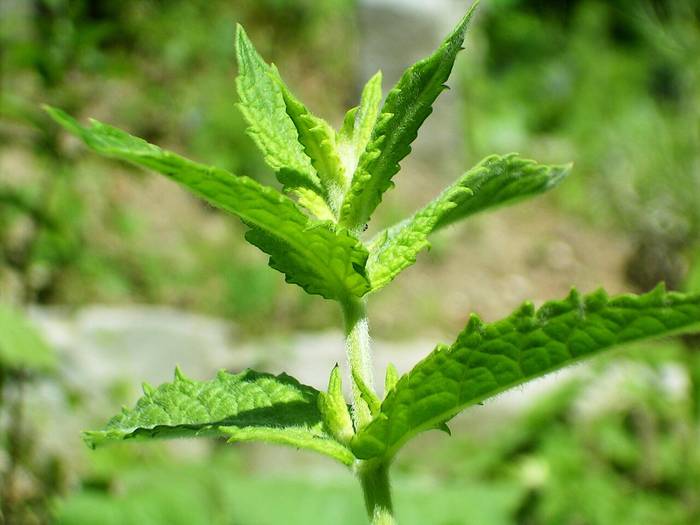
Simon Eugster -- Simon 13:07, 2 July 2006 (UTC) · CC BY-SA 3.0
Spearmint
Plant·Mentha spicata
Part shade to full sun
Sun
Moist soil
Water
Not recorded
Drainage
Zones 3–10
Hardiness
Coverage · 118 fields
Growth and size10 fields
Height
60 cm · the source gives 30–100 cm“It is 30–100 cm (12–39 in) tall, with variably hairless to hairy stems and foliage, and a wide-spreading fleshy underground rhizome from which it grows.”PFAF“Mentha spicata is a PERENNIAL growing to 0.6 m (2ft) by 1 m (3ft 3in) at a fast rate.”
Spread
100 cm“Mentha spicata is a PERENNIAL growing to 0.6 m (2ft) by 1 m (3ft 3in) at a fast rate.”
Height at age
—
empty
Spacing
45 cm (at least 30 cm)
AI estimate55 % agree
Growth rate
Fast“Mentha spicata is a PERENNIAL growing to 0.6 m (2ft) by 1 m (3ft 3in) at a fast rate.”
Habit
Spreading“The plant growth habit is a runner spreading indefinitely by rhizomes or stolons [1-2].”
Root depth
Shallow
AI estimate63 % agree
Forest garden layer
Herb layer
AI estimate90 % agree
Lifespan
~5 years
AI estimatenot measured yet
Roots6 fields
Root form
Fibrous roots
AI estimate43 % agree
Storage organ
Rhizome“Its storage organ is a rhizome, a creeping underground stem; it spreads by rhizomes.”
Spreads
By rhizomes“Its storage organ is a rhizome, a creeping underground stem; it spreads by rhizomes.”
Root depth in cm
—
empty
Mycorrhiza
Arbuscular (AM)
AI estimatenot measured yet
Light, water and soil9 fields
Sun
Full sun, light shade, part shade · best: part shade“It can grow in semi-shade (light woodland) or no shade.”
Hours of sun
4–6 h
AI estimatenot measured yet
Drought tolerant
—
empty
Tolerates waterlogging
—
empty
Soil type
Sand, loam, clay“Suitable for: light (sandy), medium (loamy) and heavy (clay) soils and can grow in heavy clay soil.”
pH
6–7.5“The pH range should be between 6.0 and 7.5.”PFAF“Suitable pH: mildly acid, neutral and basic (mildly alkaline) soils.”
Drainage
Well-drained, moist“Spearmint ideally thrives in soils that are deep, well-drained, moist, rich in nutrients and organic matter, and have a crumbly texture.”
Compacted soil
Copes fairly well
AI estimatenot measured yet
Climate5 fields
Hardiness
Zone 3–10
AI estimatenot measured yet
Killing frost
-1 °C“Killing temp. early growth: -1”EcoCrop's figure is frost during early growth (spring frost on new shoots), not winter cold.
Growing temperature
4–36 °C · optimal 15–25 °C“Temperature absolute min: 4 · Temperature absolute max: 36 · Temperature optimal min: 15 · Temperature optimal max: 25”
Chill hours
0 h
AI estimatenot measured yet
Native range
AF, AL, AM, AZ, BA, BE, BG, CH, CN, CY, DE, DK, EG, GE, GR, HK, HR, HU, IL, IN, IR, IT, JO, LB, LI, MC, MD, ME, MK, MO, NL, NO, NP, PK, PL, RO, RS, RU, SE, SI, SK, SM, SY, TM, TR, TW, VA, XK
Care (becomes tasks in Manage)4 fields
Dividing
After the last frost · After the first frost“Division can be easily carried out at almost any time of the year, though it is probably best done in the spring or autumn to allow the plant to establish more quickly.”
Dividing appears 2 times with different timing.
PFAFpartly
Watering
After rain · lasts 180 days
AI estimatenot measured yet
Pruning
After the previous stage · lasts 30 days · flower stalks and leggy stems
AI estimatenot measured yet
Dividing
March · lasts 30 days · lift and split with a spade
Dividing appears 2 times with different timing.
AI estimatenot measured yet
Through the year5 fields
Leafing out
After the last frost
AI estimatenot measured yet
Flowering
July · lasts 92 days“Spearmint flowers in the summer (from July to September in the northern hemisphere)”
Harvest
After the previous stage“Leaves are harvested 30 days after planting and then throughout the growing season, from spring to autumn, but they are best harvested just before flowering for optimal flavour.”
Dying back
After the first frost
AI estimatenot measured yet
Edible parts and pollination3 fields
The leaves
Raw or cooked; used as a flavouring in salads and cooked foods“Edible Parts: Leaves”PFAF“Although no records of toxicity have been seen for this species, large quantities of some members of this genus, especially when taken in the form of the extracted essential oil, can cause abortions so some caution is advised.”PFAF“Leaves - raw or cooked. A strong spearmint flavour, they are used as a flavouring in salads or cooked foods.”
Pollination
Self-fertile · hermaphrodite“The species is hermaphrodite (has both male and female organs) and is pollinated by Bees.”PFAF“The plant is self-fertile.”
Pollinated by
Bees“The species is hermaphrodite (has both male and female organs) and is pollinated by Bees.”
Ecology5 fields
Attracts
Bees, butterflies, wildlife“The flowers are very attractive to bees and butterflies.”PFAF“It is noted for attracting wildlife.”
Pests
Root-knot nematodes (meloidogyne spp.), root-lesion nematodes (pratylenchus spp.)“Common nematode diseases known to affect spearmint are root knot, caused by various Meloidogyne species, and root lesions, caused by members of the genus Pratylenchus.”
Diseases
Rust (puccinia menthae), leaf spot (alternaria alternata), rhizoctonia solani, verticillium dahliae, phoma strasseri, erysiphe cischoracearum, tobacco ringspot virus, cucumber mosaic virus, tomato aspermy virus“Puccinia menthae is a fungus that causes the disease called "rust".”Wikipedia“Leaf spot is a fungal disease that occurs when Alternaria alternata is present on the spearmint leaves.”Wikipedia“Other fungi that cause disease in spearmint are Rhizoctonia solani, Verticillium dahliae, Phoma strasseri, and Erysiphe cischoracearum.”Wikipedia“Spearmint can be infected by tobacco ringspot virus.”Wikipedia“This is an indication that the plant can also be infected by the viruses, cucumber mosaic and tomato aspermy.”
Takes up
Potassium, calcium
AI estimatenot measured yet
Fixes nitrogen
No
AI estimatenot measured yet
Propagation and names4 fields
Methods
Seed, division“Seed - sow spring in a cold frame.”PFAFpartly“When growing plants with a particular aroma it is best to propagate them by division”
Difficulty
1 / 5“A very easily grown plant, it succeeds in most soils and situations so long as the soil is not too dry.”
PFAFpartly
Seed
not_required
AI estimatenot measured yet
Not sorted yet67 fields
Fields the parser stores that this page has no row for yet. They show up here automatically, so nothing is hidden.
forage.DK.local_name
Grøn mynte
AI estimatenot measured yet
forage.DK.prep_cautions
Large quantities, especially of the extracted essential oil, can cause abortions; some caution is advised.“Although no records of toxicity have been seen for this species, large quantities of some members of this genus, especially when taken in the form of the extracted essential oil, can cause abortions so some caution is advised.”
forage.DK.edibility_basis
inferred
AI estimatenot measured yet
forage.DK.foraging_months.notes
Best harvested just before flowering for optimal flavour.“Leaves are harvested 30 days after planting and then throughout the growing season, from spring to autumn, but they are best harvested just before flowering for optimal flavour.”
forage.DK.foraging_months.months
5, 6, 7, 8, 9, 10
AI estimatenot measured yet
forage.DK.habitat_affinity
verge, disturbed_ground, riverbank“Roadsides and waste places, usually in damp soils and sunny positions.”Wikipediapartly“The plant is also known to be found in moist habitats such as swamps or creeks, where the soil is sand or clay.”
PFAFpartly
forage.US.local_name
Spearmint
AI estimatenot measured yet
forage.US.edible_parts
[{"part":"leaves","caution":"Large quantities, especially of the extracted essential oil, can cause abortions; some caution is advised.","preparation":"raw or cooked; used as a flavouring in salads and cooked foods","…“Edible Parts: Leaves”PFAF“Although no records of toxicity have been seen for this species, large quantities of some members of this genus, especially when taken in the form of the extracted essential oil, can cause abortions so some caution is advised.”PFAF“Leaves - raw or cooked. A strong spearmint flavour, they are used as a flavouring in salads or cooked foods.”
forage.US.prep_cautions
Large quantities, especially of the extracted essential oil, can cause abortions; some caution is advised.“Although no records of toxicity have been seen for this species, large quantities of some members of this genus, especially when taken in the form of the extracted essential oil, can cause abortions so some caution is advised.”
forage.US.edibility_basis
inferred
AI estimatenot measured yet
forage.US.foraging_months.notes
Best harvested just before flowering for optimal flavour.“Leaves are harvested 30 days after planting and then throughout the growing season, from spring to autumn, but they are best harvested just before flowering for optimal flavour.”
forage.US.foraging_months.months
5, 6, 7, 8, 9, 10
AI estimatenot measured yet
forage.US.habitat_affinity
verge, disturbed_ground, riverbank“Roadsides and waste places, usually in damp soils and sunny positions.”Wikipediapartly“The plant is also known to be found in moist habitats such as swamps or creeks, where the soil is sand or clay.”
PFAFpartly
forage.TROPICAL.local_name
Hierbabuena
AI estimatenot measured yet
forage.TROPICAL.edible_parts
[{"part":"leaves","caution":null,"preparation":"raw or cooked","season_months":[1,2,3,4,5,6,7,8,9,10,11,12]}]
AI estimatenot measured yet
forage.TROPICAL.edibility_basis
inferred
AI estimatenot measured yet
forage.TROPICAL.foraging_months.notes
Grows year-round in suitable tropical climates.
AI estimatenot measured yet
forage.TROPICAL.foraging_months.year_round
true
AI estimatenot measured yet
forage.TROPICAL.habitat_affinity
disturbed_ground, riverbank, verge
AI estimatenot measured yet
ornamental.basis
documented
AI estimatenot measured yet
ornamental.confidence
high
AI estimatenot measured yet
ornamental.fall_interest
false
AI estimatenot measured yet
ornamental.flower_colour
white, pink“Spearmint produces flowers in slender spikes, each flower pink or white in colour, 2.5–3 mm (0.098–0.118 in) long and broad.”
ornamental.evidence_quote
Spearmint (Mentha spicata) produces spikes of small, often purple, pink, or white flowers. Its foliage is bright green with a medium texture and a strong, characteristic minty fragrance. As an herbaceous perennial, it dies back to the ground in winter and does not exhibit autumn foliage color.
AI estimatenot measured yet
ornamental.foliage_colour
green
AI estimate82 % agree
ornamental.foliage_texture
medium
AI estimatenot measured yet
ornamental.winter_structure
none
AI estimatenot measured yet
ornamental.autumn_foliage_colour
none
AI estimatenot measured yet
care_regime
light
AI estimatenot measured yet
propagation.self_seeding
moderate
AI estimate20 % agree
propagation.division_season
spring or autumn“Division can be easily carried out at almost any time of the year, though it is probably best done in the spring or autumn to allow the plant to establish more quickly.”
propagation.establishment_years
1
AI estimate40 % agree
forage_proposals.DK.edibility_tier.tier
edible“Leaves - raw or cooked. A strong spearmint flavour, they are used as a flavouring in salads or cooked foods.”
forage_proposals.DK.edibility_tier.confidence
medium“Leaves - raw or cooked. A strong spearmint flavour, they are used as a flavouring in salads or cooked foods.”
forage_proposals.DK.edibility_tier.evidence_quote
Leaves - raw or cooked. A strong spearmint flavour, they are used as a flavouring in salads or cooked foods.“Leaves - raw or cooked. A strong spearmint flavour, they are used as a flavouring in salads or cooked foods.”
forage_proposals.US.edibility_tier.tier
edible“Leaves - raw or cooked. A strong spearmint flavour, they are used as a flavouring in salads or cooked foods.”
forage_proposals.US.edibility_tier.confidence
medium“Leaves - raw or cooked. A strong spearmint flavour, they are used as a flavouring in salads or cooked foods.”
forage_proposals.US.edibility_tier.evidence_quote
Leaves - raw or cooked. A strong spearmint flavour, they are used as a flavouring in salads or cooked foods.“Leaves - raw or cooked. A strong spearmint flavour, they are used as a flavouring in salads or cooked foods.”
forage_proposals.TROPICAL.edibility_tier.tier
edible
AI estimatenot measured yet
forage_proposals.TROPICAL.edibility_tier.confidence
high
AI estimatenot measured yet
forage_proposals.TROPICAL.edibility_tier.evidence_quote
In tropical regions, spearmint is a common garden herb, with its leaves used extensively in local cuisines and traditional remedies, confirming its edible status.
AI estimatenot measured yet
function_profile.biomass_return.confidence
medium“Mint can provide habitat for invertebrates, and its foliage contributes to leaf litter.”
PFAFpartly
function_profile.nutrient_flows.consumes
[{"basis":"documented","demand":"moderate","nutrient":"nitrogen","confidence":"high"},{"basis":"documented","demand":"moderate","nutrient":"phosphorus","confidence":"high"},{"basis":"documented","demand":"moderate","n…
AI estimatenot measured yet
function_profile.nutrient_flows.provides
[{"basis":"inferred","nutrient":"potassium","mechanism":"biomass_return","confidence":"low"},{"basis":"inferred","nutrient":"calcium","mechanism":"biomass_return","confidence":"low"}]
AI estimatenot measured yet
function_profile.biotic_interactions
[{"taxa":["bees","butterflies"],"basis":"documented","valence":"beneficial","relation":"attracts","confidence":"high","evidence_quote":"The flowers are very attractive to bees and butterflies.","organism_group":"polli…“The flowers are very attractive to bees and butterflies.”PFAF“It is noted for attracting wildlife.”PFAF“Mint can provide habitat for invertebrates”PFAF“Rats and mice intensely dislike the smell of mint.”PFAF“A good companion plant for growing near cabbages and tomatoes, helping to keep them free of insect pests.”Wikipedia“Common nematode diseases known to affect spearmint are root knot, caused by various Meloidogyne species, and root lesions, caused by members of the genus Pratylenchus.”Wikipedia“Spearmint can be infected by tobacco ringspot virus.”Wikipedia“This is an indication that the plant can also be infected by the viruses, cucumber mosaic and tomato aspermy.”Wikipediapartly“Fungal diseases are common diseases in spearmint.”
function_profile.aromatic_pest_effect.value
true“Mint has a strong aroma that can help deter certain pests”
function_profile.aromatic_pest_effect.confidence
high
AI estimatenot measured yet
function_profile.structural_interfaces.provides_shelter.basis
inferred
AI estimatenot measured yet
function_profile.structural_interfaces.provides_shelter.kinds
shade
AI estimatenot measured yet
function_profile.structural_interfaces.provides_shelter.confidence
low
AI estimatenot measured yet
function_profile.structural_interfaces.requires_shelter.basis
inferred
AI estimatenot measured yet
function_profile.structural_interfaces.requires_shelter.confidence
low
AI estimatenot measured yet
function_profile.structural_interfaces.provides_physical_support.basis
taxonomic
AI estimatenot measured yet
function_profile.structural_interfaces.provides_physical_support.confidence
high
AI estimatenot measured yet
function_profile.structural_interfaces.requires_physical_support.basis
taxonomic
AI estimatenot measured yet
function_profile.structural_interfaces.requires_physical_support.confidence
high
AI estimatenot measured yet
climate_tolerance.photoperiod_response
day_neutral
AI estimatenot measured yet
soil_interactions.organic_matter_contribution
medium
AI estimatenot measured yet
resource_interfaces.inputs
[{"resource":"light","quantity_description":"full sun to part shade"},{"resource":"shade","quantity_description":"tolerates semi-shade or no shade; prefers partial shade"},{"resource":"water","quantity_description":"m…“Spearmint tends to thrive with plenty of organic material in full sun to part shade.”PFAF“It prefers moist soil.”PFAFpartly“It can grow in semi-shade (light woodland) or no shade.”
resource_interfaces.outputs
[{"resource":"ground_cover","quantity_description":"spreads aggressively by runners, suitable for quick ground cover"},{"resource":"leaf_litter","quantity_description":"foliage contributes to leaf litter"},{"resource"…“Mint is a fast-growing plant, often establishing itself quickly and spreading aggressively, making it suitable for quick ground cover in gardens.”PFAF“Mint can provide habitat for invertebrates, and its foliage contributes to leaf litter.”PFAF“Mint can provide habitat for invertebrates”PFAF“Mint species produce small flowers that are rich in nectar, attracting various pollinators, including bees and butterflies.”PFAF“The flowers are very attractive to bees and butterflies.”Wikipedia“Spearmint is used for its aromatic essential oil, called oil of spearmint.”