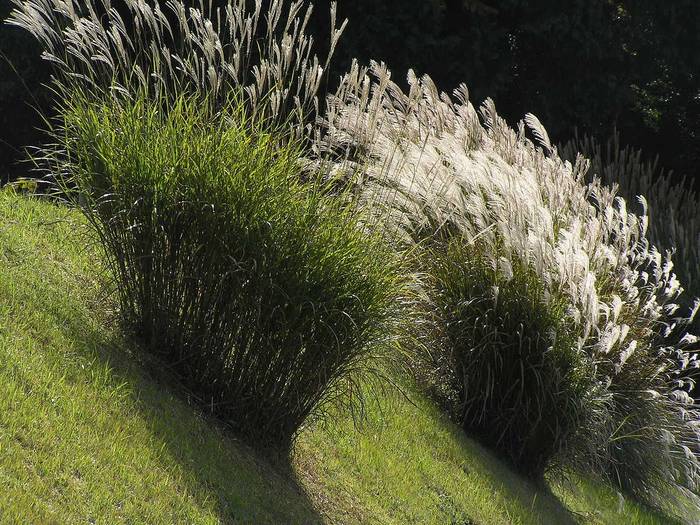
松岡明芳 · CC BY 3.0
Chinese silver grass
Plant·Miscanthus sinensis
Part shade to full sun
Sun
Moist to wet soil
Water
Well-drained soil
Drainage
Zones 5–9
Hardiness
Coverage · 90 fields
- Parser flag (climate_tolerance_low_confidence): Climate tolerance values are LLM-extracted (no authoritative EcoCrop match found). EcoCrop covers ~2,568 food-crop taxa; ornamental/native/medicinal species rely on LLM extraction.
- Height (200 cm) differs from PFAF (4 m).
Growth and size10 fields
Height
200 cm · the source gives 80–200 cm · other sources: 400 cm“growing to 0.8–2 m (3–7 ft) tall, rarely 4 m (13 ft)”PFAF“Miscanthus sinensis is a PERENNIAL growing to 4 m (13ft) by 1 m (3ft 3in) at a fast rate.”
Height (200 cm) differs from PFAF (4 m).
Spread
100 cm“Miscanthus sinensis is a PERENNIAL growing to 4 m (13ft) by 1 m (3ft 3in) at a fast rate.”
Height at age
—
empty
Spacing
90 cm (at least 60 cm)
AI estimate55 % agree
Habit
Mounding
AI estimate50 % agree
Root depth
Medium
AI estimate63 % agree
Lifespan
~10 years
AI estimatenot measured yet
Roots6 fields
Root form
Fibrous roots
AI estimate43 % agree
Spreads
No
AI estimate75 % agree
Lateral spread in cm
—
empty
Root depth in cm
—
empty
Mycorrhiza
Arbuscular (AM)
AI estimatenot measured yet
Light, water and soil9 fields
Sun
Full sun, light shade, part shade · best: full sun“It can grow in semi-shade (light woodland) or no shade.”PFAF“in sun or light shade”
Hours of sun
6 h
AI estimatenot measured yet
Water
Moist, wet · best: moist · Medium“It prefers moist soil.”Wikipedia“Miscanthus is ideal for soils that are often too wet for traditional field crops like corn.”
Tolerates waterlogging
—
empty
Soil type
Sand, loam, clay · best: loam“Prefers a deep fertile loamy soil that does not dry out in summer but succeeds in any ordinary soil that is not too dry, in sun or light shade.”PFAF“Suitable for: light (sandy), medium (loamy) and heavy (clay) soils and prefers well-drained soil.”
Drainage
Well drained“Suitable for: light (sandy), medium (loamy) and heavy (clay) soils and prefers well-drained soil.”
Compacted soil
Copes fairly well
AI estimatenot measured yet
Climate5 fields
Hardiness
Zone 5–9
AI estimatenot measured yet
Killing frost
-20 °C“Fully dormant plants are hardy to about -20°c, though the young growth in spring can be damaged by late frosts.”
Growing temperature
5–35 °C · optimal 18–30 °C
AI estimatenot measured yet
Chill hours
0 h
AI estimatenot measured yet
Care (becomes tasks in Manage)1 fields
Pruning
March · lasts 30 days · old foliage
AI estimatenot measured yet
Through the year5 fields
Leafing out
After the last frost · lasts 30 days
AI estimatenot measured yet
Dormant
After the first frost · lasts 150 days“Fully dormant plants are hardy to about -20°c, though the young growth in spring can be damaged by late frosts.”
PFAFpartly
Harvest
After the last frost · lasts 90 days“The dry surface biomass of the Chinese silver grass, which is normally harvested in spring, can be burned directly in straw fire power plants for electricity production.”
Wikipediapartly
Dying back
After the first frost · lasts 30 days
AI estimatenot measured yet
Edible parts and pollination4 fields
Pollination
Hermaphrodite“The species is hermaphrodite (has both male and female organs)”PFAF“is pollinated by Wind”
Ecology5 fields
Attracts
Birds“Attracts birds, Attractive foliage, Not North American native, Suitable for cut flowers, Suitable for dried flowers, Attractive flowers or blooms.”
Pests
—
empty
Diseases
—
empty
Takes up
—
empty
Fixes nitrogen
No
AI estimatenot measured yet
Propagation and names4 fields
Methods
Seed, division“Seed - surface sow in spring in a greenhouse and keep moist.”PFAF“Division in spring or early autumn.”
Difficulty
1 / 5“Very easy, large divisions can be planted out direct into their permanent positions.”
Seed
cold stratification can improve germination
AI estimatenot measured yet
Not sorted yet41 fields
Fields the parser stores that this page has no row for yet. They show up here automatically, so nothing is hidden.
forage.DK.local_name
Kinesisk elefantgræs
AI estimatenot measured yet
forage.DK.warnings_da
Bladene kan skære i huden, så brug handsker.
AI estimatenot measured yet
forage.DK.warnings_en
The leaves can cut the skin, so wear gloves.
AI estimatenot measured yet
forage.DK.prep_cautions
The leaves have saw-toothed edges that can cut the unwary gardener, it is best to wear gloves when working with the plant.“The leaves have saw-toothed edges that can cut the unwary gardener, it is best to wear gloves when working with the plant.”
forage.DK.edibility_basis
inferred
AI estimatenot measured yet
ornamental.basis
documented
AI estimatenot measured yet
ornamental.fragrance.source
none
AI estimate100 % agree
ornamental.fragrance.intensity
subtle
AI estimatenot measured yet
ornamental.confidence
high
AI estimatenot measured yet
ornamental.fall_interest
true“Main Bloom Time: Early fall, Late summer, Late fall, Mid fall.”
PFAFpartly
ornamental.evidence_quote
Miscanthus sinensis, also known as Chinese silvergrass, is valued for its graceful form, attractive foliage that turns shades of yellow, red, and bronze in autumn, and feathery plumes that persist into winter.
AI estimatenot measured yet
ornamental.foliage_colour
green
AI estimate82 % agree
ornamental.foliage_texture
fine
AI estimatenot measured yet
ornamental.winter_structure
seed_heads, architectural_skeleton
AI estimatenot measured yet
ornamental.autumn_foliage_colour
yellow_green, red, bronze
AI estimatenot measured yet
care_regime
none
AI estimatenot measured yet
propagation.self_seeding
light
AI estimate20 % agree
propagation.establishment_years
1
AI estimate40 % agree
function_profile.biomass_return.confidence
medium“Additionally, carbon gets back to the soil through decomposition of plant material.”
function_profile.nutrient_flows.consumes
[{"basis":"documented","demand":"moderate","nutrient":"nitrogen","confidence":"medium","evidence_quote":"Nitrogen is particularly important, with an optimal application of about 60 kg of nitrogen per hectare."}]“Nitrogen is particularly important, with an optimal application of about 60 kg of nitrogen per hectare.”
function_profile.nutrient_flows.provides
[{"basis":"inferred","nutrient":"potassium","mechanism":"biomass_return","confidence":"medium"},{"basis":"inferred","nutrient":"silica","mechanism":"mineral_extraction","confidence":"medium"}]
AI estimatenot measured yet
function_profile.biotic_interactions
[{"taxa":["birds"],"basis":"documented","valence":"neutral","relation":"attracts","confidence":"medium","evidence_quote":"Attracts birds, Attractive foliage, Not North American native, Suitable for cut flowers, Suitab…“Attracts birds, Attractive foliage, Not North American native, Suitable for cut flowers, Suitable for dried flowers, Attractive flowers or blooms.”
function_profile.aromatic_pest_effect.value
false
AI estimate80 % agree
function_profile.aromatic_pest_effect.confidence
high
AI estimatenot measured yet
function_profile.structural_interfaces.provides_shelter.basis
documented
AI estimatenot measured yet
function_profile.structural_interfaces.provides_shelter.kinds
wind
AI estimatenot measured yet
function_profile.structural_interfaces.provides_shelter.confidence
high
AI estimatenot measured yet
function_profile.structural_interfaces.requires_shelter.basis
documented
AI estimatenot measured yet
function_profile.structural_interfaces.requires_shelter.confidence
high
AI estimatenot measured yet
function_profile.structural_interfaces.provides_physical_support.form
dense_thicket
AI estimatenot measured yet
function_profile.structural_interfaces.provides_physical_support.basis
documented
AI estimatenot measured yet
function_profile.structural_interfaces.provides_physical_support.confidence
high
AI estimatenot measured yet
function_profile.structural_interfaces.requires_physical_support.basis
taxonomic
AI estimatenot measured yet
function_profile.structural_interfaces.requires_physical_support.confidence
high
AI estimatenot measured yet
climate_tolerance.photoperiod_response
short_day
AI estimatenot measured yet
soil_interactions.organic_matter_contribution
high
AI estimatenot measured yet
resource_interfaces.inputs
[{"resource":"light","quantity_description":"full sun or light shade"},{"resource":"water","quantity_description":"moist soil"},{"resource":"shade","quantity_description":"semi-shade or no shade"},{"resource":"space",…“Prefers a deep fertile loamy soil that does not dry out in summer but succeeds in any ordinary soil that is not too dry, in sun or light shade.”PFAF“It prefers moist soil.”PFAF“It can grow in semi-shade (light woodland) or no shade.”PFAF“Miscanthus sinensis is a PERENNIAL growing to 4 m (13ft) by 1 m (3ft 3in) at a fast rate.”
resource_interfaces.outputs
[{"resource":"ground_cover","quantity_description":"dense clumps that make excellent ground cover when planted close together in drifts"},{"resource":"habitat","quantity_description":"nesting structure for paper wasps…“Plants form impenetrably dense clumps and when planted close together in drifts make an excellent ground cover.”Wikipedia“This plant is the preferred structure for the nesting of some species of paper wasps, such as Ropalidia fasciata.”Wikipedia“Additionally, carbon gets back to the soil through decomposition of plant material.”