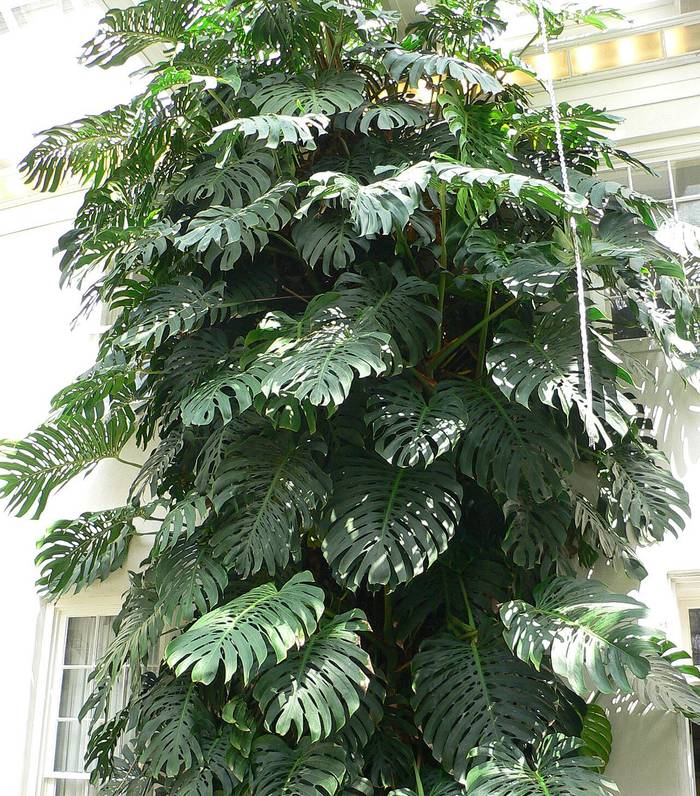
Raulbot · CC BY-SA 3.0
Swiss cheese plant
Plant·Monstera deliciosa
Shade to full sun
Sun
Moist to wet soil
Water
Well-drained soil
Drainage
Zones 10–12
Hardiness
Coverage · 104 fields
Growth and size10 fields
Plant type
Evergreen plant“Monstera deliciosa, the Swiss cheese plant or split-leaf philodendron, is a species of flowering plant.”
Height
300 cm · the source gives 200–300 cm · other sources: 2,000 cm“Although it can grow very tall in nature, it only measures between 2 and 3 m (6.6 and 9.8 ft) when grown indoors.”Wikipedia“It is able to grow up to 20 m (66 ft) high in the wild”
Height (300 cm) differs from PFAF (20 m).
Spread
600 cm“Monstera deliciosa is an evergreen Climber growing to 20 m (65ft) by 6 m (19ft) at a fast rate.”
Height at age
—
empty
Growth rate
Fast“Monstera deliciosa is an evergreen Climber growing to 20 m (65ft) by 6 m (19ft) at a fast rate.”
Root depth
Medium
AI estimate63 % agree
Forest garden layer
Climber“Monstera deliciosa is an evergreen Climber growing to 20 m (65ft) by 6 m (19ft) at a fast rate.”
Lifespan
~10 years
AI estimatenot measured yet
Roots6 fields
Root form
Fibrous roots
AI estimate43 % agree
Storage organ
None
AI estimate100 % agree
Spreads
No
AI estimate75 % agree
Lateral spread in cm
—
empty
Root depth in cm
—
empty
Mycorrhiza
—
empty
Light, water and soil9 fields
Sun
Shade, part shade, light shade, full sun · best: shade“It can grow in full shade (deep woodland) semi-shade (light woodland) or no shade.”Wikipediapartly“It needs very bright exposure, but not full sun.”
Hours of sun
2–6 h
AI estimatenot measured yet
Water
Drought tolerant
—
empty
Tolerates waterlogging
—
empty
Soil type
Sand, loam, clay, peat“Suitable for: light (sandy), medium (loamy) and heavy (clay) soils and prefers well-drained soil.”Wikipedia“It requires a well-draining, peat-based soil to thrive, such as a soil made with perlite and pieces of bark.”
pH
5–7.5 · best 5.5–6“Prefers a pH in the range 5.5 - 6, tolerating 5 - 7.5.”PFAF“Suitable pH: mildly acid and neutral soils and can grow in very acid soils.”
Compacted soil
Copes badly
AI estimatenot measured yet
Climate5 fields
Hardiness
Zone 10–12
AI estimatenot measured yet
Killing frost
-1 °C“When dormant, the plant can survive temperatures down to about -3°c, but young growth can be severely damaged at -1°c.”EcoCrop's figure is frost during early growth (spring frost on new shoots), not winter cold.
Growing temperature
18–38 °C · optimal 28–34 °C“It grows best in areas where annual daytime temperatures are within the range 28 - 34°c, but can tolerate 18 - 38°c.”Wikipediapartly“Growth ceases below 10 °C (50 °F) and it is killed by frost.”
Chill hours
0 h
AI estimatenot measured yet
Care (becomes tasks in Manage)5 fields
Watering
After rain“It is usually watered when the soil has slightly dried out (after around one or two weeks).”
Watering appears 2 times with different timing.
Support
After the previous stage“If it grows in the ground it is better to plant it near a tree, where it can climb, if not against a trellis.”
Wikipediapartly
Watering
Above 18 °C · lasts 365 days
Watering appears 2 times with different timing.
AI estimatenot measured yet
Feeding
April · lasts 180 days · balanced liquid fertiliser
AI estimatenot measured yet
Pruning
March · lasts 30 days · yellowing leaves, leggy stems
AI estimatenot measured yet
Through the year4 fields
Fruiting
After the previous stage · 365 days after“It takes longer than a year for fruits to reach maturity.”
Leafing out
Above 18 °C · lasts 14 days
AI estimatenot measured yet
Edible parts and pollination2 fields
Ecology6 fields
Attracts
Bees, insects, nitidulid beetles“The flowers are pollinated by Bees, Insects.”Wikipedia“Flowers are bisexual, containing both androecium and gynoecium, though protogynous development reduces self-pollination; in the wild they are pollinated mainly by nitidulid beetles.”
Pests
Spider mites, mealybugs, thrips
AI estimatenot measured yet
Diseases
Root rot, bacterial leaf spot
AI estimatenot measured yet
Takes up
Calcium, magnesium
AI estimatenot measured yet
Fixes nitrogen
No
AI estimatenot measured yet
Mycorrhiza
Yes
AI estimatenot measured yet
Propagation and names4 fields
Methods
Difficulty
2 / 5
AI estimatenot measured yet
Seed
none
AI estimatenot measured yet
Not sorted yet53 fields
Fields the parser stores that this page has no row for yet. They show up here automatically, so nothing is hidden.
forage.TROPICAL.local_name
Swiss Cheese Plant
AI estimatenot measured yet
forage.TROPICAL.edible_parts
[{"part":"fruit","caution":"eat only thoroughly ripe fruit, as unripe fruit irritates the mouth through calcium oxalate crystals","preparation":"eaten raw when thoroughly ripe, or made into jellies, jams, ice creams a…“Edible Parts: Fruit”PFAF“care must be taken to eat only fruits that are thoroughly ripe, since immature ones will cause swelling and irritation of the mouth because of needle-like crystals of calcium oxalate found in the tissues or sap.”PFAF“The fruit is eaten raw, made into jellies and jams, and is also used in ice creams, sherbets, soft drinks etc.”
forage.TROPICAL.prep_cautions
Cook or fully dry the plant before eating, as fresh tissue contains calcium oxalate crystals., The black irritant fibers on the fruit can be removed with a little citrus juice., People with a tendency to rheumatism, arthritis, gout, kidney stones and hyperacidity should take especial caution if including this plant in their diet.“The whole plant can be toxic when consumed fresh because it contains calcium oxalate crystals which can easily be broken down by thoroughly cooking or fully drying the plant.”Wikipedia“The black irritant fibers can be swept off with the application of a little citrus juice.”PFAF“People with a tendency to rheumatism, arthritis, gout, kidney stones and hyperacidity should take especial caution if including this plant in their diet.”
forage.TROPICAL.edibility_basis
inferred
AI estimatenot measured yet
forage.TROPICAL.foraging_months.notes
Fruit takes more than a year to mature on the plant.“It takes longer than a year for fruits to reach maturity.”
forage.TROPICAL.foraging_months.months
3, 4, 5, 6, 7, 8, 9, 10, 11, 12
AI estimatenot measured yet
forage.TROPICAL.foraging_months.year_round
true“Plants can flower and produce fruit all year round.”
ornamental.basis
documented
AI estimatenot measured yet
ornamental.fragrance.source
fruit“As the fruit ripens, these scales or platelets fall off the fruit, releasing a strong and sweet scent.”
ornamental.fragrance.intensity
strong“As the fruit ripens, these scales or platelets fall off the fruit, releasing a strong and sweet scent.”
ornamental.confidence
high
AI estimatenot measured yet
ornamental.fall_interest
false
AI estimatenot measured yet
ornamental.evidence_quote
Monstera deliciosa is known for its large, glossy, dark green leaves and insignificant flowers, followed by edible fruit. It is an evergreen plant with no autumn foliage color change.
AI estimatenot measured yet
ornamental.foliage_colour
dark_green
AI estimate82 % agree
ornamental.foliage_texture
bold“It is able to grow up to 20 m (66 ft) high in the wild, with large, leathery, glossy, pinnate, heart-shaped leaves 25–90 cm (10–35.5 in) long by 25–75 cm (10–29.5 in) broad.”
Wikipediapartly
ornamental.winter_structure
evergreen_form“Monstera deliciosa is an evergreen Climber growing to 20 m (65ft) by 6 m (19ft) at a fast rate.”
ornamental.autumn_foliage_colour
none
AI estimatenot measured yet
care_regime
routine
AI estimatenot measured yet
propagation.self_seeding
none
AI estimate20 % agree
propagation.division_season
spring
AI estimatenot measured yet
propagation.establishment_years
1
AI estimate40 % agree
spatial_profile.canopy_density
medium
AI estimatenot measured yet
sun_requirement.best
shade“Prefers growing in a shady position, but can tolerate a wide range from deep shade to fairly open and sunny.”
forage_proposals.TROPICAL.edibility_tier.tier
edible
AI estimatenot measured yet
forage_proposals.TROPICAL.edibility_tier.confidence
high
AI estimatenot measured yet
forage_proposals.TROPICAL.edibility_tier.evidence_quote
The fruit of Monstera deliciosa is edible when fully ripe, tasting like a combination of pineapple and banana. However, unripe fruit contains oxalic acid, which can cause irritation to the mouth and throat.
AI estimatenot measured yet
function_profile.biomass_return.confidence
medium
AI estimatenot measured yet
function_profile.nutrient_flows.consumes
[{"basis":"documented","demand":"moderate","nutrient":"nitrogen","confidence":"high"},{"basis":"documented","demand":"moderate","nutrient":"phosphorus","confidence":"high"},{"basis":"documented","demand":"moderate","n…
AI estimatenot measured yet
function_profile.nutrient_flows.provides
[{"basis":"inferred","nutrient":"calcium","mechanism":"biomass_return","confidence":"low"},{"basis":"inferred","nutrient":"magnesium","mechanism":"biomass_return","confidence":"low"}]
AI estimatenot measured yet
function_profile.biotic_interactions
[{"taxa":["bees","insects"],"basis":"documented","valence":"beneficial","relation":"attracts","confidence":"high","evidence_quote":"The flowers are pollinated by Bees, Insects.","organism_group":"pollinator","ecologic…“The flowers are pollinated by Bees, Insects.”Wikipedia“Flowers are bisexual, containing both androecium and gynoecium, though protogynous development reduces self-pollination; in the wild they are pollinated mainly by nitidulid beetles.”
function_profile.aromatic_pest_effect.value
false
AI estimate80 % agree
function_profile.aromatic_pest_effect.confidence
high
AI estimatenot measured yet
function_profile.structural_interfaces.provides_shelter.basis
documented
AI estimatenot measured yet
function_profile.structural_interfaces.provides_shelter.kinds
shade
AI estimatenot measured yet
function_profile.structural_interfaces.provides_shelter.confidence
high
AI estimatenot measured yet
function_profile.structural_interfaces.provides_shelter.evidence_quote
The large, broad leaves of Monstera deliciosa provide significant shade.
AI estimatenot measured yet
function_profile.structural_interfaces.requires_shelter.basis
documented
AI estimatenot measured yet
function_profile.structural_interfaces.requires_shelter.kinds
wind, frost“Prefers growing in a shady position, but can tolerate a wide range from deep shade to fairly open and sunny.”PFAFpartly“When dormant, the plant can survive temperatures down to about -3°c, but young growth can be severely damaged at -1°c.”
PFAFpartly
function_profile.structural_interfaces.requires_shelter.stage
permanent
AI estimatenot measured yet
function_profile.structural_interfaces.requires_shelter.confidence
high
AI estimatenot measured yet
function_profile.structural_interfaces.requires_shelter.evidence_quote
Monstera deliciosa is a tropical plant sensitive to cold temperatures and strong winds, which can damage its large leaves.
AI estimatenot measured yet
function_profile.structural_interfaces.provides_physical_support.basis
inferred
AI estimatenot measured yet
function_profile.structural_interfaces.provides_physical_support.confidence
low
AI estimatenot measured yet
function_profile.structural_interfaces.requires_physical_support.basis
documented“If it grows in the ground it is better to plant it near a tree, where it can climb, if not against a trellis.”
function_profile.structural_interfaces.requires_physical_support.confidence
medium“If it grows in the ground it is better to plant it near a tree, where it can climb, if not against a trellis.”
function_profile.structural_interfaces.requires_physical_support.evidence_quote
If it grows in the ground it is better to plant it near a tree, where it can climb, if not against a trellis.“If it grows in the ground it is better to plant it near a tree, where it can climb, if not against a trellis.”
climate_tolerance.photoperiod_response
day_neutral“Plants can flower and produce fruit all year round.”
PFAFpartly
soil_interactions.organic_matter_contribution
medium
AI estimatenot measured yet
component_metadata.growth_cycle
perennial
AI estimate100 % agree
resource_interfaces.inputs
[{"resource":"light","quantity_description":"very bright exposure but not full sun"},{"resource":"shade","quantity_description":"prefers a shady position and tolerates deep shade to fairly open sun"},{"resource":"wate…“It needs very bright exposure, but not full sun.”PFAF“Prefers growing in a shady position, but can tolerate a wide range from deep shade to fairly open and sunny.”Wikipedia“It is a "moderately greedy plant", in that it needs to be watered just to keep the soil slightly moist.”Wikipedia“If it grows in the ground it is better to plant it near a tree, where it can climb, if not against a trellis.”Wikipedia“Flowers are bisexual, containing both androecium and gynoecium, though protogynous development reduces self-pollination; in the wild they are pollinated mainly by nitidulid beetles.”Wikipedia“The plant requires a lot of space and a rich and loose soil (ideally garden soil and compost in equal parts).”PFAF“Spacing: 24-36 in. (60-90 cm).”
resource_interfaces.outputs
[{"resource":"fruit","quantity_description":"edible fruit"}]“Edible Parts: Fruit”