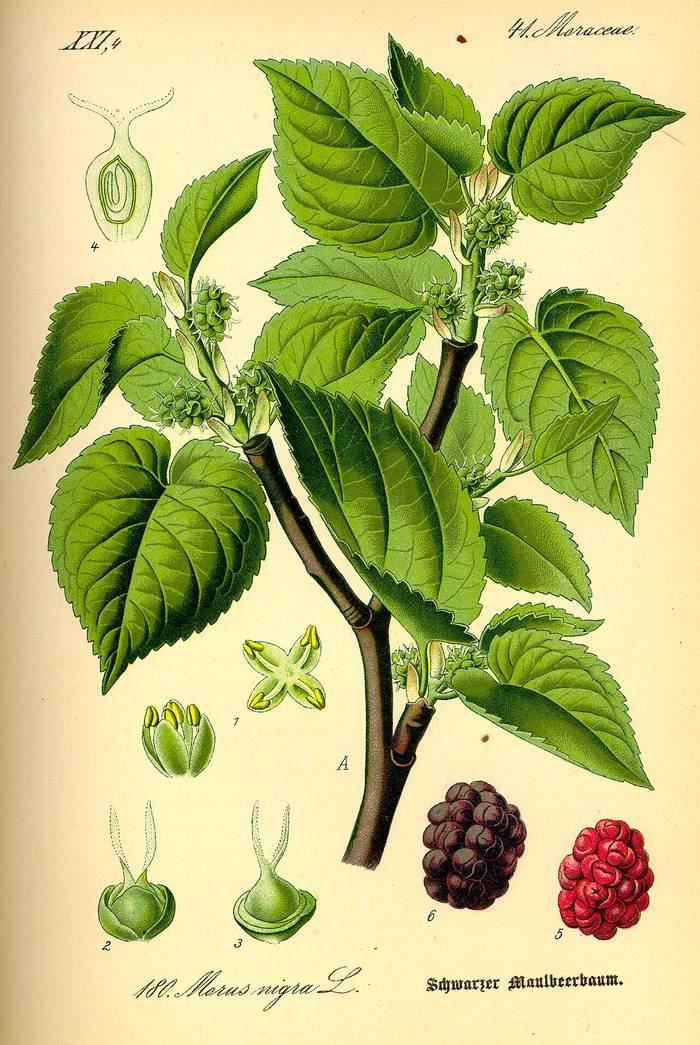
Black mulberry
Tree·Morus nigra
Part shade to full sun
Sun
Moist soil
Water
Well-drained soil
Drainage
Zones 5–9
Hardiness
Coverage · 130 fields
Growth and size11 fields
Height
1,000 cm · other sources: 1,200 cm“Morus nigra is a deciduous Tree growing to 10 m (32ft) by 15 m (49ft) at a medium rate.”Wikipedia“Morus nigra is a deciduous tree growing to 12 metres (39 feet) tall by 15 m (49 ft) broad.”
Spread
1,500 cm“Morus nigra is a deciduous Tree growing to 10 m (32ft) by 15 m (49ft) at a medium rate.”
Height at age
—
empty
Size after planting
4 yrs: 5 m tall, 2 m crown · 6 yrs: 3.5 m tall, 2 m crown · 22 yrs: 8 m tall, 5 m crown · 34 yrs: 10 m tall, 6 m crown · 66 yrs: 15 m tall, 11 m crown“Berlin tree register: 233 trees of this species measured with years since planting, height and crown diameter; median crown 11.0 m and height 15.0 m at 60–100 years after planting (19 trees).”Median of 233 measured trees in Berlin. Years count from planting nursery stock, so a small tree reaches each size later.
Spacing
900 cm (at least 600 cm)
AI estimate55 % agree
Growth rate
Medium“Morus nigra is a deciduous Tree growing to 10 m (32ft) by 15 m (49ft) at a medium rate.”
Habit
Spreading
AI estimate50 % agree
Root depth
Medium
AI estimate63 % agree
Forest garden layer
Lower tree layer
AI estimate90 % agree
Lifespan
~100 years
AI estimatenot measured yet
Roots6 fields
Root form
—
empty
Storage organ
—
empty
Lateral spread in cm
—
empty
Root depth in cm
—
empty
Mycorrhiza
—
empty
Light, water and soil9 fields
Sun
Full sun, light shade, part shade · best: full sun“Black mulberry prefers warm, moist, well-drained, light loamy soil in a sheltered, sunny position.”PFAF“It can grow in semi-shade (light woodland) or no shade.”
Hours of sun
6 h
AI estimatenot measured yet
Drought tolerant
—
empty
Tolerates waterlogging
—
empty
Soil type
Sand, loam, clay · best: loam“Prefers a warm moist but well-drained loamy soil in a sheltered sunny position.”PFAF“Suitable for: light (sandy), medium (loamy) and heavy (clay) soils and prefers well-drained soil.”
Drainage
Well drained“Suitable for: light (sandy), medium (loamy) and heavy (clay) soils and prefers well-drained soil.”
Compacted soil
Copes fairly well
AI estimatenot measured yet
Climate5 fields
Hardiness
Zone 5–9
AI estimatenot measured yet
Killing frost
-1 °C“Killing temp. early growth: -1”EcoCrop's figure is frost during early growth (spring frost on new shoots), not winter cold.
Growing temperature
10–38 °C · optimal 15–25 °C“Temperature absolute min: 10 · Temperature absolute max: 38 · Temperature optimal min: 15 · Temperature optimal max: 25”
Chill hours
400 h
AI estimatenot measured yet
Care (becomes tasks in Manage)5 fields
Pruning
After the previous stage · badly placed branches and dead wood“Any pruning should only be carried out in the winter when the plant is fully dormant because mulberries bleed badly when cut.”PFAF“Ideally prune only badly placed branches and dead wood.”
Pruning appears 2 times with different timing.
Pruning
January · lasts 30 days · new growth for fruit production · dead, diseased, or crossing branches
Pruning appears 2 times with different timing.
AI estimatenot measured yet
Feeding
March · lasts 30 days · a balanced granular fertiliser or well-rotted compost
AI estimatenot measured yet
Mulching
April · lasts 30 days
AI estimatenot measured yet
Watering
June · lasts 90 days
AI estimatenot measured yet
Through the year7 fields
Flowering
May · lasts 61 days“It is in flower from May to June, and the seeds ripen from August to September.”
Fruiting
August · 14 days after · lasts 46 days“The fruit is juicy and refreshing, though it must be used as soon as it is ripe (from mid-August to September) otherwise it will start to rot.”
PFAFpartly
Dying back
After the first frost“Plants are late coming into leaf and also lose their leaves at the first autumn frosts though the tree in leaf casts quite a dense shade.”
Leafing out
After the last frost
AI estimatenot measured yet
Dormant
After the first frost
AI estimatenot measured yet
First harvest
4–8 years after plantingTypical ~8 years; 4 = "half that time" for smaller varieties.
Edible parts and pollination5 fields
The fruit
Raw, cooked or used in preserves · May–August“Edible Parts: Fruit Shoots”PFAF“The fruit is juicy and refreshing, though it must be used as soon as it is ripe (from mid-August to September) otherwise it will start to rot.”PFAF“Fruit - raw, cooked or used in preserves.”PFAFpartly“Harvesting: Late spring to late summer.”
Pollination
Self-fertile · monoecious“Mulberry flowers are wind-pollinated and not particularly rich in nectar or pollen for attracting pollinators.”PFAF“Black mulberry is self-fertile.”PFAFpartly“The species is monoecious (individual flowers are either male or female, but both sexes can be found on the same plant).”
Pollinated by
Wind“Mulberry flowers are wind-pollinated and not particularly rich in nectar or pollen for attracting pollinators.”
Ecology6 fields
Attracts
Birds, mammals, insects, wildlife“Mulberries produce abundant fruit that provides food for birds, mammals, and insects.”PFAF“It is noted for attracting wildlife.”
Pests
Mulberry scale, mulberry borer
AI estimatenot measured yet
Diseases
Bacterial blight, powdery mildew
AI estimatenot measured yet
Takes up
Calcium, potassium
AI estimatenot measured yet
Fixes nitrogen
No
AI estimatenot measured yet
Mycorrhiza
Yes
AI estimatenot measured yet
Propagation and names4 fields
Methods
Seed, half-ripe wood cuttings, mature wood cuttings, layering“Sow the seed as soon as it is ripe if possible, otherwise in February in a cold frame.”PFAF“Cuttings of half-ripe wood, 7 - 10cm with a heel, July/August in a frame.”PFAF“Cuttings of mature wood of the current season's growth, 25 - 30cm with a heel of 2 year old wood, autumn or early spring in a cold frame or a shady bed outside.”PFAF“Layering in autumn.”
Difficulty
2 / 5
AI estimatenot measured yet
Seed
2 - 3 months cold stratification“The seed germinates best if given 2 - 3 months cold stratification.”
Not sorted yet72 fields
Fields the parser stores that this page has no row for yet. They show up here automatically, so nothing is hidden.
forage.DK.local_name
Sort morbær
AI estimatenot measured yet
forage.DK.prep_cautions
Best eaten straight from the tree, as the fruit is too soft to transport“The fruit is too soft and easily damaged to allow it to be transported to market and is, therefore, best eaten straight from the tree.”
forage.DK.edibility_basis
inferred
AI estimatenot measured yet
forage.DK.foraging_months.notes
Fruits ripen from mid-summer to early autumn.
AI estimatenot measured yet
forage.DK.foraging_months.year_round
false
AI estimatenot measured yet
forage.DK.habitat_affinity
woodland“Planting habitats include the woodland garden canopy, as a secondary woodland tree, sunny edges and dappled shade.”
forage.US.local_name
Black mulberry
AI estimatenot measured yet
forage.US.edible_parts
[{"part":"fruit","caution":"Must be used as soon as it is ripe, otherwise it rots","preparation":"Raw, cooked or used in preserves","season_months":[5,6,7,8]},{"part":"fruit","preparation":"Dried and ground into a pow…“Edible Parts: Fruit Shoots”PFAF“The fruit can also be dried and ground into a powder.”PFAF“The fruit is juicy and refreshing, though it must be used as soon as it is ripe (from mid-August to September) otherwise it will start to rot.”PFAF“Fruit - raw, cooked or used in preserves.”PFAFpartly“Harvesting: Late spring to late summer.”
forage.US.prep_cautions
Best eaten straight from the tree, as the fruit is too soft to transport“The fruit is too soft and easily damaged to allow it to be transported to market and is, therefore, best eaten straight from the tree.”
forage.US.edibility_basis
inferred
AI estimatenot measured yet
forage.US.foraging_months.notes
Fruits ripen from mid-summer to early autumn.
AI estimatenot measured yet
forage.US.foraging_months.year_round
false
AI estimatenot measured yet
forage.US.habitat_affinity
woodland“Planting habitats include the woodland garden canopy, as a secondary woodland tree, sunny edges and dappled shade.”
forage.TROPICAL.local_name
Black mulberry
AI estimatenot measured yet
forage.TROPICAL.edible_parts
[{"part":"fruit","caution":"Must be used as soon as it is ripe, otherwise it rots","preparation":"Raw, cooked or used in preserves","season_months":[5,6,7,8]},{"part":"fruit","preparation":"Dried and ground into a pow…“Edible Parts: Fruit Shoots”PFAF“The fruit can also be dried and ground into a powder.”PFAF“The fruit is juicy and refreshing, though it must be used as soon as it is ripe (from mid-August to September) otherwise it will start to rot.”PFAF“Fruit - raw, cooked or used in preserves.”PFAFpartly“Harvesting: Late spring to late summer.”
forage.TROPICAL.prep_cautions
Best eaten straight from the tree, as the fruit is too soft to transport“The fruit is too soft and easily damaged to allow it to be transported to market and is, therefore, best eaten straight from the tree.”
forage.TROPICAL.edibility_basis
inferred
AI estimatenot measured yet
forage.TROPICAL.foraging_months.notes
Fruits ripen from mid-summer to early autumn.
AI estimatenot measured yet
forage.TROPICAL.foraging_months.year_round
false
AI estimatenot measured yet
forage.TROPICAL.habitat_affinity
woodland“Planting habitats include the woodland garden canopy, as a secondary woodland tree, sunny edges and dappled shade.”
ornamental.basis
documented
AI estimatenot measured yet
ornamental.fragrance.source
none
AI estimate100 % agree
ornamental.confidence
high
AI estimatenot measured yet
ornamental.fall_interest
true
AI estimatenot measured yet
ornamental.flower_colour
insignificant
AI estimate67 % agree
ornamental.evidence_quote
Morus nigra, commonly known as black mulberry, produces small, inconspicuous flowers followed by dark purple, edible fruit. Its leaves are green, turning yellow-green in autumn, and the tree retains an interesting architectural form in winter with persistent fruit.
AI estimatenot measured yet
ornamental.foliage_colour
green
AI estimate82 % agree
ornamental.foliage_texture
medium
AI estimatenot measured yet
ornamental.winter_structure
persistent_fruit, architectural_skeleton
AI estimatenot measured yet
ornamental.autumn_foliage_colour
yellow_green
AI estimatenot measured yet
care_regime
routine
AI estimatenot measured yet
propagation.self_seeding
light
AI estimate20 % agree
propagation.division_season
late winter to early spring
AI estimatenot measured yet
propagation.establishment_years
15“The mulberry takes many years to settle down and produce good crops of fruit, about 15 years being the norm.”
size_at_age.v
1
AI estimatenot measured yet
size_at_age.basis
years_after_planting
AI estimatenot measured yet
sun_requirement.best
full_sun“Black mulberry prefers warm, moist, well-drained, light loamy soil in a sheltered, sunny position.”
forage_proposals.DK.edibility_tier.tier
choice
AI estimatenot measured yet
forage_proposals.DK.edibility_tier.confidence
high
AI estimatenot measured yet
forage_proposals.DK.edibility_tier.evidence_quote
The fruit of Morus nigra is highly prized for its sweet and tart flavor, often considered the best among mulberries for fresh eating and culinary uses.
AI estimatenot measured yet
forage_proposals.US.edibility_tier.tier
choice
AI estimatenot measured yet
forage_proposals.US.edibility_tier.confidence
high
AI estimatenot measured yet
forage_proposals.US.edibility_tier.evidence_quote
Black mulberry fruits are widely regarded as a choice edible, excellent for fresh consumption, jams, pies, and other desserts.
AI estimatenot measured yet
forage_proposals.TROPICAL.edibility_tier.tier
choice
AI estimatenot measured yet
forage_proposals.TROPICAL.edibility_tier.confidence
high
AI estimatenot measured yet
forage_proposals.TROPICAL.edibility_tier.evidence_quote
In regions where it grows, the fruit of Morus nigra is a highly sought-after edible, known for its rich flavor and versatility in cooking.
AI estimatenot measured yet
function_profile.biomass_return.confidence
medium
AI estimatenot measured yet
function_profile.nutrient_flows.consumes
[{"basis":"documented","demand":"moderate","nutrient":"nitrogen","confidence":"high"},{"basis":"documented","demand":"moderate","nutrient":"phosphorus","confidence":"high"},{"basis":"documented","demand":"high","nutri…
AI estimatenot measured yet
function_profile.nutrient_flows.provides
[{"basis":"inferred","nutrient":"calcium","mechanism":"biomass_return","confidence":"low"},{"basis":"inferred","nutrient":"potassium","mechanism":"biomass_return","confidence":"low"}]
AI estimatenot measured yet
function_profile.biotic_interactions
[{"taxa":["birds"],"basis":"documented","valence":"beneficial","relation":"attracts","confidence":"medium","evidence_quote":"Mulberries produce abundant fruit that provides food for birds, mammals, and insects.","orga…“Mulberries produce abundant fruit that provides food for birds, mammals, and insects.”PFAF“It is noted for attracting wildlife.”PFAF“Mulberry trees have rough bark that can shelter invertebrates.”PFAF“The dense foliage can serve as shelter, and the tree’s structure supports bird nesting and roosting.”
function_profile.aromatic_pest_effect.value
false“No – Mulberry trees do not have a strong aroma that would confuse or deter pests.”
function_profile.aromatic_pest_effect.confidence
high
AI estimatenot measured yet
function_profile.structural_interfaces.provides_shelter.basis
documented
AI estimatenot measured yet
function_profile.structural_interfaces.provides_shelter.kinds
shade“Mulberry trees can be used for shade, erosion control, and as a forage source for livestock.”
function_profile.structural_interfaces.provides_shelter.confidence
high
AI estimatenot measured yet
function_profile.structural_interfaces.provides_shelter.evidence_quote
Mulberry trees can be used for shade, erosion control, and as a forage source for livestock.
AI estimatenot measured yet
function_profile.structural_interfaces.requires_shelter.basis
inferred
AI estimatenot measured yet
function_profile.structural_interfaces.requires_shelter.kinds
wind“Prefers a warm moist but well-drained loamy soil in a sheltered sunny position.”
PFAFpartly
function_profile.structural_interfaces.requires_shelter.confidence
low
AI estimatenot measured yet
function_profile.structural_interfaces.requires_shelter.evidence_quote
Prefers a warm moist but well-drained loamy soil in a sheltered sunny position.
AI estimatenot measured yet
function_profile.structural_interfaces.provides_physical_support.form
trunk“Black mulberry is a good tree for growing grapes into.”
PFAFpartly
function_profile.structural_interfaces.provides_physical_support.basis
taxonomic
AI estimatenot measured yet
function_profile.structural_interfaces.provides_physical_support.confidence
high
AI estimatenot measured yet
function_profile.structural_interfaces.provides_physical_support.evidence_quote
Black mulberry is a good tree for growing grapes into.
AI estimatenot measured yet
climate_tolerance.photoperiod_response
day_neutral
AI estimatenot measured yet
soil_interactions.organic_matter_contribution
medium
AI estimatenot measured yet
component_metadata.growth_cycle
perennial
AI estimate100 % agree
resource_interfaces.inputs
[{"resource":"light","quantity_description":"semi-shade to full sun"},{"resource":"water","quantity_description":"moist soil"}]“It can grow in semi-shade (light woodland) or no shade.”PFAF“It prefers moist soil.”
resource_interfaces.outputs
[{"resource":"fruit","quantity_description":"edible fruit"},{"resource":"leaf_litter","quantity_description":"fallen leaves"},{"resource":"shade","quantity_description":"dense shade when in leaf"},{"resource":"habitat…“Fruit - raw, cooked or used in preserves.”PFAF“Plants are late coming into leaf and also lose their leaves at the first autumn frosts though the tree in leaf casts quite a dense shade.”PFAF“It is noted for attracting wildlife.”PFAF“Wood - used in joinery.”