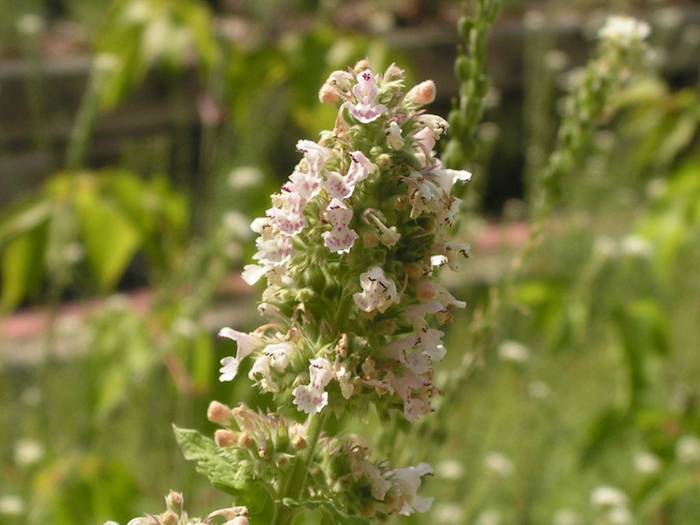
D. Gordon E. Robertson · CC BY-SA 3.0
Catnip
Plant·Nepeta cataria
Full sun
Sun
Dry to moist soil
Water
Well-drained soil
Drainage
Zones 3–9
Hardiness
Coverage · 114 fields
Growth and size10 fields
Height
100 cm · the source gives 30–100 cm“Catnip is a short-lived perennial herb that grows between 30–100 cm (12–39 in) tall.”PFAF“Nepeta cataria is a PERENNIAL growing to 1 m (3ft 3in) by 0.6 m (2ft).”
Height at age
—
empty
Spacing
45 cm (at least 30 cm)
AI estimate55 % agree
Growth rate
Fast“A fast-growing plant, the seedlings can reach flowering size in their first year.”
Habit
Mounding“Older plants tend to have more branches with particularly healthy plants becoming mound shaped.”
Lifespan
~5 years
AI estimatenot measured yet
Roots6 fields
Storage organ
None“It does not multiply vegetatively: it has no rhizomes, runners, suckers or offspring bulbs or tubers.”
Spreads
No“It does not multiply vegetatively: it has no rhizomes, runners, suckers or offspring bulbs or tubers.”
Lateral spread in cm
—
empty
Root depth in cm
—
empty
Mycorrhiza
—
empty
Light, water and soil9 fields
Sun
Full sun“Catnip is best grown in full sunlight and grows as a loosely branching, low perennial.”PFAF“It cannot grow in the shade.”
Hours of sun
6–12 h
AI estimatenot measured yet
Tolerates waterlogging
No“It requires good drainage to prevent it from becoming waterlogged.”
Soil type
pH
4.9–7.5 · best 5.5–6.5“Suitable pH: mildly acid, neutral and basic (mildly alkaline) soils and can grow in very alkaline soils.”
Drainage
Well drained“Suitable for: light (sandy) and medium (loamy) soils and prefers well-drained soil.”
Compacted soil
Copes fairly well
AI estimatenot measured yet
Climate5 fields
Hardiness
Zone 3–9
AI estimatenot measured yet
Killing frost
0 °C“Killing temp. early growth: 0”PFAFpartly“Plants are hardy to about -25°c.”EcoCrop's figure is frost during early growth (spring frost on new shoots), not winter cold.
Growing temperature
4–26 °C · optimal 7–19 °C“Temperature absolute min: 4 · Temperature absolute max: 26 · Temperature optimal min: 7 · Temperature optimal max: 19”
Chill hours
0 h
AI estimatenot measured yet
Native range
AD, AF, AL, AM, AZ, BA, BE, BG, BY, CH, CN, ES, FR, GE, GI, GR, HR, IN, IQ, IR, IT, JP, KG, KP, KR, KZ, LB, MA, MC, MD, ME, MK, MT, NP, PK, PT, RO, RS, RU, SE, SI, SM, SY, TJ, TM, TR, UZ, VA, XK
Care (becomes tasks in Manage)6 fields
Pruning
After the previous stage“If the plants are cut back hard when they are flowering a second crop of leaves will be produced.”
Dividing
After the last frost“Division in spring or autumn.”
Dividing appears 2 times with different timing.
Dividing
After the first frost“Division in spring or autumn.”
Dividing appears 2 times with different timing.
Sowing
After the previous stage“Seed - best sown as soon as it is ripe in a cold frame in the autumn.”
Pruning
March · lasts 14 days · old growth
AI estimatenot measured yet
Watering
After rain · lasts 180 days
AI estimatenot measured yet
Through the year5 fields
Flowering
July · lasts 153 days“It is in flower from July to November, and the seeds ripen from September to October.”
Fruiting
September · lasts 61 days“It is in flower from July to November, and the seeds ripen from September to October.”
Leafing out
After the last frost · Above 10 °C · lasts 14 days
AI estimatenot measured yet
Dying back
After the first frost · lasts 30 days
AI estimatenot measured yet
Dormant
After the first frost · 14 days after · lasts 150 days
AI estimatenot measured yet
Edible parts and pollination3 fields
The leaves
Pollination
Self-fertile · hermaphrodite“The species is hermaphrodite (has both male and female organs) and is pollinated by Bees.”
Pollinated by
Bees“The species is hermaphrodite (has both male and female organs) and is pollinated by Bees.”
Ecology6 fields
Attracts
Bees, butterflies, cats
AI estimatenot measured yet
Pests
—
empty
Diseases
—
empty
Takes up
Potassium, calcium, magnesium
AI estimatenot measured yet
Fixes nitrogen
No
AI estimatenot measured yet
Mycorrhiza
No
AI estimatenot measured yet
Propagation and names4 fields
Methods
Difficulty
1 / 5
AI estimatenot measured yet
Seed
cold_moist
AI estimatenot measured yet
Not sorted yet60 fields
Fields the parser stores that this page has no row for yet. They show up here automatically, so nothing is hidden.
forage.DK.local_name
Kattenmynte
AI estimatenot measured yet
forage.DK.prep_cautions
Catnip has diuretic properties and may increase amount and frequency of urination., The tea should be infused in a closed container in order to preserve the essential oils, boiling is said to spoil it., Care if using and driving or using machines.“Catnip has diuretic properties and may increase amount and frequency of urination.”PFAF“The tea should be infused in a closed container in order to preserve the essential oils, boiling is said to spoil it.”PFAF“Care if using and driving or using machines .”
forage.DK.edibility_basis
inferred
AI estimatenot measured yet
forage.DK.foraging_months.notes
Best harvested before flowering for optimal flavor.“It is in flower from July to November, and the seeds ripen from September to October.”
PFAFpartly
forage.DK.foraging_months.months
5, 6, 7, 8, 9
AI estimatenot measured yet
forage.DK.foraging_months.year_round
false
AI estimatenot measured yet
forage.DK.habitat_affinity
verge, riverbank, hedgerow, disturbed_ground“Roadsides and near streams.”PFAF“Hedgerows, borders of fields, dry banks and waste ground, especially on calcareous and gravelly soils.”
forage.US.local_name
Catnip
AI estimatenot measured yet
forage.US.edible_parts
[{"part":"leaves","caution":"Women with inflammatory diseases of the pelvis or are pregnant should not use.","preparation":"young leaves raw in salads, or fresh or dried to make an aromatic herb tea"}]“Edible Parts: Leaves”PFAF“Women with inflammatory diseases of the pelvis or are pregnant should not use.”PFAF“Young leaves - raw. A mint-like flavour, they make an aromatic flavouring in salads[7, K].”
forage.US.prep_cautions
Catnip has diuretic properties and may increase amount and frequency of urination., The tea should be infused in a closed container in order to preserve the essential oils, boiling is said to spoil it., Care if using and driving or using machines.“Catnip has diuretic properties and may increase amount and frequency of urination.”PFAF“The tea should be infused in a closed container in order to preserve the essential oils, boiling is said to spoil it.”PFAF“Care if using and driving or using machines .”
forage.US.edibility_basis
inferred
AI estimatenot measured yet
forage.US.foraging_months.notes
Best harvested before flowering for optimal flavor.“It is in flower from July to November, and the seeds ripen from September to October.”
PFAFpartly
forage.US.foraging_months.months
5, 6, 7, 8, 9
AI estimatenot measured yet
forage.US.foraging_months.year_round
false
AI estimatenot measured yet
forage.US.habitat_affinity
verge, riverbank, hedgerow, disturbed_ground“Roadsides and near streams.”PFAF“Hedgerows, borders of fields, dry banks and waste ground, especially on calcareous and gravelly soils.”
forage.TROPICAL.local_name
Catnip
AI estimatenot measured yet
forage.TROPICAL.edible_parts
[{"part":"leaves","caution":null,"preparation":"tea, culinary herb","season_months":[1,2,3,4,5,6,7,8,9,10,11,12]},{"part":"flowers","caution":null,"preparation":"tea, garnish","season_months":[1,2,3,4,5,6,7,8,9,10,11,…
AI estimatenot measured yet
forage.TROPICAL.prep_cautions
Can cause drowsiness in some individuals.
AI estimatenot measured yet
forage.TROPICAL.edibility_basis
inferred
AI estimatenot measured yet
forage.TROPICAL.foraging_months.notes
May grow year-round in suitable tropical climates, but growth may be less vigorous than in temperate zones.
AI estimatenot measured yet
forage.TROPICAL.foraging_months.year_round
true
AI estimatenot measured yet
forage.TROPICAL.habitat_affinity
disturbed_ground
AI estimatenot measured yet
ornamental.basis
documented
AI estimatenot measured yet
ornamental.fragrance.source
flower“The flowers themselves are somewhat small and inconspicuous, but quite fragrant.”
ornamental.fragrance.intensity
moderate“The flowers themselves are somewhat small and inconspicuous, but quite fragrant.”
ornamental.confidence
high
AI estimatenot measured yet
ornamental.fall_interest
false“It is in flower from July to November, and the seeds ripen from September to October.”
PFAFpartly
ornamental.flower_colour
white, pink“The petals are off-white to pink and usually dotted with purple-pink spots.”
ornamental.evidence_quote
Catnip (Nepeta cataria) is known for its grey-green foliage and small white to purplish flowers. It does not typically display significant autumn foliage color. The foliage has a strong, distinctive fragrance.
AI estimatenot measured yet
ornamental.foliage_colour
grey_green, silver“grayish canescent leaves”Wikipedia“The leaves are canescent in appearance, white in color due to being covered in fine hairs, especially so on the lower side of the leaves.”
ornamental.foliage_texture
medium
AI estimatenot measured yet
ornamental.winter_structure
none
AI estimatenot measured yet
ornamental.autumn_foliage_colour
none
AI estimatenot measured yet
care_regime
light
AI estimatenot measured yet
propagation.self_seeding
moderate
AI estimate20 % agree
propagation.establishment_years
1“A fast-growing plant, the seedlings can reach flowering size in their first year.”
sun_requirement.best
full_sun“Catnip is best grown in full sunlight and grows as a loosely branching, low perennial.”
forage_proposals.DK.edibility_tier.tier
edible
AI estimatenot measured yet
forage_proposals.DK.edibility_tier.confidence
high
AI estimatenot measured yet
forage_proposals.DK.edibility_tier.evidence_quote
Nepeta cataria leaves and young shoots are commonly used in herbal teas and as a culinary herb. It is generally considered safe for consumption in moderate amounts.
AI estimatenot measured yet
forage_proposals.US.edibility_tier.tier
edible
AI estimatenot measured yet
forage_proposals.US.edibility_tier.confidence
high
AI estimatenot measured yet
forage_proposals.US.edibility_tier.evidence_quote
Nepeta cataria leaves and young shoots are commonly used in herbal teas and as a culinary herb. It is generally considered safe for consumption in moderate amounts.
AI estimatenot measured yet
forage_proposals.TROPICAL.edibility_tier.confidence
low
AI estimatenot measured yet
function_profile.biomass_return.confidence
high
AI estimatenot measured yet
function_profile.nutrient_flows.consumes
[{"basis":"inferred","demand":"moderate","nutrient":"nitrogen","confidence":"medium"},{"basis":"inferred","demand":"low","nutrient":"phosphorus","confidence":"medium"},{"basis":"inferred","demand":"moderate","nutrient…
AI estimatenot measured yet
function_profile.nutrient_flows.provides
[{"basis":"documented","nutrient":"potassium","mechanism":"biomass_return","confidence":"high"},{"basis":"documented","nutrient":"calcium","mechanism":"biomass_return","confidence":"high"},{"basis":"documented","nutri…
AI estimatenot measured yet
function_profile.biotic_interactions
[{"taxa":["bees","butterflies"],"basis":"documented","valence":"beneficial","relation":"attracts","confidence":"high","evidence_quote":"The species is hermaphrodite (has both male and female organs) and is pollinated …“The species is hermaphrodite (has both male and female organs) and is pollinated by Bees.”Wikipedia“The compound iridodial, an iridoid extracted from catnip oil, has been found to attract lacewings that eat aphids and mites.”PFAF“It is noted for attracting wildlife.”PFAF“Catmint emits a scent that is irresistible to many cats, who will then avidly attack the plant.”PFAF“The plant is said to deter insects such as ants and flea beetles as well as rats and mice.”PFAF“The flowers are very attractive to bees.”Wikipedia“It can be a repellent for certain insects, including aphids and squash bugs.”PFAF“A strong infusion can be used to repel fleas from carpets or the fur of animals.”Wikipedia“Nepetalactone is a mosquito and fly repellent.”Wikipedia“Oil isolated from catnip by steam distillation is a repellent against insects, in particular mosquitoes, cockroaches, and termites.”PFAFpartly“It is said to repel various cabbage pests, aphis (including peach aphis), flea beetles, cucumber beetles, squash bugs and ants from plants they grow near to.”Wikipediapartly“It is also grown for its attractant qualities to house cats and butterflies.”
function_profile.aromatic_pest_effect.value
true“This chemical acts as a natural insect repellent and induces playful, euphoric behavior in cats.”
Wikipediapartly
function_profile.aromatic_pest_effect.confidence
high
AI estimatenot measured yet
function_profile.structural_interfaces.provides_shelter.basis
inferred
AI estimatenot measured yet
function_profile.structural_interfaces.provides_shelter.kinds
shade
AI estimatenot measured yet
function_profile.structural_interfaces.provides_shelter.confidence
low
AI estimatenot measured yet
climate_tolerance.photoperiod_response
long_day
AI estimatenot measured yet
soil_interactions.organic_matter_contribution
medium
AI estimatenot measured yet
component_metadata.growth_cycle
perennial“Nepeta cataria is a PERENNIAL growing to 1 m (3ft 3in) by 0.6 m (2ft).”
resource_interfaces.inputs
[{"resource":"light","quantity_description":"full sun to partial shade"},{"resource":"water","quantity_description":"moderate"}]“Catnip is best grown in full sunlight and grows as a loosely branching, low perennial.”PFAFpartly“It prefers dry or moist soil.”
Wikipediapartly
resource_interfaces.outputs
[{"resource":"pollinator_services","quantity_description":"flowers very attractive to bees"},{"resource":"aromatic_compounds","quantity_description":"nepetalactone-rich essential oil"},{"resource":"seeds","quantity_de…“The flowers are very attractive to bees.”Wikipedia“The plant terpenoid nepetalactone is the main chemical constituent of the essential oil of Nepeta cataria.”PFAF“It is in flower from July to November, and the seeds ripen from September to October.”PFAF“It is noted for attracting wildlife.”
biotic_relationships.repels
aphids, squash bugs, flea beetles, ants, rodents
AI estimatenot measured yet