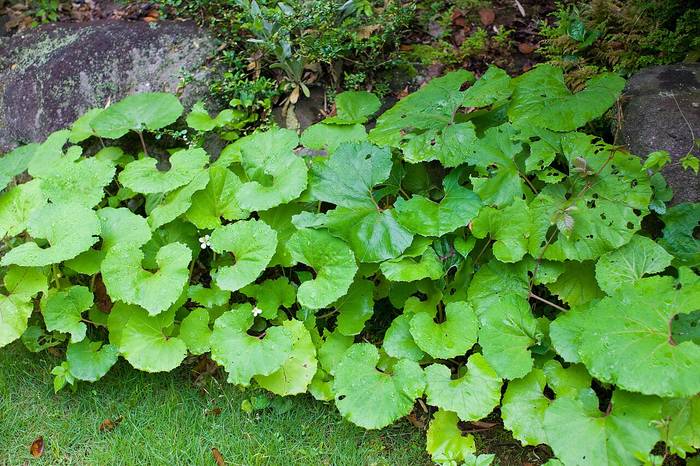
Joi Ito · CC BY 2.0
Fuki
Plant·Petasites japonicus
Shade to full sun
Sun
Moist to wet soil
Water
Not recorded
Drainage
Zones 4–9
Hardiness
Coverage · 111 fields
No obvious inconsistencies found.
Growth and size10 fields
Height
60 cm“Petasites japonicus is a PERENNIAL growing to 0.6 m (2ft) by 1.5 m (5ft in) at a fast rate.”
Spread
150 cm“Petasites japonicus is a PERENNIAL growing to 0.6 m (2ft) by 1.5 m (5ft in) at a fast rate.”
Height at age
—
empty
Spacing
90 cm (at least 60 cm)
AI estimate55 % agree
Growth rate
Fast“Petasites japonicus is a PERENNIAL growing to 0.6 m (2ft) by 1.5 m (5ft in) at a fast rate.”
Habit
Spreading“The plant growth habit is a runner spreading indefinitely by rhizomes or stolons [1-2].”
Root depth
Shallow
AI estimate63 % agree
Forest garden layer
Herb layer
AI estimate90 % agree
Lifespan
~10 years
AI estimatenot measured yet
Roots6 fields
Root form
—
empty
Storage organ
Rhizome“The root pattern is rhizomatous with underground stems sending roots and shoots along their length [1-2].”
Spreads
By rhizomes“The plant growth habit is a runner spreading indefinitely by rhizomes or stolons [1-2].”
PFAFpartly
Lateral spread in cm
—
empty
Root depth in cm
—
empty
Mycorrhiza
—
empty
Light, water and soil9 fields
Sun
Shade, part shade, light shade, full sun · best: part shade“It can grow in full shade (deep woodland) semi-shade (light woodland) or no shade.”
Hours of sun
3–6 h
AI estimatenot measured yet
Drought tolerant
—
empty
Tolerates waterlogging
—
empty
Compacted soil
Copes fairly well
AI estimatenot measured yet
Climate5 fields
Hardiness
Zone 4–9
AI estimatenot measured yet
Killing frost
-25 °C
AI estimatenot measured yet
Growing temperature
5–25 °C · optimal 10–20 °C
AI estimatenot measured yet
Chill hours
0 h
AI estimatenot measured yet
Care (becomes tasks in Manage)2 fields
Watering
July · lasts 60 days
AI estimatenot measured yet
Mulching
April · lasts 30 days
AI estimatenot measured yet
Through the year5 fields
Leafing out
After the last frost
AI estimatenot measured yet
Dormant
After the first frost
AI estimatenot measured yet
Dying back
After the first frost · lasts 30 days
AI estimatenot measured yet
Edible parts and pollination6 fields
Leaf stalks
Cooked and used like rhubarb“Like other Petasites species, fuki contains pyrrolizidine alkaloids (PAs) which have been associated with cumulative damage to the liver and tumor formation.”PFAF“Leaf stalks - cooked and used like rhubarb.”
Flower buds
Cooked or used as a flavouring“Like other Petasites species, fuki contains pyrrolizidine alkaloids (PAs) which have been associated with cumulative damage to the liver and tumor formation.”PFAF“Flower buds cooked or used as a flavouring.”
Young flowering stems
Eaten cooked“Like other Petasites species, fuki contains pyrrolizidine alkaloids (PAs) which have been associated with cumulative damage to the liver and tumor formation.”PFAF“The young flowering stems can be eaten cooked.”
The young shoots
Fried as tempura“Like other Petasites species, fuki contains pyrrolizidine alkaloids (PAs) which have been associated with cumulative damage to the liver and tumor formation.”Wikipedia“The bulb-like shoots are also picked fresh and fried as tempura.”
Pollination
Needs a partner · a male plant · dioecious“The species is dioecious (individual flowers are either male or female, but only one sex is to be found on any one plant so both male and female plants must be grown if seed is required).”PFAF“and is pollinated by Insects.”PFAF“The plant is not self-fertile.”PFAF“Dioecious, male and female plants must be grown if seed is required.”
Ecology6 fields
Pests
Slugs, snails
AI estimatenot measured yet
Diseases
—
empty
Takes up
Potassium, calcium
AI estimatenot measured yet
Fixes nitrogen
No
AI estimatenot measured yet
Mycorrhiza
No
AI estimatenot measured yet
Propagation and names4 fields
Methods
Seed, division“Seed - we have no information on this species but suggest sowing the seed in a cold frame as soon as it is ripe or in early spring.”PFAF“Division succeeds at almost any time of the year.”
Difficulty
1 / 5“Very easy, larger divisions can be planted out direct into their permanent positions.”
Seed
cold stratification recommended
AI estimatenot measured yet
Not sorted yet58 fields
Fields the parser stores that this page has no row for yet. They show up here automatically, so nothing is hidden.
forage.DK.local_name
Fuki
AI estimatenot measured yet
forage.DK.warnings_da
Spis den ikke jævnligt.
AI estimatenot measured yet
forage.DK.warnings_en
Don't eat it regularly.
AI estimatenot measured yet
forage.DK.prep_cautions
Pre-treat with ash or baking soda and soak in water to remove harshness (aku-nuki), Proper extraction can reduce the hepatotoxic alkaloids below detection limits“The traditional preparation method for this vegetable involves pre-treating with ash or baking soda and soaking in water to remove harshness (astringency), which is a technique known as aku-nuki (灰汁抜き; literally "harshness removal").”Wikipedia“The concentration of hepatotoxic PAs can be reduced to a concentration below detection limits with a proper extraction process.”
forage.DK.edibility_basis
inferred
AI estimatenot measured yet
forage.DK.foraging_months.notes
Early spring for flower buds and young leaf stalks.
AI estimatenot measured yet
forage.DK.foraging_months.months
2, 3, 4, 5
AI estimatenot measured yet
forage.DK.foraging_months.year_round
false
AI estimatenot measured yet
forage.DK.habitat_affinity
riverbank, woodland, disturbed_ground“Moist woods and thickets.”
PFAFpartly
forage.US.local_name
Fuki butterbur
AI estimatenot measured yet
forage.US.edible_parts
[{"part":"Leaf stalks","caution":"Contains pyrrolizidine alkaloids, linked to cumulative liver damage","preparation":"cooked and used like rhubarb"},{"part":"Flower buds","caution":"Contains pyrrolizidine alkaloids, l…“Like other Petasites species, fuki contains pyrrolizidine alkaloids (PAs) which have been associated with cumulative damage to the liver and tumor formation.”PFAF“Leaf stalks - cooked and used like rhubarb.”PFAF“Flower buds cooked or used as a flavouring.”PFAF“The young flowering stems can be eaten cooked.”Wikipedia“The bulb-like shoots are also picked fresh and fried as tempura.”
forage.US.prep_cautions
Pre-treat with ash or baking soda and soak in water to remove harshness (aku-nuki), Proper extraction can reduce the hepatotoxic alkaloids below detection limits“The traditional preparation method for this vegetable involves pre-treating with ash or baking soda and soaking in water to remove harshness (astringency), which is a technique known as aku-nuki (灰汁抜き; literally "harshness removal").”Wikipedia“The concentration of hepatotoxic PAs can be reduced to a concentration below detection limits with a proper extraction process.”
forage.US.edibility_basis
inferred
AI estimatenot measured yet
forage.US.foraging_months.notes
Early spring for flower buds and young leaf stalks.
AI estimatenot measured yet
forage.US.foraging_months.months
2, 3, 4, 5
AI estimatenot measured yet
forage.US.foraging_months.year_round
false
AI estimatenot measured yet
forage.US.habitat_affinity
riverbank, woodland, disturbed_ground“Moist woods and thickets.”
PFAFpartly
forage.TROPICAL.edibility_basis
inferred
AI estimatenot measured yet
forage.TROPICAL.foraging_months.year_round
false
AI estimatenot measured yet
ornamental.basis
documented
AI estimatenot measured yet
ornamental.fragrance.source
none
AI estimate100 % agree
ornamental.confidence
high
AI estimatenot measured yet
ornamental.evidence_quote
Petasites japonicus, also known as Fuki or Giant Butterbur, is a large-leaved herbaceous perennial. It produces creamy-white flowers in early spring before the leaves emerge. The foliage is green throughout the growing season and does not typically display significant autumn color.
AI estimatenot measured yet
ornamental.foliage_colour
green
AI estimate82 % agree
ornamental.foliage_texture
bold
AI estimatenot measured yet
ornamental.winter_structure
none
AI estimatenot measured yet
ornamental.autumn_foliage_colour
none
AI estimatenot measured yet
care_regime
none
AI estimatenot measured yet
propagation.self_seeding
moderate
AI estimate20 % agree
propagation.division_season
almost any time of the year“Division succeeds at almost any time of the year.”
propagation.establishment_years
1
AI estimate40 % agree
spatial_profile.canopy_density
dense
AI estimatenot measured yet
forage_proposals.DK.edibility_tier.tier
caution“Like other Petasites species, fuki contains pyrrolizidine alkaloids (PAs) which have been associated with cumulative damage to the liver and tumor formation.”
forage_proposals.DK.edibility_tier.confidence
medium“Like other Petasites species, fuki contains pyrrolizidine alkaloids (PAs) which have been associated with cumulative damage to the liver and tumor formation.”
forage_proposals.DK.edibility_tier.evidence_quote
Like other Petasites species, fuki contains pyrrolizidine alkaloids (PAs) which have been associated with cumulative damage to the liver and tumor formation.“Like other Petasites species, fuki contains pyrrolizidine alkaloids (PAs) which have been associated with cumulative damage to the liver and tumor formation.”
forage_proposals.US.edibility_tier.tier
caution“Like other Petasites species, fuki contains pyrrolizidine alkaloids (PAs) which have been associated with cumulative damage to the liver and tumor formation.”
forage_proposals.US.edibility_tier.confidence
medium“Like other Petasites species, fuki contains pyrrolizidine alkaloids (PAs) which have been associated with cumulative damage to the liver and tumor formation.”
forage_proposals.US.edibility_tier.evidence_quote
Like other Petasites species, fuki contains pyrrolizidine alkaloids (PAs) which have been associated with cumulative damage to the liver and tumor formation.“Like other Petasites species, fuki contains pyrrolizidine alkaloids (PAs) which have been associated with cumulative damage to the liver and tumor formation.”
forage_proposals.TROPICAL.edibility_tier.confidence
low
AI estimatenot measured yet
function_profile.biomass_return.confidence
high
AI estimatenot measured yet
function_profile.nutrient_flows.consumes
[{"basis":"inferred","demand":"moderate","nutrient":"nitrogen","confidence":"medium"},{"basis":"inferred","demand":"moderate","nutrient":"potassium","confidence":"medium"}]
AI estimatenot measured yet
function_profile.nutrient_flows.provides
[{"basis":"inferred","nutrient":"potassium","mechanism":"biomass_return","confidence":"medium"},{"basis":"inferred","nutrient":"calcium","mechanism":"biomass_return","confidence":"medium"}]
AI estimatenot measured yet
function_profile.biotic_interactions
[{"taxa":["insects"],"basis":"documented","valence":"beneficial","relation":"attracts","confidence":"medium","evidence_quote":"and is pollinated by Insects","organism_group":"pollinator","ecological_function":"pollina…“and is pollinated by Insects”
function_profile.aromatic_pest_effect.value
false
AI estimate80 % agree
function_profile.aromatic_pest_effect.confidence
low
AI estimatenot measured yet
function_profile.structural_interfaces.provides_shelter.basis
documented
AI estimatenot measured yet
function_profile.structural_interfaces.provides_shelter.kinds
shade
AI estimatenot measured yet
function_profile.structural_interfaces.provides_shelter.confidence
high
AI estimatenot measured yet
function_profile.structural_interfaces.requires_shelter.basis
documented“Requires a moist shady position.”
function_profile.structural_interfaces.requires_shelter.kinds
shade“Requires a moist shady position.”
function_profile.structural_interfaces.requires_shelter.confidence
medium“Requires a moist shady position.”
function_profile.structural_interfaces.requires_shelter.evidence_quote
Requires a moist shady position.“Requires a moist shady position.”
climate_tolerance.photoperiod_response
day_neutral
AI estimatenot measured yet
soil_interactions.organic_matter_contribution
high
AI estimatenot measured yet
component_metadata.growth_cycle
perennial“Petasites japonicus is a PERENNIAL growing to 0.6 m (2ft) by 1.5 m (5ft in) at a fast rate.”
resource_interfaces.inputs
[{"resource":"water","quantity_description":"moist or wet soil"},{"resource":"shade","quantity_description":"moist shady position"},{"resource":"light","quantity_description":"full shade to no shade"},{"resource":"pol…“It prefers moist or wet soil.”PFAF“Requires a moist shady position.”PFAF“It can grow in full shade (deep woodland) semi-shade (light woodland) or no shade.”PFAFpartly“and is pollinated by Insects”
resource_interfaces.outputs
[{"resource":"ground_cover","quantity_description":"ground cover in damp shady places"}]“Plants can be grown as ground cover in damp shady places.”