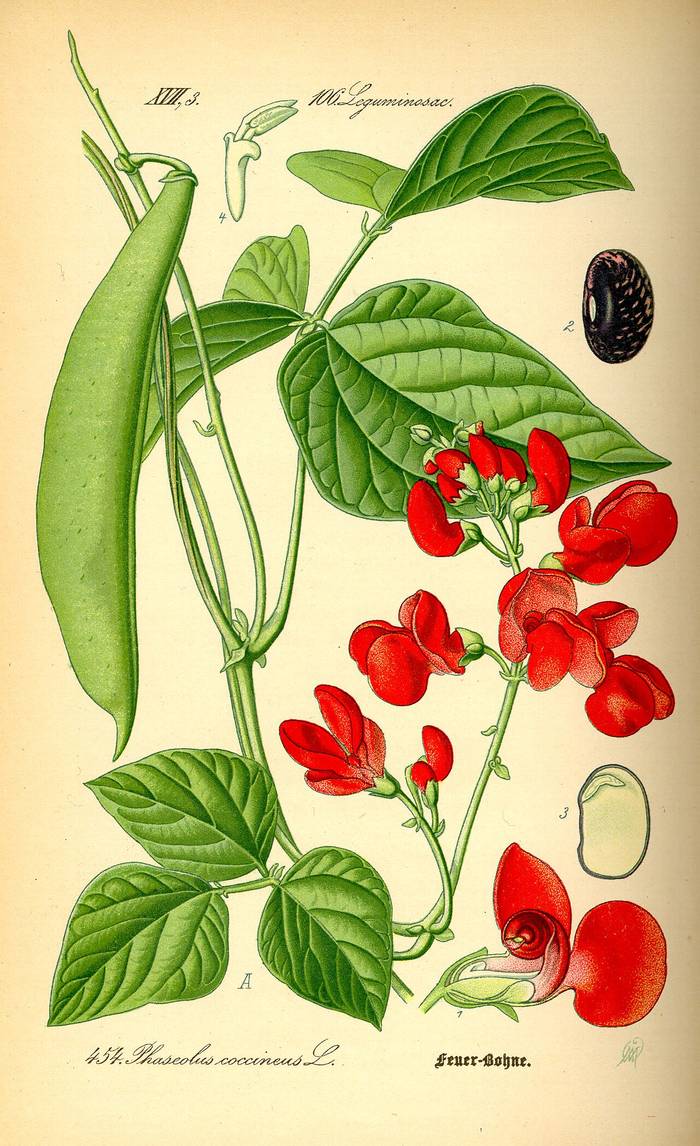
Runner bean
Plant·Phaseolus coccineus
Full sun
Sun
Moist soil
Water
Well-drained soil
Drainage
Zones 7–11
Hardiness
Coverage · 127 fields
Growth and size10 fields
Plant type
Plant
AI estimate100 % agree
Height
300 cm“Phaseolus coccineus is a ANNUAL/PERENNIAL growing to 3 m (9ft) by 1 m (3ft 3in) at a fast rate.”
Spread
100 cm“Phaseolus coccineus is a ANNUAL/PERENNIAL growing to 3 m (9ft) by 1 m (3ft 3in) at a fast rate.”
Height at age
—
empty
Spacing
15 cm (at least 10 cm)
AI estimate55 % agree
Growth rate
Fast“Phaseolus coccineus is a ANNUAL/PERENNIAL growing to 3 m (9ft) by 1 m (3ft 3in) at a fast rate.”
Root depth
Medium
AI estimate63 % agree
Forest garden layer
Climber“Most varieties are climbing plants but some dwarf forms have been developed.”
Lifespan
~1 years
AI estimatenot measured yet
Roots6 fields
Root form
—
empty
Storage organ
Root tuber“the plant is a perennial vine with tuberous roots (though it is frequently treated as an annual in colder climates)”
Wikipediapartly
Spreads
—
empty
Lateral spread in cm
—
empty
Root depth in cm
—
empty
Mycorrhiza
Arbuscular (AM)
AI estimatenot measured yet
Light, water and soil9 fields
Sun
Full sun“It cannot grow in the shade.”PFAFpartly“Requires a warm sheltered sunny position in a rich well-drained soil with plenty of moisture in the growing season.”
Hours of sun
6–8 h
AI estimatenot measured yet
Water
Moist · best: moist · Medium · 2–4 l/day“It prefers moist soil.”PFAFpartly“Requires a warm sheltered sunny position in a rich well-drained soil with plenty of moisture in the growing season.”
Drought tolerant
—
empty
Soil type
pH
5–8.2 · best 6–7“Prefers a pH in the range 6 to 7.”PFAF“Suitable pH: neutral and basic (mildly alkaline) soils.”
Drainage
Well drained“Suitable for: light (sandy), medium (loamy) and heavy (clay) soils and prefers well-drained soil.”
Compacted soil
Copes badly
AI estimatenot measured yet
Climate5 fields
Hardiness
Zone 7–11“As an annual suites hardiness zones 1-12.”
Killing frost (-1 °C) doesn't fit hardiness zone 7, which survives far lower temperatures.
PFAFpartly
Killing frost
-1 °C
Killing frost (-1 °C) doesn't fit hardiness zone 7, which survives far lower temperatures.
AI estimatenot measured yet
Growing temperature
5–30 °C · optimal 12–26 °C“Temperature absolute min: 5 · Temperature absolute max: 30 · Temperature optimal min: 12 · Temperature optimal max: 26”
Chill hours
0 h
AI estimatenot measured yet
Care (becomes tasks in Manage)12 fields
Protection
After the previous stage · slugs“The plants might need some protection from slugs since these creatures adore the young shoots in the spring[K].”
Mulching
November“The perennial roots will survive mild winters outdoors in many parts of the country, especially if given a protective mulch in late autumn, they will then give an earlier but lighter crop the following year.”
Mulching appears 2 times with different timing.
PFAFpartly
Protection
November · frost“They can also be dug up in late autumn and stored like dahlias in a cool but frost free place over winter and replanted in the following spring.”
Planting out
After the last frost“When they are large enough to handle, prick the seedlings out into individual pots and plant them out after the last expected frosts.”
Starting indoors
April“Pre-soak the seed for 12 hours in warm water and sow in mid spring in a greenhouse.”
Starting indoors appears 2 times with different timing.
PFAFpartly
Sowing
May“The seed can also be sown in situ in late spring though it may not ripen its seed in a cool summer.”
Sowing appears 2 times with different timing.
PFAFpartly
Sowing
After the last frost · 14 days after · lasts 14 days
Sowing appears 2 times with different timing.
AI estimatenot measured yet
Starting indoors
After the last frost · -28 days after · lasts 14 days
Starting indoors appears 2 times with different timing.
AI estimatenot measured yet
Hardening off
After the last frost · -7 days after · lasts 7 days
AI estimatenot measured yet
Support
After the previous stage · 14 days after · lasts 7 days
AI estimatenot measured yet
Watering
July · lasts 60 days
AI estimatenot measured yet
Mulching
After the previous stage · 21 days after · lasts 14 days
Mulching appears 2 times with different timing.
AI estimatenot measured yet
Through the year5 fields
Leafing out
May · lasts 184 days“It is in leaf from May to October, in flower from July to September, and the seeds ripen from August to October.”
Flowering
July · Set by day length · lasts 92 days“It is in leaf from May to October, in flower from July to September, and the seeds ripen from August to October.”PFAF“Plants flower under long day conditions, which is ideal for temperate regions.”
Fruiting
August · lasts 92 days“It is in leaf from May to October, in flower from July to September, and the seeds ripen from August to October.”
Dying back
October“It is in leaf from May to October, in flower from July to September, and the seeds ripen from August to October.”
Harvest
After the previous stage · 14 days after · lasts 60 days
AI estimatenot measured yet
Edible parts and pollination5 fields
The pods
Cooked · July–September
AI estimatenot measured yet
The seeds
Cooked · August–October
AI estimatenot measured yet
The flowers
Raw · July–September
AI estimatenot measured yet
Pollination
Pollinated by
Bees“The species is hermaphrodite (has both male and female organs) and is pollinated by Bees.”
Ecology5 fields
Attracts
Bees, hummingbirds
AI estimatenot measured yet
Pests
Aphids, spider_mites, bean_beetles
AI estimatenot measured yet
Diseases
Bean_rust, powdery_mildew
AI estimatenot measured yet
Takes up
—
empty
Propagation and names4 fields
Methods
Seed“Pre-soak the seed for 12 hours in warm water and sow in mid spring in a greenhouse.”
Difficulty
1 / 5
AI estimatenot measured yet
Seed
—
empty
Not sorted yet66 fields
Fields the parser stores that this page has no row for yet. They show up here automatically, so nothing is hidden.
forage.DK.local_name
Pralbønne
AI estimatenot measured yet
forage.DK.warnings_da
Kog bønnerne, før du spiser dem.
AI estimatenot measured yet
forage.DK.warnings_en
Cook the beans before you eat them.
AI estimatenot measured yet
forage.DK.prep_cautions
Raw beans contain phytohaemagglutinin and must be cooked thoroughly.
AI estimatenot measured yet
forage.DK.edibility_basis
inferred
AI estimatenot measured yet
forage.DK.foraging_months.notes
Pods and flowers are available earlier in the season, seeds and roots later.
AI estimatenot measured yet
forage.DK.foraging_months.months
7, 8, 9, 10
AI estimatenot measured yet
forage.DK.foraging_months.year_round
false
AI estimatenot measured yet
forage.DK.habitat_affinity
disturbed_ground
AI estimatenot measured yet
forage.US.local_name
Runner bean
AI estimatenot measured yet
forage.US.edible_parts
[{"part":"pods","caution":null,"preparation":"cooked","season_months":[7,8,9]},{"part":"seeds","caution":null,"preparation":"cooked","season_months":[8,9,10]},{"part":"flowers","caution":null,"preparation":"raw","seas…
AI estimatenot measured yet
forage.US.prep_cautions
Raw beans contain phytohaemagglutinin and must be cooked thoroughly.
AI estimatenot measured yet
forage.US.edibility_basis
inferred
AI estimatenot measured yet
forage.US.foraging_months.notes
Pods and flowers are available earlier in the season, seeds and roots later.
AI estimatenot measured yet
forage.US.foraging_months.months
7, 8, 9, 10
AI estimatenot measured yet
forage.US.foraging_months.year_round
false
AI estimatenot measured yet
forage.US.habitat_affinity
disturbed_ground
AI estimatenot measured yet
forage.TROPICAL.local_name
Runner bean
AI estimatenot measured yet
forage.TROPICAL.edible_parts
[{"part":"immature seedpods","caution":null,"preparation":"raw or cooked; eaten as a vegetable, in salads, soups or stews"},{"part":"mature seeds","caution":"Large quantities of the raw mature seed are poisonous.","pr…“Immature seedpods - raw or cooked.”PFAF“Young leaves - cooked and used as a potherb.”PFAF“Root - cooked.”PFAF“Large quantities of the raw mature seed are poisonous.”PFAF“Another report says that the root is poisonous.”PFAF“the seeds ripen from August to October”PFAF“in flower from July to September”PFAF“It is in leaf from May to October”PFAFpartly“The protein-rich mature seeds can be dried and stored for future use.”PFAFpartly“Flowers - raw.”
forage.TROPICAL.prep_cautions
Cook thoroughly before eating to destroy a toxic principle, Runner beans contain toxic phytohaemagglutinin; cook well before eating“They need to be thoroughly cooked before being eaten in order to destroy a toxic principle.”Wikipedia“Runner beans, like all beans, contain the toxic protein phytohaemagglutinin and thus should be cooked well before eating.”
forage.TROPICAL.edibility_basis
inferred
AI estimatenot measured yet
forage.TROPICAL.foraging_months.notes
In tropical climates, runner beans can produce year-round if conditions are favorable.
AI estimatenot measured yet
forage.TROPICAL.foraging_months.months
1, 2, 3, 4, 5, 6, 7, 8, 9, 10, 11, 12
AI estimatenot measured yet
forage.TROPICAL.foraging_months.year_round
true
AI estimatenot measured yet
forage.TROPICAL.habitat_affinity
disturbed_ground
AI estimatenot measured yet
ornamental.basis
documented
AI estimatenot measured yet
ornamental.fragrance.source
flower
AI estimate100 % agree
ornamental.fragrance.intensity
subtle
AI estimatenot measured yet
ornamental.confidence
high
AI estimatenot measured yet
ornamental.fall_interest
false
AI estimatenot measured yet
ornamental.flower_colour
red, white“Most varieties have red flowers and multicolored seeds (though some have white flowers and white seeds) and are often grown as ornamental plants.”
ornamental.evidence_quote
Phaseolus coccineus, commonly known as runner bean, produces vibrant red or white flowers. Its foliage is green throughout the growing season and does not typically display significant autumn color. The plant forms seed pods which can be ornamental in late season. The flowers have a subtle fragrance.
AI estimatenot measured yet
ornamental.foliage_colour
green
AI estimate82 % agree
ornamental.foliage_texture
medium
AI estimatenot measured yet
ornamental.winter_structure
seed_heads
AI estimatenot measured yet
ornamental.autumn_foliage_colour
none
AI estimatenot measured yet
care_regime
routine
AI estimatenot measured yet
propagation.self_seeding
light
AI estimate20 % agree
propagation.establishment_years
1
AI estimate40 % agree
forage_proposals.DK.edibility_tier.tier
edible
AI estimatenot measured yet
forage_proposals.DK.edibility_tier.confidence
high
AI estimatenot measured yet
forage_proposals.DK.edibility_tier.evidence_quote
The pods, seeds, and flowers of Phaseolus coccineus are widely consumed after proper preparation. Raw beans contain phytohaemagglutinin and must be cooked thoroughly.
AI estimatenot measured yet
forage_proposals.US.edibility_tier.tier
edible
AI estimatenot measured yet
forage_proposals.US.edibility_tier.confidence
high
AI estimatenot measured yet
forage_proposals.US.edibility_tier.evidence_quote
The pods, seeds, and flowers of Phaseolus coccineus are widely consumed after proper preparation. Raw beans contain phytohaemagglutinin and must be cooked thoroughly.
AI estimatenot measured yet
forage_proposals.TROPICAL.edibility_tier.tier
edible
AI estimatenot measured yet
forage_proposals.TROPICAL.edibility_tier.confidence
high
AI estimatenot measured yet
forage_proposals.TROPICAL.edibility_tier.evidence_quote
The pods, seeds, and flowers of Phaseolus coccineus are widely consumed after proper preparation. Raw beans contain phytohaemagglutinin and must be cooked thoroughly.
AI estimatenot measured yet
function_profile.biomass_return.confidence
medium
AI estimatenot measured yet
function_profile.nutrient_flows.consumes
[{"basis":"documented","demand":"moderate","nutrient":"phosphorus","confidence":"high"},{"basis":"documented","demand":"moderate","nutrient":"potassium","confidence":"high"}]
AI estimatenot measured yet
function_profile.nutrient_flows.provides
[{"basis":"documented","nutrient":"nitrogen","mechanism":"fixation","confidence":"high"}]“It can fix Nitrogen.”
PFAFpartly
function_profile.biotic_interactions
[{"taxa":["bees"],"basis":"documented","valence":"beneficial","relation":"attracts","confidence":"high","evidence_quote":"The species is hermaphrodite (has both male and female organs) and is pollinated by Bees.","org…“The species is hermaphrodite (has both male and female organs) and is pollinated by Bees.”Wikipedia“It is a plant visited by honeybees for both pollen and nectar, from which they produce a monofloral honey that is traditionally appreciated in Poland.”Wikipedia“The flowers attract hummingbirds, bees and other insects.”PFAF“Attracts hummingbirds.”PFAF“The plants might need some protection from slugs since these creatures adore the young shoots in the spring[K].”
function_profile.aromatic_pest_effect.value
false
AI estimate80 % agree
function_profile.aromatic_pest_effect.confidence
high
AI estimatenot measured yet
function_profile.structural_interfaces.requires_shelter.basis
inferred
AI estimatenot measured yet
function_profile.structural_interfaces.requires_shelter.kinds
wind
AI estimatenot measured yet
function_profile.structural_interfaces.requires_shelter.stage
establishment
AI estimatenot measured yet
function_profile.structural_interfaces.requires_shelter.confidence
medium
AI estimatenot measured yet
function_profile.structural_interfaces.requires_physical_support.basis
documented
AI estimatenot measured yet
function_profile.structural_interfaces.requires_physical_support.mechanism
twiner
AI estimatenot measured yet
function_profile.structural_interfaces.requires_physical_support.confidence
high
AI estimatenot measured yet
climate_tolerance.photoperiod_response
long_day“Plants flower under long day conditions, which is ideal for temperate regions.”
soil_interactions.organic_matter_contribution
medium
AI estimatenot measured yet
component_metadata.growth_cycle
perennial“Plants are perennials but are often grown as annuals, especially in the temperate zone.”
resource_interfaces.inputs
[{"resource":"light","quantity_description":"a warm sheltered sunny position; cannot grow in shade"},{"resource":"water","quantity_description":"plenty of moisture in the growing season; prefers moist soil"},{"resourc…“It prefers moist soil.”PFAF“Most varieties are climbing plants but some dwarf forms have been developed.”PFAF“It cannot grow in the shade.”PFAFpartly“Requires a warm sheltered sunny position in a rich well-drained soil with plenty of moisture in the growing season.”PFAFpartly“The species is hermaphrodite (has both male and female organs) and is pollinated by Bees.”
resource_interfaces.outputs
[{"resource":"pollinator_services","quantity_description":"flowers attract hummingbirds, bees and other insects"},{"resource":"nectar","quantity_description":"visited by honeybees for nectar"},{"resource":"pollen","qu…“The flowers attract hummingbirds, bees and other insects.”Wikipedia“It is a plant visited by honeybees for both pollen and nectar, from which they produce a monofloral honey that is traditionally appreciated in Poland.”PFAF“Immature seedpods - raw or cooked.”PFAF“The protein-rich mature seeds can be dried and stored for future use.”