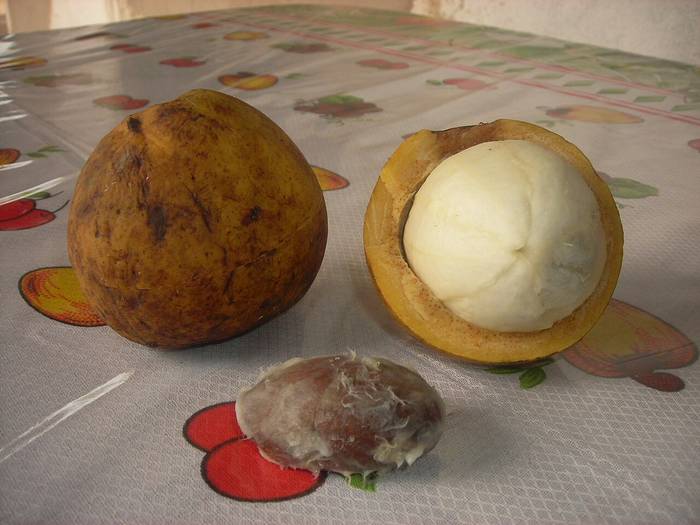
Bakuri
Tree·Platonia insignis
Full sun
Sun
Moist to boggy soil
Water
Well-drained soil
Drainage
Zones 10–13
Hardiness
Coverage · 94 fields
- Parser flag (climate_tolerance_low_confidence): Climate tolerance values are LLM-extracted (no authoritative EcoCrop match found). EcoCrop covers ~2,568 food-crop taxa; ornamental/native/medicinal species rely on LLM extraction.
Growth and size10 fields
Plant type
Deciduous tree“Platonia insignis is a dry-season deciduous tree, reaching 25–40 m high.”PFAFpartly“Platonia insignis is an evergreen Tree growing to 25 m (82ft) by 20 m (65ft) at a fast rate.”
Height
2,500 cm · the source gives 2,500–4,000 cm“Platonia insignis is a dry-season deciduous tree, reaching 25–40 m high.”PFAF“Platonia insignis is an evergreen Tree growing to 25 m (82ft) by 20 m (65ft) at a fast rate.”
Spread
2,000 cm“Platonia insignis is an evergreen Tree growing to 25 m (82ft) by 20 m (65ft) at a fast rate.”
Height at age
—
empty
Spacing
1,000 cm (at least 800 cm)
AI estimate55 % agree
Habit
Spreading
AI estimate50 % agree
Root depth
Deep
AI estimate63 % agree
Forest garden layer
Canopy
AI estimate90 % agree
Lifespan
~100 years
AI estimatenot measured yet
Roots6 fields
Root form
—
empty
Storage organ
None
AI estimate100 % agree
Spreads
By suckers“In some areas within its native range this tree is viewed as a weed because it proliferates from fallen seeds and, if felled, produces abundant suckers from the roots.”
Lateral spread in cm
—
empty
Root depth in cm
—
empty
Mycorrhiza
—
empty
Light, water and soil9 fields
Hours of sun
6–12 h
AI estimatenot measured yet
Water
Moist, wet, standing water · Medium · 5–10 l/day“It prefers moist or wet soil.”PFAFpartly“Seasonally flooded, humid forests.”
Drought tolerant
No“Plants are tolerant of various soil conditions, including poor drainage, but dislike dry soils.”
Tolerates waterlogging
Yes“Plants are tolerant of various soil conditions, including poor drainage, but dislike dry soils.”
PFAFpartly
Drainage
Well drained“Plants are tolerant of various soil conditions, including poor drainage, but dislike dry soils.”
PFAFpartly
Compacted soil
Copes badly
AI estimatenot measured yet
Climate5 fields
Hardiness
Zone 10–13
AI estimatenot measured yet
Killing frost
0 °C
AI estimatenot measured yet
Growing temperature
18–35 °C · optimal 22–30 °C
AI estimatenot measured yet
Chill hours
0 h
AI estimatenot measured yet
Care (becomes tasks in Manage)3 fields
Feeding
January · lasts 30 days · balanced NPK fertiliser
AI estimatenot measured yet
Watering
After rain · lasts 180 days
AI estimatenot measured yet
Pruning
After the previous stage · 30 days after · lasts 30 days · dead, diseased, or crossing branches
AI estimatenot measured yet
Through the year4 fields
Flowering
After rain · Set by day length · lasts 60 days
AI estimatenot measured yet
Fruiting
After the previous stage · 90 days after · lasts 120 days
AI estimatenot measured yet
Harvest
After the previous stage · 90 days after · lasts 60 days
AI estimatenot measured yet
Dying back
Set by day length · After rain · lasts 30 days
AI estimatenot measured yet
Edible parts and pollination2 fields
Pollination
Needs a partner“The white-bellied parrot (Pionites leucogaster) is a pollinator of the plant, making it ornithophilous.”
Pollinated by
Birds“The white-bellied parrot (Pionites leucogaster) is a pollinator of the plant, making it ornithophilous.”
Ecology6 fields
Attracts
White-bellied parrot (Pionites leucogaster)“The white-bellied parrot (Pionites leucogaster) is a pollinator of the plant, making it ornithophilous.”
Pests
—
empty
Diseases
—
empty
Takes up
Phosphorus, potassium
AI estimatenot measured yet
Fixes nitrogen
No
AI estimatenot measured yet
Mycorrhiza
Yes
AI estimatenot measured yet
Propagation and names4 fields
Methods
Seed“Seed - best sown as soon as it is ripe in a partially shaded position in individual containers.”
Difficulty
2 / 5
AI estimatenot measured yet
Seed
not required, but fresh seeds germinate best
AI estimatenot measured yet
Not sorted yet45 fields
Fields the parser stores that this page has no row for yet. They show up here automatically, so nothing is hidden.
forage.TROPICAL.local_name
Bacuri
AI estimatenot measured yet
forage.TROPICAL.edible_parts
[{"part":"fruit","caution":null,"preparation":"raw, or cooked into sherbet, ice cream, marmalade or jelly"},{"part":"filho (pulp of the infertile seed compartments)","caution":null,"preparation":"eaten; the part prefe…“Fruit - raw or cooked to make sherbet, ice cream, marmalade or jelly.”PFAF“The infertile seed compartments are filled with pulp called 'filho 'which is the part preferred.”
forage.TROPICAL.prep_cautions
The oil is unlikely to be edible.“The oil is unlikely to be edible.”
forage.TROPICAL.edibility_basis
inferred
AI estimatenot measured yet
forage.TROPICAL.foraging_months.notes
Fruits year-round in tropical climates, with peak seasons varying by region.
AI estimatenot measured yet
forage.TROPICAL.foraging_months.months
1, 2, 3, 4, 5
AI estimatenot measured yet
forage.TROPICAL.foraging_months.year_round
true
AI estimatenot measured yet
ornamental.basis
documented
AI estimatenot measured yet
ornamental.fragrance.source
flower“The sticky white pulp is fragrant, with a taste that is both sweet and sour.”
Wikipediapartly
ornamental.fragrance.intensity
strong
AI estimatenot measured yet
ornamental.confidence
high
AI estimatenot measured yet
ornamental.fall_interest
false
AI estimatenot measured yet
ornamental.flower_colour
pink“The flowers are 5–7 cm long and pink in color, with five petals and numerous stamens.”
ornamental.evidence_quote
Platonia insignis, commonly known as Bacuri, produces striking pink flowers and has dark green foliage. The flowers are noted for their strong fragrance. As an evergreen tree, it does not exhibit autumn foliage color change and maintains its form through winter.
AI estimatenot measured yet
ornamental.foliage_colour
dark_green“The leaves are opposite, simple oblong to elliptic, 8–15 cm long, and glossy dark green, with wavy margins and a leathery texture.”
ornamental.foliage_texture
medium
AI estimatenot measured yet
ornamental.winter_structure
evergreen_form
AI estimatenot measured yet
ornamental.autumn_foliage_colour
none
AI estimatenot measured yet
care_regime
none
AI estimatenot measured yet
propagation.self_seeding
aggressive“In some areas within its native range this tree is viewed as a weed because it proliferates from fallen seeds and, if felled, produces abundant suckers from the roots.”
propagation.division_season
null
AI estimatenot measured yet
propagation.establishment_years
3
AI estimate40 % agree
spatial_profile.canopy_density
dense
AI estimatenot measured yet
forage_proposals.TROPICAL.edibility_tier.tier
edible“Fruit - raw or cooked to make sherbet, ice cream, marmalade or jelly.”
forage_proposals.TROPICAL.edibility_tier.confidence
medium“Fruit - raw or cooked to make sherbet, ice cream, marmalade or jelly.”
forage_proposals.TROPICAL.edibility_tier.evidence_quote
Fruit - raw or cooked to make sherbet, ice cream, marmalade or jelly.“Fruit - raw or cooked to make sherbet, ice cream, marmalade or jelly.”
function_profile.biomass_return.confidence
high
AI estimatenot measured yet
function_profile.nutrient_flows.consumes
[{"basis":"inferred","demand":"moderate","nutrient":"nitrogen","confidence":"medium"},{"basis":"inferred","demand":"moderate","nutrient":"phosphorus","confidence":"medium"},{"basis":"inferred","demand":"moderate","nut…
AI estimatenot measured yet
function_profile.nutrient_flows.provides
[{"basis":"inferred","nutrient":"phosphorus","mechanism":"biomass_return","confidence":"medium"},{"basis":"inferred","nutrient":"potassium","mechanism":"biomass_return","confidence":"medium"}]
AI estimatenot measured yet
function_profile.biotic_interactions
[{"taxa":["white-bellied parrot (Pionites leucogaster)"],"basis":"documented","valence":"beneficial","relation":"attracts","confidence":"high","evidence_quote":"The white-bellied parrot (Pionites leucogaster) is a pol…“The white-bellied parrot (Pionites leucogaster) is a pollinator of the plant, making it ornithophilous.”
function_profile.aromatic_pest_effect.value
false
AI estimate80 % agree
function_profile.aromatic_pest_effect.confidence
low
AI estimatenot measured yet
function_profile.structural_interfaces.provides_shelter.basis
taxonomic
AI estimatenot measured yet
function_profile.structural_interfaces.provides_shelter.kinds
shade
AI estimatenot measured yet
function_profile.structural_interfaces.provides_shelter.confidence
high
AI estimatenot measured yet
function_profile.structural_interfaces.provides_physical_support.form
trunk
AI estimatenot measured yet
function_profile.structural_interfaces.provides_physical_support.basis
taxonomic
AI estimatenot measured yet
function_profile.structural_interfaces.provides_physical_support.confidence
high
AI estimatenot measured yet
climate_tolerance.photoperiod_response
day_neutral
AI estimatenot measured yet
soil_interactions.organic_matter_contribution
high
AI estimatenot measured yet
component_metadata.growth_cycle
perennial
AI estimate100 % agree
resource_interfaces.inputs
[{"resource":"light","quantity_description":"a sunny position; cannot grow in shade"},{"resource":"water","quantity_description":"moist or wet soil; dislikes dry soils"},{"resource":"pollination","quantity_description…“The white-bellied parrot (Pionites leucogaster) is a pollinator of the plant, making it ornithophilous.”PFAFpartly“Succeeds in a sunny position.”PFAFpartly“It prefers moist or wet soil.”
resource_interfaces.outputs
[{"resource":"fruit","quantity_description":"yellow fruit up to 900 g, eaten raw or cooked"},{"resource":"timber","quantity_description":"wood valued for construction, furniture and flooring"},{"resource":"shade","qua…“The fruit is yellow when ripe, nearly round or ovoid, 75 - 125mm wide, weighing up to 900 g.”PFAFpartly“It is valued for construction, high class furniture, flooring, ship-building and general carpentry.”Wikipediapartly“Platonia insignis is a dry-season deciduous tree, reaching 25–40 m high.”