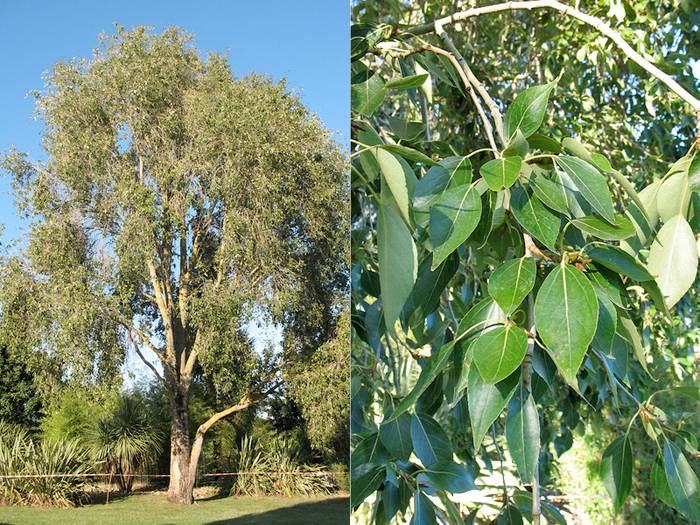
Simon's poplar
Tree·Populus simonii
Full sun
Sun
Moist soil
Water
Well-drained soil
Drainage
Zones 2–7
Hardiness
Coverage · 108 fields
No obvious inconsistencies found.
Growth and size11 fields
Plant type
Deciduous tree“Populus simonii is a deciduous Tree growing to 30 m (98ft 5in) at a fast rate.”
Spread
1,200 cm
AI estimate58 % agree
Height at age
—
empty
Size after planting
26 yrs: 15 m tall, 7 m crown · 36 yrs: 17 m tall, 9 m crown · 62 yrs: 20 m tall, 9 m crown“Berlin tree register: 2304 trees of this species measured with years since planting, height and crown diameter; median crown 9.0 m and height 20.0 m at 60–100 years after planting (560 trees).”Median of 2,304 measured trees in Berlin. Years count from planting nursery stock, so a small tree reaches each size later.
Spacing
800 cm (at least 500 cm)
AI estimate55 % agree
Habit
Columnar
AI estimate50 % agree
Root depth
Deep
AI estimate63 % agree
Forest garden layer
Canopy
AI estimate90 % agree
Lifespan
~50 years
AI estimatenot measured yet
Roots6 fields
Root form
—
empty
Storage organ
None
AI estimate100 % agree
Lateral spread in cm
—
empty
Root depth in cm
—
empty
Mycorrhiza
Ectomycorrhizal (EcM)
AI estimatenot measured yet
Light, water and soil9 fields
Hours of sun
6 h
AI estimatenot measured yet
Drought tolerant
—
empty
Tolerates waterlogging
—
empty
Soil type
Sand, loam, clay“Suitable for: light (sandy), medium (loamy) and heavy (clay) soils and prefers well-drained soil.”
Drainage
Well drained“Prefers a deep rich well-drained circumneutral soil, growing best in the south and east of Britain.”
Compacted soil
Copes fairly well
AI estimatenot measured yet
Climate5 fields
Hardiness
Zone 2–7
AI estimatenot measured yet
Killing frost
-1 °C“Killing temp. early growth: -1”EcoCrop's figure is frost during early growth (spring frost on new shoots), not winter cold.
Growing temperature
5–40 °C · optimal 15–25 °C“Temperature absolute min: 5 · Temperature absolute max: 40 · Temperature optimal min: 15 · Temperature optimal max: 25”
Chill hours
800 h
AI estimatenot measured yet
Care (becomes tasks in Manage)1 fields
Pruning
November · lasts 60 days · dead, diseased, or crossing branches
AI estimatenot measured yet
Through the year5 fields
Flowering
April · lasts 91 days“It is in flower from April to June, and the seeds ripen from May to July.”
Fruiting
May · lasts 92 days“It is in flower from April to June, and the seeds ripen from May to July.”
Leafing out
After the last frost · lasts 30 days“The leaf buds, as they swell in the spring, and the young leaves have a pleasing fragrance of balsam.”
PFAFpartly
Dying back
After the first frost · lasts 30 days“Populus simonii is a deciduous Tree growing to 30 m (98ft 5in) at a fast rate.”
PFAFpartly
Dormant
After the first frost · 30 days after · lasts 150 days
AI estimatenot measured yet
Edible parts and pollination3 fields
Pollination
Needs a partner · a male plant · dioecious“The species is dioecious (individual flowers are either male or female, but only one sex is to be found on any one plant so both male and female plants must be grown if seed is required).”PFAF“and is pollinated by Wind.”PFAF“The plant is not self-fertile.”PFAF“Dioecious. Male and female plants must be grown if seed is required.”
Ecology5 fields
Attracts
—
empty
Pests
—
empty
Takes up
—
empty
Fixes nitrogen
No
AI estimatenot measured yet
Propagation and names4 fields
Methods
Difficulty
2 / 5
AI estimatenot measured yet
Seed
cold stratification for 60-90 days
AI estimatenot measured yet
Not sorted yet59 fields
Fields the parser stores that this page has no row for yet. They show up here automatically, so nothing is hidden.
forage.DK.local_name
Kinesisk poppel
AI estimatenot measured yet
forage.DK.prep_cautions
Young leaves are best, older leaves can be bitter.
AI estimatenot measured yet
forage.DK.edibility_basis
inferred
AI estimatenot measured yet
forage.DK.foraging_months.months
4, 5, 6
AI estimatenot measured yet
forage.DK.foraging_months.year_round
false
AI estimatenot measured yet
forage.US.edible_parts
[{"part":"leaves","caution":"Best eaten when young and tender.","preparation":"cooked","season_months":[4,5,6]}]
AI estimatenot measured yet
forage.US.prep_cautions
Young leaves are best, older leaves can be bitter.
AI estimatenot measured yet
forage.US.edibility_basis
inferred
AI estimatenot measured yet
forage.US.foraging_months.months
4, 5, 6
AI estimatenot measured yet
forage.US.foraging_months.year_round
false
AI estimatenot measured yet
forage.US.habitat_affinity
riverbank, woodland, disturbed_ground
AI estimatenot measured yet
forage.TROPICAL.edibility_basis
inferred
AI estimatenot measured yet
forage.TROPICAL.foraging_months.year_round
false
AI estimatenot measured yet
ornamental.basis
documented
AI estimatenot measured yet
ornamental.fragrance.source
foliage“The leaf buds, as they swell in the spring, and the young leaves have a pleasing fragrance of balsam.”
ornamental.fragrance.intensity
subtle
AI estimatenot measured yet
ornamental.confidence
high
AI estimatenot measured yet
ornamental.fall_interest
true
AI estimatenot measured yet
ornamental.evidence_quote
Populus simonii has green foliage that turns yellow-green in autumn, providing fall interest. The flowers are insignificant. The bark can be ornamental, and the tree provides architectural structure in winter.
AI estimatenot measured yet
ornamental.foliage_colour
green
AI estimate82 % agree
ornamental.foliage_texture
medium
AI estimatenot measured yet
ornamental.winter_structure
ornamental_bark, architectural_skeleton
AI estimatenot measured yet
ornamental.autumn_foliage_colour
yellow_green
AI estimatenot measured yet
care_regime
none
AI estimatenot measured yet
propagation.self_seeding
moderate
AI estimate20 % agree
propagation.division_season
spring
AI estimatenot measured yet
propagation.establishment_years
1
AI estimate40 % agree
size_at_age.v
1
AI estimatenot measured yet
size_at_age.basis
years_after_planting
AI estimatenot measured yet
forage_proposals.DK.edibility_tier.tier
edible
AI estimatenot measured yet
forage_proposals.DK.edibility_tier.confidence
medium
AI estimatenot measured yet
forage_proposals.DK.edibility_tier.evidence_quote
The young leaves of Populus simonii are edible when cooked.
AI estimatenot measured yet
forage_proposals.US.edibility_tier.tier
edible
AI estimatenot measured yet
forage_proposals.US.edibility_tier.confidence
medium
AI estimatenot measured yet
forage_proposals.US.edibility_tier.evidence_quote
The young leaves of Populus simonii are edible when cooked.
AI estimatenot measured yet
forage_proposals.TROPICAL.edibility_tier.confidence
low
AI estimatenot measured yet
function_profile.biomass_return.confidence
high
AI estimatenot measured yet
function_profile.nutrient_flows.consumes
[{"basis":"inferred","demand":"high","nutrient":"nitrogen","confidence":"medium"},{"basis":"inferred","demand":"moderate","nutrient":"phosphorus","confidence":"medium"},{"basis":"inferred","demand":"high","nutrient":"…
AI estimatenot measured yet
function_profile.nutrient_flows.provides
[{"basis":"inferred","nutrient":"potassium","mechanism":"biomass_return","confidence":"medium"},{"basis":"inferred","nutrient":"calcium","mechanism":"biomass_return","confidence":"medium"}]
AI estimatenot measured yet
function_profile.biotic_interactions
[{"taxa":["bacterial canker"],"basis":"documented","valence":"harmful","relation":"hosts","confidence":"high","evidence_quote":"Plants are susceptible to bacterial canker.","organism_group":"pathogen","ecological_func…“Plants are susceptible to bacterial canker.”
function_profile.aromatic_pest_effect.value
false
AI estimate80 % agree
function_profile.aromatic_pest_effect.confidence
low
AI estimatenot measured yet
function_profile.structural_interfaces.provides_shelter.basis
taxonomic
AI estimatenot measured yet
function_profile.structural_interfaces.provides_shelter.kinds
wind, shade
AI estimatenot measured yet
function_profile.structural_interfaces.provides_shelter.confidence
high
AI estimatenot measured yet
function_profile.structural_interfaces.requires_shelter.basis
documented“It does not do well in exposed upland sites.”
function_profile.structural_interfaces.requires_shelter.kinds
wind“It does not do well in exposed upland sites.”
function_profile.structural_interfaces.requires_shelter.confidence
medium“It does not do well in exposed upland sites.”
function_profile.structural_interfaces.requires_shelter.evidence_quote
It does not do well in exposed upland sites.“It does not do well in exposed upland sites.”
function_profile.structural_interfaces.provides_physical_support.form
trunk
AI estimatenot measured yet
function_profile.structural_interfaces.provides_physical_support.basis
taxonomic
AI estimatenot measured yet
function_profile.structural_interfaces.provides_physical_support.confidence
high
AI estimatenot measured yet
climate_tolerance.photoperiod_response
long_day
AI estimatenot measured yet
soil_interactions.organic_matter_contribution
high
AI estimatenot measured yet
component_metadata.growth_cycle
perennial
AI estimate100 % agree
resource_interfaces.inputs
[{"resource":"light","quantity_description":"cannot grow in shade; needs open sun"},{"resource":"water","quantity_description":"prefers moist soil"}]“It cannot grow in the shade.”PFAF“It prefers moist soil.”
resource_interfaces.outputs
[{"resource":"aromatic_compounds","quantity_description":"fragrant leaf buds and young leaves (balsam scent)"},{"resource":"timber","quantity_description":"planted for timber, especially in central Europe"},{"resource…“The leaf buds, as they swell in the spring, and the young leaves have a pleasing fragrance of balsam.”PFAF“This species is often planted for timber in central Europe and occasionally elsewhere in Europe.”PFAF“It is in flower from April to June, and the seeds ripen from May to July.”PFAF“Populus simonii is a deciduous Tree growing to 30 m (98ft 5in) at a fast rate.”