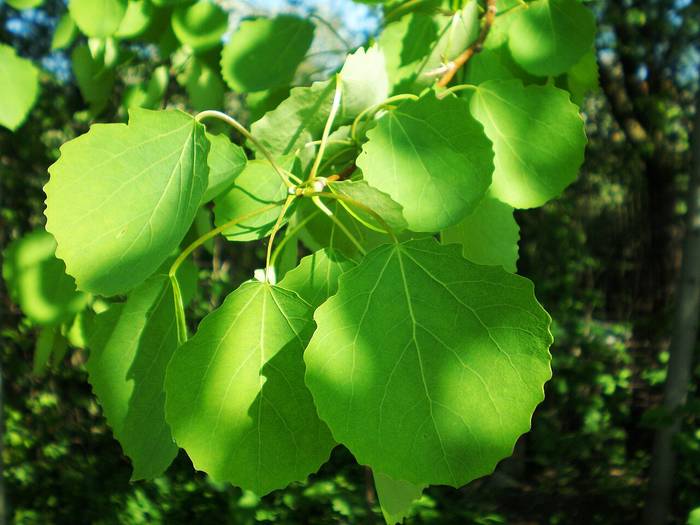
Šarūnas Šimkus · CC BY-SA 3.0
Aspen
Tree·Populus tremula
Part shade to full sun
Sun
Moist to wet soil
Water
Wet soil
Drainage
Zones 2–7
Hardiness
Coverage · 113 fields
No obvious inconsistencies found.
Growth and size11 fields
Plant type
Deciduous tree“Populus tremula is a deciduous Tree growing to 18 m (59ft) by 10 m (32ft) at a fast rate.”
Height
1,800 cm · other sources: 4,000 cm, 3,000 cm“Populus tremula is a deciduous Tree growing to 18 m (59ft) by 10 m (32ft) at a fast rate.”Wikipedia“It is a substantial deciduous tree growing to 40 metres (130 ft) tall by 10 m (33 ft) broad, with a trunk attaining over 1 metre (3 ft 3 in) in diameter.”JRC forest tree atlas“Eurasian aspen (Populus tremula L.) is a medium-size, fast-growing tree, exceptionally reaching a height of 30 m.”
Spread
1,000 cm“Populus tremula is a deciduous Tree growing to 18 m (59ft) by 10 m (32ft) at a fast rate.”
Height at age
—
empty
Size after planting
6 yrs: 9 m tall, 3 m crown · 13 yrs: 12 m tall, 3 m crown · 16 yrs: 12 m tall, 4 m crown · 35 yrs: 15.5 m tall, 6 m crown · 66 yrs: 22 m tall, 10 m crown“Berlin tree register: 1618 trees of this species measured with years since planting, height and crown diameter; median crown 10.0 m and height 22.0 m at 60–100 years after planting (207 trees).”Median of 1,618 measured trees in Berlin. Years count from planting nursery stock, so a small tree reaches each size later.
Spacing
800 cm (at least 500 cm)
AI estimate55 % agree
Growth rate
Fast“Populus tremula is a deciduous Tree growing to 18 m (59ft) by 10 m (32ft) at a fast rate.”
Habit
Columnar
AI estimate50 % agree
Root depth
Shallow“After an individual has been damaged or destroyed, root suckers are produced abundantly on the shallow lateral roots.”
Forest garden layer
Canopy
AI estimate90 % agree
Lifespan
~80 years
AI estimatenot measured yet
Roots6 fields
Root form
Plate root (shallow)“After an individual has been damaged or destroyed, root suckers are produced abundantly on the shallow lateral roots.”
Wikipediapartly
Storage organ
None
AI estimate100 % agree
Lateral spread in cm
4,000 cm“Like other aspens, it spreads extensively by suckers (root sprouts), which may be produced up to 40 m from the parent tree, forming extensive clonal colonies.”
Root depth in cm
—
empty
Mycorrhiza
Ectomycorrhizal (EcM)
AI estimatenot measured yet
Light, water and soil9 fields
Sun
Full sun, light shade, part shade · best: full sun“It can grow in semi-shade (light woodland) or no shade.”JRC forest tree atlaspartly“Eurasian aspen is a light-demanding, rapidly growing broad-leaved tree.”
Hours of sun
6 h
AI estimatenot measured yet
Water
Moist, wet · best: moist · Medium“It also grows on a wide range of soils, from slightly dry to wet soils of poor to rich nutrient status, although it favours moist soils with a high organic matter content and wet conditions.”PFAF“It prefers moist or wet soil.”Wikipediapartly“Eurasian aspen is a water and light demanding species that is able to vigorously colonize an open area after fire, clear cutting or other kinds of damage.”
Drought tolerant
—
empty
Tolerates waterlogging
Yes“The enormous wide natural range demonstrates its tolerance of a high variety of climatic and habitat conditions, such as frost, shade, waterlogging, wind and weed competition.”
Soil type
Sand, loam, clay“Suitable for: light (sandy), medium (loamy) and heavy (clay) soils and can grow in heavy clay and nutritionally poor soils.”
Compacted soil
Copes fairly well
AI estimatenot measured yet
Climate5 fields
Hardiness
Zone 2–7
AI estimatenot measured yet
Killing frost
-40 °C
AI estimatenot measured yet
Growing temperature
0–30 °C · optimal 10–25 °C
AI estimatenot measured yet
Chill hours
800 h
AI estimatenot measured yet
Native range
AD, AL, AM, AT, AZ, BA, BE, BG, BT, BY, CH, CN, CZ, DE, DK, DZ, EE, ES, FI, FR, GB, GE, GG, GI, GR, HK, HR, HU, IE, IN, IS, IT, JE, JP, KP, KR, KZ, LB, LI, LT, LU, LV, MC, MD, ME, MK, MM, MN, MO, NL, NO, PL, PT, RO, RS, RU, SE, SI, SK, SM, SY, TR, TW, UA, VA, XK
Through the year5 fields
Flowering
February · lasts 59 days“Flowers are produced in February-March before the leaves appear.”
Fruiting
May · lasts 61 days“It is in flower from February to March, and the seeds ripen from May to June.”
Dying back
After the first frost“In spring the young leaves are coppery-brown and turn to golden yellow in autumn, making it attractive in all vegetative seasons.”
JRC forest tree atlaspartly
Leafing out
After the last frost · Above 5 °C · lasts 14 days
AI estimatenot measured yet
Dormant
After the first frost · lasts 150 days
AI estimatenot measured yet
Edible parts and pollination3 fields
Inner bark
Ecology5 fields
Attracts
Wildlife, over 90 associated insect species, green hairstreak butterfly, birds and mammals that require young forests“It is noted for attracting wildlife.”PFAF“The aspen is a very good wildlife plant, it has over 90 associated insect species and is a food plant for the green hairstreak butterfly.”Wikipedia“The tree further provides habitat for several mammals and birds that require young forests.”
Pests
Moose, deer, livestock, rabbits“In boreal, temperate, and mountain forests, aspen can be heavily defoliated by moose and deer (Cervidae), livestock, rabbits (Leporidae), or killed by bark stripping or fraying activities.”
Diseases
Neofabraea populi, entoleuca mammata, melampsora leaf rusts, melampsora pinitorqua“The fungi Neofabraea populi and Entoleuca mammata, which have been imported into Europe and Scandinavia from North America, can potentially cause severe infections.”JRC forest tree atlas“Like other poplars aspen can be attacked by several species of leaf rusts of genus Melampsora.”JRC forest tree atlas“The species Melampsora pinitorqua, which causes serious diseases on young Scots pine stands, has the aspen trees as an intermediate host, so that aspen has been eliminated from most managed forests containing pine in Finland.”
Takes up
—
empty
Fixes nitrogen
No
AI estimatenot measured yet
Propagation and names4 fields
Methods
Seed sown as soon as ripe in spring, Cuttings of mature wood taken in November/December, Suckers in early spring, Root cuttings in winter“Seed - must be sown as soon as it is ripe in spring.”PFAF“Cuttings of mature wood in November/December in a sheltered outdoor bed.”PFAF“Suckers in early spring.”PFAF“Root cuttings in the winter.”
Seed
cold stratification required for 60-90 days
AI estimatenot measured yet
Not sorted yet65 fields
Fields the parser stores that this page has no row for yet. They show up here automatically, so nothing is hidden.
forage.DK.local_name
Bævreasp
AI estimatenot measured yet
forage.DK.prep_cautions
Famine food: only used when all else fails.“A famine food, it is only used when all else fails.”
forage.DK.edibility_basis
inferred
AI estimatenot measured yet
forage.DK.foraging_months.notes
Inner bark is best harvested in spring when sap is rising.
AI estimatenot measured yet
forage.DK.foraging_months.months
3, 4, 5
AI estimatenot measured yet
forage.DK.foraging_months.year_round
false
AI estimatenot measured yet
forage.DK.habitat_affinity
woodland, disturbed_ground“Found in open woodlands and scrubby heathland, usually on poorer soils where it is sometimes dominant.”JRC forest tree atlas“It can tolerate a wide range of habitat conditions and typically colonises disturbed areas (for example after fire, wind-throw, etc.).”
forage.US.local_name
European aspen
AI estimatenot measured yet
forage.US.edible_parts
[{"part":"inner bark","caution":"Best used in survival situations or as a supplement to other flours.","preparation":"dried and ground into flour","season_months":[3,4,5]}]
AI estimatenot measured yet
forage.US.prep_cautions
Bitter taste if not prepared properly.
AI estimatenot measured yet
forage.US.edibility_basis
inferred
AI estimatenot measured yet
forage.US.foraging_months.notes
Inner bark is best harvested in spring when sap is rising.
AI estimatenot measured yet
forage.US.foraging_months.months
3, 4, 5
AI estimatenot measured yet
forage.US.foraging_months.year_round
false
AI estimatenot measured yet
forage.US.habitat_affinity
woodland, disturbed_ground
AI estimatenot measured yet
forage.TROPICAL.edibility_basis
inferred
AI estimatenot measured yet
forage.TROPICAL.foraging_months.year_round
false
AI estimatenot measured yet
ornamental.basis
documented
AI estimatenot measured yet
ornamental.fragrance.source
none
AI estimate100 % agree
ornamental.fragrance.intensity
subtle
AI estimatenot measured yet
ornamental.confidence
high
AI estimatenot measured yet
ornamental.fall_interest
true“In spring the young leaves are coppery-brown and turn to golden yellow in autumn, making it attractive in all vegetative seasons.”
ornamental.evidence_quote
The leaves turn yellow-green in autumn, providing some seasonal interest. The bark is smooth and grey-green, becoming fissured with age, offering winter structure.
AI estimatenot measured yet
ornamental.foliage_colour
green
AI estimate82 % agree
ornamental.foliage_texture
medium
AI estimatenot measured yet
ornamental.winter_structure
ornamental_bark, architectural_skeleton
AI estimatenot measured yet
ornamental.autumn_foliage_colour
yellow_green
AI estimatenot measured yet
care_regime
none
AI estimatenot measured yet
propagation.self_seeding
moderate“Though Eurasian aspen may produce enormous numbers of viable seeds, seedlings find it difficult to establish apart from under suitable environmental conditions or after a forest fire.”
JRC forest tree atlaspartly
propagation.establishment_years
3“If sufficient growth is made, it might be possible to plant them out in late summer into their permanent positions, otherwise keep them in the cold frame until the following late spring and then plant them out.”
PFAFpartly
size_at_age.v
1
AI estimatenot measured yet
size_at_age.basis
years_after_planting
AI estimatenot measured yet
forage_proposals.DK.edibility_tier.tier
caution“A famine food, it is only used when all else fails.”
forage_proposals.DK.edibility_tier.confidence
medium
AI estimatenot measured yet
forage_proposals.DK.edibility_tier.evidence_quote
The inner bark can be dried, ground into a powder and used as a flour.
AI estimatenot measured yet
forage_proposals.US.edibility_tier.tier
edible
AI estimatenot measured yet
forage_proposals.US.edibility_tier.confidence
medium
AI estimatenot measured yet
forage_proposals.US.edibility_tier.evidence_quote
The inner bark can be dried, ground into a powder and used as a flour.
AI estimatenot measured yet
forage_proposals.TROPICAL.edibility_tier.confidence
low
AI estimatenot measured yet
function_profile.biomass_return.confidence
high
AI estimatenot measured yet
function_profile.nutrient_flows.consumes
[{"basis":"documented","demand":"high","nutrient":"nitrogen","confidence":"high"},{"basis":"inferred","demand":"moderate","nutrient":"phosphorus","confidence":"medium"},{"basis":"inferred","demand":"moderate","nutrien…
AI estimatenot measured yet
function_profile.nutrient_flows.provides
[{"basis":"inferred","nutrient":"calcium","mechanism":"mineral_extraction","confidence":"medium"},{"basis":"inferred","nutrient":"potassium","mechanism":"mineral_extraction","confidence":"medium"},{"basis":"inferred",…
AI estimatenot measured yet
function_profile.biotic_interactions
[{"taxa":["wildlife"],"basis":"documented","valence":"beneficial","relation":"attracts","confidence":"medium","evidence_quote":"It is noted for attracting wildlife.","organism_group":"wildlife"},{"taxa":["over 90 asso…“It is noted for attracting wildlife.”PFAF“The aspen is a very good wildlife plant, it has over 90 associated insect species and is a food plant for the green hairstreak butterfly.”Wikipedia“This species is important for the hornet moth, which uses it as a host during the larval stage.”Wikipedia“The tree further provides habitat for several mammals and birds that require young forests.”JRC forest tree atlas“In boreal, temperate, and mountain forests, aspen can be heavily defoliated by moose and deer (Cervidae), livestock, rabbits (Leporidae), or killed by bark stripping or fraying activities.”JRC forest tree atlas“The fungi Neofabraea populi and Entoleuca mammata, which have been imported into Europe and Scandinavia from North America, can potentially cause severe infections.”JRC forest tree atlas“Like other poplars aspen can be attacked by several species of leaf rusts of genus Melampsora.”JRC forest tree atlas“The species Melampsora pinitorqua, which causes serious diseases on young Scots pine stands, has the aspen trees as an intermediate host, so that aspen has been eliminated from most managed forests containing pine in Finland.”
function_profile.aromatic_pest_effect.value
false
AI estimate80 % agree
function_profile.aromatic_pest_effect.confidence
low
AI estimatenot measured yet
function_profile.structural_interfaces.provides_shelter.basis
taxonomic
AI estimatenot measured yet
function_profile.structural_interfaces.provides_shelter.kinds
wind“A very fast growing and wind resistant tree, it can be planted to provide a shelterbelt.”
function_profile.structural_interfaces.provides_shelter.confidence
high
AI estimatenot measured yet
function_profile.structural_interfaces.provides_shelter.evidence_quote
A very fast growing and wind resistant tree, it can be planted to provide a shelterbelt.
AI estimatenot measured yet
function_profile.structural_interfaces.requires_shelter.basis
documented
AI estimatenot measured yet
function_profile.structural_interfaces.requires_shelter.confidence
medium
AI estimatenot measured yet
function_profile.structural_interfaces.requires_shelter.evidence_quote
Plants are very tolerant of exposure, doing well in cold exposed sites so long as sufficient moisture is present.
AI estimatenot measured yet
function_profile.structural_interfaces.provides_physical_support.form
trunk“It is a substantial deciduous tree growing to 40 metres (130 ft) tall by 10 m (33 ft) broad, with a trunk attaining over 1 metre (3 ft 3 in) in diameter.”
function_profile.structural_interfaces.provides_physical_support.basis
taxonomic
AI estimatenot measured yet
function_profile.structural_interfaces.provides_physical_support.confidence
high
AI estimatenot measured yet
function_profile.structural_interfaces.provides_physical_support.evidence_quote
It is a substantial deciduous tree growing to 40 metres (130 ft) tall by 10 m (33 ft) broad, with a trunk attaining over 1 metre (3 ft 3 in) in diameter.
AI estimatenot measured yet
function_profile.structural_interfaces.requires_physical_support.basis
taxonomic
AI estimatenot measured yet
function_profile.structural_interfaces.requires_physical_support.confidence
high
AI estimatenot measured yet
climate_tolerance.photoperiod_response
long_day
AI estimatenot measured yet
soil_interactions.organic_matter_contribution
high
AI estimatenot measured yet
component_metadata.growth_cycle
perennial
AI estimate100 % agree
resource_interfaces.inputs
[{"resource":"light","quantity_description":"full light; a light-demanding tree"},{"resource":"water","quantity_description":"moist to wet soil"},{"resource":"space","quantity_description":"at least 12 m clear of buil…“Eurasian aspen is a light-demanding, rapidly growing broad-leaved tree.”PFAF“It prefers moist or wet soil.”PFAF“The species is dioecious (individual flowers are either male or female, but only one sex is to be found on any one plant so both male and female plants must be grown if seed is required).”PFAFpartly“Especially when grown on clay soils, they should not be planted within 12 metres of buildings since the root system can damage the building's foundations by drying out the soil.”
resource_interfaces.outputs
[{"resource":"shade","quantity_description":"canopy to about 18 m tall"},{"resource":"wind_shelter","quantity_description":"fast-growing shelterbelt"},{"resource":"leaf_litter","quantity_description":"deciduous leaf f…“Populus tremula is a deciduous Tree growing to 18 m (59ft) by 10 m (32ft) at a fast rate.”PFAF“A very fast growing and wind resistant tree, it can be planted to provide a shelterbelt.”PFAFpartly“The aspen is a very good wildlife plant, it has over 90 associated insect species and is a food plant for the green hairstreak butterfly.”Wikipediapartly“The fluff assists wind dispersal of the seeds when the capsules split open at maturity.”Wikipediapartly“The wood of aspen is light and soft with very little shrinkage.”