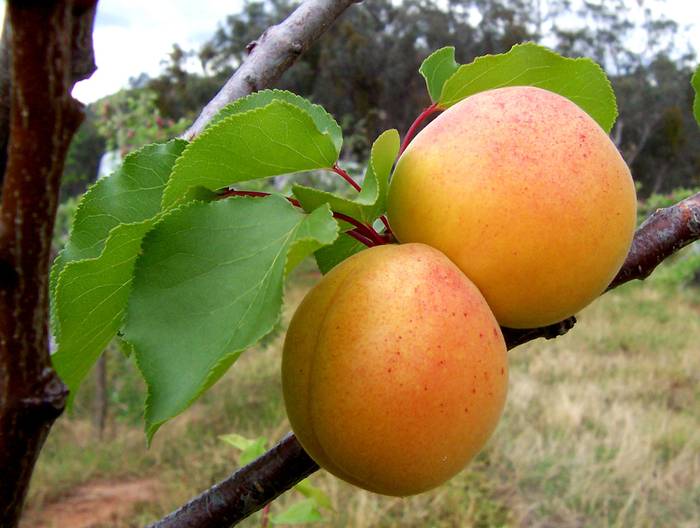
Fir0002 · CC BY-SA 3.0
Apricot
Tree·Prunus armeniaca
Part shade to full sun
Sun
Moist soil
Water
Well-drained soil
Drainage
Zones 4–8
Hardiness
Coverage · 138 fields
No obvious inconsistencies found.
Growth and size11 fields
Plant type
Deciduous tree“Prunus armeniaca is a deciduous Tree growing to 9 m (29ft) by 6 m (19ft) at a medium rate.”
Height
900 cm · other sources: 800 cm, 1,200 cm“Prunus armeniaca is a deciduous Tree growing to 9 m (29ft) by 6 m (19ft) at a medium rate.”Wikipedia“Prunus armeniaca is a small tree, 8–12 m (26–39 ft) tall, with a trunk up to 40 cm (16 in) in diameter and a dense, spreading canopy.”
Spread
600 cm“Prunus armeniaca is a deciduous Tree growing to 9 m (29ft) by 6 m (19ft) at a medium rate.”
Height at age
—
empty
Rootstock trials
Haggith (apricot seedling): 4.41 m after 10 yrs · M800 (P. besseyi x P. sibirica): 3.95 m after 10 yrs · Yuksa (P. besseyi x P. armeniaca): 3.96 m after 10 yrs“1 published rootstock trials (Haggith (apricot seedling), M800 (P. besseyi x P. sibirica), Yuksa (P. besseyi x P. armeniaca)) measured height and crown width at known years after planting.”
Rootstock trials
Spacing
600 cm (at least 450 cm)
AI estimate55 % agree
Growth rate
Medium“Prunus armeniaca is a deciduous Tree growing to 9 m (29ft) by 6 m (19ft) at a medium rate.”
Habit
Spreading“Prunus armeniaca is a small tree, 8–12 m (26–39 ft) tall, with a trunk up to 40 cm (16 in) in diameter and a dense, spreading canopy.”
Root depth
Shallow“Most members of this genus are shallow-rooted and will produce suckers if the roots are damaged.”
Forest garden layer
Lower tree layer
AI estimate90 % agree
Lifespan
~40 years
AI estimatenot measured yet
Roots6 fields
Root form
Plate root (shallow)“Most genus members are shallow-rooted, forming a plate near the soil surface, and will produce suckers if the roots are damaged.”
Storage organ
—
empty
Lateral spread in cm
—
empty
Root depth in cm
—
empty
Mycorrhiza
Arbuscular (AM)
AI estimatenot measured yet
Light, water and soil9 fields
Sun
Full sun, light shade, part shade · best: full sun“It can grow in semi-shade (light woodland) or no shade.”
Hours of sun
6–12 h
AI estimatenot measured yet
Drought tolerant
—
empty
Tolerates waterlogging
—
empty
Soil type
Sand, loam · best: loam“Thrives in a loamy soil, doing well on limestone.”PFAF“Suitable for: light (sandy) and medium (loamy) soils and prefers well-drained soil.”
pH
5–8 · best 6.5–7.5“Prefers a pH in the range 6.5 to 7.5.”PFAF“Suitable pH: mildly acid, neutral and basic (mildly alkaline) soils.”
Drainage
Well drained“Suitable for: light (sandy) and medium (loamy) soils and prefers well-drained soil.”
Compacted soil
Copes badly
AI estimatenot measured yet
Climate5 fields
Hardiness
Zone 4–8
AI estimatenot measured yet
Killing frost
-1 °C“Killing temp. early growth: -1”EcoCrop's figure is frost during early growth (spring frost on new shoots), not winter cold.
Growing temperature
7–40 °C · optimal 14–35 °C“Temperature absolute min: 7 · Temperature absolute max: 40 · Temperature optimal min: 14 · Temperature optimal max: 35”
Chill hours
700 h
AI estimatenot measured yet
Care (becomes tasks in Manage)7 fields
Pruning
June · lasts 90 days“Any pruning should be carried out in the summer to allow rapid healing and therefore less risk of infection.”
PFAFpartly
Protection
After the previous stage · lasts 30 days · frost“However, if given the benefit of a south or west facing wall and some protection from frosts when it is in flower, reasonable crops can usually be produced in southern England.”
PFAFpartly
Planting out
May · lasts 60 days“Grow them on in a greenhouse or cold frame for their first winter and plant them out in late spring or early summer of the following year.”
PFAFpartly
Feeding
March · lasts 30 days · a balanced granular fertiliser or well-rotted compost
AI estimatenot measured yet
Mulching
April · lasts 30 days
AI estimatenot measured yet
Watering
June · lasts 90 days
AI estimatenot measured yet
Protection
March · lasts 30 days · frost
AI estimatenot measured yet
Through the year7 fields
Leafing out
After the previous stage · lasts 30 days“they are produced singly or in pairs in early spring before the leaves.”
Wikipediapartly
Flowering
March · lasts 60 days“It is in flower from March to April, and the seeds ripen from July to September.”
Dormant
After the first frost · lasts 150 days“Prunus armeniaca is a deciduous Tree growing to 9 m (29ft) by 6 m (19ft) at a medium rate.”
PFAFpartly
Dying back
After the first frost · Set by day length · lasts 30 days
AI estimatenot measured yet
First harvest
4 years after plantingFrom Cornell Cooperative Extension's Table 2 ('Planting and harvesting guidelines for various fruit crops'), the apricot row's 'Bearing Age (years)' column reads 4. The guide does not state whether this counts from seed or from planting a nursery tree, but the table is titled 'Planting and harvesting guidelines' and sits alongside apple rows (e.g. 'bear fruit the second or third year after planting' elsewhere in the same document for nursery stock), so it is read here as years after planting a nursery tree.
Edible parts and pollination7 fields
The fruit
Raw, cooked or dried for later use · July–September“Fruit - raw, cooked or dried for later use.”PFAFpartly“The fruit is available from mid to late summer.”
The seeds
Raw or cooked“Bitter seeds should be eaten in strict moderation, but sweet ones can be eaten freely.”PFAF“Seed - raw or cooked.”
Oil
Pressed from the seed as an edible semi-drying cooking oil“Consume in small quantities if it tastes strongly of bitter almonds.”PFAF“The pressed seed contains up to 50% of an edible semi-drying cooking oil known as the oil of almond.”
Pollination
Self-fertile · hermaphrodite“The species is hermaphrodite (has both male and female organs) and is pollinated by Insects.”PFAF“The plant is self-fertile.”PFAF“The plants are self-fertile, but hand pollination would be advisable since they are normally flowering before many pollinating insects are active.”
Pollinated by
Insects“The species is hermaphrodite (has both male and female organs) and is pollinated by Insects.”
Ecology5 fields
Attracts
Insects, wildlife“The species is hermaphrodite (has both male and female organs) and is pollinated by Insects.”PFAF“It is noted for attracting wildlife.”
Pests
Aphids, plum curculio, peach tree borer
AI estimatenot measured yet
Diseases
Honey fungus, canker“Plants in this genus are notably susceptible to honey fungus.”PFAFpartly“‘Alfred’ is less prone to canker.”
Takes up
Potassium, calcium
AI estimatenot measured yet
Fixes nitrogen
No
AI estimatenot measured yet
Propagation and names4 fields
Methods
Seed, half-ripe cuttings, softwood cuttings, layering“Seed - requires 2 - 3 months cold stratification and is best sown in a cold frame as soon as it is ripe.”PFAF“Cuttings of half-ripe wood with a heel, July/August in a frame. Difficult.”PFAF“Softwood cuttings from strongly growing plants in spring to early summer in a frame. Difficult.”PFAF“Layering in spring.”
Difficulty
2 / 5
AI estimatenot measured yet
Seed
2 - 3 months cold stratification“Seed - requires 2 - 3 months cold stratification and is best sown in a cold frame as soon as it is ripe.”
Not sorted yet77 fields
Fields the parser stores that this page has no row for yet. They show up here automatically, so nothing is hidden.
forage.DK.local_name
Abrikos
AI estimatenot measured yet
forage.DK.prep_cautions
Any very bitter seed or fruit should not be eaten., The species produces hydrogen cyanide, a poison that gives almonds their characteristic flavour.“Usually present in too small a quantity to do any harm, any very bitter seed or fruit should not be eaten.”PFAF“This species produces hydrogen cyanide, a poison that gives almonds their characteristic flavour.”
forage.DK.edibility_basis
inferred
AI estimatenot measured yet
forage.DK.foraging_months.notes
Harvest late summer into autumn.“Harvest late summer into autumn.”
forage.DK.foraging_months.year_round
false
AI estimatenot measured yet
forage.DK.habitat_affinity
disturbed_ground
AI estimatenot measured yet
forage.US.local_name
Apricot
AI estimatenot measured yet
forage.US.edible_parts
[{"part":"fruit","caution":null,"preparation":"raw, cooked or dried for later use","season_months":[7,8,9]},{"part":"seed","caution":"Bitter seeds should be eaten in strict moderation; sweet seeds can be eaten freely.…“Bitter seeds should be eaten in strict moderation, but sweet ones can be eaten freely.”PFAF“Consume in small quantities if it tastes strongly of bitter almonds.”PFAF“Fruit - raw, cooked or dried for later use.”PFAF“Seed - raw or cooked.”PFAF“The pressed seed contains up to 50% of an edible semi-drying cooking oil known as the oil of almond.”PFAF“An edible gum is obtained from the trunk.”PFAFpartly“The fruit is available from mid to late summer.”
forage.US.prep_cautions
Any very bitter seed or fruit should not be eaten., The species produces hydrogen cyanide, a poison that gives almonds their characteristic flavour.“Usually present in too small a quantity to do any harm, any very bitter seed or fruit should not be eaten.”PFAF“This species produces hydrogen cyanide, a poison that gives almonds their characteristic flavour.”
forage.US.edibility_basis
inferred
AI estimatenot measured yet
forage.US.foraging_months.notes
Harvest late summer into autumn.“Harvest late summer into autumn.”
forage.US.foraging_months.year_round
false
AI estimatenot measured yet
forage.US.habitat_affinity
disturbed_ground
AI estimatenot measured yet
forage.TROPICAL.local_name
Apricot
AI estimatenot measured yet
forage.TROPICAL.edible_parts
[{"part":"fruit","caution":null,"preparation":"raw or cooked","season_months":[5,6,7]}]
AI estimatenot measured yet
forage.TROPICAL.prep_cautions
Seeds (kernels) contain cyanogenic glycosides and should be consumed in very small quantities, especially bitter varieties.
AI estimatenot measured yet
forage.TROPICAL.edibility_basis
inferred
AI estimatenot measured yet
forage.TROPICAL.foraging_months.notes
Apricots are typically grown in temperate regions, but in some subtropical or high-altitude tropical areas, they may fruit earlier or over a longer season.
AI estimatenot measured yet
forage.TROPICAL.foraging_months.months
5, 6, 7
AI estimatenot measured yet
forage.TROPICAL.foraging_months.year_round
false
AI estimatenot measured yet
forage.TROPICAL.habitat_affinity
disturbed_ground
AI estimatenot measured yet
ornamental.basis
documented
AI estimatenot measured yet
ornamental.fragrance.source
flower“Apricot (P. armeniaca) is a dwarf to medium tree with attractive fragrant flowers.”
ornamental.fragrance.intensity
subtle
AI estimatenot measured yet
ornamental.confidence
high
AI estimatenot measured yet
ornamental.fall_interest
true
AI estimatenot measured yet
ornamental.flower_colour
pink, white“Bloom Color: Pink.”Wikipedia“The flowers are 2–4.5 cm (0.8–1.8 in) in diameter, with five white to pinkish petals; they are produced singly or in pairs in early spring before the leaves.”
ornamental.evidence_quote
The flowers are white to pink, appearing in early spring before the leaves. The foliage is green, turning yellow-green to yellow in autumn. The bark is ornamental, providing winter interest. Flowers have a subtle fragrance.
AI estimatenot measured yet
ornamental.foliage_colour
green
AI estimate82 % agree
ornamental.foliage_texture
medium
AI estimatenot measured yet
ornamental.winter_structure
ornamental_bark
AI estimatenot measured yet
ornamental.autumn_foliage_colour
yellow_green, yellow_green
AI estimatenot measured yet
care_regime
routine
AI estimatenot measured yet
propagation.self_seeding
none
AI estimate20 % agree
propagation.division_season
not applicable
AI estimatenot measured yet
propagation.establishment_years
3
AI estimate40 % agree
size_at_age.v
1
AI estimatenot measured yet
size_at_age.basis
years_after_planting
AI estimatenot measured yet
spatial_profile.canopy_density
dense“Prunus armeniaca is a small tree, 8–12 m (26–39 ft) tall, with a trunk up to 40 cm (16 in) in diameter and a dense, spreading canopy.”
forage_proposals.DK.edibility_tier.tier
choice
AI estimatenot measured yet
forage_proposals.DK.edibility_tier.confidence
high
AI estimatenot measured yet
forage_proposals.DK.edibility_tier.evidence_quote
The fruit of Prunus armeniaca, commonly known as apricot, is widely consumed fresh, dried, or in various cooked preparations such as jams and desserts. It is highly valued for its sweet flavor and nutritional content.
AI estimatenot measured yet
forage_proposals.US.edibility_tier.tier
choice
AI estimatenot measured yet
forage_proposals.US.edibility_tier.confidence
high
AI estimatenot measured yet
forage_proposals.US.edibility_tier.evidence_quote
Apricot fruit is a popular and safe food item, enjoyed globally for its taste and versatility in culinary applications. It is considered a choice edible fruit.
AI estimatenot measured yet
forage_proposals.TROPICAL.edibility_tier.tier
choice
AI estimatenot measured yet
forage_proposals.TROPICAL.edibility_tier.confidence
high
AI estimatenot measured yet
forage_proposals.TROPICAL.edibility_tier.evidence_quote
In tropical and subtropical regions where apricots are cultivated, the fruit is a well-established and highly regarded edible, consumed in many forms.
AI estimatenot measured yet
function_profile.biomass_return.confidence
medium
AI estimatenot measured yet
function_profile.nutrient_flows.consumes
[{"basis":"documented","demand":"high","nutrient":"nitrogen","confidence":"high"},{"basis":"documented","demand":"moderate","nutrient":"phosphorus","confidence":"high"},{"basis":"documented","demand":"high","nutrient"…
AI estimatenot measured yet
function_profile.nutrient_flows.provides
[{"basis":"inferred","nutrient":"potassium","mechanism":"biomass_return","confidence":"low"},{"basis":"inferred","nutrient":"calcium","mechanism":"biomass_return","confidence":"low"}]
AI estimatenot measured yet
function_profile.biotic_interactions
[{"taxa":["insects"],"basis":"documented","valence":"beneficial","relation":"attracts","confidence":"high","evidence_quote":"The species is hermaphrodite (has both male and female organs) and is pollinated by Insects.…“The species is hermaphrodite (has both male and female organs) and is pollinated by Insects.”PFAF“It is noted for attracting wildlife.”PFAF“Plants in this genus are notably susceptible to honey fungus.”PFAFpartly“‘Alfred’ is less prone to canker.”
function_profile.aromatic_pest_effect.value
false
AI estimate80 % agree
function_profile.aromatic_pest_effect.confidence
high
AI estimatenot measured yet
function_profile.structural_interfaces.provides_shelter.basis
taxonomic
AI estimatenot measured yet
function_profile.structural_interfaces.provides_shelter.kinds
shade
AI estimatenot measured yet
function_profile.structural_interfaces.provides_shelter.confidence
high
AI estimatenot measured yet
function_profile.structural_interfaces.requires_shelter.basis
documented
AI estimatenot measured yet
function_profile.structural_interfaces.requires_shelter.kinds
frost“The tree is perfectly hardy in Britain but it usually flowers very early in the spring and the flowers are then liable to be destroyed by frosts.”
function_profile.structural_interfaces.requires_shelter.stage
establishment
AI estimatenot measured yet
function_profile.structural_interfaces.requires_shelter.confidence
high
AI estimatenot measured yet
function_profile.structural_interfaces.requires_shelter.evidence_quote
The tree is perfectly hardy in Britain but it usually flowers very early in the spring and the flowers are then liable to be destroyed by frosts.
AI estimatenot measured yet
function_profile.structural_interfaces.provides_physical_support.form
trunk“The plant growth habit is a standard with a non-suckering single trunk [1-2].”
function_profile.structural_interfaces.provides_physical_support.basis
taxonomic
AI estimatenot measured yet
function_profile.structural_interfaces.provides_physical_support.confidence
high
AI estimatenot measured yet
function_profile.structural_interfaces.provides_physical_support.evidence_quote
The plant growth habit is a standard with a non-suckering single trunk [1-2].
AI estimatenot measured yet
function_profile.structural_interfaces.requires_physical_support.basis
taxonomic
AI estimatenot measured yet
function_profile.structural_interfaces.requires_physical_support.confidence
high
AI estimatenot measured yet
climate_tolerance.photoperiod_response
day_neutral
AI estimatenot measured yet
soil_interactions.organic_matter_contribution
medium
AI estimatenot measured yet
component_metadata.growth_cycle
perennial
AI estimate100 % agree
resource_interfaces.inputs
[{"resource":"light","quantity_description":"full sun preferred; succeeds in light shade but fruits better in sun"},{"resource":"water","quantity_description":"prefers moist soil; drops fruit buds in summer drought"},…“Requires a well-drained moisture-retentive fertile soil in a warm sunny position.”PFAF“The species is hermaphrodite (has both male and female organs) and is pollinated by Insects.”PFAFpartly“It prefers moist soil.”
resource_interfaces.outputs
[{"resource":"fruit","quantity_description":"up to 55 kg from larger trees"},{"resource":"seeds","quantity_description":"pressed kernels yield up to 50% edible oil"},{"resource":"timber","quantity_description":"wood l…“Yields up to 55kg (120lb) from larger trees are possible.”PFAF“The pressed seed contains up to 50% of an edible semi-drying cooking oil known as the oil of almond.”PFAF“Prunus armeniaca is a deciduous Tree growing to 9 m (29ft) by 6 m (19ft) at a medium rate.”PFAF“It is noted for attracting wildlife.”PFAFpartly“Adhesive Dye Gum Oil Oil Wood”