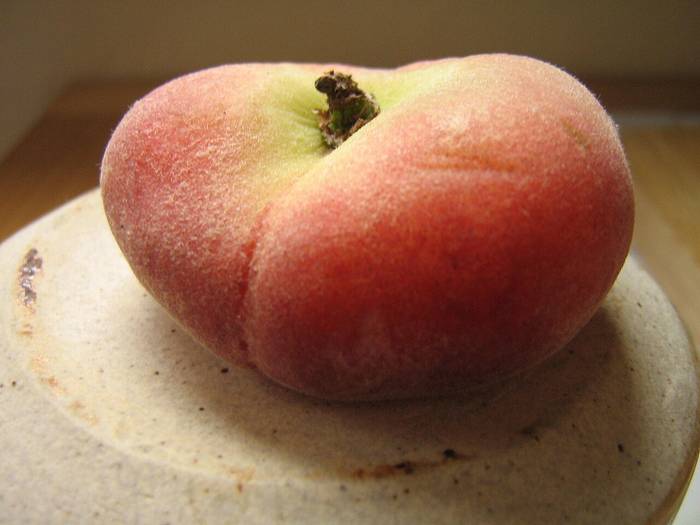
Daum · CC BY-SA 3.0
Flat peach
Tree·Prunus persica var. platycarpa
Part shade to full sun
Sun
Moist soil
Water
Not recorded
Drainage
Not recorded
Hardiness
Coverage · 111 fields
Growth and size11 fields
Plant type
Deciduous tree“Prunus persica is a deciduous Tree growing to 6 m (19ft) by 6 m (19ft) at a fast rate.”
Height
600 cm · other sources: 300 cm“Prunus persica is a deciduous Tree growing to 6 m (19ft) by 6 m (19ft) at a fast rate.”Wikipedia“The peach is a deciduous tree or tree like shrub that may rarely grow to as much as 10 meters (33 ft) tall, but is more typically 3 m (10 ft) with large specimens reaching 4 m (13 ft).”
Spread
600 cm · other sources: 300 cm, 400 cm“Prunus persica is a deciduous Tree growing to 6 m (19ft) by 6 m (19ft) at a fast rate.”Wikipedia“The spread of the crown is similar to the height, ranging from 3 to 4 m (9.8 to 13.1 ft).”
Height at age
—
empty
Rootstock trials
Atlas: 3.47 m after 9 yrs · Viking: 3.37 m after 9 yrs · Fortuna: 2.67 m after 9 yrs · Krymsk 86: 3.35 m after 9 yrs · Rootpac R: 3.23 m after 9 yrs · Controller 5: 2.88 m after 9 yrs · Controller 7: 3.29 m after 9 yrs · Controller 8: 3.08 m after 9 yrs · Krymsk 1 (VVA-1): 2.36 m after 9 yrs · Bright's Hybrid #5: 3.38 m after 9 yrs · Lovell (peach seedling): 3.37 m after 9 yrs · Empyrean 2 (P. domestica): 3.16 m after 9 yrs · Empyrean 3 (P. domestica): 2.7 m after 9 yrs · Guardian (peach seedling): 3.38 m after 9 yrs · Prunus americana seedling: 2.78 m after 9 yrs · KV-010123 (peach seedling): 3.26 m after 9 yrs · KV-010127 (peach seedling): 3.43 m after 9 yrs · Imperial California (P. domestica): 3.23 m after 9 yrs · mean of 13 rootstocks common to all sites: 2.99 m after 9 yrs“1 published rootstock trials (Atlas, Bright's Hybrid #5, Controller 5, Controller 7, Controller 8, Empyrean 2 (P. domestica), Empyrean 3 (P. domestica), Fortuna, Guardian (peach seedling), Imperial California (P. domestica), KV-010123 (peach seedling), KV-010127 (peach seedling), Krymsk 1 (VVA-1), Krymsk 86, Lovell (peach seedling), Prunus americana seedling, Rootpac R, Viking, mean of 13 rootstocks common to all sites) measured height and crown width at known years after planting.”
Rootstock trials
Spacing
400 cm (at least 300 cm)
AI estimate55 % agree
Growth rate
Fast“Prunus persica is a deciduous Tree growing to 6 m (19ft) by 6 m (19ft) at a fast rate.”
Habit
—
empty
Forest garden layer
Lower tree layer
AI estimate90 % agree
Lifespan
~20 years“It is relatively short lived, usually not exceeding twenty years of age.”
Roots6 fields
Root form
Plate root (shallow)“The root pattern is flat with shallow roots spreading near the soil surface.”
Storage organ
None
AI estimate100 % agree
Lateral spread in cm
—
empty
Root depth in cm
—
empty
Mycorrhiza
Arbuscular (AM)
AI estimatenot measured yet
Light, water and soil9 fields
Sun
Full sun, part shade, light shade · best: full sun“Peach trees need full sun, and a layout that allows good natural air flow to assist the thermal environment for the tree.”PFAF“Succeeds in light shade but fruits better in a sunny position.”
Hours of sun
6–12 h
AI estimatenot measured yet
Drought tolerant
—
empty
Tolerates waterlogging
—
empty
Soil type
Sand, loam, clay · best: loam“Thrives in a loamy soil, doing well on limestone.”PFAF“Suitable for: light (sandy), medium (loamy) and heavy (clay) soils and prefers well-drained soil.”
pH
4.5–7.5 · best 6–7“Prefers a pH in the range 6 to 7.”PFAF“Suitable pH: mildly acid, neutral and basic (mildly alkaline) soils.”
Compacted soil
Copes badly
AI estimatenot measured yet
Climate5 fields
Hardiness
—
empty
Killing frost
—
empty
Growing temperature
7–35 °C · optimal 20–33 °C
AI estimatenot measured yet
Chill hours
600 h“Most cultivars require 600 to 1,000 hours of chilling at temperatures between 4 and 10 °C (40 and 50 °F).”
Native range
—
empty
Care (becomes tasks in Manage)14 fields
Planting out
December · lasts 30 days“Peaches are planted in early winter.”
Planting out appears 2 times with different timing.
Wikipediapartly
Watering
After the previous stage · lasts 150 days“During the growth season, they need a regular and reliable supply of water, with higher amounts just before harvest.”
Watering appears 2 times with different timing.
Mulching
After the previous stage · lasts 150 days“With periodic mulching, additional nutrients are generally not required for trees in soil.”
Mulching appears 2 times with different timing.
Pruning
After the previous stage · lasts 60 days“In order to have a single trunk, trees must be pruned and likewise the branches have a tendency to droop over time and must be trained to allow for access under the tree.”
Protection
After the last frost · -14 days after · lasts 14 days · frost“Requires shelter from north and north-east winds and also from spring frosts.”
Protection
After the previous stage · lasts 150 days · wind“Requires shelter from north and north-east winds and also from spring frosts.”
PFAFpartly
Protection
After rain · lasts 120 days · rain“Peach leaf curl can also be prevented by protecting the plants from winter and early spring rains, perhaps by covering them in plastic.”
Sowing
After the previous stage · lasts 60 days“Seed - requires 2 - 3 months cold stratification and is best sown in a cold frame as soon as it is ripe.”
PFAFpartly
Planting out
After the last frost · lasts 60 days“Grow them on in a greenhouse or cold frame for their first winter and plant them out in late spring or early summer of the following year.”
Planting out appears 2 times with different timing.
PFAFpartly
Pruning
February · lasts 28 days · new fruiting wood · dead, diseased, or crossing branches, and to open up the canopy
AI estimatenot measured yet
Feeding
March · lasts 30 days · a balanced granular fertiliser or well-rotted compost
AI estimatenot measured yet
Mulching
April · lasts 30 days
Mulching appears 2 times with different timing.
AI estimatenot measured yet
Watering
June · lasts 90 days
Watering appears 2 times with different timing.
AI estimatenot measured yet
Protection
November · lasts 60 days · frost
AI estimatenot measured yet
Through the year5 fields
Leafing out
Once the chill need is met · lasts 30 days“During quiescence, buds break and grow when sufficient warm weather favorable to growth is accumulated.”
Flowering
April · lasts 21 days“It is in flower in April, and the seeds ripen from July to August.”
Fruiting
July · lasts 62 days“It is in flower in April, and the seeds ripen from July to August.”
Harvest
July · lasts 92 days“plums and peaches are usually harvested from July to September (Northern Hemisphere)”
Dying back
After the first frost · lasts 30 days
AI estimatenot measured yet
Edible parts and pollination3 fields
The fruit
Fresh“The flat peach, (Prunus persica var. platycarpa, formerly also called var. compressa) also known as the doughnut/donut peach or Saturn peach, is a variety of peach with pale yellow fruit that is oblate in shape.”
Pollination
Pollinated by
Bees“The species is hermaphrodite (has both male and female organs) and is pollinated by Bees.”
Ecology5 fields
Pests
Peachtree borer (synanthedon exitiosa), peach twig borer (anarsia lineatella), yellow peach moth (conogethes punctiferalis), fruit tree leafroller (archips argyrospila), oriental fruit moth (grapholita molesta), lesser peachtree borer (synanthedon pictipes), japanese beetle (popillia japonica), shothole borer (scolytus rugulosus), plum curculio (conotrachelus nenuphar), green peach aphid (myzus persicae), white peach scale (pseudaulacaspis pentagona), san jose scale (comstockaspis perniciosa)“the peachtree borer (Synanthedon exitiosa)”Wikipedia“the peach twig borer (Anarsia lineatella)”Wikipedia“the yellow peach moth (Conogethes punctiferalis)”Wikipedia“the fruit tree leafroller (Archips argyrospila)”Wikipedia“oriental fruit moths (Grapholita molesta)”Wikipedia“the lesser peachtree borer (Synanthedon pictipes)”Wikipedia“the Japanese beetle (Popillia japonica)”Wikipedia“the shothole borer (Scolytus rugulosus)”Wikipedia“plum curculio (Conotrachelus nenuphar)”Wikipedia“Green peach aphids (Myzus persicae) can be a significant problem on peach trees.”Wikipedia“the white peach scale (Pseudaulacaspis pentagona)”Wikipedia“the San Jose scale (Comstockaspis perniciosa)”
Diseases
Peach leaf curl, brown rot, bacterial spot, peach scab, honey fungus“Peach trees are prone to a disease called leaf curl, which usually does not directly affect the fruit, but does reduce the crop yield by partially defoliating the tree.”Wikipedia“The fruit is susceptible to diseases including brown rot, bacterial spot, and peach scab.”PFAF“Plants in this genus are notably susceptible to honey fungus.”
Takes up
Potassium, phosphorus
AI estimatenot measured yet
Fixes nitrogen
No
AI estimatenot measured yet
Propagation and names3 fields
Methods
Seed, half-ripe cuttings, softwood cuttings, layering, grafting“Seed - requires 2 - 3 months cold stratification and is best sown in a cold frame as soon as it is ripe.”PFAF“Cuttings of half-ripe wood with a heel, July/August in a frame.”PFAF“Softwood cuttings from strongly growing plants in spring to early summer in a frame.”PFAF“Layering in spring.”Wikipedia“Most peach trees sold by nurseries are cultivars budded or grafted onto a suitable rootstock.”
Difficulty
3 / 5
AI estimatenot measured yet
Seed
2-3 months cold stratification“Seed - requires 2 - 3 months cold stratification and is best sown in a cold frame as soon as it is ripe.”
Not sorted yet50 fields
Fields the parser stores that this page has no row for yet. They show up here automatically, so nothing is hidden.
forage.DK.edibility_basis
inferred
AI estimatenot measured yet
forage.DK.foraging_months.notes
Harvested in late spring through the end of summer.“They are harvested in late spring through the end of summer.”
forage.DK.foraging_months.months
6, 7, 8, 9
AI estimatenot measured yet
forage.DK.foraging_months.year_round
false
AI estimatenot measured yet
forage.US.edible_parts
[{"part":"fruit","preparation":"fresh"}]“The flat peach, (Prunus persica var. platycarpa, formerly also called var. compressa) also known as the doughnut/donut peach or Saturn peach, is a variety of peach with pale yellow fruit that is oblate in shape.”
forage.US.edibility_basis
inferred
AI estimatenot measured yet
forage.US.foraging_months.notes
Harvested in late spring through the end of summer.“They are harvested in late spring through the end of summer.”
forage.US.foraging_months.months
6, 7, 8, 9
AI estimatenot measured yet
forage.US.foraging_months.year_round
false
AI estimatenot measured yet
ornamental.basis
documented
AI estimatenot measured yet
ornamental.fragrance.source
flower
AI estimate100 % agree
ornamental.fragrance.intensity
subtle
AI estimatenot measured yet
ornamental.confidence
high
AI estimatenot measured yet
ornamental.fall_interest
true
AI estimatenot measured yet
ornamental.evidence_quote
Peach trees are known for their attractive pink blossoms in spring, green foliage in summer, and yellow-green autumn leaves. The bark can be ornamental, and the flowers have a subtle fragrance.
AI estimatenot measured yet
ornamental.foliage_colour
green
AI estimate82 % agree
ornamental.foliage_texture
medium
AI estimatenot measured yet
ornamental.winter_structure
coloured_stems“Twigs on peach trees have a smooth, hairless surface, the bark is usually red, but may be green on the sides not exposed to the sun.”
ornamental.autumn_foliage_colour
yellow_green
AI estimatenot measured yet
care_regime
routine
AI estimatenot measured yet
propagation.self_seeding
none
AI estimate20 % agree
propagation.division_season
not applicable
AI estimatenot measured yet
propagation.establishment_years
3
AI estimate40 % agree
size_at_age.v
1
AI estimatenot measured yet
size_at_age.basis
years_after_planting
AI estimatenot measured yet
function_profile.biomass_return.confidence
medium
AI estimatenot measured yet
function_profile.nutrient_flows.consumes
[{"basis":"documented","demand":"high","nutrient":"nitrogen","confidence":"high"},{"basis":"documented","demand":"moderate","nutrient":"phosphorus","confidence":"high"},{"basis":"documented","demand":"high","nutrient"…“With periodic mulching, additional nutrients are generally not required for trees in soil.”
Wikipediapartly
function_profile.nutrient_flows.provides
[{"basis":"inferred","nutrient":"potassium","mechanism":"biomass_return","confidence":"low"},{"basis":"inferred","nutrient":"phosphorus","mechanism":"biomass_return","confidence":"low"}]
AI estimatenot measured yet
function_profile.biotic_interactions
[{"taxa":["bees"],"basis":"documented","valence":"beneficial","relation":"attracts","confidence":"high","evidence_quote":"The species is hermaphrodite (has both male and female organs) and is pollinated by Bees.","org…“The species is hermaphrodite (has both male and female organs) and is pollinated by Bees.”PFAF“It is noted for attracting wildlife.”Wikipedia“the peachtree borer (Synanthedon exitiosa)”Wikipedia“the peach twig borer (Anarsia lineatella)”Wikipedia“the yellow peach moth (Conogethes punctiferalis)”Wikipedia“the fruit tree leafroller (Archips argyrospila)”Wikipedia“oriental fruit moths (Grapholita molesta)”Wikipedia“the lesser peachtree borer (Synanthedon pictipes)”Wikipedia“the Japanese beetle (Popillia japonica)”Wikipedia“the shothole borer (Scolytus rugulosus)”Wikipedia“plum curculio (Conotrachelus nenuphar)”Wikipedia“Green peach aphids (Myzus persicae) can be a significant problem on peach trees.”Wikipedia“The fruit is susceptible to diseases including brown rot, bacterial spot, and peach scab.”PFAF“Plants in this genus are notably susceptible to honey fungus.”Wikipedia“the white peach scale (Pseudaulacaspis pentagona)”Wikipedia“the San Jose scale (Comstockaspis perniciosa)”Wikipediapartly“The tree is a host for such species as the Japanese beetle (Popillia japonica), the shothole borer (Scolytus rugulosus), and plum curculio (Conotrachelus nenuphar).”Wikipediapartly“Peach trees are prone to a disease called leaf curl, which usually does not directly affect the fruit, but does reduce the crop yield by partially defoliating the tree.”
function_profile.aromatic_pest_effect.value
false
AI estimate80 % agree
function_profile.aromatic_pest_effect.confidence
high
AI estimatenot measured yet
function_profile.structural_interfaces.provides_shelter.basis
taxonomic
AI estimatenot measured yet
function_profile.structural_interfaces.provides_shelter.kinds
shade
AI estimatenot measured yet
function_profile.structural_interfaces.provides_shelter.confidence
high
AI estimatenot measured yet
function_profile.structural_interfaces.requires_shelter.basis
documented
AI estimatenot measured yet
function_profile.structural_interfaces.requires_shelter.kinds
wind, frost“Requires shelter from north and north-east winds and also from spring frosts.”
function_profile.structural_interfaces.requires_shelter.stage
establishment
AI estimatenot measured yet
function_profile.structural_interfaces.requires_shelter.confidence
medium
AI estimatenot measured yet
function_profile.structural_interfaces.requires_shelter.evidence_quote
Requires shelter from north and north-east winds and also from spring frosts.
AI estimatenot measured yet
function_profile.structural_interfaces.provides_physical_support.form
trunk
AI estimatenot measured yet
function_profile.structural_interfaces.provides_physical_support.basis
taxonomic
AI estimatenot measured yet
function_profile.structural_interfaces.provides_physical_support.confidence
high
AI estimatenot measured yet
climate_tolerance.photoperiod_response
day_neutral
AI estimatenot measured yet
soil_interactions.organic_matter_contribution
medium
AI estimatenot measured yet
component_metadata.growth_cycle
perennial
AI estimate100 % agree
resource_interfaces.inputs
[{"resource":"light","quantity_description":"full sun"},{"resource":"water","quantity_description":"regular, reliable supply during the growing season, higher just before harvest"},{"resource":"wind_shelter","quantity…“Peach trees need full sun, and a layout that allows good natural air flow to assist the thermal environment for the tree.”Wikipedia“During the growth season, they need a regular and reliable supply of water, with higher amounts just before harvest.”PFAF“Requires shelter from north and north-east winds and also from spring frosts.”PFAF“The species is hermaphrodite (has both male and female organs) and is pollinated by Bees.”
resource_interfaces.outputs
[{"resource":"fruit","quantity_description":"pale yellow, oblate fruit"},{"resource":"nectar","quantity_description":"spring blossom nectar for bees"}]“The flat peach, (Prunus persica var. platycarpa, formerly also called var. compressa) also known as the doughnut/donut peach or Saturn peach, is a variety of peach with pale yellow fruit that is oblate in shape.”