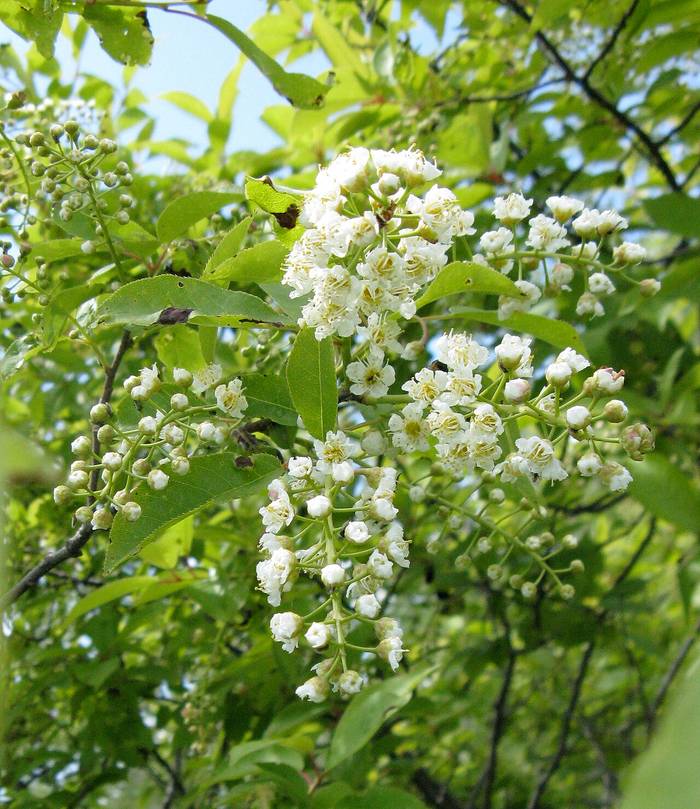
Chokecherry
Tree·Prunus virginiana
Part shade to full sun
Sun
Moist soil
Water
Not recorded
Drainage
Zones 2–7
Hardiness
Coverage · 108 fields
No obvious inconsistencies found.
Growth and size10 fields
Plant type
Deciduous tree“Prunus virginiana is a deciduous Shrub growing to 3.6 m (11ft 10in) at a fast rate.”
Height
360 cm · other sources: 600 cm“Prunus virginiana is a deciduous Shrub growing to 3.6 m (11ft 10in) at a fast rate.”Wikipedia“Forming a tree generally up to 6 metres (19+1⁄2 feet) tall, the leaves are oval, green, and smooth, with racemes of white flowers and red to black drupes.”
Spread
1,800 cm“Chokecherry is a suckering shrub or small tree typically growing to 1–6 metres (3+1⁄2–19+1⁄2 feet) tall—rarely to 10 m (33 ft)—and a substantial width of 18 m (60 ft).”
Height at age
—
empty
Spacing
450 cm (at least 300 cm)
AI estimate55 % agree
Growth rate
Fast“Prunus virginiana is a deciduous Shrub growing to 3.6 m (11ft 10in) at a fast rate.”
Habit
Spreading“The plant forms thickets by means of suckers from its extensive root system and can be planted for erosion control.”
Root depth
Medium
AI estimate63 % agree
Forest garden layer
Lower tree layer
AI estimate90 % agree
Lifespan
~40 years
AI estimatenot measured yet
Roots6 fields
Root form
Plate root (shallow)“The root pattern is flat with shallow roots forming a plate near the soil surface [1-2].”
Storage organ
None
AI estimate100 % agree
Lateral spread in cm
—
empty
Root depth in cm
—
empty
Mycorrhiza
Arbuscular (AM)
AI estimatenot measured yet
Light, water and soil9 fields
Sun
Full sun, light shade, part shade · best: full sun“Requires a sunny position.”PFAF“It can grow in semi-shade (light woodland) or no shade.”
Hours of sun
6 h
AI estimatenot measured yet
Drought tolerant
—
empty
Tolerates waterlogging
—
empty
Soil type
Sand, loam, clay · best: loam“Thrives in a loamy soil, doing well on limestone.”PFAF“Suitable for: light (sandy), medium (loamy) and heavy (clay) soils and prefers well-drained soil.”
Compacted soil
Copes fairly well
AI estimatenot measured yet
Climate5 fields
Hardiness
Zone 2–7
AI estimatenot measured yet
Killing frost
-40 °C
AI estimatenot measured yet
Growing temperature
5–30 °C · optimal 15–25 °C
AI estimatenot measured yet
Chill hours
800 h
AI estimatenot measured yet
Care (becomes tasks in Manage)1 fields
Pruning
February · lasts 28 days · dead, damaged, or crossing branches
AI estimatenot measured yet
Through the year7 fields
Leafing out
After the last frost · lasts 30 days
AI estimatenot measured yet
Harvest
After the previous stage · lasts 30 days“The chokecherry fruit can be eaten when fully ripe”
Dying back
After the first frost · lasts 30 days
AI estimatenot measured yet
Dormant
After the first frost · lasts 150 days
AI estimatenot measured yet
First harvest
1–2 years after plantingOrdinal wording converted (N-1): 'second year' -> 1 (rarely), first good fruit set 'before the fourth year' -> by the third year -> 2. Source does not say whether counted from planting.
Edible parts and pollination3 fields
The fruit
Cooked, jams, jellies, pies · July–September
AI estimatenot measured yet
Pollination
Self-fertile · hermaphrodite“The species is hermaphrodite (has both male and female organs) and is pollinated by Insects.”PFAF“The plant is self-fertile.”
Pollinated by
Insects“The species is hermaphrodite (has both male and female organs) and is pollinated by Insects.”
Ecology5 fields
Attracts
Bees and butterflies, other pollinators, birds, mammals“Yes – Prunus species are known for their showy flowers that produce both nectar and pollen, attracting bees, butterflies, and other pollinators.”Wikipedia“Many wildlife, including birds and game animals, eat the berries.”PFAF“The fruits are an important food source for birds and mammals, and the trees provide shelter through their dense foliage.”
Pests
Tent caterpillar, larvae of various lepidoptera, deer and elk (browsing)“The wild chokecherry is often considered a pest, as it is a host for the tent caterpillar, a threat to other fruit plants.”Wikipedia“The leaves serve as food for caterpillars of various Lepidoptera.”Wikipedia“Deer and elk sometimes browse the twigs profusely, not letting the plant grow above knee height.”
Takes up
Calcium, potassium
AI estimatenot measured yet
Fixes nitrogen
No
AI estimatenot measured yet
Propagation and names4 fields
Methods
Seed sown in a cold frame after 2-3 months cold stratification, half-ripe cuttings with a heel, softwood cuttings, layering, division of suckers“Seed - requires 2 - 3 months cold stratification and is best sown in a cold frame as soon as it is ripe.”PFAF“Cuttings of half-ripe wood with a heel, July/August in a frame.”PFAF“Softwood cuttings from strongly growing plants in spring to early summer in a frame.”PFAF“Layering in spring.”PFAF“Division of suckers during the dormant season.”
Difficulty
2 / 5
AI estimatenot measured yet
Seed
2-3 months cold stratification“Seed - requires 2 - 3 months cold stratification and is best sown in a cold frame as soon as it is ripe.”
Not sorted yet58 fields
Fields the parser stores that this page has no row for yet. They show up here automatically, so nothing is hidden.
forage.DK.local_name
virginsk hæg
AI estimatenot measured yet
forage.DK.prep_cautions
Remove pits before consumption, as they contain cyanogenic glycosides.
AI estimatenot measured yet
forage.DK.edibility_basis
inferred
AI estimatenot measured yet
forage.DK.foraging_months.months
7, 8, 9
AI estimatenot measured yet
forage.DK.foraging_months.year_round
false
AI estimatenot measured yet
forage.DK.habitat_affinity
woodland, hedgerow, verge
AI estimatenot measured yet
forage.US.local_name
Chokecherry
AI estimatenot measured yet
forage.US.edible_parts
[{"part":"fruit","caution":"Eat fruit only when fully ripe; unripe fruit contains a toxin.","preparation":"Raw when fully mature, or cooked; normally used in pies and jellies."},{"part":"seed","caution":"Do not eat th…“The chokecherry fruit can be eaten when fully ripe, but otherwise contains a toxin.”PFAF“Do not eat the seed if it is too bitter - see the notes above on toxicity.”PFAF“Fruit - raw or cooked. Very harsh, it is normally used in pies, jellies etc.”PFAF“Seed - raw or cooked. Very nutritious, they are added to pemmican.”PFAF“The bark and twigs are a tea substitute.”PFAF“It is in flower in May, and the seeds ripen in August.”
forage.US.prep_cautions
Eat fruit only when fully ripe; unripe fruit contains a toxin., Do not eat the stone; it is poisonous., Do not eat very bitter seed or fruit.“The chokecherry fruit can be eaten when fully ripe, but otherwise contains a toxin.”Wikipedia“The stone of the fruit is poisonous.”PFAF“Usually present in too small a quantity to do any harm, any very bitter seed or fruit should not be eaten.”
forage.US.edibility_basis
inferred
AI estimatenot measured yet
forage.US.foraging_months.notes
Fruit ripens in late summer to early autumn. Bark can be harvested throughout the growing season.
AI estimatenot measured yet
forage.US.foraging_months.year_round
false
AI estimatenot measured yet
forage.US.habitat_affinity
forage.TROPICAL.edibility_basis
inferred
AI estimatenot measured yet
forage.TROPICAL.foraging_months.notes
Not native to tropical regions.
AI estimatenot measured yet
forage.TROPICAL.foraging_months.year_round
false
AI estimatenot measured yet
ornamental.basis
documented
AI estimatenot measured yet
ornamental.fragrance.source
flower“While Prunus species are fragrant when blooming, they are not known for emitting strong pest-repelling scents.”
ornamental.fragrance.intensity
moderate
AI estimatenot measured yet
ornamental.confidence
high
AI estimatenot measured yet
ornamental.fall_interest
true
AI estimatenot measured yet
ornamental.flower_colour
white“white flowers are produced in racemes measuring 4–11 cm (1+1⁄2–4+1⁄4 in) long”
ornamental.evidence_quote
Prunus virginiana, commonly known as chokecherry, produces white flowers in spring, green foliage that turns yellow-green to red in autumn, and persistent dark red to black fruits that remain on the tree into winter.
AI estimatenot measured yet
ornamental.foliage_colour
dark_green“The leaves are oval, pointed, dark green above with a paler underside, smooth on both surfaces”
ornamental.foliage_texture
medium
AI estimatenot measured yet
ornamental.winter_structure
persistent_fruit
AI estimatenot measured yet
ornamental.autumn_foliage_colour
yellow_green, red
AI estimatenot measured yet
care_regime
none
AI estimatenot measured yet
propagation.self_seeding
moderate
AI estimate20 % agree
propagation.establishment_years
2
AI estimate40 % agree
spatial_profile.canopy_density
medium
AI estimatenot measured yet
forage_proposals.DK.edibility_tier.tier
caution
AI estimatenot measured yet
forage_proposals.DK.edibility_tier.confidence
high
AI estimatenot measured yet
forage_proposals.DK.edibility_tier.evidence_quote
The fruit is edible when cooked, but the seeds, leaves, and bark contain cyanogenic glycosides, which can be toxic if consumed in large quantities. Cooking the fruit helps to break down these compounds.
AI estimatenot measured yet
forage_proposals.US.edibility_tier.tier
caution“The unripe fruits are toxic, as is the stone and much of the plant, but the ripe fruits are edible, being part of Native American cuisine.”
forage_proposals.US.edibility_tier.confidence
high
AI estimatenot measured yet
forage_proposals.US.edibility_tier.evidence_quote
The fruit is edible when cooked, but the seeds, leaves, and bark contain cyanogenic glycosides, which can be toxic if consumed in large quantities. Cooking the fruit helps to break down these compounds.
AI estimatenot measured yet
forage_proposals.TROPICAL.edibility_tier.confidence
low
AI estimatenot measured yet
function_profile.biomass_return.confidence
medium
AI estimatenot measured yet
function_profile.nutrient_flows.consumes
[{"basis":"documented","demand":"moderate","nutrient":"nitrogen","confidence":"high"},{"basis":"documented","demand":"moderate","nutrient":"phosphorus","confidence":"high"},{"basis":"documented","demand":"moderate","n…
AI estimatenot measured yet
function_profile.nutrient_flows.provides
[{"basis":"inferred","nutrient":"calcium","mechanism":"biomass_return","confidence":"low"},{"basis":"inferred","nutrient":"potassium","mechanism":"biomass_return","confidence":"low"}]
AI estimatenot measured yet
function_profile.biotic_interactions
[{"taxa":["bees","butterflies","other pollinators"],"basis":"documented","valence":"beneficial","relation":"attracts","confidence":"medium","evidence_quote":"Yes – Prunus species are known for their showy flowers that…“Yes – Prunus species are known for their showy flowers that produce both nectar and pollen, attracting bees, butterflies, and other pollinators.”PFAF“Prunus species offer shelter for invertebrates, particularly in their rough bark and leaf litter.”Wikipedia“Many wildlife, including birds and game animals, eat the berries.”PFAF“The fruits are an important food source for birds and mammals, and the trees provide shelter through their dense foliage.”Wikipedia“The wild chokecherry is often considered a pest, as it is a host for the tent caterpillar, a threat to other fruit plants.”Wikipedia“The leaves serve as food for caterpillars of various Lepidoptera.”Wikipedia“Deer and elk sometimes browse the twigs profusely, not letting the plant grow above knee height.”PFAF“Plants in this genus are notably susceptible to honey fungus.”
function_profile.aromatic_pest_effect.value
false“No – While Prunus species are fragrant when blooming, they are not known for emitting strong pest-repelling scents.”
function_profile.aromatic_pest_effect.confidence
high
AI estimatenot measured yet
function_profile.structural_interfaces.provides_shelter.basis
taxonomic
AI estimatenot measured yet
function_profile.structural_interfaces.provides_shelter.kinds
shade, wind
AI estimatenot measured yet
function_profile.structural_interfaces.provides_shelter.confidence
medium
AI estimatenot measured yet
function_profile.structural_interfaces.provides_physical_support.form
trunk
AI estimatenot measured yet
function_profile.structural_interfaces.provides_physical_support.basis
taxonomic
AI estimatenot measured yet
function_profile.structural_interfaces.provides_physical_support.confidence
high
AI estimatenot measured yet
climate_tolerance.photoperiod_response
day_neutral
AI estimatenot measured yet
soil_interactions.organic_matter_contribution
medium
AI estimatenot measured yet
component_metadata.growth_cycle
perennial
AI estimate100 % agree
resource_interfaces.inputs
[{"resource":"light","quantity_description":"a sunny position for best fruiting"},{"resource":"shade","quantity_description":"tolerates semi-shade or no shade"},{"resource":"water","quantity_description":"moist soil"}…“Requires a sunny position.”PFAF“It can grow in semi-shade (light woodland) or no shade.”PFAF“It prefers moist soil.”PFAF“The species is hermaphrodite (has both male and female organs) and is pollinated by Insects.”
resource_interfaces.outputs
[{"resource":"fruit","quantity_description":"dark, juicy drupe up to 8 mm in diameter"},{"resource":"seeds","quantity_description":"single large seed in each fruit, edible"},{"resource":"nectar","quantity_description"…“The fruit is up to 8mm in diameter and contains a single large seed.”PFAF“Yes – Prunus species are known for their showy flowers that produce both nectar and pollen, attracting bees, butterflies, and other pollinators.”PFAF“The fruits are an important food source for birds and mammals, and the trees provide shelter through their dense foliage.”PFAF“Prunus species offer shelter for invertebrates, particularly in their rough bark and leaf litter.”PFAF“It is not valuable because of its small size and irregular shape, but is used for skewers etc.”PFAFpartly“Very nutritious, they are added to pemmican.”