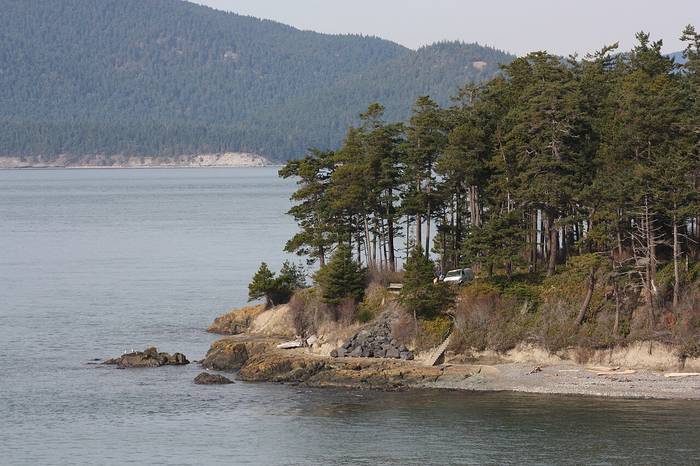
Walter Siegmund (talk) · CC BY-SA 3.0
Douglas fir
Tree·Pseudotsuga menziesii
Part shade to full sun
Sun
Moist to wet soil
Water
Not recorded
Drainage
Zones 4–9
Hardiness
Coverage · 106 fields
No obvious inconsistencies found.
Growth and size11 fields
Plant type
Evergreen tree“Pseudotsuga menziesii is an evergreen Tree growing to 75 m (246ft) by 20 m (65ft) at a fast rate.”
Height
7,500 cm“Pseudotsuga menziesii is an evergreen Tree growing to 75 m (246ft) by 20 m (65ft) at a fast rate.”
Spread
2,000 cm“Pseudotsuga menziesii is an evergreen Tree growing to 75 m (246ft) by 20 m (65ft) at a fast rate.”
Height at age
5,500 cm after 100 years“Trees in sheltered Scottish valleys have reached 55 metres in 100 years.”
Size after planting
13 yrs: 5 m tall, 2 m crown · 17 yrs: 11 m tall, 3 m crown · 36 yrs: 18 m tall, 5 m crown · 69 yrs: 22 m tall, 7.5 m crown“Berlin tree register: 2267 trees of this species measured with years since planting, height and crown diameter; median crown 7.5 m and height 22.0 m at 60–100 years after planting (788 trees).”Median of 2,267 measured trees in Berlin. Years count from planting nursery stock, so a small tree reaches each size later.
Spacing
1,000 cm (at least 600 cm)
AI estimate55 % agree
Growth rate
Fast“Pseudotsuga menziesii is an evergreen Tree growing to 75 m (246ft) by 20 m (65ft) at a fast rate.”
Habit
Columnar“The trunk is cylindrical, with short, flat-topped crown, giving it a columnar shape.”
Root depth
Taproot“However, it exhibits considerable morphological plasticity, and on drier sites P. menziesii var. menziesii will generate deeper taproots.”
Forest garden layer
Canopy
AI estimate90 % agree
Lifespan
~1,300 years“The largest coast Douglas-firs regularly live over 500 years, with the oldest specimens living for over 1,300 years.”
Roots6 fields
Root form
Taproot“However, it exhibits considerable morphological plasticity, and on drier sites P. menziesii var. menziesii will generate deeper taproots.”
Storage organ
None“No clonal growth organ is recorded: it does not spread vegetatively (no suckers, no rhizomes).”
Spreads
No“No clonal growth organ is recorded: it does not spread vegetatively (no suckers, no rhizomes).”
Lateral spread in cm
—
empty
Root depth in cm
—
empty
Mycorrhiza
Ectomycorrhizal (EcM)
AI estimatenot measured yet
Light, water and soil9 fields
Sun
Full sun, part shade, light shade · best: full sun“Trees can be established in light shade but this must be removed in the first few years or growth will suffer.”
PFAFpartly
Hours of sun
6 h
AI estimatenot measured yet
Water
Drought tolerant
—
empty
Tolerates waterlogging
—
empty
Soil type
Sand, loam, clay · best: loam“The best specimens are found on well-drained deep loamy soils with plenty of moisture.”PFAF“Suitable for: light (sandy), medium (loamy) and heavy (clay) soils.”
Drainage
Moist but not waterlogged; well-drained.“Prefers a moist but not water-logged alluvial soil.”
Compacted soil
Copes badly
AI estimatenot measured yet
Climate5 fields
Hardiness
Zone 4–9
AI estimatenot measured yet
Killing frost
-30 °C
AI estimatenot measured yet
Growing temperature
0–30 °C · optimal 10–25 °C
AI estimatenot measured yet
Chill hours
800 h
AI estimatenot measured yet
Through the year3 fields
Flowering
March · lasts 92 days“It is in leaf all year, in flower from March to May, and the seeds ripen from September to November.”
Fruiting
September · lasts 91 days“It is in leaf all year, in flower from March to May, and the seeds ripen from September to November.”
Edible parts and pollination5 fields
The needles
Tea · January–December
AI estimatenot measured yet
Inner bark (cambium)
Dried and ground into flour, or eaten raw · March–May
AI estimatenot measured yet
Young cones
Roasted or boiled · May–June
AI estimatenot measured yet
Pollination
Self-fertile · monoecious“Douglas fir is a monoecious unisexual species, commonly starting to produce cones at 12 to 15 years of age.”PFAF“The species is monoecious (individual flowers are either male or female, but both sexes can be found on the same plant) and is pollinated by Wind.”
Pollinated by
Wind“The species is monoecious (individual flowers are either male or female, but both sexes can be found on the same plant) and is pollinated by Wind.”
Ecology5 fields
Attracts
Small mammals (moles, shrews, chipmunks) feeding on seed“Douglas-fir seeds are an extremely important food source for small mammals such as moles, shrews, and chipmunks, which consume an estimated 65% of each annual seed crop.”
Pests
Woolly conifer aphid (adelges cooleyi), chionodes abella, chionodes periculella, cydia illutana, large pine weevil (hylobius abietis), douglas-fir beetle, douglas-fir dwarf mistletoe (arceuthobium douglasii), black-tailed deer, north american porcupine, douglas squirrel“The leaves are also used by the woolly conifer aphid Adelges cooleyi”Wikipedia“the gelechiid moths Chionodes abella and C. periculella as well as the cone scale-eating tortrix moth Cydia illutana have been recorded specifically on P. menziesii.”JRC forest tree atlas“Douglas fir coexists with the natural niche of the large pine weevil, to which it is highly susceptible.”Wikipedia“Other threats to Douglas-fir include red ring rot and the Douglas-fir beetle.”Wikipedia“A parasitic plant which uses P. menziesii is the Douglas-fir dwarf mistletoe (Arceuthobium douglasii).”Wikipedia“black-tailed deer browse new seedlings and saplings in spring and summer.”Wikipedia“The inner bark is the primary winter food for the North American porcupine.”Wikipedia“The Douglas squirrel harvests and hoards great quantities of Douglas-fir cones, and also consumes mature pollen cones, the inner bark, terminal shoots, and developing young needles.”
Diseases
Laminated root rot, shoestring root-rot, diplodia tip blight, red ring rot“Fungal diseases such as laminated root rot and shoestring root-rot can cause significant damage”Wikipedia“In Austria, Diplodia tip blight was reported to affect Douglas fir provenances.”Wikipedia“Other threats to Douglas-fir include red ring rot and the Douglas-fir beetle.”
Takes up
—
empty
Fixes nitrogen
No
AI estimatenot measured yet
Propagation and names4 fields
Methods
Seed sown in a cold frame, autumn to winter, seed sown in an outdoor seedbed, early spring“Seed - best sown in the autumn to winter in a cold frame so that it is stratified.”PFAF“If you have plenty of seed then it can be sown in an outdoor seedbed in early spring.”
Difficulty
3 / 5
AI estimatenot measured yet
Seed
autumn to winter sowing in a cold frame, so the seed is stratified“Seed - best sown in the autumn to winter in a cold frame so that it is stratified.”
Not sorted yet58 fields
Fields the parser stores that this page has no row for yet. They show up here automatically, so nothing is hidden.
forage.DK.local_name
Douglasgran
AI estimatenot measured yet
forage.DK.edibility_basis
inferred
AI estimatenot measured yet
forage.DK.foraging_months.notes
Needles can be harvested year-round, while inner bark and young cones are seasonal.
AI estimatenot measured yet
forage.DK.foraging_months.year_round
true
AI estimatenot measured yet
forage.DK.habitat_affinity
woodland
AI estimatenot measured yet
forage.US.edible_parts
[{"part":"young shoot tips","caution":null,"preparation":"used as a flavouring in cooked foods"},{"part":"young leaves and twigs","caution":null,"preparation":"steeped as a refreshing tea"},{"part":"fresh leaves","cau…“Young shoot tips - used as a flavouring in cooked foods.”PFAF“A refreshing tea is made from the young leaves and twigs.”PFAF“The fresh leaves have a pleasant balsamic odour and are used as a coffee substitute.”PFAF“Inner bark - dried, ground into a meal and mixed with cereals for making bread etc.”PFAF“A sweet manna-like substance is exuded from the bark.”
forage.US.edibility_basis
inferred
AI estimatenot measured yet
forage.US.foraging_months.notes
Needles can be harvested year-round, while inner bark and young cones are seasonal.
AI estimatenot measured yet
forage.US.habitat_affinity
woodland, coast“In its natural range Douglas fir grows in pure or mixed-species stands.”Wikipedia“grows in the coastal regions from west-central British Columbia southward to Central California”
ornamental.basis
documented
AI estimatenot measured yet
ornamental.confidence
high
AI estimatenot measured yet
ornamental.fall_interest
false
AI estimatenot measured yet
ornamental.flower_colour
ornamental.evidence_quote
The needles are dark green to blue-green, soft, and emit a strong, resinous fragrance when crushed. As an evergreen conifer, it retains its foliage year-round and does not exhibit autumn colour change.
AI estimatenot measured yet
ornamental.foliage_colour
dark_green“The petioled needles are flat, grooved, dark green above, lighter green below, and usually spreading all around the stem like the bristles of a bottle brush.”
ornamental.foliage_texture
fine
AI estimatenot measured yet
ornamental.winter_structure
evergreen_form, ornamental_bark“The tree is a conical, evergreen conifer with long whorled branches and drooping twigs.”PFAF“The gray bark is usually deeply furrowed.”
ornamental.autumn_foliage_colour
none
AI estimatenot measured yet
care_regime
none
AI estimatenot measured yet
propagation.self_seeding
moderate
AI estimate20 % agree
propagation.division_season
not applicable
AI estimatenot measured yet
propagation.establishment_years
5
AI estimate40 % agree
size_at_age.v
1
AI estimatenot measured yet
size_at_age.basis
years_after_planting
AI estimatenot measured yet
forage_proposals.DK.edibility_tier.tier
edible
AI estimatenot measured yet
forage_proposals.DK.edibility_tier.confidence
high
AI estimatenot measured yet
forage_proposals.DK.edibility_tier.evidence_quote
The needles can be used to make a refreshing tea, and the inner bark was traditionally eaten by indigenous peoples.
AI estimatenot measured yet
forage_proposals.US.edibility_tier.tier
edible
AI estimatenot measured yet
forage_proposals.US.edibility_tier.confidence
high
AI estimatenot measured yet
forage_proposals.US.edibility_tier.evidence_quote
The needles can be used to make a refreshing tea, and the inner bark was traditionally eaten by indigenous peoples.
AI estimatenot measured yet
function_profile.biomass_return.confidence
high
AI estimatenot measured yet
function_profile.nutrient_flows.consumes
[{"basis":"documented","demand":"moderate","nutrient":"nitrogen","confidence":"high"},{"basis":"documented","demand":"moderate","nutrient":"phosphorus","confidence":"high"},{"basis":"documented","demand":"moderate","n…
AI estimatenot measured yet
function_profile.nutrient_flows.provides
[{"basis":"inferred","nutrient":"calcium","mechanism":"biomass_return","confidence":"medium"},{"basis":"inferred","nutrient":"magnesium","mechanism":"biomass_return","confidence":"medium"}]
AI estimatenot measured yet
function_profile.biotic_interactions
[{"taxa":["woolly conifer aphid (Adelges cooleyi)"],"basis":"documented","valence":"harmful","relation":"hosts","confidence":"high","evidence_quote":"The leaves are also used by the woolly conifer aphid Adelges cooley…“The leaves are also used by the woolly conifer aphid Adelges cooleyi”Wikipedia“the gelechiid moths Chionodes abella and C. periculella as well as the cone scale-eating tortrix moth Cydia illutana have been recorded specifically on P. menziesii.”JRC forest tree atlas“Douglas fir coexists with the natural niche of the large pine weevil, to which it is highly susceptible.”Wikipedia“Other threats to Douglas-fir include red ring rot and the Douglas-fir beetle.”Wikipedia“Fungal diseases such as laminated root rot and shoestring root-rot can cause significant damage”Wikipedia“In Austria, Diplodia tip blight was reported to affect Douglas fir provenances.”Wikipedia“black-tailed deer browse new seedlings and saplings in spring and summer.”Wikipedia“The inner bark is the primary winter food for the North American porcupine.”Wikipedia“The Douglas squirrel harvests and hoards great quantities of Douglas-fir cones, and also consumes mature pollen cones, the inner bark, terminal shoots, and developing young needles.”Wikipedia“Douglas-fir seeds are an extremely important food source for small mammals such as moles, shrews, and chipmunks, which consume an estimated 65% of each annual seed crop.”Wikipedia“its diet consists chiefly of Douglas-fir needles”Wikipedia“The red tree vole nests almost exclusively on branches or in the trunks of the trees”Wikipediapartly“The Douglas squirrel harvests and hoards great quantities of Douglas-fir cones”Wikipediapartly“the primary habitat of the red tree vole (Arborimus longicaudus) and the spotted owl (Strix occidentalis)”
function_profile.aromatic_pest_effect.value
false
AI estimate80 % agree
function_profile.aromatic_pest_effect.confidence
low
AI estimatenot measured yet
function_profile.structural_interfaces.provides_shelter.basis
documented
AI estimatenot measured yet
function_profile.structural_interfaces.provides_shelter.kinds
wind, shade
AI estimatenot measured yet
function_profile.structural_interfaces.provides_shelter.confidence
high
AI estimatenot measured yet
function_profile.structural_interfaces.provides_shelter.evidence_quote
A fast growing and fairly wind-resistant tree, it is often used in shelterbelt plantings.
AI estimatenot measured yet
function_profile.structural_interfaces.requires_shelter.basis
inferred
AI estimatenot measured yet
function_profile.structural_interfaces.requires_shelter.kinds
shade
AI estimatenot measured yet
function_profile.structural_interfaces.requires_shelter.stage
establishment
AI estimatenot measured yet
function_profile.structural_interfaces.requires_shelter.confidence
low
AI estimatenot measured yet
function_profile.structural_interfaces.requires_shelter.evidence_quote
Trees can be established in light shade but this must be removed in the first few years or growth will suffer.
AI estimatenot measured yet
function_profile.structural_interfaces.provides_physical_support.form
trunk
AI estimatenot measured yet
function_profile.structural_interfaces.provides_physical_support.basis
taxonomic
AI estimatenot measured yet
function_profile.structural_interfaces.provides_physical_support.confidence
high
AI estimatenot measured yet
function_profile.structural_interfaces.requires_physical_support.basis
inferred
AI estimatenot measured yet
function_profile.structural_interfaces.requires_physical_support.confidence
low
AI estimatenot measured yet
climate_tolerance.photoperiod_response
day_neutral
AI estimatenot measured yet
soil_interactions.organic_matter_contribution
high
AI estimatenot measured yet
component_metadata.growth_cycle
perennial
AI estimate100 % agree
resource_interfaces.inputs
[{"resource":"light","quantity_description":"It cannot grow in the shade."},{"resource":"water","quantity_description":"Requires abundant rainfall for good growth."}]“It cannot grow in the shade.”PFAF“The trees require abundant rainfall for good growth.”
resource_interfaces.outputs
[{"resource":"wind_shelter","quantity_description":"Fairly wind-resistant; often used in shelterbelt plantings."},{"resource":"timber","quantity_description":"Heavy, strong, fine-grained, durable wood."},{"resource":"…“A fast growing and fairly wind-resistant tree, it is often used in shelterbelt plantings.”PFAF“Wood - heavy, strong, fine grained, durable, though it can be of variable quality.”Wikipedia“the primary habitat of the red tree vole (Arborimus longicaudus) and the spotted owl (Strix occidentalis)”PFAF“The leaves have a strong sweet fruity aroma.”PFAF“the seeds ripen from September to November”