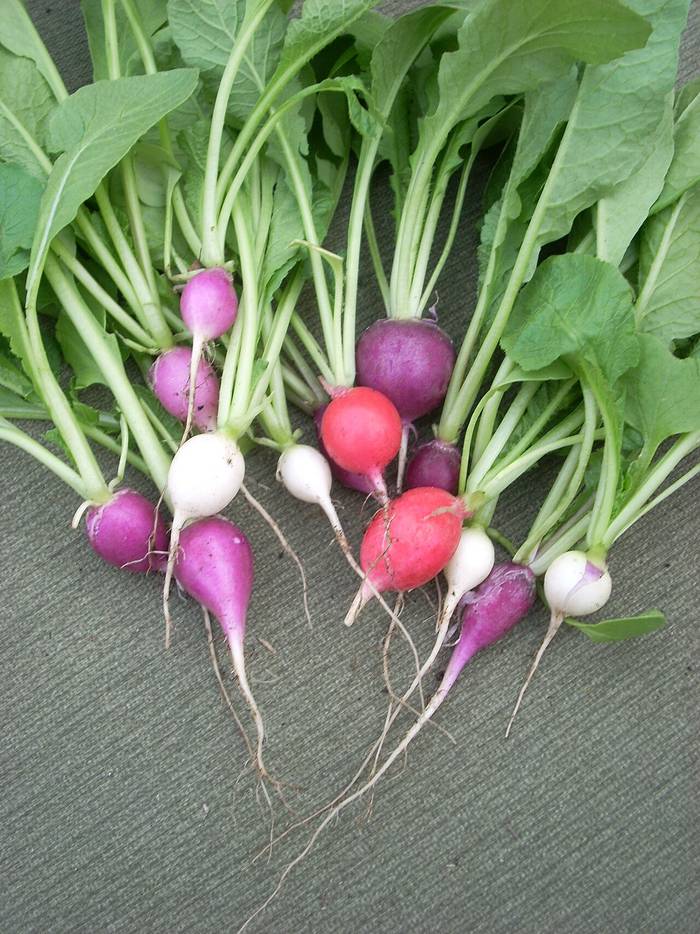
Radish
Plant·Raphanus sativus
Part shade to full sun
Sun
Moist soil
Water
Well-drained soil
Drainage
Zones 2–11
Hardiness
Coverage · 115 fields
Growth and size10 fields
Plant type
Plant
AI estimate100 % agree
Height
50 cm · other sources: 60 cm“Raphanus sativus is a ANNUAL growing to 0.5 m (1ft 8in) by 0.2 m (0ft 8in) at a fast rate.”Wikipedia“A longer root form, including oriental radishes, daikon or mooli, and winter radishes, grows up to 60 cm (24 in) long with foliage about 60 cm (24 in) high with a spread of 45 cm (18 in).”
Spread
20 cm · other sources: 45 cm“Raphanus sativus is a ANNUAL growing to 0.5 m (1ft 8in) by 0.2 m (0ft 8in) at a fast rate.”Wikipedia“A longer root form, including oriental radishes, daikon or mooli, and winter radishes, grows up to 60 cm (24 in) long with foliage about 60 cm (24 in) high with a spread of 45 cm (18 in).”
Height at age
—
empty
Spacing
5 cm (at least 2 cm)
AI estimate55 % agree
Growth rate
Fast“Raphanus sativus is a ANNUAL growing to 0.5 m (1ft 8in) by 0.2 m (0ft 8in) at a fast rate.”
Habit
Mounding
AI estimate50 % agree
Forest garden layer
Herb layer
AI estimate90 % agree
Lifespan
~1 years
AI estimatenot measured yet
Roots6 fields
Root form
Taproot“Radishes are annual or biennial brassicaceous crops grown for their swollen tap roots which can be globular, tapering, or cylindrical.”
Storage organ
None“It does not multiply vegetatively: it has no rhizomes, runners, suckers or offspring bulbs or tubers.”
Spreads
No“It does not multiply vegetatively: it has no rhizomes, runners, suckers or offspring bulbs or tubers.”
Lateral spread in cm
—
empty
Root depth in cm
—
empty
Mycorrhiza
Non-mycorrhizal
AI estimatenot measured yet
Light, water and soil9 fields
Sun
Full sun, light shade, part shade · best: full sun“Radishes grow best in full sun in light, sandy loams”PFAF“It can grow in semi-shade (light woodland) or no shade.”
Hours of sun
6–8 h
AI estimatenot measured yet
Drought tolerant
No“Plants are susceptible to drought and require irrigation during dry spells in the summer or the root quality will rapidly deteriorate and the plant will go to seed.”
Tolerates waterlogging
—
empty
Soil type
Sand, loam, clay · best: loam“Suitable for: light (sandy), medium (loamy) and heavy (clay) soils.”PFAF“Very easily cultivated fast-growing plants which prefer a rich light soil with ample moisture.”PFAF“They dislike very heavy or acid soils.”Wikipediapartly“Radishes grow best in full sun in light, sandy loams, with a soil pH 6.5 to 7.0, but for late-season crops, a clayey-loam is ideal.”
pH
4.3–8.3 · best 6.5–7“Radishes grow best in full sun in light, sandy loams, with a soil pH 6.5 to 7.0, but for late-season crops, a clayey-loam is ideal.”PFAF“Suitable pH: neutral and basic (mildly alkaline) soils.”
Compacted soil
Copes badly
AI estimatenot measured yet
Climate5 fields
Hardiness
Zone 2–11
AI estimatenot measured yet
Killing frost
-7 °C
AI estimatenot measured yet
Growing temperature
4–29 °C · optimal 10–18 °C“Best quality roots are obtained under moderate day lengths with air temperatures in the range 10 to 18 °C (50 to 65 °F).”
Wikipediapartly
Chill hours
0 h
AI estimatenot measured yet
Care (becomes tasks in Manage)4 fields
Sowing
March · lasts 120 days“Seed - sow outdoors in situ in succession from late winter to the middle of summer.”Wikipediapartly“The depth at which seeds are planted affects the size of the root, from 1 cm (1⁄2 in) deep recommended for small radishes to 4 cm (1+1⁄2 in) for large radishes.”
PFAFpartly
Watering
After rain“Plants are susceptible to drought and require irrigation during dry spells in the summer or the root quality will rapidly deteriorate and the plant will go to seed.”
Watering appears 2 times with different timing.
Weeding
After the previous stage · lasts 28 days“During the growing period, the crop needs to be thinned and weeds controlled, and irrigation may be required.”Wikipediapartly“Under average conditions, the crop matures in 3–4 weeks, but in colder weather, 6–7 weeks may be required.”
Wikipediapartly
Watering
April · lasts 150 days
Watering appears 2 times with different timing.
AI estimatenot measured yet
Through the year5 fields
Leafing out
Above 18 °C · lasts 4 days“The seed germinates in three to four days in moist conditions with soil temperatures between 18 and 29 °C (65 and 85 °F).”
Flowering
June · lasts 92 days“It is in flower from June to August, and the seeds ripen from July to September.”
Fruiting
July · lasts 92 days“It is in flower from June to August, and the seeds ripen from July to September.”
Harvest
After the previous stage · 21 days after · lasts 7 days“Under average conditions, the crop matures in 3–4 weeks, but in colder weather, 6–7 weeks may be required.”
Wikipediapartly
Dying back
Set by day length
AI estimatenot measured yet
Edible parts and pollination8 fields
Young flower clusters
Raw or cooked · June–August“Young flower clusters - raw or cooked.”PFAF“It is in flower from June to August”
The seeds
Raw, or sprouted · July–September“the seeds ripen from July to September”PFAFpartly“The seed can be soaked for 12 hours in warm water and then allowed to sprout for about 6 days.”
Young seedpods
Raw“Young seedpods - raw.”PFAF“They must be eaten when young because they quickly become tough and fibrous.”
The roots
Raw or cooked“Root - raw or cooked.”PFAF“The Japanese radishes have higher concentrations of glucosinolate, a substance that acts against the thyroid gland.”
Pollination
Self-fertile · hermaphrodite“The species is hermaphrodite (has both male and female organs) and is pollinated by Bees, flies.”PFAF“is pollinated by Bees, flies.”
Ecology5 fields
Attracts
Bees, flies“The species is hermaphrodite (has both male and female organs) and is pollinated by Bees, flies.”
Pests
Flea beetles, swede midge, cabbage root fly“The larvae of flea beetles live in the soil, but the adult beetles cause damage to the crop, biting small "shot holes" in the leaves, especially of seedlings.”Wikipedia“The swede midge (Contarinia nasturtii) attacks the foliage and growing tip of the plant and causes distortion, multiple (or no) growing tips, and swollen or crinkled leaves and stems.”Wikipedia“The larvae of the cabbage root fly sometimes attack the roots.”
Diseases
Club root“'Red King' has a mild flavor, with good resistance to club root, a problem that can arise from poor drainage.”
Takes up
—
empty
Fixes nitrogen
No
AI estimatenot measured yet
Propagation and names4 fields
Methods
Seed“Seed - sow outdoors in situ in succession from late winter to the middle of summer.”
Difficulty
1 / 5“Very easily cultivated fast-growing plants which prefer a rich light soil with ample moisture.”
PFAFpartly
Seed
none
AI estimatenot measured yet
Not sorted yet59 fields
Fields the parser stores that this page has no row for yet. They show up here automatically, so nothing is hidden.
forage.DK.local_name
Radise
AI estimatenot measured yet
forage.DK.warnings_da
Må ikke forveksles med giftige vilde sennepsarter.
AI estimatenot measured yet
forage.DK.warnings_en
Don't confuse it with poisonous wild mustards.
AI estimatenot measured yet
forage.DK.prep_cautions
Ensure proper identification to avoid confusion with toxic wild mustards.“It is probably best to remove the skin.”
PFAFpartly
forage.DK.edibility_basis
inferred
AI estimatenot measured yet
forage.DK.foraging_months.notes
Can be grown and harvested throughout the warmer months, with some varieties suitable for cooler season extension.
AI estimatenot measured yet
forage.DK.foraging_months.year_round
false
AI estimatenot measured yet
forage.DK.habitat_affinity
disturbed_ground
AI estimatenot measured yet
forage.US.local_name
Radish
AI estimatenot measured yet
forage.US.edible_parts
[{"part":"root","caution":null,"preparation":"raw","season_months":[4,5,6,7,8,9,10]},{"part":"leaves","caution":null,"preparation":"raw","season_months":[4,5,6,7,8,9,10]},{"part":"seed_pods","caution":null,"preparatio…
AI estimatenot measured yet
forage.US.prep_cautions
Ensure proper identification to avoid confusion with toxic wild mustards.
AI estimatenot measured yet
forage.US.edibility_basis
inferred
AI estimatenot measured yet
forage.US.foraging_months.notes
Can be grown and harvested throughout the warmer months, with some varieties suitable for cooler season extension.
AI estimatenot measured yet
forage.US.foraging_months.months
4, 5, 6, 7, 8, 9, 10
AI estimatenot measured yet
forage.US.foraging_months.year_round
false
AI estimatenot measured yet
forage.US.habitat_affinity
disturbed_ground
AI estimatenot measured yet
forage.TROPICAL.local_name
Radish
AI estimatenot measured yet
forage.TROPICAL.edible_parts
[{"part":"root","caution":null,"preparation":"raw","season_months":[1,2,3,4,5,6,7,8,9,10,11,12]},{"part":"leaves","caution":null,"preparation":"raw","season_months":[1,2,3,4,5,6,7,8,9,10,11,12]},{"part":"seed_pods","c…
AI estimatenot measured yet
forage.TROPICAL.prep_cautions
Ensure proper identification to avoid confusion with toxic wild mustards.
AI estimatenot measured yet
forage.TROPICAL.edibility_basis
inferred
AI estimatenot measured yet
forage.TROPICAL.foraging_months.notes
Can be grown year-round in suitable tropical climates.
AI estimatenot measured yet
forage.TROPICAL.foraging_months.months
1, 2, 3, 4, 5, 6, 7, 8, 9, 10, 11, 12
AI estimatenot measured yet
forage.TROPICAL.foraging_months.year_round
true
AI estimatenot measured yet
forage.TROPICAL.habitat_affinity
disturbed_ground
AI estimatenot measured yet
ornamental.basis
documented
AI estimatenot measured yet
ornamental.fragrance.source
none
AI estimate100 % agree
ornamental.confidence
high
AI estimatenot measured yet
ornamental.evidence_quote
Radish flowers are typically white, pink, or purple. The foliage is green and does not exhibit significant autumn color change. The plant is an annual and does not have winter structure or notable fragrance.
AI estimatenot measured yet
ornamental.foliage_colour
green
AI estimate82 % agree
ornamental.foliage_texture
medium
AI estimatenot measured yet
ornamental.winter_structure
none
AI estimatenot measured yet
ornamental.autumn_foliage_colour
none
AI estimatenot measured yet
care_regime
routine
AI estimatenot measured yet
propagation.self_seeding
moderate
AI estimate20 % agree
propagation.division_season
none
AI estimatenot measured yet
propagation.establishment_years
0
AI estimate40 % agree
forage_proposals.DK.edibility_tier.tier
edible
AI estimatenot measured yet
forage_proposals.DK.edibility_tier.confidence
high
AI estimatenot measured yet
forage_proposals.DK.edibility_tier.evidence_quote
the entire plant is edible“the entire plant is edible”
forage_proposals.US.edibility_tier.tier
edible
AI estimatenot measured yet
forage_proposals.US.edibility_tier.confidence
high
AI estimatenot measured yet
forage_proposals.US.edibility_tier.evidence_quote
The roots, leaves, and seed pods of Raphanus sativus are widely consumed as food items globally.
AI estimatenot measured yet
forage_proposals.TROPICAL.edibility_tier.tier
edible
AI estimatenot measured yet
forage_proposals.TROPICAL.edibility_tier.confidence
high
AI estimatenot measured yet
forage_proposals.TROPICAL.edibility_tier.evidence_quote
The roots, leaves, and seed pods of Raphanus sativus are widely consumed as food items globally.
AI estimatenot measured yet
function_profile.biomass_return.confidence
medium
AI estimatenot measured yet
function_profile.nutrient_flows.consumes
[{"basis":"documented","demand":"moderate","nutrient":"nitrogen","confidence":"high"},{"basis":"documented","demand":"moderate","nutrient":"phosphorus","confidence":"high"},{"basis":"documented","demand":"moderate","n…
AI estimatenot measured yet
function_profile.biotic_interactions
[{"taxa":["bees","flies"],"basis":"documented","valence":"beneficial","relation":"attracts","confidence":"high","evidence_quote":"The species is hermaphrodite (has both male and female organs) and is pollinated by Bee…“The species is hermaphrodite (has both male and female organs) and is pollinated by Bees, flies.”Wikipedia“They can also function as a trap crop, luring insect pests away from the main crop.”PFAF“They are said to repel cucumber beetles if planted near cucumber plants and they also repel the vine borers which attack squashes, marrows and courgettes.”PFAF“It is also useful for repelling various other insect pests such as carrot root fly.”Wikipedia“Radishes can be useful as companion plants for many other crops, probably because their pungent odour deters such insect pests as aphids, cucumber beetles, tomato hornworms, squash bugs, and ants.”Wikipedia“The larvae of flea beetles live in the soil, but the adult beetles cause damage to the crop, biting small "shot holes" in the leaves, especially of seedlings.”Wikipedia“The swede midge (Contarinia nasturtii) attacks the foliage and growing tip of the plant and causes distortion, multiple (or no) growing tips, and swollen or crinkled leaves and stems.”Wikipedia“The larvae of the cabbage root fly sometimes attack the roots.”Wikipedia“'Red King' has a mild flavor, with good resistance to club root, a problem that can arise from poor drainage.”
function_profile.aromatic_pest_effect.value
true“Radishes can be useful as companion plants for many other crops, probably because their pungent odour deters such insect pests as aphids, cucumber beetles, tomato hornworms, squash bugs, and ants.”
function_profile.aromatic_pest_effect.confidence
high
AI estimatenot measured yet
climate_tolerance.photoperiod_response
day_neutral
AI estimatenot measured yet
soil_interactions.organic_matter_contribution
medium
AI estimatenot measured yet
component_metadata.growth_cycle
annual“Raphanus sativus is a ANNUAL growing to 0.5 m (1ft 8in) by 0.2 m (0ft 8in) at a fast rate.”
resource_interfaces.inputs
[{"resource":"light","quantity_description":"Full sun is best; tolerates semi-shade or no shade."},{"resource":"water","quantity_description":"Prefers moist soil; needs irrigation during dry summer spells."},{"resourc…“Plants are susceptible to drought and require irrigation during dry spells in the summer or the root quality will rapidly deteriorate and the plant will go to seed.”PFAF“The species is hermaphrodite (has both male and female organs) and is pollinated by Bees, flies.”Wikipediapartly“Radishes grow best in full sun in light, sandy loams, with a soil pH 6.5 to 7.0, but for late-season crops, a clayey-loam is ideal.”
resource_interfaces.outputs
[{"resource":"mulch_biomass","quantity_description":"Fodder varieties grown as green manure or cover crop."},{"resource":"seeds","quantity_description":"Seed yields an edible oil; some types grown for seed."}]“An edible oil is obtained from the seed.”PFAFpartly“There is a fodder variety that grows more vigorously and is used as a green manure.”
biotic_relationships.repels
cucumber beetles, vine borers, carrot root fly, aphids, tomato hornworms, squash bugs, ants“They are said to repel cucumber beetles if planted near cucumber plants and they also repel the vine borers which attack squashes, marrows and courgettes.”PFAF“It is also useful for repelling various other insect pests such as carrot root fly.”Wikipedia“Radishes can be useful as companion plants for many other crops, probably because their pungent odour deters such insect pests as aphids, cucumber beetles, tomato hornworms, squash bugs, and ants.”