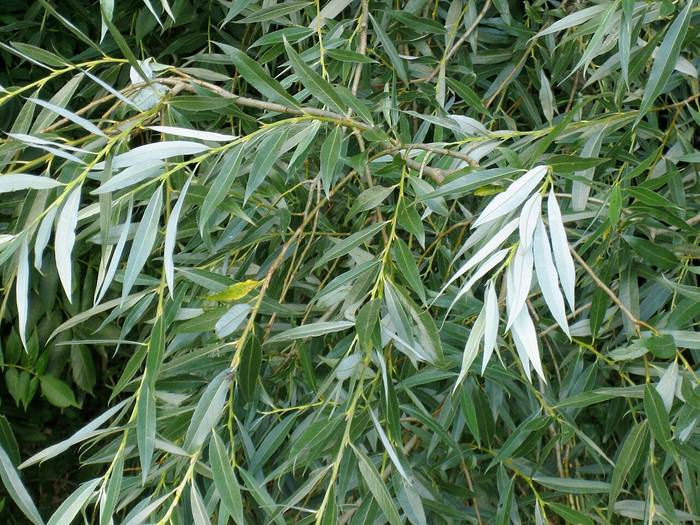
MPF · CC BY-SA 3.0
White willow
Tree·Salix alba
Full sun
Sun
Moist to boggy soil
Water
Not recorded
Drainage
Zones 2–9
Hardiness
Coverage · 121 fields
Growth and size11 fields
Plant type
Deciduous tree“Salix alba is a deciduous Tree growing to 25 m (82ft) by 10 m (32ft) at a fast rate.”
Height
2,500 cm · the source gives 1,000–3,000 cm · other sources: 3,000 cm“It is a medium to large deciduous tree growing up to 10–30 m (33–98 ft) tall, with a trunk up to 1 m (3.3 ft) diameter and an irregular, often-leaning crown.”PFAF“Salix alba is a deciduous Tree growing to 25 m (82ft) by 10 m (32ft) at a fast rate.”JRC forest tree atlas“It is one of the largest of the willow species and can reach heights of up to 30 m and a diameter of 1 m or more.”
Spread
1,000 cm“Salix alba is a deciduous Tree growing to 25 m (82ft) by 10 m (32ft) at a fast rate.”
Height at age
—
empty
Size after planting
7 yrs: 6 m tall, 4 m crown · 12 yrs: 8 m tall, 5 m crown · 16 yrs: 10 m tall, 5 m crown · 35 yrs: 14 m tall, 8 m crown · 71 yrs: 17 m tall, 11 m crown“Berlin tree register: 3073 trees of this species measured with years since planting, height and crown diameter; median crown 11.0 m and height 17.0 m at 60–100 years after planting (696 trees).”Median of 3,073 measured trees in Berlin. Years count from planting nursery stock, so a small tree reaches each size later.
Spacing
500 cm (at least 800 cm)“Spacing cuttings about every 5 metres will soon provide shelter and a suitable environment for planting out woodland trees that are not so wind tolerant.”
Growth rate
Fast“Salix alba is a deciduous Tree growing to 25 m (82ft) by 10 m (32ft) at a fast rate.”
Habit
Spreading
AI estimate50 % agree
Root depth
Deep
AI estimate63 % agree
Forest garden layer
Canopy
AI estimate90 % agree
Lifespan
~100 years
AI estimatenot measured yet
Roots6 fields
Root form
Fibrous roots
AI estimate43 % agree
Storage organ
None“No clonal growth organ is recorded: it does not spread vegetatively (no suckers, no rhizomes).”
Spreads
No“No clonal growth organ is recorded: it does not spread vegetatively (no suckers, no rhizomes).”
Lateral spread in cm
—
empty
Root depth in cm
—
empty
Mycorrhiza
Both AM and EcM
AI estimatenot measured yet
Light, water and soil9 fields
Sun
Full sun“It cannot grow in the shade.”JRC forest tree atlas“It is strongly light-demanding and does not tolerate shade.”
Hours of sun
6 h
AI estimatenot measured yet
Water
Moist, wet, standing water · Medium · 10 l/day“It prefers moist or wet soil.”PFAF“A very easily grown plant, it succeeds in most soils, including wet, ill-drained or intermittently flooded soils, but prefers a damp, heavy soil in a sunny position.”Wikipediapartly“Like all willows, Salix alba is usually to be found in wet or poorly-drained soil at the edge of pools, lakes or rivers.”
Drought tolerant
—
empty
Tolerates waterlogging
Yes“Adults of white willow are noticeably tolerant to inundation, performing better even in comparison with flood-tolerant taxa such as Ulmus laevis, Ulmus minor and Quercus robur.”
Soil type
Sand, loam, clay · best: clay“A very easily grown plant, it succeeds in most soils, including wet, ill-drained or intermittently flooded soils, but prefers a damp, heavy soil in a sunny position.”PFAF“Suitable for: light (sandy), medium (loamy) and heavy (clay) soils and can grow in heavy clay soil.”
Drainage
Moist to wet; tolerates ill-drained or intermittently flooded soil“A very easily grown plant, it succeeds in most soils, including wet, ill-drained or intermittently flooded soils, but prefers a damp, heavy soil in a sunny position.”
Compacted soil
Copes fairly well
AI estimatenot measured yet
Climate5 fields
Hardiness
Zone 2–9
Killing frost (-25 °C) doesn't fit hardiness zone 2, which survives far lower temperatures.
AI estimatenot measured yet
Killing frost
-25 °C
Killing frost (-25 °C) doesn't fit hardiness zone 2, which survives far lower temperatures.
AI estimatenot measured yet
Growing temperature
5–30 °C · optimal 10–25 °C
AI estimatenot measured yet
Chill hours
0 h
AI estimatenot measured yet
Native range
AD, AF, AL, AM, AT, AZ, BA, BE, BG, BY, CH, CN, CY, CZ, DE, DZ, EE, ES, FR, GE, GI, GR, HR, HU, IL, IQ, IR, IT, JO, KZ, LB, LI, LT, LU, MA, MC, MD, ME, MK, MT, NL, PL, PT, RO, RS, RU, SI, SK, SM, SY, TM, TN, TR, UA, UZ, VA, XK
Care (becomes tasks in Manage)4 fields
Pruning
After the previous stage
AI estimatenot measured yet
Sowing
After the previous stage
AI estimatenot measured yet
Pruning
November · lasts 60 days · dead, damaged, or crossing branches
AI estimatenot measured yet
Mulching
March · lasts 30 days
AI estimatenot measured yet
Through the year5 fields
Leafing out
After the last frost · lasts 30 days
AI estimatenot measured yet
Dying back
After the first frost · lasts 30 days
AI estimatenot measured yet
Dormant
After the first frost · 30 days after · lasts 150 days
AI estimatenot measured yet
Edible parts and pollination5 fields
Inner bark
The leaves
The young shoots
Pollination
Needs a partner · a male plant · dioecious“The species is dioecious (individual flowers are either male or female, but only one sex is to be found on any one plant so both male and female plants must be grown if seed is required).”PFAF“and is pollinated by Bees.”Wikipedia“The flowers are produced in catkins in early spring and are pollinated by insects.”PFAF“The plant is not self-fertile.”PFAF“Male and female plants must be grown if seed is required.”
Ecology5 fields
Attracts
Bees, pollinating insects, wildlife“A very important food plant for the caterpillars of many species of butterflies and a good bee plant, providing an early source of nectar and pollen.”JRC forest tree atlas“The yellow male catkins are up to 5 cm long; the female ones are shorter and greenish-yellow, becoming fluffy white, and attract pollinating insects.”PFAF“It is noted for attracting wildlife.”
Pests
Asian longhorned beetle (anoplophora glabripennis), gypsy moth (lymantria dispar), phytobia barnesi, porthetria obfuscate, yponomeuta rorella“The white willow is also attacked by the Asian longhorned beetle (Anoplophora glabripennis), despite showing noticeable resistance and thus potentially acting as overwintering reservoir of the beetle.”JRC forest tree atlas“It suffers from occasional but severe outbreaks of the gypsy moth (Lymantria dispar).”JRC forest tree atlas“Furthermore, it is susceptible to Phytobia barnesi, which impairs the wood quality, and to the defoliators Porthetria obfuscate and Yponomeuta rorella.”
Diseases
Watermark disease (brenneria salicis), willow anthracnose (marssonina salicicola)“being susceptible to several diseases, including watermark disease caused by the bacterium Brenneria salicis”Wikipedia“willow anthracnose, caused by the fungus Marssonina salicicola”
Takes up
—
empty
Fixes nitrogen
No
AI estimatenot measured yet
Propagation and names4 fields
Methods
Seed sown on the surface as soon as it is ripe in late spring, Cuttings of mature wood of the current year's growth, taken November to February, in a sheltered outdoor bed or planted straight into the permanent position, Cuttings of half-ripe wood, taken June to August in a frame“Seed - must be surface sown as soon as it is ripe in late spring.”PFAF“Cuttings of mature wood of the current year's growth, November to February in a sheltered outdoor bed or planted straight into their permanent position and given a good weed-suppressing mulch.”PFAF“Cuttings of half-ripe wood, June to August in a frame.”
Difficulty
2 / 5
AI estimatenot measured yet
Seed
cold stratification for 1-3 months
AI estimatenot measured yet
Not sorted yet67 fields
Fields the parser stores that this page has no row for yet. They show up here automatically, so nothing is hidden.
forage.DK.local_name
Hvid-pil
AI estimatenot measured yet
forage.DK.warnings_da
Bør ikke spises under graviditet.
AI estimatenot measured yet
forage.DK.warnings_en
Don't eat during pregnancy.
AI estimatenot measured yet
forage.DK.prep_cautions
forage.DK.edibility_basis
inferred
AI estimatenot measured yet
forage.DK.foraging_months.notes
Estimate: leaves and young shoots are available through the growing season; not stated in sources.
AI estimatenot measured yet
forage.DK.foraging_months.months
3, 4, 5, 6, 7, 8, 9
AI estimatenot measured yet
forage.DK.foraging_months.year_round
false
AI estimatenot measured yet
forage.DK.habitat_affinity
riverbank, woodland“By streams and rivers, marshes, woods and wet fens on richer soils.”
forage.US.edible_parts
[{"part":"young leaves","caution":"bitter, best in small quantities","preparation":"cooked","season_months":[4,5]},{"part":"inner bark","caution":"bitter, used as a famine food or medicinal","preparation":"dried and g…
AI estimatenot measured yet
forage.US.prep_cautions
bitter taste, contains salicin
AI estimatenot measured yet
forage.US.edibility_basis
inferred
AI estimatenot measured yet
forage.US.foraging_months.months
3, 4, 5, 6, 7, 8, 9
AI estimatenot measured yet
forage.US.foraging_months.year_round
false
AI estimatenot measured yet
forage.US.habitat_affinity
riverbank, disturbed_ground
AI estimatenot measured yet
forage.TROPICAL.edibility_basis
inferred
AI estimatenot measured yet
forage.TROPICAL.foraging_months.notes
Not typically found in tropical regions for foraging.
AI estimatenot measured yet
forage.TROPICAL.foraging_months.year_round
false
AI estimatenot measured yet
ornamental.basis
documented
AI estimatenot measured yet
ornamental.fragrance.source
none
AI estimate100 % agree
ornamental.fragrance.intensity
subtle
AI estimatenot measured yet
ornamental.confidence
high
AI estimatenot measured yet
ornamental.fall_interest
true
AI estimatenot measured yet
ornamental.flower_colour
yellow, green“The yellow male catkins are up to 5 cm long”JRC forest tree atlas“the female ones are shorter and greenish-yellow”
ornamental.evidence_quote
The foliage is grey-green, turning yellow-green in autumn. Winter interest comes from the coloured stems and architectural skeleton of the tree.
AI estimatenot measured yet
ornamental.foliage_texture
fine
AI estimatenot measured yet
ornamental.winter_structure
coloured_stems“is a cultivar grown in gardens for its shoots, which are golden-yellow for one to two years before turning brown.”
ornamental.autumn_foliage_colour
yellow_green
AI estimatenot measured yet
care_regime
none
AI estimatenot measured yet
propagation.self_seeding
moderate
AI estimate20 % agree
propagation.division_season
spring
AI estimatenot measured yet
propagation.establishment_years
1
AI estimate40 % agree
size_at_age.v
1
AI estimatenot measured yet
size_at_age.basis
years_after_planting
AI estimatenot measured yet
sun_requirement.best
full_sun“A very easily grown plant, it succeeds in most soils, including wet, ill-drained or intermittently flooded soils, but prefers a damp, heavy soil in a sunny position.”
forage_proposals.DK.edibility_tier.tier
caution
AI estimatenot measured yet
forage_proposals.DK.edibility_tier.confidence
high
AI estimatenot measured yet
forage_proposals.DK.edibility_tier.evidence_quote
The young leaves can be cooked and eaten, though they are bitter. The inner bark can be dried and ground into a flour, but it is also bitter and generally considered a famine food or for medicinal use due to its salicin content.
AI estimatenot measured yet
forage_proposals.US.edibility_tier.tier
caution
AI estimatenot measured yet
forage_proposals.US.edibility_tier.confidence
high
AI estimatenot measured yet
forage_proposals.US.edibility_tier.evidence_quote
Young leaves are edible cooked, but bitter. The inner bark can be used as a flour extender in survival situations, but its bitterness and salicin content limit its palatability and quantity.
AI estimatenot measured yet
forage_proposals.TROPICAL.edibility_tier.confidence
low
AI estimatenot measured yet
function_profile.biomass_return.confidence
high
AI estimatenot measured yet
function_profile.nutrient_flows.consumes
[{"basis":"inferred","demand":"high","nutrient":"nitrogen","confidence":"medium","evidence_quote":null},{"basis":"inferred","demand":"moderate","nutrient":"phosphorus","confidence":"medium","evidence_quote":null},{"ba…
AI estimatenot measured yet
function_profile.nutrient_flows.provides
[{"basis":"inferred","nutrient":"potassium","mechanism":"mineral_extraction","confidence":"medium","evidence_quote":null},{"basis":"inferred","nutrient":"calcium","mechanism":"mineral_extraction","confidence":"medium"…
AI estimatenot measured yet
function_profile.biotic_interactions
[{"taxa":["bees","pollinating insects"],"basis":"documented","valence":"beneficial","relation":"attracts","confidence":"high","evidence_quote":"A very important food plant for the caterpillars of many species of butte…“A very important food plant for the caterpillars of many species of butterflies and a good bee plant, providing an early source of nectar and pollen.”PFAF“It is noted for attracting wildlife.”PFAF“A very good wildlife habitat, more than 200 species of insects are associated with this tree.”JRC forest tree atlas“The yellow male catkins are up to 5 cm long; the female ones are shorter and greenish-yellow, becoming fluffy white, and attract pollinating insects.”JRC forest tree atlas“It suffers from occasional but severe outbreaks of the gypsy moth (Lymantria dispar).”JRC forest tree atlas“Furthermore, it is susceptible to Phytobia barnesi, which impairs the wood quality, and to the defoliators Porthetria obfuscate and Yponomeuta rorella.”Wikipedia“willow anthracnose, caused by the fungus Marssonina salicicola”JRC forest tree atlaspartly“The white willow is also attacked by the Asian longhorned beetle (Anoplophora glabripennis), despite showing noticeable resistance and thus potentially acting as overwintering reservoir of the beetle.”Wikipediapartly“being susceptible to several diseases, including watermark disease caused by the bacterium Brenneria salicis”
function_profile.aromatic_pest_effect.value
false
AI estimate80 % agree
function_profile.aromatic_pest_effect.confidence
low
AI estimatenot measured yet
function_profile.structural_interfaces.provides_shelter.basis
documented
AI estimatenot measured yet
function_profile.structural_interfaces.provides_shelter.kinds
wind, shade“A fast growing tree and tolerant of maritime exposure, it can be grown as a shelterbelt.”PFAF“Trees cast a relatively light shade.”
function_profile.structural_interfaces.provides_shelter.confidence
high
AI estimatenot measured yet
function_profile.structural_interfaces.provides_shelter.evidence_quote
A fast growing tree and tolerant of maritime exposure, it can be grown as a shelterbelt.
AI estimatenot measured yet
function_profile.structural_interfaces.requires_shelter.basis
documented
AI estimatenot measured yet
function_profile.structural_interfaces.requires_shelter.confidence
high
AI estimatenot measured yet
function_profile.structural_interfaces.provides_physical_support.form
trunk
AI estimatenot measured yet
function_profile.structural_interfaces.provides_physical_support.basis
taxonomic
AI estimatenot measured yet
function_profile.structural_interfaces.provides_physical_support.confidence
high
AI estimatenot measured yet
function_profile.structural_interfaces.provides_physical_support.evidence_quote
It is a medium to large deciduous tree growing up to 10–30 m (33–98 ft) tall, with a trunk up to 1 m (3.3 ft) diameter and an irregular, often-leaning crown.
AI estimatenot measured yet
function_profile.structural_interfaces.requires_physical_support.basis
taxonomic
AI estimatenot measured yet
function_profile.structural_interfaces.requires_physical_support.confidence
high
AI estimatenot measured yet
climate_tolerance.photoperiod_response
day_neutral
AI estimatenot measured yet
soil_interactions.organic_matter_contribution
high
AI estimatenot measured yet
component_metadata.growth_cycle
perennial
AI estimate100 % agree
resource_interfaces.inputs
[{"resource":"light","quantity_description":"strongly light-demanding; does not tolerate shade"},{"resource":"water","quantity_description":"moist or wet soil; roots need access to water"},{"resource":"pollination","q…“It is strongly light-demanding and does not tolerate shade.”PFAF“It prefers moist or wet soil.”Wikipedia“The flowers are produced in catkins in early spring and are pollinated by insects.”
resource_interfaces.outputs
[{"resource":"habitat","quantity_description":"more than 200 species of insects associated with the tree"},{"resource":"nectar","quantity_description":"early source of nectar"},{"resource":"pollen","quantity_descripti…“A very good wildlife habitat, more than 200 species of insects are associated with this tree.”PFAF“A very important food plant for the caterpillars of many species of butterflies and a good bee plant, providing an early source of nectar and pollen.”PFAF“Trees cast a relatively light shade.”PFAF“A fast growing tree and tolerant of maritime exposure, it can be grown as a shelterbelt.”PFAF“Wood - elastic, soft, easy to split, does not splinter.”PFAF“It is in flower from April to May, and the seeds ripen in June.”