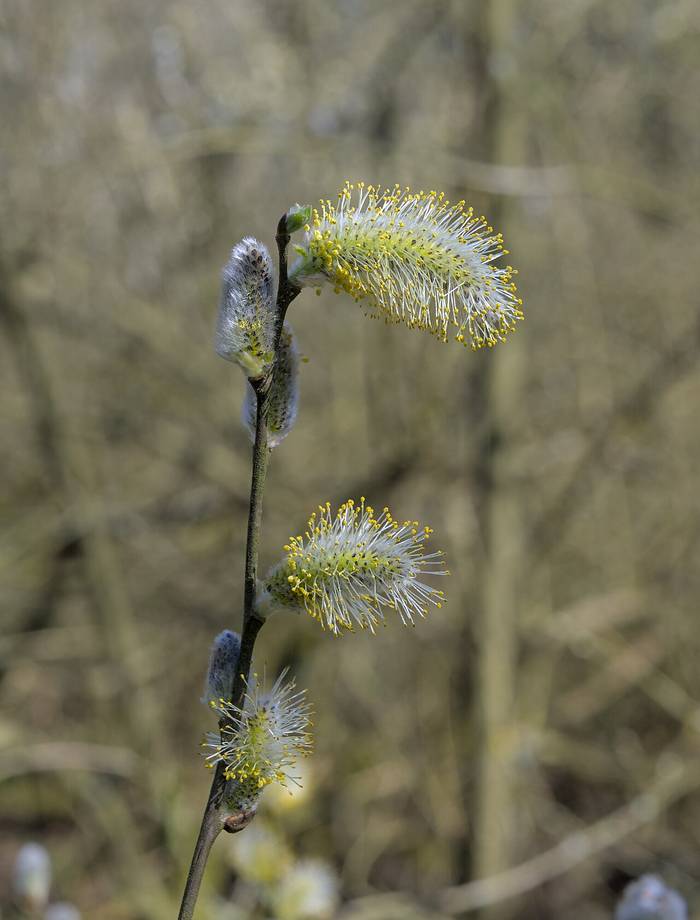
Goat willow
Goat willow (Salix caprea) is a tree. It grows best in full sun and has moderate water needs. It grows well with rowan.
About Goat willow
Goat willow is a perennial, deciduous tree that grows 8–10 m tall.[1][2] It grows fast.[1] It can live for around 60 years. Goat willow grows wild in Denmark.
The flowers give nectar and pollen to pollinators.[1][3]
The bark can be eaten.[1] The young shoots can be eaten too.[1] The leaves can be eaten too.[1] Recorded from the source text, not a safety check. Confirm with a trusted guide before eating anything.
How to plant goat willow
Goat willow does best in full sun, but also copes with shade.[1][3] It grows in sandy soil, loam and clay.[1] It does best at a pH of 5.5–8.5.[1] In a forest garden it belongs in the lower tree layer.[1]
Plant trees 1.5 m apart, at least 3 m.[1] It is well established after about a year. It can be propagated from seed or from cuttings.[1]
A year with Goat willow
Spring. It has yellow flowers in March.[1] Mulch around it in March and April. Spread well-rotted compost or bark chips on the soil around the plant. It comes into leaf in April.
Winter. It rests through the winter. It needs around 400 hours of winter cold to crop well. Prune it in February and March. Cut out dead, damaged, or crossing branches. Take a little off to tidy the shape. Less than you think. Leave new growth if coppicing alone.
Pests and diseases
Goat willow can be attacked by rhabdophaga rosaria (camellia gall midge), pontania pedunculi (leaf-galler sawfly), phyllocolpa (leaf-folder sawfly), nematus miliaris (sawfly), asian longhorned beetle (anoplophora glabripennis) and gypsy moth (lymantria dispar).[2][3] Diseases include melampsora capaearum (rust fungus), rhytisma salicinum (fungus) and honey fungus.[1][3]
Companions and wildlife
Goat willowSources
- Plants For A Future — Salix caprea · CC BY 4.0, Plants For A Future
- Wikipedia — Salix caprea · CC BY-SA 4.0
- JRC forest tree atlas · CC BY 4.0
- CLO-PLA (clonal growth) · Klimešová et al. 2017
- Berlin tree register · DL-DE-Zero-2.0
Added to the wiki 4 October 2026
Plan your garden with perma
Open app