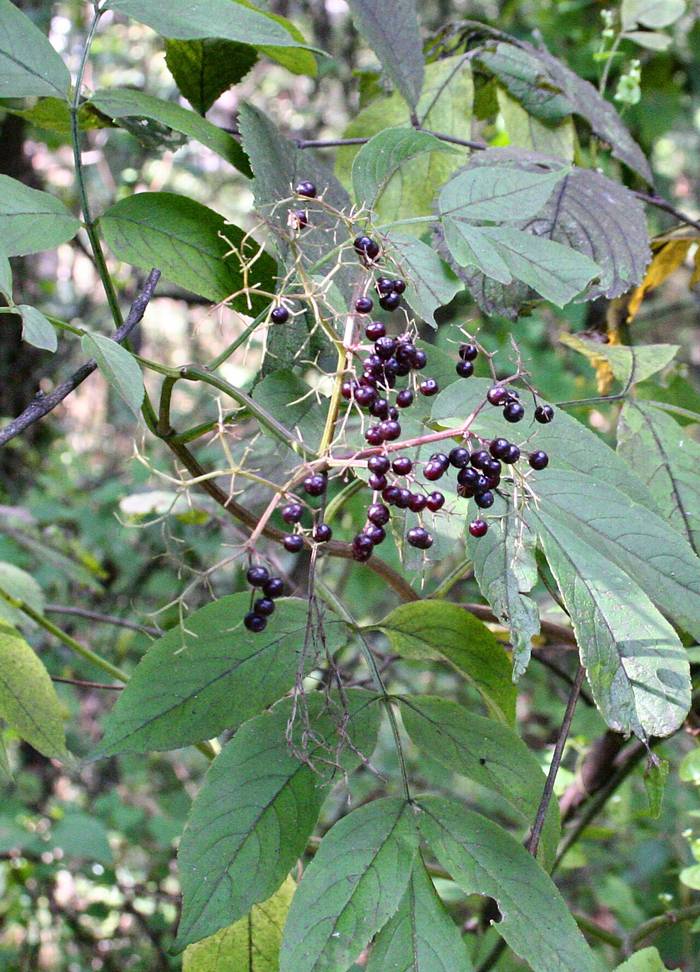
Tysto · CC BY 2.5
American elder
Shrub·Sambucus canadensis
Part shade to full sun
Sun
Moist to wet soil
Water
Not recorded
Drainage
Zones 3–10
Hardiness
Coverage · 115 fields
No obvious inconsistencies found.
Growth and size10 fields
Plant type
Deciduous shrub“Sambucus canadensis is a deciduous Shrub growing to 4 m (13ft) by 4 m (13ft) at a fast rate.”
Height
400 cm · other sources: 600 cm“Sambucus canadensis is a deciduous Shrub growing to 4 m (13ft) by 4 m (13ft) at a fast rate.”Wikipedia“It is a deciduous suckering shrub growing to 6 metres (20 feet) tall.”
Spread
400 cm“Sambucus canadensis is a deciduous Shrub growing to 4 m (13ft) by 4 m (13ft) at a fast rate.”
Height at age
—
empty
Spacing
240 cm (at least 180 cm)
AI estimate55 % agree
Growth rate
Fast“Sambucus canadensis is a deciduous Shrub growing to 4 m (13ft) by 4 m (13ft) at a fast rate.”
Habit
Spreading
AI estimate50 % agree
Root depth
Shallow“The root pattern is flat with shallow roots forming a plate near the soil surface [1-2].”
Forest garden layer
Shrub layer
AI estimate90 % agree
Lifespan
~60 years
AI estimatenot measured yet
Roots6 fields
Root form
Plate root (shallow)“The root pattern is flat with shallow roots forming a plate near the soil surface [1-2].”
Storage organ
—
empty
Spreads
By suckers“A fast-growing but short-lived plant, it often forms thickets by means of root suckers.”
Lateral spread in cm
—
empty
Root depth in cm
—
empty
Mycorrhiza
Arbuscular (AM)
AI estimatenot measured yet
Light, water and soil9 fields
Sun
Full sun, light shade, part shade · best: full sun“It can grow in semi-shade (light woodland) or no shade.”Wikipedia“It grows in full sun to partial shade and can tolerate moist.”
Hours of sun
6 h
AI estimatenot measured yet
Water
Drought tolerant
—
empty
Tolerates waterlogging
—
empty
Soil type
Sand, loam, clay · best: loam“Tolerates most soils, including chalk, but prefers a moist loamy soil.”PFAF“Suitable for: light (sandy), medium (loamy) and heavy (clay) soils and can grow in heavy clay soil.”
Drainage
Moist, well-drained“It prefers moist, well-drained soils and can thrive in a variety of environments, including disturbed areas.”
Compacted soil
Copes fairly well
AI estimatenot measured yet
Climate5 fields
Hardiness
Zone 3–10
AI estimatenot measured yet
Killing frost
-1 °C“Killing temp. early growth: -1”EcoCrop's figure is frost during early growth (spring frost on new shoots), not winter cold.
Growing temperature
5–25 °C · optimal 15–20 °C“Temperature absolute min: 5 · Temperature absolute max: 25 · Temperature optimal min: 15 · Temperature optimal max: 20”
Chill hours
400 h
AI estimatenot measured yet
Care (becomes tasks in Manage)3 fields
Pruning
February · lasts 28 days · new canes for fruit production · dead, damaged, or oldest canes
AI estimatenot measured yet
Mulching
April · lasts 30 days
AI estimatenot measured yet
Feeding
April · lasts 30 days · a balanced granular fertiliser or compost
AI estimatenot measured yet
Through the year7 fields
Leafing out
After the last frost · lasts 30 days
AI estimatenot measured yet
Harvest
August · lasts 60 days“Elderberries are usually harvested in late summer to early autumn, around August to September (Northern Hemisphere), when the berries are fully ripe.”
Dormant
After the first frost · lasts 150 days“Elderberry is tolerant of salt-laden gales and can be grown as a shelter hedge in exposed maritime areas, although it is bare in the winter.”
PFAFpartly
Fruiting
After the previous stage · 30 days after · lasts 45 days
AI estimatenot measured yet
Dying back
After the first frost · lasts 14 days
AI estimatenot measured yet
First harvest
0 years after plantingA small crop in the planting year (0); full production from the third year.
Edible parts and pollination5 fields
The flowers
The fruit
Cooked into pies, jams, jellies, sauces and bread; dried · August–September“Edible Parts: Flowers Fruit Leaves”PFAF“The fruit has been known to cause stomach upsets to some people.”PFAF“Elderberries are usually harvested in late summer to early autumn, around August to September (Northern Hemisphere), when the berries are fully ripe.”PFAFpartly“The fruit is normally cooked and used in pies, jams, jellies, sauces, bread etc.”
The young shoots
Cooked, as an asparagus substitute“Young shoots are said to be edible when cooked and to be used as an asparagus substitute though, since the leaves are also said to be poisonous, this report should be viewed with some doubt.”
Pollination
Self-fertile · hermaphrodite“The species is hermaphrodite (has both male and female organs) and is pollinated by Insects.”PFAF“The plant is self-fertile.”
Pollinated by
Insects“The species is hermaphrodite (has both male and female organs) and is pollinated by Insects.”
Ecology5 fields
Attracts
Pollinating insects, birds, small mammals“Yes – Elderberry flowers are highly attractive to pollinators like bees and other insects due to their abundant nectar and pollen.”PFAF“The berries are a valuable food source for birds and small mammals.”
Pests
Aphids, elderberry borer
AI estimatenot measured yet
Diseases
Powdery mildew, cankers
AI estimatenot measured yet
Takes up
—
empty
Fixes nitrogen
No
AI estimatenot measured yet
Propagation and names4 fields
Methods
Seed, Half-ripe wood cuttings, Mature wood cuttings, Division of suckers“Seed - best sown as soon as it is ripe in the autumn in a cold frame, when it should germinate in early spring.”PFAF“Cuttings of half-ripe wood, 7 - 10cm with a heel, July/August in a frame.”PFAF“Cuttings of mature wood of the current season's growth, 15 - 20cm with a heel, late autumn in a frame or a sheltered outdoor bed.”PFAF“Division of suckers in the dormant season.”
Difficulty
2 / 5
AI estimatenot measured yet
Seed
2 months warm followed by 2 months cold stratification“Stored seed can be sown in the spring in a cold frame but will probably germinate better if it is given 2 months warm followed by 2 months cold stratification first.”
Not sorted yet61 fields
Fields the parser stores that this page has no row for yet. They show up here automatically, so nothing is hidden.
forage.DK.local_name
canadisk hyld
AI estimatenot measured yet
forage.DK.warnings_da
Umodne bær og blade kan være giftige.
AI estimatenot measured yet
forage.DK.warnings_en
Unripe berries and leaves can be toxic.
AI estimatenot measured yet
forage.DK.prep_cautions
Cook or dry the fruit; fresh raw fruit tastes rank, Remove the seeds and cook the ripe berries, Leaves, stems, roots, seeds and unripe fruit can be toxic, The unripe fruit contains a toxic alkaloid and cyanogenic glycosides“They are at their best after being dried, the fresh raw fruit has a rather rank taste.”Wikipedia“Most parts of the plant are toxic with cyanogenic glycosides, but the ripe berries can be cooked for food use with the seeds removed.”Wikipedia“Inedible parts of the plant, such as the leaves, stems, roots, seeds and unripe fruits, can be toxic due to the presence of cyanogenic glycosides and alkaloids.”PFAF“The unripe fruit contains a toxic alkaloid and cyanogenic glycosides.”
forage.DK.edibility_basis
inferred
AI estimatenot measured yet
forage.DK.foraging_months.months
7, 8, 9“Elderberries are usually harvested in late summer to early autumn, around August to September (Northern Hemisphere), when the berries are fully ripe.”PFAFpartly“It is in flower in July, and the seeds ripen in September.”
forage.DK.foraging_months.year_round
false
AI estimatenot measured yet
forage.DK.habitat_affinity
riverbank, woodland, disturbed_ground“Rich moist soils along streams and rivers, woodland margins and waste ground.”
forage.US.local_name
American elderberry
AI estimatenot measured yet
forage.US.edible_parts
[{"part":"flowers","caution":null,"preparation":"Fritters, or tea from dried flowers","season_months":[7]},{"part":"fruit","caution":"Raw fruit may upset the stomach in some people","preparation":"Cooked into pies, ja…“Edible Parts: Flowers Fruit Leaves”PFAF“Young shoots are said to be edible when cooked and to be used as an asparagus substitute though, since the leaves are also said to be poisonous, this report should be viewed with some doubt.”PFAF“The fruit has been known to cause stomach upsets to some people.”PFAF“Flowers - raw or cooked. They are often covered in batter and made into fritters.”PFAF“Elderberries are usually harvested in late summer to early autumn, around August to September (Northern Hemisphere), when the berries are fully ripe.”PFAFpartly“The fruit is normally cooked and used in pies, jams, jellies, sauces, bread etc.”PFAFpartly“It is in flower in July, and the seeds ripen in September.”
forage.US.prep_cautions
Cook or dry the fruit; fresh raw fruit tastes rank, Remove the seeds and cook the ripe berries, Leaves, stems, roots, seeds and unripe fruit can be toxic, The unripe fruit contains a toxic alkaloid and cyanogenic glycosides“They are at their best after being dried, the fresh raw fruit has a rather rank taste.”Wikipedia“Most parts of the plant are toxic with cyanogenic glycosides, but the ripe berries can be cooked for food use with the seeds removed.”Wikipedia“Inedible parts of the plant, such as the leaves, stems, roots, seeds and unripe fruits, can be toxic due to the presence of cyanogenic glycosides and alkaloids.”PFAF“The unripe fruit contains a toxic alkaloid and cyanogenic glycosides.”
forage.US.edibility_basis
inferred
AI estimatenot measured yet
forage.US.foraging_months.notes
Flowers in early summer, berries ripen late summer to early autumn.
AI estimatenot measured yet
forage.US.foraging_months.months
7, 8, 9“Elderberries are usually harvested in late summer to early autumn, around August to September (Northern Hemisphere), when the berries are fully ripe.”PFAFpartly“It is in flower in July, and the seeds ripen in September.”
forage.US.foraging_months.year_round
false
AI estimatenot measured yet
forage.US.habitat_affinity
riverbank, woodland, disturbed_ground“Rich moist soils along streams and rivers, woodland margins and waste ground.”
forage.TROPICAL.edibility_basis
inferred
AI estimatenot measured yet
forage.TROPICAL.foraging_months.year_round
false
AI estimatenot measured yet
ornamental.basis
documented
AI estimatenot measured yet
ornamental.fragrance.intensity
subtle
AI estimatenot measured yet
ornamental.confidence
high
AI estimatenot measured yet
ornamental.flower_colour
white, cream“of white flowers above the foliage”PFAF“clusters of small white or cream-colored flowers”
ornamental.evidence_quote
American elderberry (Sambucus canadensis) produces clusters of small, creamy-white flowers in late spring to early summer, followed by dark purple berries. The foliage is typically green, turning yellow-green in autumn. The flowers have a subtle, sweet fragrance.
AI estimatenot measured yet
ornamental.foliage_colour
green
AI estimate82 % agree
ornamental.foliage_texture
medium
AI estimatenot measured yet
ornamental.autumn_foliage_colour
yellow_green
AI estimatenot measured yet
care_regime
none
AI estimatenot measured yet
propagation.self_seeding
moderate
AI estimate20 % agree
propagation.establishment_years
2
AI estimate40 % agree
forage_proposals.DK.edibility_tier.confidence
low
AI estimatenot measured yet
forage_proposals.US.edibility_tier.tier
caution
AI estimatenot measured yet
forage_proposals.US.edibility_tier.confidence
high
AI estimatenot measured yet
forage_proposals.US.edibility_tier.evidence_quote
The berries of Sambucus canadensis are edible when cooked, but raw berries and other plant parts contain cyanogenic glycosides that can cause nausea, vomiting, and diarrhea. Cooking neutralizes these compounds.
AI estimatenot measured yet
forage_proposals.TROPICAL.edibility_tier.confidence
low
AI estimatenot measured yet
function_profile.biomass_return.confidence
medium
AI estimatenot measured yet
function_profile.nutrient_flows.consumes
[{"basis":"documented","demand":"moderate","nutrient":"nitrogen","confidence":"high"},{"basis":"documented","demand":"moderate","nutrient":"phosphorus","confidence":"high"},{"basis":"documented","demand":"high","nutri…
AI estimatenot measured yet
function_profile.nutrient_flows.provides
[{"basis":"inferred","nutrient":"potassium","mechanism":"biomass_return","confidence":"medium"},{"basis":"inferred","nutrient":"calcium","mechanism":"biomass_return","confidence":"medium"}]
AI estimatenot measured yet
function_profile.biotic_interactions
[{"taxa":["bees","other insects"],"basis":"documented","valence":"beneficial","relation":"attracts","confidence":"high","evidence_quote":"Yes – Elderberry flowers are highly attractive to pollinators like bees and oth…“Yes – Elderberry flowers are highly attractive to pollinators like bees and other insects due to their abundant nectar and pollen.”PFAF“The berries are a valuable food source for birds and small mammals.”PFAF“The dense foliage and branching structure provide excellent cover and shelter for wildlife, and birds may nest within the shrub.”PFAF“The dense, shrubby growth provides overwintering habitat for insects.”
function_profile.aromatic_pest_effect.value
false“No – Elderberry does not produce a strong scent that would confuse or repel pests.”
function_profile.aromatic_pest_effect.confidence
low
AI estimatenot measured yet
function_profile.structural_interfaces.provides_shelter.basis
documented
AI estimatenot measured yet
function_profile.structural_interfaces.provides_shelter.kinds
wind, shade“It can be used as a hedge or windbreak and is often planted in riparian zones for erosion control.”
PFAFpartly
function_profile.structural_interfaces.provides_shelter.confidence
medium
AI estimatenot measured yet
function_profile.structural_interfaces.provides_shelter.evidence_quote
It can be used as a hedge or windbreak and is often planted in riparian zones for erosion control.
AI estimatenot measured yet
function_profile.structural_interfaces.requires_shelter.basis
inferred
AI estimatenot measured yet
function_profile.structural_interfaces.requires_shelter.confidence
low
AI estimatenot measured yet
function_profile.structural_interfaces.provides_physical_support.basis
inferred
AI estimatenot measured yet
function_profile.structural_interfaces.provides_physical_support.confidence
low
AI estimatenot measured yet
function_profile.structural_interfaces.requires_physical_support.basis
inferred
AI estimatenot measured yet
function_profile.structural_interfaces.requires_physical_support.confidence
low
AI estimatenot measured yet
climate_tolerance.photoperiod_response
day_neutral
AI estimatenot measured yet
soil_interactions.organic_matter_contribution
medium
AI estimatenot measured yet
component_metadata.growth_cycle
perennial
AI estimate100 % agree
resource_interfaces.inputs
[{"resource":"light","quantity_description":"tolerates some shade; fruit better in a sunny position"},{"resource":"water","quantity_description":"prefers moist soil"},{"resource":"pollination","quantity_description":"…“It takes some shade, but fruits are better in a sunny position.”PFAF“It prefers moist soil.”PFAFpartly“The species is hermaphrodite (has both male and female organs) and is pollinated by Insects.”
resource_interfaces.outputs
[{"resource":"pollinator_services","quantity_description":"attracts pollinators in agroforestry"},{"resource":"nectar","quantity_description":"flowers rich in nectar and pollen"},{"resource":"fruit","quantity_descript…“Elderberry is beneficial in agroforestry for attracting pollinators and wildlife.”PFAF“Yes – Elderberry flowers are highly attractive to pollinators like bees and other insects due to their abundant nectar and pollen.”PFAF“Yields of up to 7kg of fruit per tree have been recorded.”PFAF“The dense, shrubby growth provides overwintering habitat for insects.”PFAF“Leaf litter from elderberry can also provide ground cover for invertebrates.”PFAFpartly“It can be used as a hedge or windbreak and is often planted in riparian zones for erosion control.”