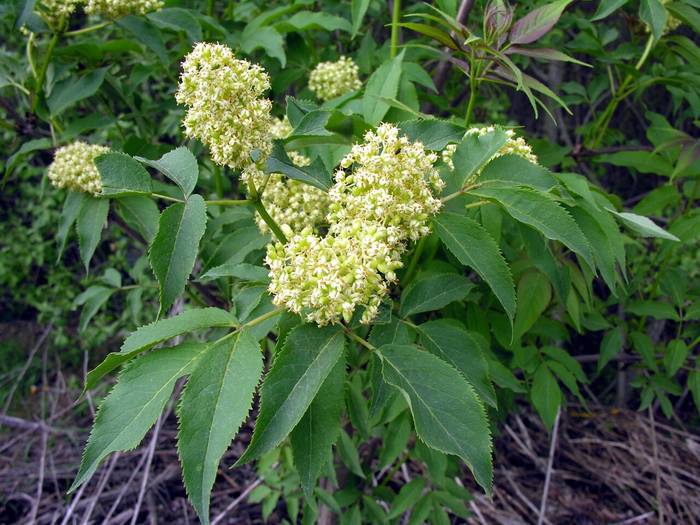
Algirdas at Lithuanian Wikipedia · CC BY-SA 3.0
red-berried elder
Shrub·Sambucus racemosa
Part shade to full sun
Sun
Moist to wet soil
Water
Not recorded
Drainage
Zones 3–9
Hardiness
Coverage · 119 fields
No obvious inconsistencies found.
Growth and size10 fields
Height
400 cm · the source gives 200–400 cm“Sambucus racemosa is medium-sized shrub growing 2–4 m (7–13 ft) (rarely 6 m (20 ft)) tall.”PFAF“Sambucus racemosa is a deciduous Shrub growing to 4 m (13ft 1in).”
Spread
300 cm
AI estimate58 % agree
Height at age
—
empty
Spacing
250 cm (at least 150 cm)
AI estimate55 % agree
Growth rate
—
empty
Habit
Spreading
AI estimate50 % agree
Root depth
Medium
AI estimate63 % agree
Forest garden layer
Shrub layer
AI estimate90 % agree
Lifespan
~20 years
AI estimatenot measured yet
Roots6 fields
Root form
Fibrous roots
AI estimate43 % agree
Storage organ
None“No clonal growth organ is recorded: it does not spread vegetatively (no suckers, no rhizomes).”
Spreads
No“No clonal growth organ is recorded: it does not spread vegetatively (no suckers, no rhizomes).”
Lateral spread in cm
—
empty
Root depth in cm
—
empty
Mycorrhiza
Arbuscular (AM)
AI estimatenot measured yet
Light, water and soil9 fields
Sun
Full sun, light shade, part shade · best: full sun“It can grow in semi-shade (light woodland) or no shade.”
PFAFpartly
Hours of sun
6–12 h
AI estimatenot measured yet
Water
Moist, wet · best: moist · Medium“It prefers moist soil.”PFAF“Moist to wet soils along streams, in woods and open areas from valleys to around 3,000 metres.”
Drought tolerant
—
empty
Tolerates waterlogging
—
empty
Soil type
Compacted soil
Copes fairly well
AI estimatenot measured yet
Climate5 fields
Hardiness
Zone 3–9
AI estimatenot measured yet
Killing frost
-35 °C
AI estimatenot measured yet
Growing temperature
0–30 °C · optimal 10–25 °C
AI estimatenot measured yet
Chill hours
400 h
AI estimatenot measured yet
Native range
AD, AL, AT, BA, BE, BG, BY, CA, CH, CZ, DE, ES, FR, GG, GI, GR, HR, HU, IT, JE, LI, LU, MC, MD, ME, MK, NL, PL, PM, RO, RS, RU, SI, SK, SM, UA, US, VA, XK
Care (becomes tasks in Manage)1 fields
Pruning
February · lasts 28 days · dead, damaged, or crossing branches
AI estimatenot measured yet
Through the year5 fields
Leafing out
After the last frost · Above 5 °C · lasts 30 days
AI estimatenot measured yet
Dying back
After the first frost · Set by day length · lasts 30 days
AI estimatenot measured yet
Dormant
After the first frost · 15 days after · lasts 150 days
AI estimatenot measured yet
Edible parts and pollination6 fields
The flowers
The fruit
The roots
Made into a tea-like beverage“The root is made into a tea-like beverage.”Wikipedia“The stems, roots and foliage are poisonous, and the fruit can be toxic or cause nausea if eaten raw.”
Pollination
Self-fertile · hermaphrodite“The species is hermaphrodite (has both male and female organs)”PFAF“and is pollinated by Insects”
Ecology5 fields
Attracts
Insects, flies, hoverflies, butterflies, hummingbirds, birds“The species is hermaphrodite (has both male and female organs) and is pollinated by Insects.”Wikipedia“The flowers are fragrant and visited by flies (particularly hoverflies), hummingbirds and butterflies.”Wikipedia“It is eaten by birds, which disperse the seeds in their droppings.”
Pests
Aphids, elderberry_borer
AI estimatenot measured yet
Diseases
Powdery_mildew, cankers
AI estimatenot measured yet
Takes up
Calcium, potassium
AI estimatenot measured yet
Fixes nitrogen
No
AI estimatenot measured yet
Propagation and names4 fields
Methods
Seed, cuttings of half-ripe wood, cuttings of mature wood“Seed - best sown as soon as it is ripe in the autumn in a cold frame, when it should germinate in early spring.”PFAF“Cuttings of half-ripe wood, 7 - 10cm with a heel, July/August in a frame.”PFAF“Cuttings of mature wood of the current season's growth, 15 - 20cm with a heel, late autumn in a frame or a sheltered outdoor bed.”
Difficulty
2 / 5
AI estimatenot measured yet
Seed
2 months warm followed by 2 months cold stratification“will probably germinate better if it is given 2 months warm followed by 2 months cold stratification first”
Not sorted yet68 fields
Fields the parser stores that this page has no row for yet. They show up here automatically, so nothing is hidden.
forage.DK.local_name
Rød hyld
AI estimatenot measured yet
forage.DK.warnings_da
Stængler, rødder og blade er giftige.
AI estimatenot measured yet
forage.DK.warnings_en
Stems, roots and leaves are poisonous.
AI estimatenot measured yet
forage.DK.prep_cautions
Berries are potentially poisonous raw and reportedly safe when cooked., Fruit can be dried before use, losing some of its rank taste., Stems, roots and foliage are poisonous., Any toxin in the fruit is reported to be destroyed by cooking.“Although potentially poisonous when raw, the berries are reportedly safe to eat when cooked.”PFAF“The fruit can be dried prior to use, it will then lose some of its rank taste.”Wikipedia“The stems, roots and foliage are poisonous, and the fruit can be toxic or cause nausea if eaten raw.”PFAF“Any toxin the fruit might contain is liable to be of very low toxicity and is destroyed when the fruit is cooked.”
forage.DK.edibility_basis
inferred
AI estimatenot measured yet
forage.DK.foraging_months.notes
Flowers in late spring, berries in summer to early autumn.
AI estimatenot measured yet
forage.DK.foraging_months.year_round
false
AI estimatenot measured yet
forage.DK.habitat_affinity
riverbank, woodland“It grows in riparian environments, woodlands, and other habitats, generally in moist areas.”
forage.US.local_name
Red elderberry
AI estimatenot measured yet
forage.US.edible_parts
[{"part":"flowers","caution":null,"preparation":"raw or cooked","season_months":[6,7]},{"part":"fruit","caution":"Raw fruit can be toxic or cause nausea.","preparation":"raw or cooked"},{"part":"root","caution":"Roots…“Edible Parts: Flowers Fruit”PFAF“The root is made into a tea-like beverage.”Wikipedia“The stems, roots and foliage are poisonous, and the fruit can be toxic or cause nausea if eaten raw.”PFAF“Flowers - raw or cooked.”PFAF“Fruit - raw or cooked.”PFAFpartly“It is in flower from June to July.”
forage.US.prep_cautions
Berries are potentially poisonous raw and reportedly safe when cooked., Fruit can be dried before use, losing some of its rank taste., Stems, roots and foliage are poisonous., Any toxin in the fruit is reported to be destroyed by cooking.“Although potentially poisonous when raw, the berries are reportedly safe to eat when cooked.”PFAF“The fruit can be dried prior to use, it will then lose some of its rank taste.”Wikipedia“The stems, roots and foliage are poisonous, and the fruit can be toxic or cause nausea if eaten raw.”PFAF“Any toxin the fruit might contain is liable to be of very low toxicity and is destroyed when the fruit is cooked.”
forage.US.edibility_basis
inferred
AI estimatenot measured yet
forage.US.foraging_months.notes
Flowers in late spring, berries in summer to early autumn.
AI estimatenot measured yet
forage.US.foraging_months.year_round
false
AI estimatenot measured yet
forage.US.habitat_affinity
riverbank, woodland“It grows in riparian environments, woodlands, and other habitats, generally in moist areas.”
forage.TROPICAL.edible_parts
[{"part":"berries","caution":"raw berries are mildly toxic","preparation":"cooked","season_months":[7,8,9]},{"part":"flowers","caution":null,"preparation":"cooked","season_months":[5,6]}]
AI estimatenot measured yet
forage.TROPICAL.prep_cautions
raw berries are mildly toxic and should be cooked
AI estimatenot measured yet
forage.TROPICAL.edibility_basis
inferred
AI estimatenot measured yet
forage.TROPICAL.foraging_months.notes
Flowers in late spring, berries in summer to early autumn.
AI estimatenot measured yet
forage.TROPICAL.foraging_months.months
5, 6, 7, 8, 9
AI estimatenot measured yet
forage.TROPICAL.foraging_months.year_round
false
AI estimatenot measured yet
forage.TROPICAL.habitat_affinity
woodland, disturbed_ground
AI estimatenot measured yet
ornamental.basis
documented
AI estimatenot measured yet
ornamental.fragrance.source
flower“The flowers are fragrant and visited by flies (particularly hoverflies), hummingbirds and butterflies.”
ornamental.fragrance.intensity
subtle
AI estimatenot measured yet
ornamental.confidence
high
AI estimatenot measured yet
ornamental.fall_interest
true
AI estimatenot measured yet
ornamental.flower_colour
white, cream, yellow“the open flowers are white, cream, or yellowish”
ornamental.evidence_quote
Sambucus racemosa, commonly known as red elderberry, produces creamy-yellow flowers in spring, followed by bright red berries in summer. Its green foliage turns yellowish-green in autumn. The berries persist into winter, providing ornamental interest.
AI estimatenot measured yet
ornamental.foliage_colour
green
AI estimate82 % agree
ornamental.foliage_texture
medium
AI estimatenot measured yet
ornamental.winter_structure
persistent_fruit
AI estimatenot measured yet
ornamental.autumn_foliage_colour
yellow_green
AI estimatenot measured yet
care_regime
none
AI estimatenot measured yet
propagation.self_seeding
moderate
AI estimate20 % agree
propagation.division_season
autumn
AI estimatenot measured yet
propagation.establishment_years
2
AI estimate40 % agree
spatial_profile.canopy_density
medium
AI estimatenot measured yet
forage_proposals.DK.edibility_tier.tier
caution
AI estimatenot measured yet
forage_proposals.DK.edibility_tier.confidence
high
AI estimatenot measured yet
forage_proposals.DK.edibility_tier.evidence_quote
The berries of Sambucus racemosa are considered mildly toxic when raw due to cyanogenic glycosides, which are destroyed by cooking. The flowers are generally considered safe.
AI estimatenot measured yet
forage_proposals.US.edibility_tier.tier
caution
AI estimatenot measured yet
forage_proposals.US.edibility_tier.confidence
high
AI estimatenot measured yet
forage_proposals.US.edibility_tier.evidence_quote
The berries of Sambucus racemosa are considered mildly toxic when raw due to cyanogenic glycosides, which are destroyed by cooking. The flowers are generally considered safe.
AI estimatenot measured yet
forage_proposals.TROPICAL.edibility_tier.confidence
low
AI estimatenot measured yet
function_profile.biomass_return.confidence
high
AI estimatenot measured yet
function_profile.nutrient_flows.consumes
[{"basis":"documented","demand":"moderate","nutrient":"nitrogen","confidence":"high"},{"basis":"documented","demand":"moderate","nutrient":"phosphorus","confidence":"high"},{"basis":"documented","demand":"moderate","n…
AI estimatenot measured yet
function_profile.nutrient_flows.provides
[{"basis":"inferred","nutrient":"calcium","mechanism":"biomass_return","confidence":"medium"},{"basis":"inferred","nutrient":"potassium","mechanism":"biomass_return","confidence":"medium"}]
AI estimatenot measured yet
function_profile.biotic_interactions
[{"taxa":["bees","flies"],"basis":"documented","valence":"beneficial","relation":"attracts","confidence":"high","organism_group":"pollinator","ecological_function":"pollination"},{"taxa":["robins","waxwings"],"basis":…
AI estimatenot measured yet
function_profile.aromatic_pest_effect.value
false
AI estimate80 % agree
function_profile.aromatic_pest_effect.confidence
low
AI estimatenot measured yet
function_profile.structural_interfaces.provides_shelter.basis
inferred
AI estimatenot measured yet
function_profile.structural_interfaces.provides_shelter.kinds
wind, shade
AI estimatenot measured yet
function_profile.structural_interfaces.provides_shelter.confidence
medium
AI estimatenot measured yet
function_profile.structural_interfaces.requires_shelter.basis
inferred
AI estimatenot measured yet
function_profile.structural_interfaces.requires_shelter.confidence
low
AI estimatenot measured yet
function_profile.structural_interfaces.provides_physical_support.basis
inferred
AI estimatenot measured yet
function_profile.structural_interfaces.provides_physical_support.confidence
low
AI estimatenot measured yet
function_profile.structural_interfaces.requires_physical_support.basis
inferred
AI estimatenot measured yet
function_profile.structural_interfaces.requires_physical_support.confidence
low
AI estimatenot measured yet
climate_tolerance.photoperiod_response
day_neutral
AI estimatenot measured yet
soil_interactions.organic_matter_contribution
high
AI estimatenot measured yet
component_metadata.growth_cycle
perennial
AI estimate100 % agree
resource_interfaces.inputs
[{"resource":"light","quantity_description":"best in a sunny position; tolerates some shade"},{"resource":"water","quantity_description":"prefers moist soil"},{"resource":"shade","quantity_description":"grows in semi-…“Tolerates some shade but is best in a sunny position.”PFAF“It prefers moist soil.”PFAF“It can grow in semi-shade (light woodland) or no shade.”PFAF“The species is hermaphrodite (has both male and female organs) and is pollinated by Insects.”
resource_interfaces.outputs
[{"resource":"fruit","quantity_description":"bright red drupe, 3 to 5 seeds per fruit"},{"resource":"seeds","quantity_description":"dispersed by birds in their droppings"},{"resource":"pollinator_services","quantity_d…“The fruit is a bright red drupe (to purple-black in var. melanocarpa) containing 3 to 5 seeds.”Wikipedia“It is eaten by birds, which disperse the seeds in their droppings.”Wikipedia“The flowers are fragrant and visited by flies (particularly hoverflies), hummingbirds and butterflies.”Wikipedia“The leaflets have a strong disagreeable scent when crushed.”