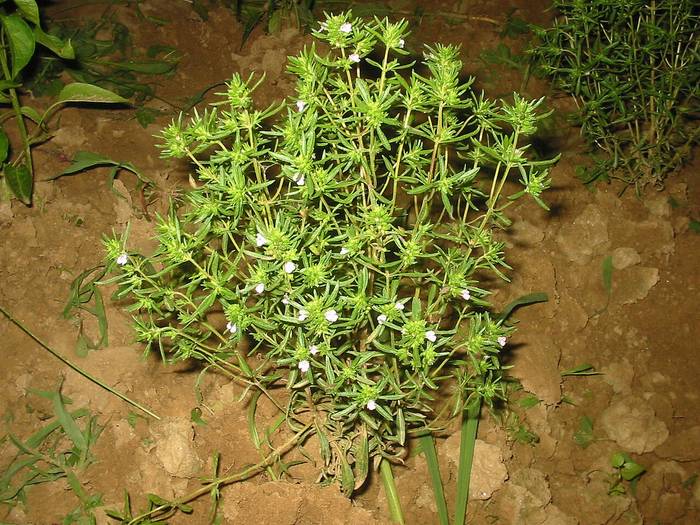
No machine-readable author provided. Bogdan assumed (based on copyright claims). · CC BY-SA 3.0
Summer savory
Plant·Satureja hortensis
Full sun
Sun
Dry to moist soil
Water
Well-drained soil
Drainage
Zones 3–11
Hardiness
Coverage · 110 fields
Growth and size10 fields
Plant type
Plant
AI estimate100 % agree
Height
30 cm · other sources: 60 cm“Satureja hortensis is a ANNUAL growing to 0.3 m (1ft) by 0.4 m (1ft 4in).”Wikipedia“It grows to around 30 to 60 cm (1 to 2 ft) in height and has very slender, bronze-green leaves.”
Height at age
—
empty
Spacing
20 cm (at least 15 cm)
AI estimate55 % agree
Habit
Mounding
AI estimate50 % agree
Root depth
Shallow
AI estimate63 % agree
Forest garden layer
Herb layer
AI estimate90 % agree
Roots6 fields
Root form
Fibrous roots
AI estimate43 % agree
Storage organ
None“It does not multiply vegetatively: it has no rhizomes, runners, suckers or offspring bulbs or tubers.”
Spreads
No“It does not multiply vegetatively: it has no rhizomes, runners, suckers or offspring bulbs or tubers.”
Lateral spread in cm
—
empty
Root depth in cm
—
empty
Mycorrhiza
Arbuscular (AM)
AI estimatenot measured yet
Light, water and soil9 fields
Sun
Full sun“A very easily grown plant when given suitable conditions, it prefers a rich light soil with plenty of moisture and succeeds in a hot dry sunny position.”
Hours of sun
6–8 h
AI estimatenot measured yet
Tolerates waterlogging
No“It is very intolerant of soils that remain damp and dislikes shade.”
PFAFpartly
Soil type
Sand, loam · best: sand“Suitable for: light (sandy) and medium (loamy) soils and prefers well-drained soil.”
pH
5.5–8.2 · best 6–7“Suitable pH: mildly acid, neutral and basic (mildly alkaline) soils and can grow in very alkaline soils.”
Drainage
Well drained“Suitable for: light (sandy) and medium (loamy) soils and prefers well-drained soil.”
Compacted soil
Copes fairly well
AI estimatenot measured yet
Climate5 fields
Hardiness
Zone 3–11
AI estimatenot measured yet
Killing frost
-5 °C
AI estimatenot measured yet
Growing temperature
14–30 °C · optimal 20–26 °C“Temperature absolute min: 14 · Temperature absolute max: 30 · Temperature optimal min: 20 · Temperature optimal max: 26”
Chill hours
0 h
AI estimatenot measured yet
Care (becomes tasks in Manage)7 fields
Sowing
April“Seed - sow April in situ and only just cover.”
Sowing appears 3 times with different timing.
Sowing
After the first frost“In areas with mild winters an autumn sowing will provide an earlier supply of leaves.”
Sowing appears 3 times with different timing.
PFAFpartly
Pruning
June · the tops“The early spring seedlings are often topped for fresh use in June.”
Pruning appears 2 times with different timing.
Pruning
After the previous stage“If cut back as the flower buds appear, it will produce a fresh flush of leaves.”
Pruning appears 2 times with different timing.
Sowing
After the last frost · 14 days after
Sowing appears 3 times with different timing.
AI estimatenot measured yet
Watering
June · lasts 90 days
AI estimatenot measured yet
Mulching
After the previous stage · 30 days after
AI estimatenot measured yet
Through the year6 fields
Flowering
July · lasts 62 days“It is in flower from July to August, and the seeds ripen from August to September.”
Harvest
After the previous stage · -1 days after“The leaves are harvested just before the plant comes into flower.”
Harvest
June · lasts 30 days“The early spring seedlings are often topped for fresh use in June.”
Dying back
After the first frost“The plant only lives for a single summer which makes it an annual plant.”
Edible parts and pollination4 fields
The leaves
Raw or cooked; fresh or dried; as a herb tea“Edible Parts: Leaves Shoots”PFAFpartly“Leaves - raw or cooked.”
PFAFpartly
Flowering shoots
Essential oil used as a food flavouring“The flowering shoots contain about 0.5% essential oil, this is used as a food flavouring.”PFAFpartly“Edible Parts: Leaves Shoots”
Pollination
Self-fertile · hermaphrodite“The species is hermaphrodite (has both male and female organs) and is pollinated by Insects.”Wikipedia“The main pollinators of summer savory are bees, bumblebees, wasps, Bombyliidae and hoverflies, which support plant reproduction and seed production.”PFAF“The plant is self-fertile.”
Ecology5 fields
Attracts
Bees, bumblebees, wasps, Bombyliidae, hoverflies, wildlife“The main pollinators of summer savory are bees, bumblebees, wasps, Bombyliidae and hoverflies, which support plant reproduction and seed production.”PFAF“It is noted for attracting wildlife.”
Pests
—
empty
Diseases
—
empty
Takes up
—
empty
Fixes nitrogen
No
AI estimatenot measured yet
Propagation and names4 fields
Methods
Seed, cutting“Seed - sow April in situ and only just cover.”Wikipedia“while also being easily cultivated from seed or cutting.”
Seed
none
AI estimatenot measured yet
Not sorted yet54 fields
Fields the parser stores that this page has no row for yet. They show up here automatically, so nothing is hidden.
forage.DK.local_name
Sommer Sar
AI estimatenot measured yet
forage.DK.edibility_basis
inferred
AI estimatenot measured yet
forage.DK.foraging_months.notes
The leaves are harvested just before the plant comes into flower.“The leaves are harvested just before the plant comes into flower.”
forage.DK.foraging_months.months
6, 7, 8, 9“The early spring seedlings are often topped for fresh use in June.”
Wikipediapartly
forage.DK.foraging_months.year_round
false
AI estimatenot measured yet
forage.DK.habitat_affinity
disturbed_ground
AI estimatenot measured yet
forage.US.local_name
Summer savory
AI estimatenot measured yet
forage.US.edible_parts
[{"part":"leaves","caution":null,"preparation":"raw or cooked; fresh or dried; as a herb tea"},{"part":"flowering shoots","caution":null,"preparation":"essential oil used as a food flavouring"}]“The flowering shoots contain about 0.5% essential oil, this is used as a food flavouring.”PFAFpartly“Edible Parts: Leaves Shoots”PFAFpartly“Leaves - raw or cooked.”
forage.US.edibility_basis
inferred
AI estimatenot measured yet
forage.US.foraging_months.notes
The leaves are harvested just before the plant comes into flower.“The leaves are harvested just before the plant comes into flower.”
forage.US.foraging_months.months
6, 7, 8, 9“The early spring seedlings are often topped for fresh use in June.”
Wikipediapartly
forage.US.foraging_months.year_round
false
AI estimatenot measured yet
forage.US.habitat_affinity
disturbed_ground
AI estimatenot measured yet
forage.TROPICAL.edible_parts
[{"part":"leaves","caution":null,"preparation":"raw or cooked","season_months":[1,2,3,4,5,6,7,8,9,10,11,12]}]
AI estimatenot measured yet
forage.TROPICAL.edibility_basis
inferred
AI estimatenot measured yet
forage.TROPICAL.foraging_months.notes
Can be grown year-round in tropical climates.
AI estimatenot measured yet
forage.TROPICAL.foraging_months.year_round
true
AI estimatenot measured yet
forage.TROPICAL.habitat_affinity
disturbed_ground
AI estimatenot measured yet
ornamental.basis
documented
AI estimatenot measured yet
ornamental.fragrance.intensity
strong
AI estimatenot measured yet
ornamental.confidence
high
AI estimatenot measured yet
ornamental.fall_interest
false
AI estimatenot measured yet
ornamental.flower_colour
white, pink, purple“This herb has lilac tubular flowers which bloom in the northern hemisphere from July to September.”
Wikipediapartly
ornamental.evidence_quote
Summer savory has small white to pinkish-purple flowers and fine-textured green foliage. It is an annual herb that dies back in winter, so it has no autumn foliage color or winter structure. The foliage is highly aromatic and has a strong, peppery fragrance.
AI estimatenot measured yet
ornamental.foliage_colour
bronze, green“It grows to around 30 to 60 cm (1 to 2 ft) in height and has very slender, bronze-green leaves.”
ornamental.foliage_texture
fine
AI estimatenot measured yet
ornamental.winter_structure
none
AI estimatenot measured yet
ornamental.autumn_foliage_colour
none
AI estimatenot measured yet
care_regime
light
AI estimatenot measured yet
propagation.self_seeding
moderate
AI estimate20 % agree
propagation.establishment_years
0“The plant only lives for a single summer which makes it an annual plant.”
Wikipediapartly
spatial_profile.canopy_density
medium
AI estimatenot measured yet
sun_requirement.best
full_sun“A very easily grown plant when given suitable conditions, it prefers a rich light soil with plenty of moisture and succeeds in a hot dry sunny position.”
forage_proposals.DK.edibility_tier.confidence
high
AI estimatenot measured yet
forage_proposals.DK.edibility_tier.evidence_quote
Summer savory (Satureja hortensis) is widely cultivated and used as a culinary herb, with its leaves being consumed raw or cooked.
AI estimatenot measured yet
forage_proposals.US.edibility_tier.confidence
high
AI estimatenot measured yet
forage_proposals.US.edibility_tier.evidence_quote
Summer savory (Satureja hortensis) is a popular culinary herb, with its leaves used fresh or dried in various dishes.
AI estimatenot measured yet
forage_proposals.TROPICAL.edibility_tier.tier
edible
AI estimatenot measured yet
forage_proposals.TROPICAL.edibility_tier.confidence
high
AI estimatenot measured yet
forage_proposals.TROPICAL.edibility_tier.evidence_quote
Summer savory is a common herb used globally, including in tropical regions, for its aromatic leaves in cooking.
AI estimatenot measured yet
function_profile.biomass_return.confidence
medium
AI estimatenot measured yet
function_profile.nutrient_flows.consumes
[{"basis":"documented","demand":"moderate","nutrient":"nitrogen","confidence":"high"},{"basis":"documented","demand":"moderate","nutrient":"phosphorus","confidence":"high"},{"basis":"documented","demand":"moderate","n…
AI estimatenot measured yet
function_profile.biotic_interactions
[{"taxa":["bees"],"basis":"documented","valence":"beneficial","relation":"attracts","confidence":"high","organism_group":"pollinator","ecological_function":"pollination"},{"taxa":["bumblebees"],"basis":"documented","v…“The main pollinators of summer savory are bees, bumblebees, wasps, Bombyliidae and hoverflies, which support plant reproduction and seed production.”PFAF“It is noted for attracting wildlife.”Wikipedia“This herb can be grown in pots, ornamental borders and herb gardens and is an excellent companion plant that can deter aphids when grown next to broad beans.”
function_profile.aromatic_pest_effect.confidence
high
AI estimatenot measured yet
climate_tolerance.photoperiod_response
day_neutral
AI estimatenot measured yet
soil_interactions.organic_matter_contribution
low
AI estimatenot measured yet
component_metadata.growth_cycle
annual“Satureja hortensis is a ANNUAL growing to 0.3 m (1ft) by 0.4 m (1ft 4in).”
resource_interfaces.inputs
[{"resource":"light","quantity_description":"hot, dry, sunny position; cannot grow in shade"},{"resource":"water","quantity_description":"dry or moist soil; tolerates drought"}]“It cannot grow in the shade.”PFAF“It prefers dry or moist soil and can tolerate drought.”PFAFpartly“succeeds in a hot dry sunny position”
resource_interfaces.outputs
[{"resource":"pollinator_services","quantity_description":"flowers very attractive to bees"},{"resource":"nectar","quantity_description":"nectar in tubular flowers, hard for pollinators to reach"},{"resource":"aromati…“The flowers are very attractive to bees.”Wikipedia“Because of its tubular flower shape, the nectar is encapsulated in the flower which makes it hard to reach for pollinators.”PFAF“The flowering shoots contain about 0.5% essential oil, this is used as a food flavouring.”PFAF“It is in flower from July to August, and the seeds ripen from August to September.”
biotic_relationships.repels
aphids“This herb can be grown in pots, ornamental borders and herb gardens and is an excellent companion plant that can deter aphids when grown next to broad beans.”