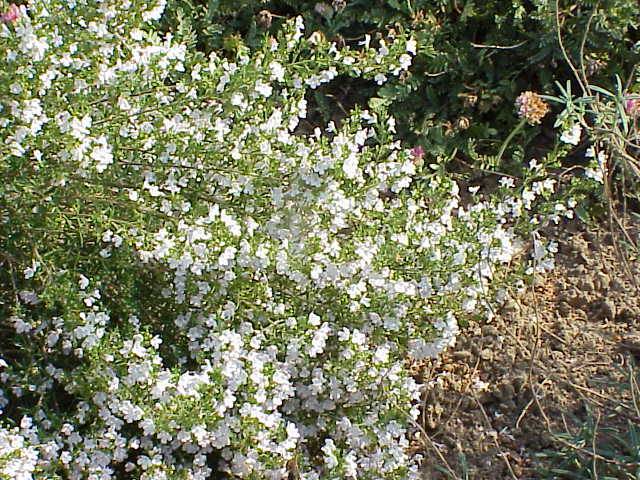
Kurt Stüber [1] · CC BY-SA 3.0
Winter savory
Shrub·Satureja montana
Full sun
Sun
Dry to moist soil
Water
Well-drained soil
Drainage
Zone 4
Hardiness
Coverage · 121 fields
No obvious inconsistencies found.
Growth and size10 fields
Plant type
Evergreen shrub“Satureja montana is an evergreen Shrub growing to 0.4 m (1ft 4in) by 0.3 m (1ft) at a medium rate.”
Height
40 cm · the source gives 10–40 cm“It grows to between 10 and 40 cm (4 and 16 in) tall.”PFAF“Satureja montana is an evergreen Shrub growing to 0.4 m (1ft 4in) by 0.3 m (1ft) at a medium rate.”
Spread
30 cm“Satureja montana is an evergreen Shrub growing to 0.4 m (1ft 4in) by 0.3 m (1ft) at a medium rate.”
Height at age
—
empty
Spacing
45 cm (at least 20 cm)“Plants can be grown as a ground cover when spaced about 45cm apart each way.”
Growth rate
Medium“Satureja montana is an evergreen Shrub growing to 0.4 m (1ft 4in) by 0.3 m (1ft) at a medium rate.”
Root depth
Medium
AI estimate63 % agree
Forest garden layer
Shrub layer“Satureja montana is an evergreen Shrub growing to 0.4 m (1ft 4in) by 0.3 m (1ft) at a medium rate.”
Lifespan
~5 years
AI estimatenot measured yet
Roots6 fields
Root form
Fibrous roots
AI estimate43 % agree
Storage organ
None
AI estimate100 % agree
Spreads
No
AI estimate75 % agree
Lateral spread in cm
—
empty
Root depth in cm
—
empty
Mycorrhiza
Arbuscular (AM)
AI estimatenot measured yet
Light, water and soil9 fields
Tolerates waterlogging
No“It is very intolerant of damp soils, especially in the winter, and dislikes shade.”
pH
6–7.5 · best 6.5–7“Suitable pH: mildly acid, neutral and basic (mildly alkaline) soils and can grow in very alkaline soils.”
Compacted soil
Copes fairly well
AI estimatenot measured yet
Climate5 fields
Killing frost
-1 °C“Killing temp. early growth: -1”EcoCrop's figure is frost during early growth (spring frost on new shoots), not winter cold.
Growing temperature
6–40 °C · optimal 13–30 °C“Temperature absolute min: 6 · Temperature absolute max: 40 · Temperature optimal min: 13 · Temperature optimal max: 30”
Chill hours
0 h
AI estimatenot measured yet
Native range
AD, AL, BA, ES, FR, GG, GI, GR, HR, IT, JE, LB, LI, MC, ME, MK, RS, SI, SM, SY, TR, VA, XK
Care (becomes tasks in Manage)7 fields
Protection
After the first frost · frost“if you live in an area of cold winters, it might be best to grow them on in a cold frame for their first winter and plant them out in late spring or early summer of the following year[K].”
Planting out
After the last frost“plant them out in late spring or early summer of the following year”
Pruning
April · lasts 30 days · flowered stems
AI estimatenot measured yet
Mulching
March · lasts 30 days
AI estimatenot measured yet
Through the year5 fields
Harvest
May · lasts 61 days“Winter savory is typically harvested in late spring to early summer, just before flowering for the best flavor.”
PFAFpartly
Leafing out
After the last frost“In temperate climates it becomes dormant in winter, putting out leaves on the bare stems in the spring.”
Edible parts and pollination3 fields
The leaves
Pollination
Self-fertile · hermaphrodite“The species is hermaphrodite (has both male and female organs) and is pollinated by Insects.”PFAF“The plant is self-fertile.”
Pollinated by
Insects“The species is hermaphrodite (has both male and female organs) and is pollinated by Insects.”
Ecology5 fields
Attracts
Bees, butterflies“Winter savory flowers are rich in nectar and pollen, attracting various pollinators, including bees and butterflies.”PFAFpartly“A good bee plant.”
Pests
—
empty
Diseases
—
empty
Takes up
—
empty
Fixes nitrogen
No
AI estimatenot measured yet
Propagation and names4 fields
Methods
Seed, half ripe cuttings, young wood cuttings, division“Seed - surface sow in April in a greenhouse.”PFAF“Cuttings of half-ripe wood, 5 - 8cm taken at a node, July/August in a frame.”PFAF“Cuttings of young wood, preferably with a heel, April/May in a frame.”PFAF“Division in early spring as growth commences.”
Difficulty
2 / 5
AI estimatenot measured yet
Seed
none
AI estimatenot measured yet
Not sorted yet67 fields
Fields the parser stores that this page has no row for yet. They show up here automatically, so nothing is hidden.
forage.DK.local_name
Vintersar
AI estimatenot measured yet
forage.DK.edibility_basis
inferred
AI estimatenot measured yet
forage.DK.foraging_months.notes
Leaves can be harvested year-round, though flavor is best before flowering.
AI estimatenot measured yet
forage.DK.foraging_months.months
5, 6“Harvesting: Late spring to early summer, just before flowering, for the best flavour.”
forage.DK.foraging_months.year_round
true
AI estimatenot measured yet
forage.DK.habitat_affinity
hedgerow, disturbed_ground
AI estimatenot measured yet
forage.US.local_name
Winter savory
AI estimatenot measured yet
forage.US.edible_parts
[{"part":"leaves","caution":null,"preparation":"cooked","season_months":[1,2,3,4,5,6,7,8,9,10,11,12]},{"part":"leaves","caution":null,"preparation":"raw","season_months":[1,2,3,4,5,6,7,8,9,10,11,12]}]
AI estimatenot measured yet
forage.US.edibility_basis
inferred
AI estimatenot measured yet
forage.US.foraging_months.notes
Leaves can be harvested year-round, though flavor is best before flowering.
AI estimatenot measured yet
forage.US.foraging_months.months
1, 2, 3, 4, 5, 6, 7, 8, 9, 10, 11, 12
AI estimatenot measured yet
forage.US.foraging_months.year_round
true
AI estimatenot measured yet
forage.US.habitat_affinity
hedgerow, disturbed_ground
AI estimatenot measured yet
forage.TROPICAL.edible_parts
[{"part":"leaves","caution":null,"preparation":"cooked","season_months":[1,2,3,4,5,6,7,8,9,10,11,12]},{"part":"leaves","caution":null,"preparation":"raw","season_months":[1,2,3,4,5,6,7,8,9,10,11,12]}]
AI estimatenot measured yet
forage.TROPICAL.edibility_basis
inferred
AI estimatenot measured yet
forage.TROPICAL.foraging_months.notes
In suitable tropical climates, leaves can be harvested year-round.
AI estimatenot measured yet
forage.TROPICAL.foraging_months.months
1, 2, 3, 4, 5, 6, 7, 8, 9, 10, 11, 12
AI estimatenot measured yet
forage.TROPICAL.foraging_months.year_round
true
AI estimatenot measured yet
forage.TROPICAL.habitat_affinity
disturbed_ground
AI estimatenot measured yet
ornamental.basis
documented
AI estimatenot measured yet
ornamental.fragrance.intensity
strong
AI estimatenot measured yet
ornamental.confidence
high
AI estimatenot measured yet
ornamental.fall_interest
false
AI estimatenot measured yet
ornamental.flower_colour
pink, white, purple“Bloom Color: Pink, White.”Wikipediapartly“It has dark green leaves and summer flowers ranging from pale lavender, pink to white.”
ornamental.evidence_quote
Winter savory (Satureja montana) is a small, semi-evergreen subshrub with narrow, dark green leaves and small white to pinkish-purple flowers. The foliage is highly aromatic.
AI estimatenot measured yet
ornamental.foliage_colour
dark_green“It has dark green leaves and summer flowers ranging from pale lavender, pink to white.”
ornamental.foliage_texture
fine“The leathery, dark green leaves are opposite, oval-lanceolate or needle-like, 1–2 cm long and 5 mm broad.”
Wikipediapartly
ornamental.winter_structure
evergreen_form“Satureja montana is an evergreen Shrub growing to 0.4 m (1ft 4in) by 0.3 m (1ft) at a medium rate.”
PFAFpartly
ornamental.autumn_foliage_colour
none
AI estimatenot measured yet
care_regime
light
AI estimatenot measured yet
propagation.self_seeding
light
AI estimate20 % agree
propagation.division_season
early spring as growth commences“Division in early spring as growth commences.”
propagation.establishment_years
2“Winter savory is considered a slow grower, often taking about 1 to 2 years to establish and reach full size.”
forage_proposals.DK.edibility_tier.confidence
high
AI estimatenot measured yet
forage_proposals.DK.edibility_tier.evidence_quote
Winter savory (Satureja montana) leaves are commonly used as a culinary herb, both fresh and dried, in various dishes.
AI estimatenot measured yet
forage_proposals.US.edibility_tier.tier
edible
AI estimatenot measured yet
forage_proposals.US.edibility_tier.confidence
high
AI estimatenot measured yet
forage_proposals.US.edibility_tier.evidence_quote
Winter savory (Satureja montana) leaves are commonly used as a culinary herb, both fresh and dried, in various dishes.
AI estimatenot measured yet
forage_proposals.TROPICAL.edibility_tier.tier
edible
AI estimatenot measured yet
forage_proposals.TROPICAL.edibility_tier.confidence
high
AI estimatenot measured yet
forage_proposals.TROPICAL.edibility_tier.evidence_quote
Winter savory (Satureja montana) leaves are commonly used as a culinary herb, both fresh and dried, in various dishes.
AI estimatenot measured yet
function_profile.biomass_return.confidence
medium
AI estimatenot measured yet
function_profile.nutrient_flows.consumes
[{"basis":"documented","demand":"moderate","nutrient":"nitrogen","confidence":"high"},{"basis":"documented","demand":"moderate","nutrient":"phosphorus","confidence":"high"},{"basis":"documented","demand":"moderate","n…
AI estimatenot measured yet
function_profile.biotic_interactions
[{"taxa":["bees","butterflies"],"basis":"documented","valence":"beneficial","relation":"attracts","confidence":"high","evidence_quote":"Winter savory flowers are rich in nectar and pollen, attracting various pollinato…“Winter savory flowers are rich in nectar and pollen, attracting various pollinators, including bees and butterflies.”PFAF“The plant can provide overwintering sites for beneficial insects and its groundcover can protect invertebrates during colder months.”PFAF“The foliage can also offer shelter for small wildlife.”Wikipedia“Winter savory is used as a companion plant for beans, keeping bean weevils away”
function_profile.aromatic_pest_effect.value
true“The aromatic scent of winter savory can help deter pests, making it a valuable companion plant in gardens.”
function_profile.aromatic_pest_effect.confidence
high
AI estimatenot measured yet
function_profile.structural_interfaces.provides_shelter.basis
inferred
AI estimatenot measured yet
function_profile.structural_interfaces.provides_shelter.kinds
wind
AI estimatenot measured yet
function_profile.structural_interfaces.provides_shelter.confidence
low
AI estimatenot measured yet
function_profile.structural_interfaces.requires_shelter.basis
documented“if you live in an area of cold winters, it might be best to grow them on in a cold frame for their first winter”
function_profile.structural_interfaces.requires_shelter.kinds
frost“if you live in an area of cold winters, it might be best to grow them on in a cold frame for their first winter”
function_profile.structural_interfaces.requires_shelter.stage
establishment“if you live in an area of cold winters, it might be best to grow them on in a cold frame for their first winter”
function_profile.structural_interfaces.requires_shelter.confidence
medium“if you live in an area of cold winters, it might be best to grow them on in a cold frame for their first winter”
function_profile.structural_interfaces.requires_shelter.evidence_quote
if you live in an area of cold winters, it might be best to grow them on in a cold frame for their first winter“if you live in an area of cold winters, it might be best to grow them on in a cold frame for their first winter”
function_profile.structural_interfaces.provides_physical_support.basis
taxonomic
AI estimatenot measured yet
function_profile.structural_interfaces.provides_physical_support.confidence
high
AI estimatenot measured yet
function_profile.structural_interfaces.requires_physical_support.basis
taxonomic
AI estimatenot measured yet
function_profile.structural_interfaces.requires_physical_support.confidence
high
AI estimatenot measured yet
climate_tolerance.photoperiod_response
day_neutral
AI estimatenot measured yet
soil_interactions.organic_matter_contribution
low
AI estimatenot measured yet
component_metadata.growth_cycle
perennial“is a perennial, semi-evergreen herb in the family Lamiaceae, native to warm temperate regions of southern Europe, the Mediterranean, and Africa.”
resource_interfaces.inputs
[{"resource":"light","quantity_description":"six hours of sun per day, in a hot dry sunny position"},{"resource":"shade","quantity_description":"cannot grow in shade; dislikes shade"},{"resource":"water","quantity_des…“It requires six hours of sun per day and well-draining soil.”PFAF“It cannot grow in the shade.”PFAF“Plants can be grown as a ground cover when spaced about 45cm apart each way.”PFAFpartly“It prefers dry or moist soil and can tolerate drought.”PFAFpartly“The species is hermaphrodite (has both male and female organs) and is pollinated by Insects.”
resource_interfaces.outputs
[{"resource":"pollinator_services","quantity_description":"a good bee plant; flowers attract bees and butterflies"},{"resource":"nectar","quantity_description":"flowers rich in nectar, July to October"},{"resource":"p…“A good bee plant.”PFAF“Winter savory flowers are rich in nectar and pollen, attracting various pollinators, including bees and butterflies.”PFAF“Plants can be grown as a ground cover when spaced about 45cm apart each way.”PFAF“the seeds ripen from August to October”PFAFpartly“The plant can provide overwintering sites for beneficial insects and its groundcover can protect invertebrates during colder months.”PFAFpartly“An essential oil is obtained from the leaves.”