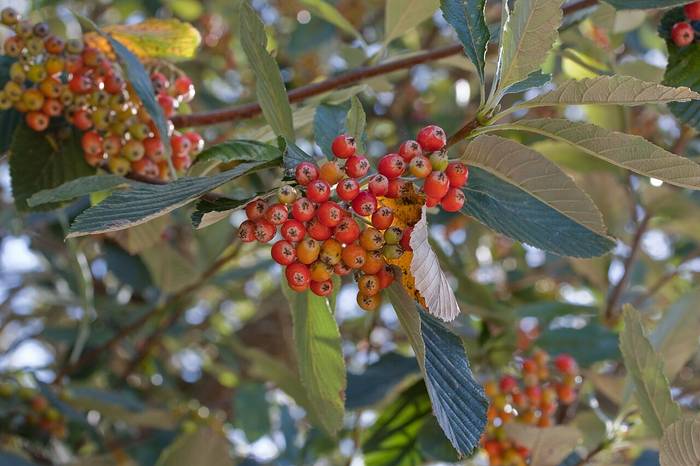
Julie Anne Workman · CC BY-SA 3.0
Whitebeam
Tree·Sorbus aria
Part shade to full sun
Sun
Moist soil
Water
Well-drained soil
Drainage
Zones 5–8
Hardiness
Coverage · 121 fields
No obvious inconsistencies found.
Growth and size11 fields
Plant type
Deciduous tree“Sorbus aria is a deciduous Tree growing to 12 m (39ft) by 8 m (26ft) at a medium rate.”
Height
1,200 cm · the source gives 500–1,500 cm“Sorbus aria (L.) Crantz (syn. Aria nivea) or common whitebeam is a slow-growing, small to medium sized deciduous tree or shrub that grows up to 5-15 m tall, rarely up to 20 m and 40 cm in diameter.”PFAF“Sorbus aria is a deciduous Tree growing to 12 m (39ft) by 8 m (26ft) at a medium rate.”
Spread
800 cm“Sorbus aria is a deciduous Tree growing to 12 m (39ft) by 8 m (26ft) at a medium rate.”
Height at age
—
empty
Size after planting
3 yrs: 5 m tall, 2 m crown · 7 yrs: 5 m tall, 1.5 m crown · 18 yrs: 6 m tall, 3 m crown · 34 yrs: 7 m tall, 4 m crown · 67 yrs: 10 m tall, 7 m crown“Berlin tree register: 1092 trees of this species measured with years since planting, height and crown diameter; median crown 7.0 m and height 10.0 m at 60–100 years after planting (35 trees).”Median of 1,092 measured trees in Berlin. Years count from planting nursery stock, so a small tree reaches each size later.
Spacing
600 cm (at least 400 cm)
AI estimate55 % agree
Growth rate
Medium“Sorbus aria is a deciduous Tree growing to 12 m (39ft) by 8 m (26ft) at a medium rate.”
Habit
Vase-shaped“Typically compact and domed, the plant has a few upswept branches and the leaves have an almost-white underside.”
Wikipediapartly
Root depth
Deep
AI estimate63 % agree
Forest garden layer
Lower tree layer
AI estimate90 % agree
Lifespan
~100 years
AI estimatenot measured yet
Roots6 fields
Root form
Heart root“The root pattern is branching: a heart root, dividing from the crown into several primary roots going down and out [2-1].”
Storage organ
None“No clonal growth organ is recorded: it does not spread vegetatively (no suckers, no rhizomes).”
Spreads
No“No clonal growth organ is recorded: it does not spread vegetatively (no suckers, no rhizomes).”
Lateral spread in cm
—
empty
Root depth in cm
—
empty
Mycorrhiza
Arbuscular (AM)
AI estimatenot measured yet
Light, water and soil9 fields
Sun
Hours of sun
6 h
AI estimatenot measured yet
Drought tolerant
Yes
AI estimatenot measured yet
Tolerates waterlogging
—
empty
Soil type
Sand, loam, clay“Suitable for: light (sandy), medium (loamy) and heavy (clay) soils, prefers well-drained soil and can grow in heavy clay soil.”PFAF“Does well on heavy clays.”
pH
4.5–9“Suitable pH: mildly acid, neutral and basic (mildly alkaline) soils and can grow in very acid and very alkaline soils.”
Drainage
Well drained“Suitable for: light (sandy), medium (loamy) and heavy (clay) soils, prefers well-drained soil and can grow in heavy clay soil.”
Compacted soil
Copes fairly well
AI estimatenot measured yet
Climate5 fields
Hardiness
Zone 5–8
AI estimatenot measured yet
Killing frost
-25 °C
AI estimatenot measured yet
Growing temperature
5–30 °C · optimal 10–25 °C
AI estimatenot measured yet
Chill hours
800 h
AI estimatenot measured yet
Native range
AD, AL, AT, BA, BE, BG, CH, CZ, DE, DK, DZ, ES, FR, GB, GG, GI, GR, HR, HU, IT, JE, LI, LU, MA, MC, ME, MK, MT, PL, PT, RO, RS, SI, SK, SM, TN, VA, XK
Care (becomes tasks in Manage)1 fields
Pruning
November · lasts 60 days · dead, diseased, or crossing branches
AI estimatenot measured yet
Through the year6 fields
Leafing out
After the last frost
AI estimatenot measured yet
Flowering
May · lasts 61 days
AI estimatenot measured yet
Fruiting
September · lasts 61 days“They ripen from September to October and often stay on the twigs during winter.”
Harvest
August · lasts 92 days“The fruits are typically harvested in late summer to early autumn, from August to October (Northern Hemisphere), once they are fully ripe.”
Dying back
After the first frost“The leaves change colour from light green in spring to dark green in summer, and then to yellow in autumn.”
Dormant
After the first frost · 30 days after · lasts 150 days
AI estimatenot measured yet
Edible parts and pollination4 fields
The fruit
Bletted to eat raw; also cooked or made into preserves · August–October“Edible Parts: Fruit”PFAF“The seeds probably contain hydrogen cyanide.”PFAF“The fruits are typically harvested in late summer to early autumn, from August to October (Northern Hemisphere), once they are fully ripe.”PFAFpartly“Fruit - raw or cooked and used in preserves etc.”
Pollination
Needs a partner · another variety · hermaphrodite“The species is hermaphrodite (has both male and female organs) and is pollinated by Insects.”PFAF“Pollination is primarily conducted by insects, including bees and butterflies, which are attracted to the flowers for their nectar.”PFAF“The plant is not self-fertile.”
Pollinated by
Insects, bees, butterflies“The species is hermaphrodite (has both male and female organs) and is pollinated by Insects.”PFAF“Pollination is primarily conducted by insects, including bees and butterflies, which are attracted to the flowers for their nectar.”
Ecology5 fields
Attracts
Bees, butterflies, birds, wildlife“Pollination is primarily conducted by insects, including bees and butterflies, which are attracted to the flowers for their nectar.”PFAF“The fruit is very attractive to birds.”
Pests
Aphids, sawflies
AI estimatenot measured yet
Takes up
Calcium, potassium
AI estimatenot measured yet
Fixes nitrogen
No
AI estimatenot measured yet
Propagation and names4 fields
Difficulty
2 / 5
AI estimatenot measured yet
Seed
2 weeks warm, then 14-16 weeks cold stratification“Stored seed germinates better if given 2 weeks warm then 14 - 16 weeks cold stratification, so sow it as early in the year as possible.”
Not sorted yet70 fields
Fields the parser stores that this page has no row for yet. They show up here automatically, so nothing is hidden.
forage.DK.local_name
Hvidtjørn
AI estimatenot measured yet
forage.DK.prep_cautions
Frozen or cooked fruit is edible but not tasty“The frozen or cooked fruits are edible but not tasty.”
forage.DK.edibility_basis
inferred
AI estimatenot measured yet
forage.DK.foraging_months.notes
Fruit often stays on the twigs during winter.“They ripen from September to October and often stay on the twigs during winter.”
forage.DK.foraging_months.months
8, 9, 10“The fruits are typically harvested in late summer to early autumn, from August to October (Northern Hemisphere), once they are fully ripe.”
forage.DK.foraging_months.year_round
false
AI estimatenot measured yet
forage.US.local_name
Whitebeam
AI estimatenot measured yet
forage.US.edible_parts
[{"part":"fruit","caution":"Seeds probably contain hydrogen cyanide.","preparation":"Bletted to eat raw; also cooked or made into preserves","season_months":[8,9,10]}]“Edible Parts: Fruit”PFAF“The seeds probably contain hydrogen cyanide.”PFAF“The fruits are typically harvested in late summer to early autumn, from August to October (Northern Hemisphere), once they are fully ripe.”PFAFpartly“Fruit - raw or cooked and used in preserves etc.”
forage.US.prep_cautions
Frozen or cooked fruit is edible but not tasty“The frozen or cooked fruits are edible but not tasty.”
forage.US.edibility_basis
inferred
AI estimatenot measured yet
forage.US.foraging_months.notes
Fruit often stays on the twigs during winter.“They ripen from September to October and often stay on the twigs during winter.”
forage.US.foraging_months.months
8, 9, 10“The fruits are typically harvested in late summer to early autumn, from August to October (Northern Hemisphere), once they are fully ripe.”
forage.US.foraging_months.year_round
false
AI estimatenot measured yet
forage.TROPICAL.edibility_basis
inferred
AI estimatenot measured yet
forage.TROPICAL.foraging_months.notes
Not typically found in tropical regions.
AI estimatenot measured yet
forage.TROPICAL.foraging_months.year_round
false
AI estimatenot measured yet
ornamental.basis
documented
AI estimatenot measured yet
ornamental.fragrance.source
none“No – Sorbus species do not have a notable scent that acts as a pest confuser.”
ornamental.fragrance.intensity
subtle
AI estimatenot measured yet
ornamental.confidence
high
AI estimatenot measured yet
ornamental.fall_interest
true“The leaves change colour from light green in spring to dark green in summer, and then to yellow in autumn.”
ornamental.flower_colour
white, cream“Whitebeam is a monoceous hermaphrodite species with white flowers.”Wikipediapartly“The hermaphrodite cream-white flowers appear in May, are insect pollinated, and go on to produce scarlet berries, which are often eaten by birds.”
ornamental.evidence_quote
Sorbus aria, commonly known as Whitebeam, features white flowers in spring, dark green leaves with a silvery underside, and yellow-green autumn foliage. It produces persistent red berries that provide winter interest, along with an attractive architectural form. The flowers have a subtle fragrance.
AI estimatenot measured yet
ornamental.foliage_colour
dark_green“The leaves change colour from light green in spring to dark green in summer, and then to yellow in autumn.”
ornamental.foliage_texture
medium
AI estimatenot measured yet
ornamental.winter_structure
persistent_fruit“They ripen from September to October and often stay on the twigs during winter.”
ornamental.autumn_foliage_colour
yellow_green“The leaves change colour from light green in spring to dark green in summer, and then to yellow in autumn.”
JRC forest tree atlaspartly
care_regime
none
AI estimatenot measured yet
propagation.self_seeding
light
AI estimate20 % agree
propagation.division_season
not applicable
AI estimatenot measured yet
propagation.establishment_years
2“Seedlings are very slow to put on top-growth for their first year or two, but they are busy building up a good root system.”
PFAFpartly
size_at_age.v
1
AI estimatenot measured yet
size_at_age.basis
years_after_planting
AI estimatenot measured yet
spatial_profile.canopy_density
dense
AI estimatenot measured yet
sun_requirement.best
full_sun“Tolerates light shade, though it fruits better in a sunny position[K].”
sun_requirement.best_for
fruit“Tolerates light shade, though it fruits better in a sunny position[K].”
forage_proposals.DK.edibility_tier.tier
edible
AI estimatenot measured yet
forage_proposals.DK.edibility_tier.confidence
high
AI estimatenot measured yet
forage_proposals.DK.edibility_tier.evidence_quote
The fruits of Sorbus aria are edible, though often astringent when raw and unripe. They are best consumed after cooking or when fully ripe, at which point they become sweeter and less astringent.
AI estimatenot measured yet
forage_proposals.US.edibility_tier.tier
edible
AI estimatenot measured yet
forage_proposals.US.edibility_tier.confidence
high
AI estimatenot measured yet
forage_proposals.US.edibility_tier.evidence_quote
Whitebeam fruits are edible, particularly after cooking or when bletted (fully ripe). Raw, unripe fruits can be quite astringent.
AI estimatenot measured yet
forage_proposals.TROPICAL.edibility_tier.confidence
low
AI estimatenot measured yet
function_profile.biomass_return.confidence
medium“They can also contribute to soil improvement.”
PFAFpartly
function_profile.nutrient_flows.consumes
[{"basis":"inferred","demand":"moderate","nutrient":"nitrogen","confidence":"medium"},{"basis":"inferred","demand":"moderate","nutrient":"phosphorus","confidence":"medium"},{"basis":"inferred","demand":"moderate","nut…
AI estimatenot measured yet
function_profile.nutrient_flows.provides
[{"basis":"inferred","nutrient":"calcium","mechanism":"biomass_return","confidence":"medium"},{"basis":"inferred","nutrient":"potassium","mechanism":"biomass_return","confidence":"medium"}]“They can also contribute to soil improvement.”
PFAFpartly
function_profile.biotic_interactions
[{"taxa":["bees","butterflies"],"basis":"documented","valence":"beneficial","relation":"attracts","confidence":"high","evidence_quote":"Pollination is primarily conducted by insects, including bees and butterflies, wh…“Pollination is primarily conducted by insects, including bees and butterflies, which are attracted to the flowers for their nectar.”JRC forest tree atlas“They are eaten and dispersed mostly by birds.”PFAF“The dense canopy provides shelter and roosting opportunities for birds, while the fallen leaves contribute to the detritus layer for invertebrates.”PFAF“The rough bark, leaf litter, and berry detritus provide overwintering sites for invertebrates and beneficial insects.”PFAF“The fruit (berries) of Sorbus species, such as rowan or mountain ash, are eaten by birds and mammals.”PFAF“Plants are susceptible to fireblight.”
function_profile.aromatic_pest_effect.value
false“No – Sorbus species do not have a notable scent that acts as a pest confuser.”
function_profile.aromatic_pest_effect.confidence
high
AI estimatenot measured yet
function_profile.structural_interfaces.provides_shelter.basis
inferred
AI estimatenot measured yet
function_profile.structural_interfaces.provides_shelter.kinds
wind, shade“Very tolerant of exposed maritime conditions, it makes a good windbreak tree near the coast.”PFAF“Trees cast a fairly dense shade when mature.”
function_profile.structural_interfaces.provides_shelter.confidence
medium
AI estimatenot measured yet
function_profile.structural_interfaces.provides_shelter.evidence_quote
Very tolerant of exposed maritime conditions, it makes a good windbreak tree near the coast.
AI estimatenot measured yet
function_profile.structural_interfaces.requires_shelter.basis
documented“It is hardy to UK zone 5 and is not frost tender.”
PFAFpartly
function_profile.structural_interfaces.requires_shelter.kinds
frost“It is hardy to UK zone 5 and is not frost tender.”
PFAFpartly
function_profile.structural_interfaces.requires_shelter.stage
establishment“It is hardy to UK zone 5 and is not frost tender.”
PFAFpartly
function_profile.structural_interfaces.requires_shelter.confidence
medium“It is hardy to UK zone 5 and is not frost tender.”
PFAFpartly
function_profile.structural_interfaces.requires_shelter.evidence_quote
It is best to keep them in pots in a cold frame for their first winter and then plant them out into their permanent positions in late spring.“It is hardy to UK zone 5 and is not frost tender.”
PFAFpartly
function_profile.structural_interfaces.provides_physical_support.form
trunk
AI estimatenot measured yet
function_profile.structural_interfaces.provides_physical_support.basis
taxonomic
AI estimatenot measured yet
function_profile.structural_interfaces.provides_physical_support.confidence
high
AI estimatenot measured yet
function_profile.structural_interfaces.requires_physical_support.basis
taxonomic
AI estimatenot measured yet
function_profile.structural_interfaces.requires_physical_support.confidence
high
AI estimatenot measured yet
climate_tolerance.photoperiod_response
day_neutral
AI estimatenot measured yet
soil_interactions.organic_matter_contribution
medium
AI estimatenot measured yet
component_metadata.growth_cycle
perennial
AI estimate100 % agree
resource_interfaces.inputs
[{"resource":"light","quantity_description":"open sunny position preferred; tolerates light shade"},{"resource":"water","quantity_description":"prefers moist soil"},{"resource":"pollination","quantity_description":"in…“It prefers moist soil.”PFAF“The plant is not self-fertile.”PFAF“It can grow in semi-shade (light woodland) or no shade.”PFAFpartly“Succeeds in most reasonably good soils in an open sunny position.”
resource_interfaces.outputs
[{"resource":"shade","quantity_description":"fairly dense shade when mature"},{"resource":"wind_shelter","quantity_description":"a windbreak near the coast"},{"resource":"fruit","quantity_description":"orange to scarl…“Trees cast a fairly dense shade when mature.”PFAF“Very tolerant of exposed maritime conditions, it makes a good windbreak tree near the coast.”JRC forest tree atlas“Fruits are orange to scarlet globose pomes 8-15 mm in diameter with many lenticels on the skin.”PFAF“Pollination is primarily conducted by insects, including bees and butterflies, which are attracted to the flowers for their nectar.”PFAF“Yes – Sorbus species produce clusters of small, white flowers that are rich in nectar and pollen, attracting bees, butterflies, and other pollinators.”PFAF“The dense canopy provides shelter and roosting opportunities for birds, while the fallen leaves contribute to the detritus layer for invertebrates.”PFAF“It is in flower from May to June, and the seeds ripen from September to October.”PFAF“Wood - hard, heavy, close grained. Used for beams etc.”