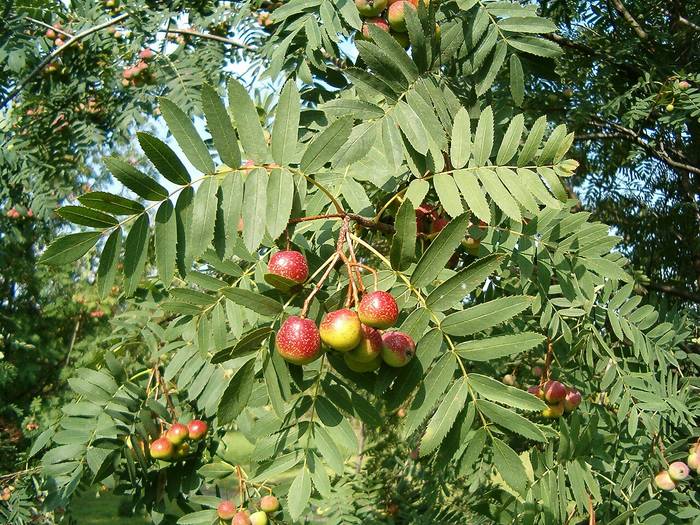
BotBln · CC BY-SA 3.0
Service tree
Tree·Sorbus domestica
Part shade to full sun
Sun
Dry to moist soil
Water
Well-drained soil
Drainage
Zones 5–8
Hardiness
Coverage · 114 fields
No obvious inconsistencies found.
Growth and size10 fields
Plant type
Deciduous tree“Sorbus domestica is a deciduous Tree growing to 15 m (49ft 3in) at a medium rate.”
Height
1,500 cm · other sources: 2,000 cm“Sorbus domestica is a deciduous Tree growing to 15 m (49ft 3in) at a medium rate.”JRC forest tree atlas“usually reaching around 20 m in height”
Spread
1,000 cm
AI estimate58 % agree
Height at age
—
empty
Spacing
800 cm (at least 600 cm)
AI estimate55 % agree
Habit
Spreading
AI estimate50 % agree
Root depth
Deep
AI estimate63 % agree
Forest garden layer
Lower tree layer
AI estimate90 % agree
Lifespan
~200 years“It is long-lived and often reaches 200 years of age, occasionally up to 400 or more.”
Roots6 fields
Root form
Heart root“a heart root, dividing from the crown into several primary roots going down and out”
Storage organ
None
AI estimate100 % agree
Lateral spread in cm
—
empty
Root depth in cm
—
empty
Mycorrhiza
Arbuscular (AM)
AI estimatenot measured yet
Light, water and soil9 fields
Sun
Hours of sun
6 h
AI estimatenot measured yet
Water
Dry, moist · best: moist · Medium“It prefers moist soil.”JRC forest tree atlas“It is able to grow on dry sites”PFAFpartly“drought-tolerant once established”
Tolerates waterlogging
—
empty
Soil type
Sand, loam, clay“Suitable for: light (sandy), medium (loamy) and heavy (clay) soils and prefers well-drained soil.”
Drainage
Well drained“Suitable for: light (sandy), medium (loamy) and heavy (clay) soils and prefers well-drained soil.”
Compacted soil
Copes fairly well
AI estimatenot measured yet
Climate5 fields
Hardiness
Zone 5–8
AI estimatenot measured yet
Killing frost
-1 °C“Killing temp. early growth: -1”EcoCrop's figure is frost during early growth (spring frost on new shoots), not winter cold.
Growing temperature
8–32 °C · optimal 12–25 °C“Temperature absolute min: 8 · Temperature absolute max: 32 · Temperature optimal min: 12 · Temperature optimal max: 25”
Chill hours
800 h
AI estimatenot measured yet
Native range
AD, AL, AT, BA, BE, BG, CH, CZ, DE, DZ, ES, FR, GG, GI, GR, HR, HU, IT, JE, LI, LU, MA, MC, ME, MK, MT, RO, RS, RU, SI, SK, SM, UA, VA, XK
Care (becomes tasks in Manage)4 fields
Pruning
After the previous stage“Pruning is typically only necessary if shaping or size control is desired.”
PFAFpartly
Planting out
After the last frost“plant them out into their permanent positions in late spring”
PFAFpartly
Pruning
January · lasts 60 days · dead, diseased, or crossing branches
AI estimatenot measured yet
Mulching
March · lasts 30 days
AI estimatenot measured yet
Through the year7 fields
Leafing out
After the last frost · Above 5 °C · lasts 14 days
AI estimatenot measured yet
Flowering
After the previous stage · 30 days after · lasts 21 days
AI estimatenot measured yet
Fruiting
After the previous stage · 90 days after · lasts 60 days
AI estimatenot measured yet
Harvest
September · lasts 30 days
AI estimatenot measured yet
Dying back
After the first frost · Set by day length · lasts 30 days
AI estimatenot measured yet
Dormant
After the first frost · lasts 150 days
AI estimatenot measured yet
First harvest
2–6 years after plantingUW-Madison CIAS uncommon fruit page: 2-3 years, but its grower (Carandale Farm) waited up to 6, so the range is 2-6. Not stated whether counted from planting.
Edible parts and pollination4 fields
The fruit
Ecology5 fields
Attracts
Bees, butterflies, birds, mammals, wildlife“Sorbus species produce clusters of small, white flowers that are rich in nectar and pollen, attracting bees, butterflies, and other pollinators.”PFAF“The fruit (berries) of Sorbus species, such as rowan or mountain ash, are eaten by birds and mammals.”PFAF“It is noted for attracting wildlife.”
Pests
Aphids, codling_moth
AI estimatenot measured yet
Diseases
Fireblight, canker, apple scab“Plants are susceptible to fireblight and to canker (which is especially prevalent in areas with high rainfall)”JRC forest tree atlas“Diseases of apple, such as European canker of apple (Nectria galligen) and apple scab (Venturia inaequalis) can affect the service tree and cause premature leaf fall.”
Takes up
Calcium, potassium, phosphorus
AI estimatenot measured yet
Fixes nitrogen
No
AI estimatenot measured yet
Propagation and names4 fields
Methods
Seed, root suckers“Seed - best sown as soon as it is ripe in a cold frame.”CLO-PLA (clonal growth)“It spreads by suckers: new shoots from buds on its roots.”
Seed
2 weeks warm then 14 - 16 weeks cold“Stored seed germinates better if given 2 weeks warm then 14 - 16 weeks cold stratification, so sow it as early in the year as possible.”
Not sorted yet60 fields
Fields the parser stores that this page has no row for yet. They show up here automatically, so nothing is hidden.
forage.DK.local_name
Rønnebær
AI estimatenot measured yet
forage.DK.prep_cautions
Seeds probably contain hydrogen cyanide., Highly astringent and gritty when picked straight off the tree.“The seeds probably contain hydrogen cyanide.”Wikipedia“Picked straight off the tree, it is highly astringent and gritty”
forage.DK.edibility_basis
inferred
AI estimatenot measured yet
forage.DK.foraging_months.notes
Fruits ripen in autumn after the first frosts, becoming less astringent.
AI estimatenot measured yet
forage.DK.foraging_months.months
8, 9, 10“The fruits are typically harvested in late summer to early autumn, from August to October (Northern Hemisphere), once they are fully ripe.”
forage.DK.foraging_months.year_round
false
AI estimatenot measured yet
forage.US.local_name
Service tree
AI estimatenot measured yet
forage.US.edible_parts
[{"part":"fruit","caution":"astringent when unripe","preparation":"raw, cooked","season_months":[9,10]}]
AI estimatenot measured yet
forage.US.prep_cautions
Fruits are very astringent before they are fully ripe or 'bletted'.
AI estimatenot measured yet
forage.US.edibility_basis
inferred
AI estimatenot measured yet
forage.US.foraging_months.notes
Fruits ripen in autumn after the first frosts, becoming less astringent.
AI estimatenot measured yet
forage.US.foraging_months.months
9, 10
AI estimatenot measured yet
forage.US.foraging_months.year_round
false
AI estimatenot measured yet
forage.US.habitat_affinity
woodland, hedgerow
AI estimatenot measured yet
forage.TROPICAL.edibility_basis
inferred
AI estimatenot measured yet
forage.TROPICAL.foraging_months.notes
Not typically found in tropical regions.
AI estimatenot measured yet
forage.TROPICAL.foraging_months.year_round
false
AI estimatenot measured yet
ornamental.basis
documented
AI estimatenot measured yet
ornamental.fragrance.source
none“No – Sorbus species do not have a notable scent that acts as a pest confuser.”
ornamental.fragrance.intensity
subtle
AI estimatenot measured yet
ornamental.confidence
high
AI estimatenot measured yet
ornamental.fall_interest
true
AI estimatenot measured yet
ornamental.flower_colour
white, pink“The flowers are 13–18 mm (0.51–0.71 in) diameter, with five white petals and 20 creamy-white stamens”PFAF“producing clusters of white or pink flowers”
ornamental.evidence_quote
The flowers are white, appearing in late spring. The foliage is green, turning yellow-green to red in autumn. The tree has persistent fruit and attractive bark, providing winter interest.
AI estimatenot measured yet
ornamental.foliage_colour
green
AI estimate82 % agree
ornamental.foliage_texture
medium
AI estimatenot measured yet
ornamental.winter_structure
persistent_fruit, ornamental_bark, architectural_skeleton
AI estimatenot measured yet
ornamental.autumn_foliage_colour
yellow_green, red
AI estimatenot measured yet
propagation.division_season
none
AI estimatenot measured yet
propagation.establishment_years
3
AI estimate40 % agree
sun_requirement.best
full_sun“though it prefers an open, sunny position for optimal fruit production”
sun_requirement.best_for
fruit“though it prefers an open, sunny position for optimal fruit production”
forage_proposals.DK.edibility_tier.tier
edible
AI estimatenot measured yet
forage_proposals.DK.edibility_tier.confidence
high
AI estimatenot measured yet
forage_proposals.DK.edibility_tier.evidence_quote
The fruit is eaten either raw or cooked.“The fruit is eaten either raw or cooked.”
forage_proposals.US.edibility_tier.tier
edible
AI estimatenot measured yet
forage_proposals.US.edibility_tier.confidence
high
AI estimatenot measured yet
forage_proposals.US.edibility_tier.evidence_quote
Service tree fruits are edible, though often bletted or cooked to reduce astringency, and are used in various culinary applications.
AI estimatenot measured yet
forage_proposals.TROPICAL.edibility_tier.confidence
low
AI estimatenot measured yet
function_profile.biomass_return.confidence
medium“The dense canopy provides shelter and roosting opportunities for birds, while the fallen leaves contribute to the detritus layer for invertebrates.”
PFAFpartly
function_profile.nutrient_flows.consumes
[{"basis":"documented","demand":"moderate","nutrient":"nitrogen","confidence":"high"},{"basis":"documented","demand":"moderate","nutrient":"phosphorus","confidence":"high"},{"basis":"documented","demand":"moderate","n…
AI estimatenot measured yet
function_profile.nutrient_flows.provides
[{"basis":"inferred","nutrient":"calcium","mechanism":"biomass_return","confidence":"medium"},{"basis":"inferred","nutrient":"potassium","mechanism":"biomass_return","confidence":"medium"},{"basis":"inferred","nutrien…
AI estimatenot measured yet
function_profile.biotic_interactions
[{"taxa":["fireblight","canker"],"basis":"documented","valence":"harmful","relation":"hosts","confidence":"high","evidence_quote":"Plants are susceptible to fireblight and to canker (which is especially prevalent in a…“Plants are susceptible to fireblight and to canker (which is especially prevalent in areas with high rainfall)”JRC forest tree atlas“Diseases of apple, such as European canker of apple (Nectria galligen) and apple scab (Venturia inaequalis) can affect the service tree and cause premature leaf fall.”PFAF“Sorbus species produce clusters of small, white flowers that are rich in nectar and pollen, attracting bees, butterflies, and other pollinators.”JRC forest tree atlas“Although the seeds are well dispersed by birds and mammals, the regeneration rate from seeds is low, and the tree also frequently regenerates by root suckers.”PFAF“The dense canopy provides shelter and roosting opportunities for birds, while the fallen leaves contribute to the detritus layer for invertebrates.”PFAF“The rough bark, leaf litter, and berry detritus provide overwintering sites for invertebrates and beneficial insects.”PFAF“It is noted for attracting wildlife.”
function_profile.aromatic_pest_effect.value
false“Sorbus species do not have a notable scent that acts as a pest confuser.”
function_profile.aromatic_pest_effect.confidence
high
AI estimatenot measured yet
function_profile.structural_interfaces.provides_shelter.basis
inferred
AI estimatenot measured yet
function_profile.structural_interfaces.provides_shelter.kinds
shade“Sorbus species can be used as shade trees and are beneficial for wildlife, providing food and habitat.”
function_profile.structural_interfaces.provides_shelter.confidence
medium
AI estimatenot measured yet
function_profile.structural_interfaces.provides_shelter.evidence_quote
Sorbus species can be used as shade trees and are beneficial for wildlife, providing food and habitat.
AI estimatenot measured yet
function_profile.structural_interfaces.provides_physical_support.form
trunk
AI estimatenot measured yet
function_profile.structural_interfaces.provides_physical_support.basis
taxonomic
AI estimatenot measured yet
function_profile.structural_interfaces.provides_physical_support.confidence
high
AI estimatenot measured yet
climate_tolerance.photoperiod_response
day_neutral
AI estimatenot measured yet
soil_interactions.organic_matter_contribution
medium“They can also contribute to soil improvement.”
PFAFpartly
component_metadata.growth_cycle
perennial
AI estimate100 % agree
resource_interfaces.inputs
[{"resource":"light","quantity_description":"Tolerates light shade, but fruits better and at higher quality in full sun."},{"resource":"water","quantity_description":"Drought-tolerant once established; needs a minimum…“It is tolerant of light shade but produces more and better-quality fruit when grown in full sun.”JRC forest tree atlas“It is able to grow on dry sites and cope with drought during the vegetation period, requiring a minimum rainfall of 500 mm per year.”PFAF“Partially self-fertile, but fruit production is higher with cross-pollination.”
resource_interfaces.outputs
[{"resource":"fruit","quantity_description":"Edible apple- or pear-shaped fruit, 2-3 cm in diameter."},{"resource":"nectar","quantity_description":"Clusters of small white flowers rich in nectar."},{"resource":"pollen…“The edible fruits are apple or pear-shaped, 2-3 cm in diameter.”PFAF“Sorbus species produce clusters of small, white flowers that are rich in nectar and pollen, attracting bees, butterflies, and other pollinators.”PFAF“Sorbus species can be used as shade trees and are beneficial for wildlife, providing food and habitat.”PFAF“The dense canopy provides shelter and roosting opportunities for birds, while the fallen leaves contribute to the detritus layer for invertebrates.”PFAF“The fallen leaves can serve as ground cover, benefiting the ecosystem.”JRC forest tree atlas“The hard and heavy wood is of good quality and can command a high price; it is often used for making small objects such as screws, gear teeth, bearings and rifle butts.”JRC forest tree atlas“Fruit usually contains 2-5 (up to 10) seeds.”