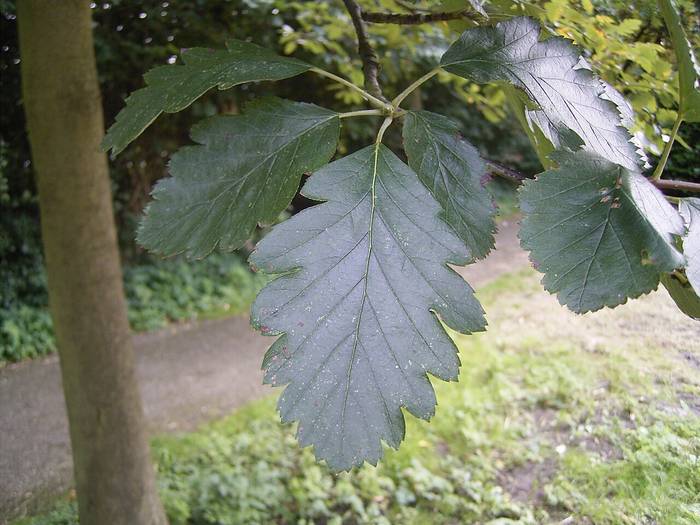
TeunSpaans · CC BY-SA 3.0
Swedish whitebeam
Tree·Sorbus intermedia
Part shade to full sun
Sun
Moist soil
Water
Well-drained soil
Drainage
Zones 4–8
Hardiness
Coverage · 75 fields
- Parser flag (climate_tolerance_low_confidence): Climate tolerance values are LLM-extracted (no authoritative EcoCrop match found). EcoCrop covers ~2,568 food-crop taxa; ornamental/native/medicinal species rely on LLM extraction.
- Parser flag (edibility_basis_unverified): forage.DK.edibility_tier is not present as an explicit field in the profile; forage.DK lists edible_parts (fruit, methods raw/cooked) with no edibility_basis marked 'curated', and prep_cautions note seeds probably contain hydrogen cyanide, so the edible-fruit claim is inferred and unverified.
Growth and size10 fields
Plant type
Deciduous tree“Sorbus intermedia is a deciduous Tree growing to 12 m (39ft) by 12 m (39ft) at a medium rate.”
Height
1,200 cm · the source gives 1,000–2,000 cm“growing to 10–20 m (33–66 ft) tall”PFAF“Sorbus intermedia is a deciduous Tree growing to 12 m (39ft) by 12 m (39ft) at a medium rate.”
Spread
1,200 cm“Sorbus intermedia is a deciduous Tree growing to 12 m (39ft) by 12 m (39ft) at a medium rate.”
Height at age
—
empty
Spacing
1,200 cm (at least 600 cm)
AI estimate55 % agree
Growth rate
Medium“Sorbus intermedia is a deciduous Tree growing to 12 m (39ft) by 12 m (39ft) at a medium rate.”
Root depth
Medium
AI estimate63 % agree
Forest garden layer
Canopy
AI estimate90 % agree
Lifespan
—
empty
Roots6 fields
Root form
Heart root
AI estimate43 % agree
Storage organ
None
AI estimate100 % agree
Spreads
No
AI estimate75 % agree
Lateral spread in cm
—
empty
Root depth in cm
—
empty
Mycorrhiza
Arbuscular (AM)
AI estimatenot measured yet
Light, water and soil9 fields
Sun
Full sun, light shade, part shade · best: full sun“Succeeds in most reasonably good well-drained soils in an open sunny position.”PFAF“It can grow in semi-shade (light woodland) or no shade.”
Hours of sun
—
empty
Drought tolerant
—
empty
Tolerates waterlogging
—
empty
Soil type
Sand, loam, clay“Suitable for: light (sandy), medium (loamy) and heavy (clay) soils and prefers well-drained soil.”
pH
4.5–9“Suitable pH: mildly acid, neutral and basic (mildly alkaline) soils and can grow in very acid and very alkaline soils.”
Drainage
Well drained“Suitable for: light (sandy), medium (loamy) and heavy (clay) soils and prefers well-drained soil.”
Compacted soil
Copes fairly well
AI estimatenot measured yet
Climate5 fields
Hardiness
Zone 4–8
AI estimatenot measured yet
Killing frost
-30 °C
AI estimatenot measured yet
Growing temperature
· optimal 10–25 °C
AI estimatenot measured yet
Chill hours
—
empty
Native range
—
empty
Through the year5 fields
Flowering
May · lasts 21 days“It is in flower in May, and the seeds ripen from September to October.”
Fruiting
September · lasts 60 days“It is in flower in May, and the seeds ripen from September to October.”
PFAFpartly
Dying back
After the first frost · lasts 30 days
AI estimatenot measured yet
Leafing out
After the last frost · lasts 30 days
AI estimatenot measured yet
Dormant
After the first frost · 30 days after · lasts 150 days
AI estimatenot measured yet
Edible parts and pollination3 fields
The fruit
Pollination
Pollinated by
Insects“The species is hermaphrodite (has both male and female organs) and is pollinated by Insects, Apomictic (reproduce by seeds formed without sexual fusion).”
Ecology5 fields
Attracts
Birds, insects, wildlife
AI estimatenot measured yet
Pests
—
empty
Diseases
—
empty
Takes up
—
empty
Fixes nitrogen
No
AI estimatenot measured yet
Propagation and names3 fields
Difficulty
3 / 5
AI estimatenot measured yet
Seed
2 weeks warm then 14 - 16 weeks cold stratification“Stored seed germinates better if given 2 weeks warm then 14 - 16 weeks cold stratification, so sow it as early in the year as possible.”
Not sorted yet29 fields
Fields the parser stores that this page has no row for yet. They show up here automatically, so nothing is hidden.
forage.DK.warnings_da
Frøene er sandsynligvis giftige.
AI estimatenot measured yet
forage.DK.warnings_en
The seeds are probably poisonous.
AI estimatenot measured yet
forage.DK.prep_cautions
The seeds probably contain hydrogen cyanide.“The seeds probably contain hydrogen cyanide.”
forage.DK.edibility_basis
inferred
AI estimatenot measured yet
forage.DK.foraging_months.months
9, 10“It is in flower in May, and the seeds ripen from September to October.”
forage.DK.habitat_affinity
woodland“In the Nordic countries, the tree typically grows in forests, pastures or forest edges.”
Wikipediapartly
ornamental.basis
documented
AI estimatenot measured yet
ornamental.confidence
high
AI estimatenot measured yet
ornamental.fall_interest
true“The fruit is an oval pome 15 mm (0.59 in) long and 10 mm (0.39 in) in diameter, orange-red to red, maturing in mid autumn.”
Wikipediapartly
ornamental.evidence_quote
The fruit is an oval pome 15 mm (0.59 in) long and 10 mm (0.39 in) in diameter, orange-red to red, maturing in mid autumn.
AI estimatenot measured yet
ornamental.foliage_colour
green“The leaves are green above, and densely hairy with pale grey-white hairs beneath”
ornamental.autumn_foliage_colour
yellow_green“The autumn colour is dull yellowish to grey-brown.”
Wikipediapartly
care_regime
none
AI estimatenot measured yet
propagation.establishment_years
2
AI estimate40 % agree
function_profile.biomass_return.confidence
medium
AI estimatenot measured yet
function_profile.nutrient_flows.consumes
[{"basis":"inferred","demand":"moderate","nutrient":"nitrogen","confidence":"low"}]
AI estimatenot measured yet
function_profile.biotic_interactions
[{"taxa":["thrushes","waxwings"],"basis":"documented","valence":"beneficial","relation":"attracts","confidence":"high","organism_group":"bird","ecological_function":"seed_dispersal"},{"taxa":["wildlife"],"basis":"docu…“The fruit is dryish, bearing an average of 4.1 seeds per fruit, and eaten by thrushes and waxwings, which disperse the seeds.”PFAF“It is noted for attracting wildlife.”PFAF“The species is hermaphrodite (has both male and female organs) and is pollinated by Insects, Apomictic (reproduce by seeds formed without sexual fusion).”PFAF“The fruits are very attractive to birds.”
function_profile.aromatic_pest_effect.value
false
AI estimate80 % agree
function_profile.aromatic_pest_effect.confidence
low
AI estimatenot measured yet
function_profile.structural_interfaces.provides_shelter.basis
documented“Resistant to maritime exposure, this tree can be used as a part of a shelterbelt planting.”
function_profile.structural_interfaces.provides_shelter.kinds
wind“Resistant to maritime exposure, this tree can be used as a part of a shelterbelt planting.”
function_profile.structural_interfaces.provides_shelter.confidence
medium“Resistant to maritime exposure, this tree can be used as a part of a shelterbelt planting.”
soil_interactions.organic_matter_contribution
medium
AI estimatenot measured yet
component_metadata.growth_cycle
perennial
AI estimate100 % agree
resource_interfaces.inputs
[{"resource":"light","quantity_description":"open sunny position preferred for fruiting; tolerates light shade"},{"resource":"water","quantity_description":"prefers moist soil"}]“Tolerates very acid or alkaline soils and light shade, though it fruits better in a sunny position[K].”PFAF“It prefers moist soil.”
resource_interfaces.outputs
[{"resource":"fruit","quantity_description":"oval pome about 15 mm long, orange-red to red, maturing in mid autumn"},{"resource":"seeds","quantity_description":"average of 4.1 seeds per fruit"},{"resource":"habitat","…“The fruit is an oval pome 15 mm (0.59 in) long and 10 mm (0.39 in) in diameter, orange-red to red, maturing in mid autumn.”Wikipedia“The fruit is dryish, bearing an average of 4.1 seeds per fruit, and eaten by thrushes and waxwings, which disperse the seeds.”PFAF“It is noted for attracting wildlife.”PFAF“Resistant to maritime exposure, this tree can be used as a part of a shelterbelt planting.”Wikipedia“The flowers are 15–20 mm (0.59–0.79 in) diameter, with five white petals and 20 yellowish-white stamens; they are produced in corymbs 8–12 cm (3.1–4.7 in) diameter in late spring.”