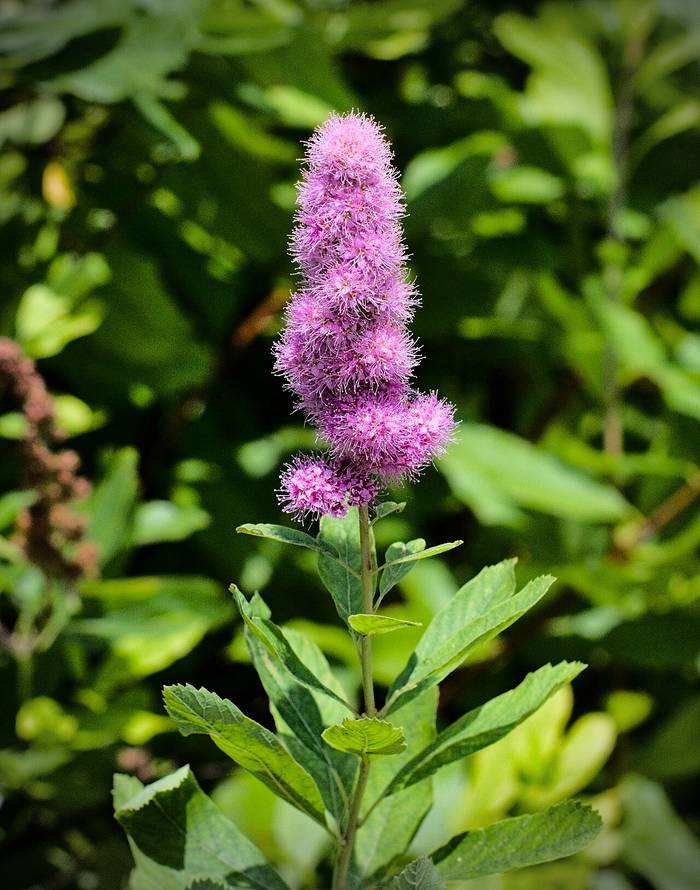
M0tty · CC BY-SA 3.0
Willow-leaved meadowsweet
Shrub·Spiraea salicifolia
Part shade to full sun
Sun
Moist to wet soil
Water
Not recorded
Drainage
Zones 3–8
Hardiness
Coverage · 106 fields
- Parser flag (climate_tolerance_low_confidence): Climate tolerance values are LLM-extracted (no authoritative EcoCrop match found). EcoCrop covers ~2,568 food-crop taxa; ornamental/native/medicinal species rely on LLM extraction.
- Parser flag (species_trait_mismatch): The ornamental section states 'flower_colour': ['pink'] and 'evidence_quote': 'Spiraea salicifolia, commonly known as bridal wreath spirea, features pink flowers...'. However, Spiraea salicifolia (Willowleaf Meadowsweet) is known for its white flowers, not pink. The common name 'Bridal Wreath Spirea' is often associated with Spiraea x vanhouttei, which has white flowers, but the specific epithet 'salicifolia' refers to the willowleaf species, which also has white flowers. This suggests a mismatch in flower color for the given scientific name.
Growth and size10 fields
Spread
150 cm
AI estimate58 % agree
Height at age
—
empty
Spacing
120 cm (at least 90 cm)
AI estimate55 % agree
Growth rate
—
empty
Habit
Spreading
AI estimate50 % agree
Root depth
Medium
AI estimate63 % agree
Forest garden layer
Shrub layer“Spiraea salicifolia is a deciduous Shrub growing to 1.8 m (6ft).”
Lifespan
~20 years
AI estimatenot measured yet
Roots6 fields
Root form
Fibrous roots
AI estimate43 % agree
Storage organ
None“No clonal growth organ is recorded: it does not spread vegetatively (no suckers, no rhizomes).”
Spreads
No“No clonal growth organ is recorded: it does not spread vegetatively (no suckers, no rhizomes).”
Lateral spread in cm
—
empty
Root depth in cm
—
empty
Mycorrhiza
Arbuscular (AM)
AI estimatenot measured yet
Light, water and soil9 fields
Sun
Full sun, light shade, part shade · best: full sun“Tolerates most soils, but prefers a good loamy soil, abundant moisture and full sunlight.”PFAF“It can grow in semi-shade (light woodland) or no shade.”
Hours of sun
6 h
AI estimatenot measured yet
Water
Moist, wet · best: moist · Medium“It prefers moist soil.”PFAF“Wet boggy places in the mountains of N. Japan.”
Drought tolerant
—
empty
Tolerates waterlogging
—
empty
Soil type
Sand, loam, clay · best: loam“Tolerates most soils, but prefers a good loamy soil, abundant moisture and full sunlight.”PFAF“Suitable for: light (sandy), medium (loamy) and heavy (clay) soils.”
Compacted soil
Copes fairly well
AI estimatenot measured yet
Climate5 fields
Hardiness
Zone 3–8
AI estimatenot measured yet
Growing temperature
0–30 °C · optimal 15–25 °C
AI estimatenot measured yet
Chill hours
800 h
AI estimatenot measured yet
Native range
AT, BA, BG, CN, CZ, HR, HU, JP, KP, KR, KZ, LI, MD, ME, MK, MN, PL, RO, RS, RU, SI, XK
Care (becomes tasks in Manage)4 fields
Dividing
After the last frost“It is apt to get thin and poor unless divided up fairly regularly and replanted in fairly good soil.”
PFAFpartly
Sowing
After the previous stage“Seed - we have no information for this species but suggest sowing the seed as soon as it is ripe in a cold frame if possible.”
PFAFpartly
Pruning
After the previous stage · 14 days after · lasts 30 days · new growth for next year's flowers · oldest stems and spent flower heads
AI estimatenot measured yet
Mulching
March · lasts 30 days
AI estimatenot measured yet
Through the year5 fields
Leafing out
After the last frost · Above 5 °C · lasts 14 days
AI estimatenot measured yet
Fruiting
After the previous stage · 30 days after · lasts 60 days
AI estimatenot measured yet
Dying back
After the first frost · Set by day length · lasts 30 days
AI estimatenot measured yet
Dormant
After the first frost · 30 days after · lasts 150 days
AI estimatenot measured yet
Edible parts and pollination4 fields
The leaves
Pollination
Self-fertile · hermaphrodite“The species is hermaphrodite (has both male and female organs) and is pollinated by Insects.”
Pollinated by
Insects“The species is hermaphrodite (has both male and female organs) and is pollinated by Insects.”
Ecology5 fields
Attracts
Insects“The species is hermaphrodite (has both male and female organs) and is pollinated by Insects.”
Pests
—
empty
Diseases
—
empty
Takes up
Potassium, calcium
AI estimatenot measured yet
Fixes nitrogen
No
AI estimatenot measured yet
Propagation and names4 fields
Methods
Seed, half-ripe cuttings, hardwood cuttings, division of suckers“Seed - we have no information for this species but suggest sowing the seed as soon as it is ripe in a cold frame if possible.”PFAF“Cuttings of half-ripe wood, July/August in a light sandy soil a frame.”PFAF“Cuttings of mature wood of the current seasons growth, 15cm long, October/November in an outdoor frame.”PFAF“Division of suckers in early spring.”
Difficulty
2 / 5
AI estimatenot measured yet
Seed
likely required“It is likely to require stratification before it germinates, so stored seed should be sown in a cold frame as early in the year as you receive it.”
Not sorted yet54 fields
Fields the parser stores that this page has no row for yet. They show up here automatically, so nothing is hidden.
forage.DK.local_name
Pilebladet spiræa
AI estimatenot measured yet
forage.DK.edibility_basis
inferred
AI estimatenot measured yet
forage.DK.foraging_months.notes
No documented foraging information for Spiraea salicifolia in Denmark.
AI estimatenot measured yet
forage.DK.foraging_months.year_round
false
AI estimatenot measured yet
forage.US.local_name
Willowleaf meadowsweet
AI estimatenot measured yet
forage.US.edible_parts
forage.US.edibility_basis
inferred
AI estimatenot measured yet
forage.US.foraging_months.notes
No documented foraging information for Spiraea salicifolia in the US.
AI estimatenot measured yet
forage.US.foraging_months.year_round
false
AI estimatenot measured yet
forage.TROPICAL.edibility_basis
inferred
AI estimatenot measured yet
forage.TROPICAL.foraging_months.notes
Spiraea salicifolia is not typically found or foraged in tropical regions.
AI estimatenot measured yet
forage.TROPICAL.foraging_months.year_round
false
AI estimatenot measured yet
ornamental.basis
documented
AI estimatenot measured yet
ornamental.fragrance.source
none
AI estimate100 % agree
ornamental.confidence
high
AI estimatenot measured yet
ornamental.fall_interest
true
AI estimatenot measured yet
ornamental.flower_colour
pink
AI estimate67 % agree
ornamental.evidence_quote
Spiraea salicifolia, commonly known as bridal wreath spirea, features pink flowers and green foliage that turns yellow-green in autumn. It has a medium foliage texture and provides winter interest through its architectural skeleton.
AI estimatenot measured yet
ornamental.foliage_colour
green
AI estimate82 % agree
ornamental.foliage_texture
medium
AI estimatenot measured yet
ornamental.winter_structure
architectural_skeleton
AI estimatenot measured yet
ornamental.autumn_foliage_colour
yellow_green
AI estimatenot measured yet
care_regime
light
AI estimatenot measured yet
propagation.self_seeding
moderate
AI estimate20 % agree
propagation.establishment_years
1
AI estimate40 % agree
sun_requirement.best
full_sun“Tolerates most soils, but prefers a good loamy soil, abundant moisture and full sunlight.”
forage_proposals.DK.edibility_tier.tier
toxic
AI estimatenot measured yet
forage_proposals.DK.edibility_tier.confidence
medium
AI estimatenot measured yet
forage_proposals.DK.edibility_tier.evidence_quote
Spiraea salicifolia is generally considered to have low toxicity, but some sources suggest it may contain cyanogenic glycosides, which can release hydrogen cyanide upon ingestion. While not typically fatal, ingestion of large quantities could cause mild discomfort.
AI estimatenot measured yet
forage_proposals.US.edibility_tier.tier
toxic
AI estimatenot measured yet
forage_proposals.US.edibility_tier.confidence
medium
AI estimatenot measured yet
forage_proposals.US.edibility_tier.evidence_quote
Spiraea salicifolia is generally considered to have low toxicity, but some sources suggest it may contain cyanogenic glycosides, which can release hydrogen cyanide upon ingestion. While not typically fatal, ingestion of large quantities could cause mild discomfort.
AI estimatenot measured yet
forage_proposals.TROPICAL.edibility_tier.tier
toxic
AI estimatenot measured yet
forage_proposals.TROPICAL.edibility_tier.confidence
medium
AI estimatenot measured yet
forage_proposals.TROPICAL.edibility_tier.evidence_quote
Spiraea salicifolia is generally considered to have low toxicity, but some sources suggest it may contain cyanogenic glycosides, which can release hydrogen cyanide upon ingestion. While not typically fatal, ingestion of large quantities could cause mild discomfort.
AI estimatenot measured yet
function_profile.biomass_return.confidence
medium
AI estimatenot measured yet
function_profile.nutrient_flows.consumes
[{"basis":"inferred","demand":"moderate","nutrient":"nitrogen","confidence":"medium"},{"basis":"inferred","demand":"moderate","nutrient":"phosphorus","confidence":"medium"},{"basis":"inferred","demand":"moderate","nut…
AI estimatenot measured yet
function_profile.nutrient_flows.provides
[{"basis":"inferred","nutrient":"potassium","mechanism":"biomass_return","confidence":"medium"},{"basis":"inferred","nutrient":"calcium","mechanism":"biomass_return","confidence":"medium"}]
AI estimatenot measured yet
function_profile.biotic_interactions
[{"taxa":["insects"],"basis":"documented","valence":"beneficial","relation":"attracts","confidence":"medium","evidence_quote":"The species is hermaphrodite (has both male and female organs) and is pollinated by Insect…“The species is hermaphrodite (has both male and female organs) and is pollinated by Insects.”
function_profile.aromatic_pest_effect.value
false
AI estimate80 % agree
function_profile.aromatic_pest_effect.confidence
low
AI estimatenot measured yet
function_profile.structural_interfaces.provides_shelter.basis
inferred
AI estimatenot measured yet
function_profile.structural_interfaces.provides_shelter.kinds
wind, shade
AI estimatenot measured yet
function_profile.structural_interfaces.provides_shelter.confidence
medium
AI estimatenot measured yet
function_profile.structural_interfaces.provides_physical_support.form
dense_thicket“A rampant suckering shrub, it quickly produces dense thickets.”
function_profile.structural_interfaces.provides_physical_support.basis
inferred
AI estimatenot measured yet
function_profile.structural_interfaces.provides_physical_support.confidence
medium
AI estimatenot measured yet
function_profile.structural_interfaces.provides_physical_support.evidence_quote
A rampant suckering shrub, it quickly produces dense thickets.
AI estimatenot measured yet
climate_tolerance.photoperiod_response
day_neutral
AI estimatenot measured yet
soil_interactions.organic_matter_contribution
medium
AI estimatenot measured yet
component_metadata.growth_cycle
perennial
AI estimate100 % agree
resource_interfaces.inputs
[{"resource":"light","quantity_description":"prefers full sunlight"},{"resource":"shade","quantity_description":"tolerates semi-shade or no shade"},{"resource":"water","quantity_description":"prefers moist soil and ab…“Tolerates most soils, but prefers a good loamy soil, abundant moisture and full sunlight.”PFAF“It can grow in semi-shade (light woodland) or no shade.”PFAFpartly“It prefers moist soil.”
resource_interfaces.outputs
[{"resource":"pollinator_services","quantity_description":"insect-pollinated flowers"}]“The species is hermaphrodite (has both male and female organs) and is pollinated by Insects.”