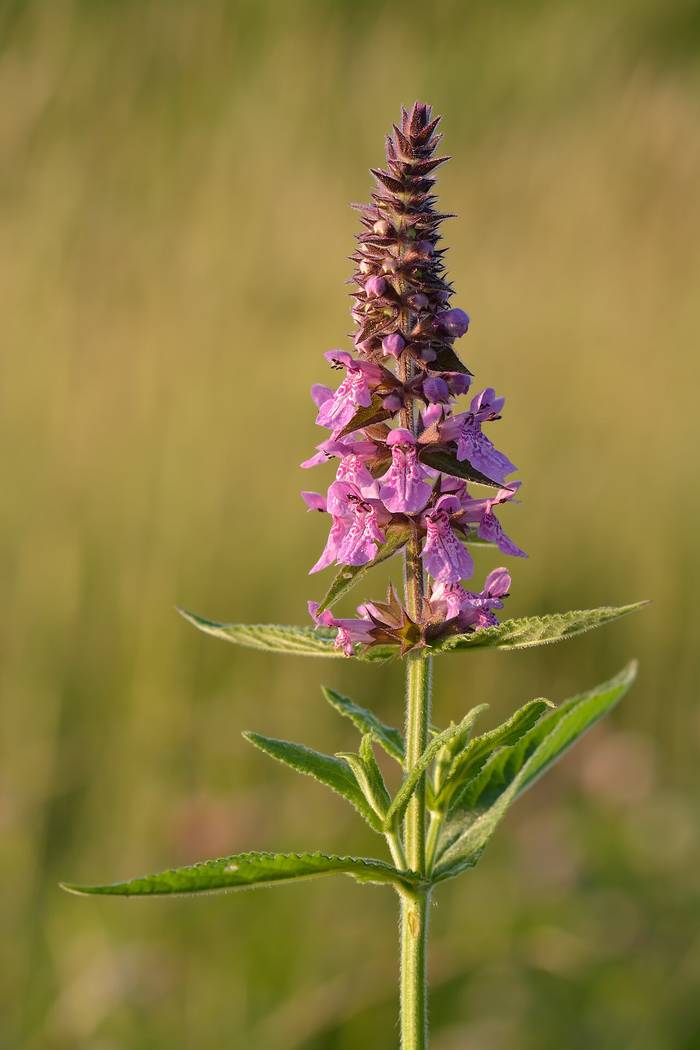
Ivar Leidus · CC BY-SA 3.0
marsh woundwort
Plant·Stachys palustris
Part shade to full sun
Sun
Moist to wet soil
Water
Well-drained soil
Drainage
Zones 4–8
Hardiness
Coverage · 102 fields
No obvious inconsistencies found.
Growth and size10 fields
Height
100 cm · other sources: 80 cm“Stachys palustris is a PERENNIAL growing to 1 m (3ft 3in) by 0.4 m (1ft 4in).”Wikipedia“is an edible perennial grassland herb growing to 80 centimeters tall.”
Height at age
—
empty
Spacing
45 cm (at least 30 cm)
AI estimate55 % agree
Growth rate
—
empty
Habit
Spreading
AI estimate50 % agree
Root depth
Shallow
AI estimate63 % agree
Forest garden layer
Herb layer“is an edible perennial grassland herb growing to 80 centimeters tall.”
Wikipediapartly
Lifespan
~5 years
AI estimatenot measured yet
Roots6 fields
Root form
—
empty
Storage organ
Stem tuber“Its storage organ is a stem tuber; it multiplies by offspring stem tubers.”
Root depth in cm
—
empty
Mycorrhiza
Arbuscular (AM)
AI estimatenot measured yet
Light, water and soil9 fields
Sun
Full sun, light shade, part shade · best: full sun“It can grow in semi-shade (light woodland) or no shade.”
Hours of sun
6–12 h
AI estimatenot measured yet
Drought tolerant
—
empty
Tolerates waterlogging
—
empty
Soil type
Sand, loam, clay“Suitable for: light (sandy), medium (loamy) and heavy (clay) soils and prefers well-drained soil.”
Drainage
Well drained“Suitable for: light (sandy), medium (loamy) and heavy (clay) soils and prefers well-drained soil.”
Compacted soil
Copes fairly well
AI estimatenot measured yet
Climate5 fields
Hardiness
Zone 4–8
AI estimatenot measured yet
Killing frost
-25 °C
AI estimatenot measured yet
Growing temperature
5–30 °C · optimal 15–25 °C
AI estimatenot measured yet
Chill hours
0 h
AI estimatenot measured yet
Native range
AD, AL, AM, AT, AZ, BA, BE, BG, BY, CH, CN, CZ, DE, DK, EE, ES, FI, FR, GB, GE, GG, GI, GR, HR, HU, IE, IN, IR, IT, JE, KG, KZ, LI, LT, LU, LV, MC, MD, ME, MK, MN, NL, NO, PL, PT, RO, RS, RU, SE, SI, SK, SM, TR, UA, US, UZ, VA, XK
Through the year4 fields
Flowering
July · lasts 92 days“It is in flower from July to September, and the seeds ripen from August to October.”
Fruiting
August · lasts 92 days“It is in flower from July to September, and the seeds ripen from August to October.”
Leafing out
After the last frost · Above 5 °C · lasts 30 days
AI estimatenot measured yet
Dying back
After the first frost · lasts 30 days
AI estimatenot measured yet
Edible parts and pollination6 fields
The tubers
Raw or cooked; can be dried and ground into a powder“Tubers - raw or cooked”PFAF“The tubers can be dried and ground into a powder that is used in making bread etc.”
The seeds
August–October“the seeds ripen from August to October”PFAFpartly“Seed. No further details are given.”
Pollination
Self-fertile · hermaphrodite“The species is hermaphrodite (has both male and female organs)”PFAF“is pollinated by Bees”
Ecology5 fields
Attracts
Pests
—
empty
Diseases
—
empty
Takes up
—
empty
Fixes nitrogen
No
AI estimatenot measured yet
Propagation and names4 fields
Methods
Seed, division, offspring stem tubers“Seed - sow spring in a cold frame.”PFAF“Division in spring.”CLO-PLA (clonal growth)“Its storage organ is a stem tuber; it multiplies by offspring stem tubers.”
Difficulty
2 / 5
AI estimatenot measured yet
Seed
cold_moist_stratification_required
AI estimatenot measured yet
Not sorted yet53 fields
Fields the parser stores that this page has no row for yet. They show up here automatically, so nothing is hidden.
forage.DK.local_name
sump-svinerod
AI estimatenot measured yet
forage.DK.warnings_da
Bør ikke spises under graviditet og amning.
AI estimatenot measured yet
forage.DK.warnings_en
Don't eat during pregnancy or breastfeeding.
AI estimatenot measured yet
forage.DK.prep_cautions
Avoid during pregnancy & breast feeding, All parts of the plant have an unpleasant smell when bruised; young shoots have a disagreeable smell when cooked.“Avoid during pregnancy & breast feeding”PFAF“All parts of the plant emit an unpleasant smell when bruised.”
forage.DK.edibility_basis
inferred
AI estimatenot measured yet
forage.DK.foraging_months.notes
Seeds ripen August to October; tubers are formed in autumn.“The tubers are formed in the autumn.”
forage.DK.foraging_months.months
9, 10, 11, 12, 1, 2, 3, 4“the seeds ripen from August to October”
PFAFpartly
forage.DK.foraging_months.year_round
false
AI estimatenot measured yet
forage.DK.habitat_affinity
riverbank, disturbed_ground“By streams and ditches, also in swamps and fens.”Wikipedia“in arable ground and in waste places”
forage.US.local_name
marsh woundwort
AI estimatenot measured yet
forage.US.edible_parts
[{"part":"leaves"},{"part":"tubers","preparation":"raw or cooked; can be dried and ground into a powder"},{"part":"young shoots","preparation":"cooked"},{"part":"seed","season_months":[8,9,10]}]“Edible Parts: Leaves Root Seed Shoots”PFAF“Tubers - raw or cooked”PFAF“Young shoots - cooked.”PFAF“The tubers can be dried and ground into a powder that is used in making bread etc.”PFAF“the seeds ripen from August to October”PFAFpartly“Seed. No further details are given.”
forage.US.prep_cautions
Avoid during pregnancy & breast feeding, All parts of the plant have an unpleasant smell when bruised; young shoots have a disagreeable smell when cooked.“Avoid during pregnancy & breast feeding”PFAF“All parts of the plant emit an unpleasant smell when bruised.”
forage.US.edibility_basis
inferred
AI estimatenot measured yet
forage.US.foraging_months.notes
Seeds ripen August to October; tubers are formed in autumn.“The tubers are formed in the autumn.”
forage.US.foraging_months.months
9, 10, 11, 12, 1, 2, 3, 4“the seeds ripen from August to October”
PFAFpartly
forage.US.foraging_months.year_round
false
AI estimatenot measured yet
forage.US.habitat_affinity
riverbank, disturbed_ground“By streams and ditches, also in swamps and fens.”Wikipedia“in arable ground and in waste places”
forage.TROPICAL.edibility_basis
inferred
AI estimatenot measured yet
forage.TROPICAL.foraging_months.year_round
false
AI estimatenot measured yet
ornamental.basis
documented
AI estimatenot measured yet
ornamental.fragrance.intensity
subtle“Although the marsh woundwort has little fragrance, it is very attractive to bumblebees.”
Wikipediapartly
ornamental.confidence
high
AI estimatenot measured yet
ornamental.fall_interest
false
AI estimatenot measured yet
ornamental.flower_colour
purple, red“The purplish-red flowers are in terminal spikes, with gaps in the lower part of the spike.”
ornamental.evidence_quote
Stachys palustris, commonly known as marsh woundwort, produces whorls of purple flowers. Its foliage is green and it does not typically exhibit significant autumn colour.
AI estimatenot measured yet
ornamental.foliage_colour
green
AI estimate82 % agree
ornamental.foliage_texture
medium
AI estimatenot measured yet
ornamental.winter_structure
none
AI estimatenot measured yet
ornamental.autumn_foliage_colour
none
AI estimatenot measured yet
care_regime
none
AI estimatenot measured yet
propagation.self_seeding
moderate
AI estimate20 % agree
propagation.establishment_years
1
AI estimate40 % agree
forage_proposals.DK.edibility_tier.tier
edible
AI estimatenot measured yet
forage_proposals.DK.edibility_tier.confidence
high
AI estimatenot measured yet
forage_proposals.DK.edibility_tier.evidence_quote
The tubers of Stachys palustris are edible and can be eaten raw or cooked. They have a nutty flavor and are a good source of starch.
AI estimatenot measured yet
forage_proposals.US.edibility_tier.tier
edible
AI estimatenot measured yet
forage_proposals.US.edibility_tier.confidence
high
AI estimatenot measured yet
forage_proposals.US.edibility_tier.evidence_quote
Marsh woundwort tubers are edible and can be prepared in various ways, similar to potatoes. They are a traditional food source in some regions.
AI estimatenot measured yet
forage_proposals.TROPICAL.edibility_tier.confidence
low
AI estimatenot measured yet
function_profile.biomass_return.confidence
medium
AI estimatenot measured yet
function_profile.nutrient_flows.consumes
[{"basis":"inferred","demand":"moderate","nutrient":"nitrogen","confidence":"medium"},{"basis":"inferred","demand":"moderate","nutrient":"phosphorus","confidence":"medium"},{"basis":"inferred","demand":"moderate","nut…
AI estimatenot measured yet
function_profile.biotic_interactions
[{"taxa":["bumblebees","bees"],"basis":"documented","valence":"beneficial","relation":"attracts","confidence":"high","evidence_quote":"The flowers are mostly visited by bumblebees.","organism_group":"pollinator","ecol…“The flowers are mostly visited by bumblebees.”PFAF“It is noted for attracting wildlife.”
function_profile.aromatic_pest_effect.value
false
AI estimate80 % agree
function_profile.aromatic_pest_effect.confidence
low
AI estimatenot measured yet
function_profile.structural_interfaces.provides_shelter.basis
inferred
AI estimatenot measured yet
function_profile.structural_interfaces.provides_shelter.kinds
shade
AI estimatenot measured yet
function_profile.structural_interfaces.provides_shelter.confidence
low
AI estimatenot measured yet
climate_tolerance.photoperiod_response
long_day
AI estimatenot measured yet
soil_interactions.organic_matter_contribution
medium
AI estimatenot measured yet
component_metadata.growth_cycle
perennial“Stachys palustris is a PERENNIAL growing to 1 m (3ft 3in) by 0.4 m (1ft 4in).”
resource_interfaces.inputs
[{"resource":"light","quantity_description":"semi-shade or no shade"},{"resource":"water","quantity_description":"moist to wet soil"}]“It can grow in semi-shade (light woodland) or no shade.”PFAF“It prefers moist or wet soil.”
resource_interfaces.outputs
[{"resource":"pollinator_services","quantity_description":"a good bee plant, with flowers mostly visited by bumblebees"},{"resource":"habitat","quantity_description":"noted for attracting wildlife"},{"resource":"seeds…“It is noted for attracting wildlife.”Wikipedia“The seeds of this plant disperse well, the dry fruit capsules float away and this probably why the plant is frequently found on the banks of lakes and other bodies of water.”PFAF“All parts of the plant emit an unpleasant smell when bruised.”PFAFpartly“A good bee plant.”