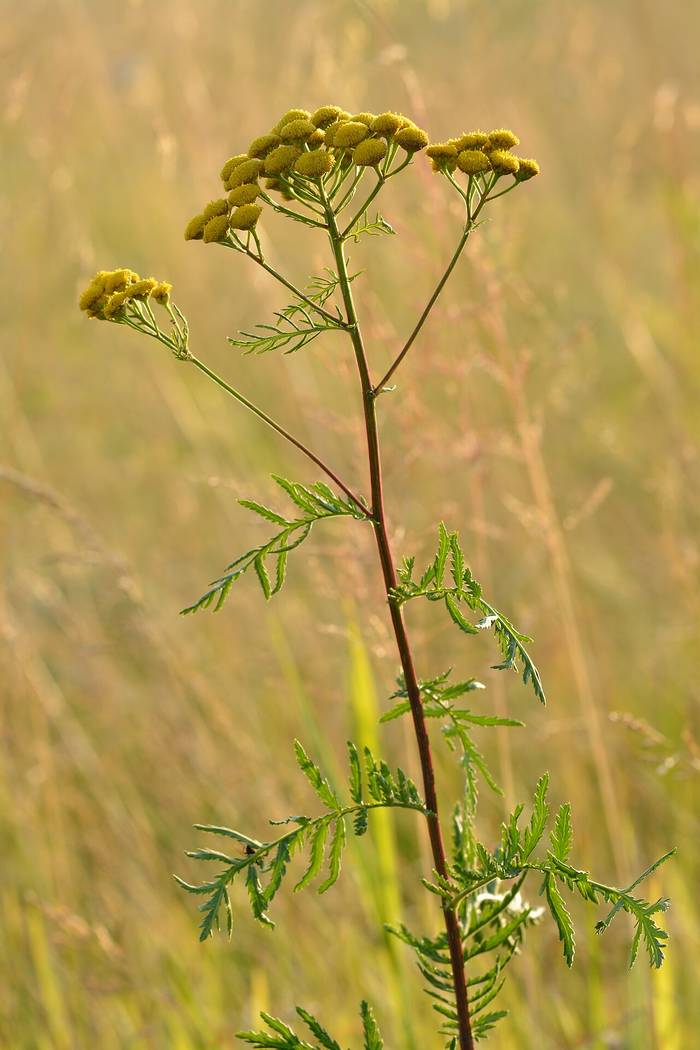
Ivar Leidus · CC BY-SA 3.0
Tansy
Plant·Tanacetum vulgare
Full sun
Sun
Dry to moist soil
Water
Not recorded
Drainage
Zones 3–9
Hardiness
Coverage · 113 fields
No obvious inconsistencies found.
Growth and size10 fields
Height
100 cm · the source gives 50–150 cm“It has a stout, somewhat reddish, erect stem, usually smooth, 50–150 cm (20–59 in) tall, and branching near the top.”PFAF“Tanacetum vulgare is a PERENNIAL growing to 1 m (3ft 3in) by 1.5 m (5ft) at a fast rate.”
Spread
150 cm“Tanacetum vulgare is a PERENNIAL growing to 1 m (3ft 3in) by 1.5 m (5ft) at a fast rate.”
Height at age
—
empty
Spacing
60 cm (at least 45 cm)
AI estimate55 % agree
Growth rate
Fast“Tanacetum vulgare is a PERENNIAL growing to 1 m (3ft 3in) by 1.5 m (5ft) at a fast rate.”
Habit
Spreading
AI estimate50 % agree
Root depth
Medium
AI estimate63 % agree
Forest garden layer
Herb layer“Tansy is a flowering herbaceous clump-forming plant with finely divided compound leaves and yellow, button-like flowers.”
Lifespan
~10 years
AI estimatenot measured yet
Roots6 fields
Root form
Fibrous roots
AI estimate43 % agree
Storage organ
Rhizome“Its storage organ is a rhizome, a creeping underground stem; it spreads by rhizomes.”
Spreads
By rhizomes“Its storage organ is a rhizome, a creeping underground stem; it spreads by rhizomes.”
Root depth in cm
—
empty
Mycorrhiza
Arbuscular (AM)
AI estimatenot measured yet
Light, water and soil9 fields
Hours of sun
6–12 h
AI estimatenot measured yet
Drought tolerant
—
empty
Tolerates waterlogging
—
empty
Soil type
Sand, loam, clay“Suitable for: light (sandy), medium (loamy) and heavy (clay) soils and prefers well-drained soil.”
Drainage
Prefers well-drained soil“Suitable for: light (sandy), medium (loamy) and heavy (clay) soils and prefers well-drained soil.”
Compacted soil
Copes fairly well
AI estimatenot measured yet
Climate5 fields
Hardiness
Zone 3–9
AI estimatenot measured yet
Killing frost
-30 °C
AI estimatenot measured yet
Growing temperature
5–30 °C · optimal 15–25 °C
AI estimatenot measured yet
Chill hours
0 h
AI estimatenot measured yet
Native range
AD, AL, AM, AT, AZ, BA, BE, BG, BY, CH, CN, DE, DK, EE, ES, FI, FR, GB, GE, GG, GI, GR, HR, HU, IT, JE, JP, KG, KP, KR, KZ, LT, LU, LV, MC, MD, ME, MK, MN, MT, NL, NO, PL, RO, RS, RU, SE, SI, SM, TR, UA, VA, XK
Care (becomes tasks in Manage)2 fields
Pruning
After the previous stage · 30 days after · lasts 15 days · spent flower heads
AI estimatenot measured yet
Dividing
March · lasts 30 days · lift and split with a spade
AI estimatenot measured yet
Through the year4 fields
Flowering
August · lasts 61 days“It is in flower from August to September, and the seeds ripen from August to October.”
Fruiting
August · lasts 92 days“It is in flower from August to September, and the seeds ripen from August to October.”
Leafing out
After the last frost · lasts 30 days
AI estimatenot measured yet
Dying back
After the first frost · lasts 30 days
AI estimatenot measured yet
Edible parts and pollination4 fields
The flowers
Eaten or used as a garnish · August–September“The flowers have a unique flavour and are eaten or used as a garnish.”PFAFpartly“It is in flower from August to September, and the seeds ripen from August to October.”
Pollination
Self-fertile · hermaphrodite“The species is hermaphrodite (has both male and female organs) and is pollinated by Bees, flies, beetles.”PFAF“The plant is self-fertile.”
Pollinated by
Bees, flies, beetles“The species is hermaphrodite (has both male and female organs) and is pollinated by Bees, flies, beetles.”
Ecology5 fields
Attracts
Pests
Tansy beetle (chrysolina graminis)“Some insects, notably the tansy beetle Chrysolina graminis, have resistance to the toxins and subsist almost exclusively on the plant.”
Diseases
—
empty
Takes up
Potassium, calcium
AI estimatenot measured yet
Fixes nitrogen
No
AI estimatenot measured yet
Propagation and names4 fields
Methods
Seed, division“Seed - sow spring in a greenhouse.”PFAF“Division is very simple at almost any time in the growing season, though spring is probably best.”
Difficulty
2 / 5
AI estimatenot measured yet
Seed
cold_moist
AI estimatenot measured yet
Names
75 names in 25 languagesFarve-Reseda, Gul Reseda, Guldknap, Rejnfan, Spidslappet Løvefod, Vellugtende Agermåne
Not sorted yet64 fields
Fields the parser stores that this page has no row for yet. They show up here automatically, so nothing is hidden.
forage.DK.local_name
Rejnfang
AI estimatenot measured yet
forage.DK.warnings_da
Giftig i store mængder., Bør ikke spises under graviditet.
AI estimatenot measured yet
forage.DK.warnings_en
Poisonous in large amounts., Don't eat during pregnancy.
AI estimatenot measured yet
forage.DK.prep_cautions
poisonous if large quantities are ingested, not recommended for internal use, can cause contact dermatitis in sensitive individuals, pregnant women should not use this herb“The plant is poisonous if large quantities are ingested.”PFAF“This plant is not recommended for internal use.”Wikipedia“Many tansy species contain a volatile oil which can cause contact dermatitis in sensitive individuals.”Wikipedia“Traditionally, tansy was often used for its emmenagogue effects to bring on menstruation or end an unwanted pregnancy, and pregnant women are advised to not use this herb.”
forage.DK.edibility_basis
inferred
AI estimatenot measured yet
forage.DK.foraging_months.notes
Not typically foraged for food in Denmark due to toxicity concerns.
AI estimatenot measured yet
forage.DK.foraging_months.months
5, 6, 7, 8, 9“It is in flower from August to September, and the seeds ripen from August to October.”
PFAFpartly
forage.DK.foraging_months.year_round
false
AI estimatenot measured yet
forage.DK.habitat_affinity
disturbed_ground, hedgerow“A common plant of waste ground, hedgerows etc.”
forage.US.local_name
Tansy
AI estimatenot measured yet
forage.US.edible_parts
[{"part":"flowers","caution":null,"preparation":"eaten or used as a garnish","season_months":[8,9]},{"part":"leaves","caution":null,"preparation":"young leaflets, raw or cooked"}]“The flowers have a unique flavour and are eaten or used as a garnish.”PFAF“Young leaflets - raw or cooked.”PFAFpartly“It is in flower from August to September, and the seeds ripen from August to October.”
forage.US.prep_cautions
poisonous if large quantities are ingested, not recommended for internal use, can cause contact dermatitis in sensitive individuals, pregnant women should not use this herb“The plant is poisonous if large quantities are ingested.”PFAF“This plant is not recommended for internal use.”Wikipedia“Many tansy species contain a volatile oil which can cause contact dermatitis in sensitive individuals.”Wikipedia“Traditionally, tansy was often used for its emmenagogue effects to bring on menstruation or end an unwanted pregnancy, and pregnant women are advised to not use this herb.”
forage.US.edibility_basis
inferred
AI estimatenot measured yet
forage.US.foraging_months.notes
Not typically foraged for food in the US due to toxicity concerns.
AI estimatenot measured yet
forage.US.foraging_months.months
5, 6, 7, 8, 9“It is in flower from August to September, and the seeds ripen from August to October.”
PFAFpartly
forage.US.foraging_months.year_round
false
AI estimatenot measured yet
forage.US.habitat_affinity
disturbed_ground, hedgerow“A common plant of waste ground, hedgerows etc.”
forage.TROPICAL.edible_parts
[{"part":"leaves","caution":"use sparingly, toxic in large quantities","preparation":"cooked","season_months":[1,2,3,4,5,6,7,8,9,10,11,12]},{"part":"flowers","caution":"use sparingly, toxic in large quantities","prepa…
AI estimatenot measured yet
forage.TROPICAL.prep_cautions
toxic in large quantities, not for pregnant women, avoid prolonged use
AI estimatenot measured yet
forage.TROPICAL.edibility_basis
inferred
AI estimatenot measured yet
forage.TROPICAL.foraging_months.notes
May grow year-round in suitable tropical climates.
AI estimatenot measured yet
forage.TROPICAL.foraging_months.months
1, 2, 3, 4, 5, 6, 7, 8, 9, 10, 11, 12
AI estimatenot measured yet
forage.TROPICAL.foraging_months.year_round
true
AI estimatenot measured yet
forage.TROPICAL.habitat_affinity
disturbed_ground, verge
AI estimatenot measured yet
ornamental.basis
documented
AI estimatenot measured yet
ornamental.fragrance.intensity
strong
AI estimatenot measured yet
ornamental.confidence
high
AI estimatenot measured yet
ornamental.fall_interest
false
AI estimatenot measured yet
ornamental.foliage_colour
green
AI estimate82 % agree
ornamental.foliage_texture
fine“Tansy is a flowering herbaceous clump-forming plant with finely divided compound leaves and yellow, button-like flowers.”
ornamental.winter_structure
seed_heads
AI estimatenot measured yet
ornamental.autumn_foliage_colour
none
AI estimatenot measured yet
care_regime
none
AI estimatenot measured yet
propagation.self_seeding
moderate
AI estimate20 % agree
propagation.division_season
spring (probably best; division is possible at almost any time in the growing season)“Division is very simple at almost any time in the growing season, though spring is probably best.”
propagation.establishment_years
1
AI estimate40 % agree
spatial_profile.canopy_density
medium
AI estimatenot measured yet
forage_proposals.DK.edibility_tier.tier
toxic“The plant is poisonous if large quantities are ingested.”
PFAFpartly
forage_proposals.DK.edibility_tier.confidence
high
AI estimatenot measured yet
forage_proposals.DK.edibility_tier.evidence_quote
Tansy contains thujone, which is toxic and can cause convulsions, vomiting, and liver damage if ingested. It is not recommended for internal use.
AI estimatenot measured yet
forage_proposals.US.edibility_tier.tier
toxic“The plant is poisonous if large quantities are ingested.”
PFAFpartly
forage_proposals.US.edibility_tier.confidence
high
AI estimatenot measured yet
forage_proposals.US.edibility_tier.evidence_quote
Tansy contains thujone, which is toxic and can cause convulsions, vomiting, and liver damage if ingested. It is not recommended for internal use.
AI estimatenot measured yet
forage_proposals.TROPICAL.edibility_tier.tier
toxic
AI estimatenot measured yet
forage_proposals.TROPICAL.edibility_tier.confidence
high
AI estimatenot measured yet
forage_proposals.TROPICAL.edibility_tier.evidence_quote
Tansy contains thujone, which is toxic and can cause convulsions, vomiting, and liver damage if ingested. It is not recommended for internal use.
AI estimatenot measured yet
function_profile.biomass_return.confidence
high“The plant is a good addition to the compost heap, being valued for its mineral content.”
PFAFpartly
function_profile.nutrient_flows.consumes
[{"basis":"documented","demand":"moderate","nutrient":"nitrogen","confidence":"high"},{"basis":"documented","demand":"moderate","nutrient":"phosphorus","confidence":"high"},{"basis":"documented","demand":"moderate","n…
AI estimatenot measured yet
function_profile.nutrient_flows.provides
[{"basis":"documented","nutrient":"potassium","mechanism":"biomass_return","confidence":"high"},{"basis":"documented","nutrient":"calcium","mechanism":"biomass_return","confidence":"high"}]
AI estimatenot measured yet
function_profile.biotic_interactions
[{"taxa":["bees","flies","beetles"],"basis":"documented","valence":"beneficial","relation":"attracts","confidence":"high","evidence_quote":"The species is hermaphrodite (has both male and female organs) and is pollina…“The species is hermaphrodite (has both male and female organs) and is pollinated by Bees, flies, beetles.”PFAF“The flowering plant attracts hoverflies and butterflies.”PFAF“It is noted for attracting wildlife.”Wikipedia“It is planted alongside potatoes to repel the Colorado potato beetle, with one study finding tansy reduced the beetle population by 60 to 100 percent.”PFAF“Both the growing and the dried plant are said to repel flies, ants and fleas, especially if they are mixed with elder leaves (Sambucus spp.).”Wikipedia“Research has found that tansy extracts do indeed repel mosquitoes, but not as effectively as products containing DEET.”Wikipedia“Some insects, notably the tansy beetle Chrysolina graminis, have resistance to the toxins and subsist almost exclusively on the plant.”
function_profile.aromatic_pest_effect.value
true“Both the growing and the dried plant are said to repel flies, ants and fleas, especially if they are mixed with elder leaves (Sambucus spp.).”
function_profile.aromatic_pest_effect.confidence
high
AI estimatenot measured yet
function_profile.structural_interfaces.provides_shelter.basis
inferred
AI estimatenot measured yet
function_profile.structural_interfaces.provides_shelter.kinds
wind
AI estimatenot measured yet
function_profile.structural_interfaces.provides_shelter.confidence
low
AI estimatenot measured yet
climate_tolerance.photoperiod_response
long_day
AI estimatenot measured yet
soil_interactions.organic_matter_contribution
medium
AI estimatenot measured yet
component_metadata.growth_cycle
perennial“Tanacetum vulgare is a PERENNIAL growing to 1 m (3ft 3in) by 1.5 m (5ft) at a fast rate.”
resource_interfaces.inputs
[{"resource":"light","quantity_description":"cannot grow in the shade"},{"resource":"water","quantity_description":"prefers dry or moist soil"},{"resource":"space","quantity_description":"clonal growth organs spread 1…“It cannot grow in the shade.”PFAF“It prefers dry or moist soil.”CLO-PLA (clonal growth)partly“Its clonal growth organs spread 13 cm sideways.”
resource_interfaces.outputs
[{"resource":"pollinator_services","quantity_description":"attracts hoverflies and butterflies"},{"resource":"habitat","quantity_description":"noted for attracting wildlife"},{"resource":"aromatic_compounds","quantity…“The flowering plant attracts hoverflies and butterflies.”PFAF“It is noted for attracting wildlife.”PFAF“The plant is a good addition to the compost heap, being valued for its mineral content.”PFAF“It is in flower from August to September, and the seeds ripen from August to October.”
biotic_relationships.repels
Colorado potato beetle, flies, ants, fleas, mosquitoes“It is planted alongside potatoes to repel the Colorado potato beetle, with one study finding tansy reduced the beetle population by 60 to 100 percent.”PFAF“Both the growing and the dried plant are said to repel flies, ants and fleas, especially if they are mixed with elder leaves (Sambucus spp.).”Wikipedia“Research has found that tansy extracts do indeed repel mosquitoes, but not as effectively as products containing DEET.”