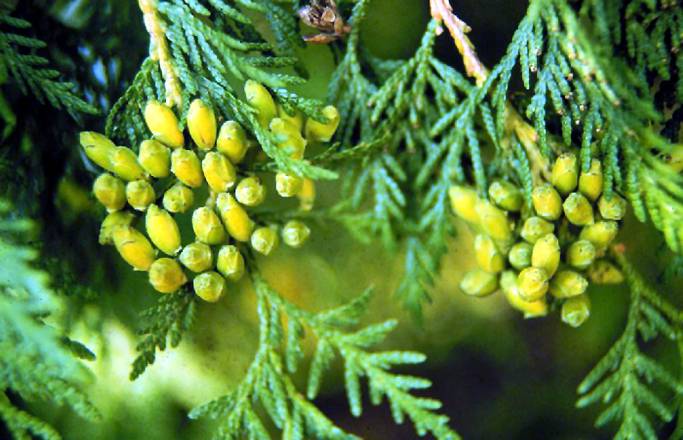
White cedar
Tree·Thuja occidentalis
Part shade to full sun
Sun
Moist to wet soil
Water
Not recorded
Drainage
Zones 2–7
Hardiness
Coverage · 98 fields
No obvious inconsistencies found.
Growth and size11 fields
Plant type
Evergreen tree“Thuja occidentalis is an evergreen Tree growing to 15 m (49ft) by 5 m (16ft) at a slow rate.”
Height
1,500 cm“Thuja occidentalis is an evergreen Tree growing to 15 m (49ft) by 5 m (16ft) at a slow rate.”
Spread
500 cm“Thuja occidentalis is an evergreen Tree growing to 15 m (49ft) by 5 m (16ft) at a slow rate.”
Height at age
—
empty
Size after planting
13 yrs: 5 m tall, 3 m crown · 16 yrs: 6 m tall, 3 m crown · 36 yrs: 9 m tall, 4 m crown · 69 yrs: 13.5 m tall, 5.2 m crown“Berlin tree register: 348 trees of this species measured with years since planting, height and crown diameter; median crown 5.2 m and height 13.5 m at 60–100 years after planting (30 trees).”Median of 348 measured trees in Berlin. Years count from planting nursery stock, so a small tree reaches each size later.
Spacing
300 cm (at least 150 cm)
AI estimate55 % agree
Growth rate
Slow“Thuja occidentalis is an evergreen Tree growing to 15 m (49ft) by 5 m (16ft) at a slow rate.”
Habit
Columnar
AI estimate50 % agree
Root depth
Medium
AI estimate63 % agree
Forest garden layer
Lower tree layer
AI estimate90 % agree
Lifespan
~400 years
AI estimatenot measured yet
Roots6 fields
Root form
Fibrous roots
AI estimate43 % agree
Storage organ
None
AI estimate100 % agree
Spreads
No
AI estimate75 % agree
Lateral spread in cm
—
empty
Root depth in cm
—
empty
Mycorrhiza
—
empty
Light, water and soil9 fields
Sun
Full sun, light shade, part shade · best: full sun“It can grow in semi-shade (light woodland) or no shade.”
Hours of sun
6 h
AI estimatenot measured yet
Water
Moist, wet · best: moist · Medium“Prefers a permanently moist soil, it is intolerant of dry soils.”PFAF“It prefers moist or wet soil.”
Soil type
Sand, loam, clay“Suitable for: light (sandy), medium (loamy) and heavy (clay) soils and can grow in heavy clay soil.”
pH
5.5–9“Suitable pH: mildly acid, neutral and basic (mildly alkaline) soils and can grow in very alkaline soils.”
Drainage
Moist to wet, well-drained“Prefers a permanently moist soil, it is intolerant of dry soils.”
PFAFpartly
Compacted soil
Copes badly
AI estimatenot measured yet
Climate5 fields
Hardiness
Zone 2–7
AI estimatenot measured yet
Killing frost
-40 °C
AI estimatenot measured yet
Growing temperature
5–30 °C · optimal 10–25 °C
AI estimatenot measured yet
Chill hours
0 h
AI estimatenot measured yet
Care (becomes tasks in Manage)3 fields
Mulching
April · lasts 30 days
AI estimatenot measured yet
Watering
After rain · lasts 120 days
AI estimatenot measured yet
Pruning
June · lasts 30 days · dead, damaged, or crossing branches, and for shaping
AI estimatenot measured yet
Through the year4 fields
Flowering
April · lasts 61 days“It is in leaf all year, in flower from April to May, and the seeds ripen from September to October.”
Fruiting
September · lasts 61 days“It is in leaf all year, in flower from April to May, and the seeds ripen from September to October.”
Leafing out
After the last frost · lasts 30 days
AI estimatenot measured yet
Dormant
After the first frost · lasts 150 days
AI estimatenot measured yet
Edible parts and pollination2 fields
Pollination
Self-fertile · monoecious“The species is monoecious (individual flowers are either male or female, but both sexes can be found on the same plant) and is pollinated by Wind.”PFAF“is pollinated by Wind”
Ecology6 fields
Attracts
Birds“Attracts birds, North American native, Wetlands plant, Inconspicuous flowers or blooms.”
Pests
Deer“deer find the soft evergreen foliage a very attractive winter food and strip it rapidly.”
Wikipediapartly
Diseases
—
empty
Takes up
—
empty
Fixes nitrogen
No
AI estimatenot measured yet
Mycorrhiza
Yes
AI estimatenot measured yet
Propagation and names4 fields
Methods
Seed, cuttings“Seed - best sown when ripe in the autumn in a cold frame.”PFAF“Cuttings of half-ripe wood, 5 - 8cm with a heel, July/August in a shaded frame.”
Difficulty
3 / 5
AI estimatenot measured yet
Seed
short cold stratification“Stored seed germinates best if given a short cold stratification.”
Not sorted yet48 fields
Fields the parser stores that this page has no row for yet. They show up here automatically, so nothing is hidden.
forage.DK.local_name
Almindelig thuja
AI estimatenot measured yet
forage.DK.prep_cautions
Avoid consuming large quantities due to thujone content
AI estimatenot measured yet
forage.DK.edibility_basis
inferred
AI estimatenot measured yet
forage.DK.foraging_months.year_round
false
AI estimatenot measured yet
forage.DK.habitat_affinity
woodland, riverbank
AI estimatenot measured yet
forage.US.local_name
American Arbor-vitae
AI estimatenot measured yet
forage.US.edible_parts
[{"part":"young shoot pith","caution":null,"preparation":"cooked; can be added to soups"},{"part":"inner bark","caution":"emergency or scarcity food only","preparation":"cooked; dried, ground to a powder and mixed wit…“Pith of young shoots - cooked.”PFAF“Inner bark - cooked.”PFAF“The leafy branchlets are used as a tea substitute but are probably best avoided by pregnant women.”PFAF“Another report says that the foliage and bark are used, the resulting tea is a good source of vitamin C.”PFAF“Inner bark - cooked. It is only used in times of emergency or scarcity.”PFAF“Pith of young shoots - cooked. It can be added to soups.”PFAF“The inner bark can be dried and ground into a powder, then used with wheat or other cereals in making bread, biscuits etc.”
forage.US.prep_cautions
Essential oil from the leaves is poisonous if taken in large doses., This plant should not be used by pregnant women., Contains thujone, a neurotoxin; internal use can be harmful with prolonged use or during pregnancy., Use oil internally only in small quantities and under medical supervision.“An essential oil from the leaves is poisonous if taken in large doses.”PFAF“This plant should not be used by pregnant women.”Wikipedia“Due to the presence of the neurotoxic compound thujone, internal use can be harmful if used for prolonged periods or while pregnant.”PFAF“Use oil internally in small quantities and under medical supervision.”
forage.US.edibility_basis
inferred
AI estimatenot measured yet
forage.US.habitat_affinity
woodland, riverbank“Northern white cedar grows naturally in wet forests”PFAFpartly“Swamps and cool rocky banks of streams, forming dense almost impenetrable forests.”
Wikipediapartly
forage.TROPICAL.edibility_basis
inferred
AI estimatenot measured yet
forage.TROPICAL.foraging_months.year_round
false
AI estimatenot measured yet
ornamental.basis
documented
AI estimatenot measured yet
ornamental.confidence
high
AI estimatenot measured yet
ornamental.fall_interest
true
AI estimatenot measured yet
ornamental.evidence_quote
The foliage is green, turning bronze in winter, and has a strong, characteristic aroma when crushed. Flowers are inconspicuous.
AI estimatenot measured yet
ornamental.foliage_colour
green
AI estimate82 % agree
ornamental.foliage_texture
fine“The foliage forms in flat sprays with scale-like leaves 3–5 millimetres (1⁄8–3⁄16 in) long.”
Wikipediapartly
ornamental.winter_structure
evergreen_form, ornamental_bark“Thuja occidentalis is an evergreen Tree growing to 15 m (49ft) by 5 m (16ft) at a slow rate.”Wikipedia“The bark is red-brown, furrowed and peels in narrow, longitudinal strips.”
ornamental.autumn_foliage_colour
bronze
AI estimatenot measured yet
care_regime
none
AI estimatenot measured yet
propagation.self_seeding
light
AI estimate20 % agree
propagation.division_season
not applicable
AI estimatenot measured yet
propagation.establishment_years
3
AI estimate40 % agree
size_at_age.v
1
AI estimatenot measured yet
size_at_age.basis
years_after_planting
AI estimatenot measured yet
function_profile.biomass_return.confidence
medium
AI estimatenot measured yet
function_profile.nutrient_flows.consumes
[{"basis":"inferred","demand":"moderate","nutrient":"nitrogen","confidence":"medium"},{"basis":"inferred","demand":"moderate","nutrient":"phosphorus","confidence":"medium"},{"basis":"inferred","demand":"moderate","nut…
AI estimatenot measured yet
function_profile.nutrient_flows.provides
[{"basis":"inferred","nutrient":"calcium","mechanism":"biomass_return","confidence":"low","evidence_quote":null}]
AI estimatenot measured yet
function_profile.biotic_interactions
[{"taxa":["birds"],"basis":"documented","valence":"beneficial","relation":"attracts","confidence":"medium","evidence_quote":"Attracts birds, North American native, Wetlands plant, Inconspicuous flowers or blooms.","or…“Attracts birds, North American native, Wetlands plant, Inconspicuous flowers or blooms.”Wikipedia“deer find the soft evergreen foliage a very attractive winter food and strip it rapidly.”PFAF“This essential oil also has insect repellent properties.”
function_profile.aromatic_pest_effect.value
true“This essential oil also has insect repellent properties.”
function_profile.aromatic_pest_effect.confidence
medium
AI estimatenot measured yet
function_profile.structural_interfaces.provides_shelter.basis
documented
AI estimatenot measured yet
function_profile.structural_interfaces.provides_shelter.kinds
wind, shade
AI estimatenot measured yet
function_profile.structural_interfaces.provides_shelter.confidence
high
AI estimatenot measured yet
function_profile.structural_interfaces.provides_physical_support.form
trunk
AI estimatenot measured yet
function_profile.structural_interfaces.provides_physical_support.basis
taxonomic
AI estimatenot measured yet
function_profile.structural_interfaces.provides_physical_support.confidence
high
AI estimatenot measured yet
climate_tolerance.photoperiod_response
day_neutral
AI estimatenot measured yet
soil_interactions.organic_matter_contribution
medium
AI estimatenot measured yet
component_metadata.growth_cycle
perennial
AI estimate100 % agree
resource_interfaces.inputs
[{"resource":"water","quantity_description":"permanently moist to wet soil; intolerant of dry soil"},{"resource":"light","quantity_description":"tolerates semi-shade or no shade"},{"resource":"pollination","quantity_d…“Prefers a permanently moist soil, it is intolerant of dry soils.”PFAF“It can grow in semi-shade (light woodland) or no shade.”PFAF“The species is monoecious (individual flowers are either male or female, but both sexes can be found on the same plant) and is pollinated by Wind.”
resource_interfaces.outputs
[{"resource":"aromatic_compounds","quantity_description":"wood and foliage strongly aromatic"},{"resource":"timber","quantity_description":"light, soft, very durable wood"},{"resource":"seeds","quantity_description":"…“The wood and the foliage are strongly aromatic.”PFAF“It is in leaf all year, in flower from April to May, and the seeds ripen from September to October.”PFAF“Attracts birds, North American native, Wetlands plant, Inconspicuous flowers or blooms.”PFAFpartly“Wood - light, soft, not strong, brittle, coarse grained, very durable, easily worked, does not warp.”