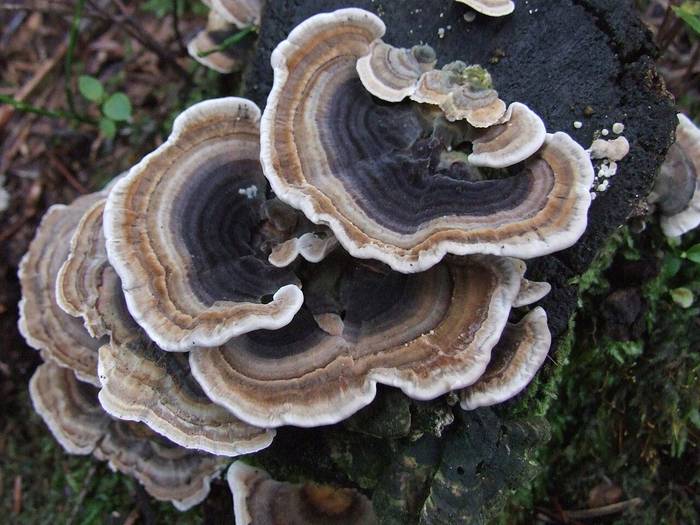
Jerzy Opioła · CC BY-SA 3.0
turkey tail
Fungi·Trametes versicolor
Shade
Sun
High
Water
Well-drained soil
Drainage
Not recorded
Hardiness
Coverage · 107 fields
No obvious inconsistencies found.
Growth and size10 fields
Plant type
Fungus“Trametes versicolor – also known as Coriolus versicolor and Polyporus versicolor – is a common polypore mushroom found throughout the world.”
Height
1 cm
AI estimate75 % agree
Height at age
—
empty
Spacing
10 cm (at least 5 cm)
AI estimate55 % agree
Growth rate
—
empty
Habit
—
empty
Root depth
Shallow
AI estimate63 % agree
Forest garden layer
Fungal layer
AI estimate90 % agree
Lifespan
—
empty
Roots6 fields
Root form
—
empty
Storage organ
—
empty
Spreads
—
empty
Lateral spread in cm
—
empty
Root depth in cm
—
empty
Mycorrhiza
—
empty
Light, water and soil9 fields
Sun
Shade
AI estimate71 % agree
Hours of sun
—
empty
Water
High
AI estimate74 % agree
Drought tolerant
—
empty
Tolerates waterlogging
—
empty
Soil type
—
empty
pH
4.5–7
AI estimate78 % agree
Drainage
Well drained
AI estimatenot measured yet
Compacted soil
Copes fairly well
AI estimatenot measured yet
Climate5 fields
Hardiness
—
empty
Killing frost
—
empty
Growing temperature
—
empty
Chill hours
—
empty
Through the year3 fields
Leafing out
After rain · Once it is warm enough · lasts 30 days
AI estimatenot measured yet
Fruiting
September · lasts 90 days
AI estimatenot measured yet
Dormant
Above 0 °C · lasts 120 days
AI estimatenot measured yet
Edible parts and pollination3 fields
Fruiting body
Teas and powders“The fruiting body is somewhat semicircular, with no discernable stalk, and the tough flesh is 1–3 millimetres (1⁄16–1⁄8 in) thick.”Wikipedia“Trametes versicolor is considered too tough to eat, but can be prepared in many ways, such as teas and powders.”
Pollination
—
empty
Pollinated by
—
empty
Ecology6 fields
Attracts
Nemaxera betulinella (caterpillars), Polyporivora picta (maggots), Mycetophila luctuosa (fungus gnat)“The species may be eaten by caterpillars of the fungus moth Nemaxera betulinella, maggots of the fly Polyporivora picta, and the fungus gnat Mycetophila luctuosa.”
Pests
—
empty
Diseases
—
empty
Takes up
—
empty
Fixes nitrogen
No
AI estimatenot measured yet
Mycorrhiza
No
AI estimatenot measured yet
Propagation and names4 fields
Methods
Spore print, log inoculation
AI estimatenot measured yet
Difficulty
2 / 5
AI estimatenot measured yet
Seed
—
empty
Not sorted yet61 fields
Fields the parser stores that this page has no row for yet. They show up here automatically, so nothing is hidden.
forage.DK.local_name
Flerfarvet læderporesvamp
AI estimatenot measured yet
forage.DK.prep_cautions
Marketed as a dietary supplement, but quality can vary due to inconsistent processing and labeling, and the safety and effectiveness evidence is limited.“It is commonly marketed as a dietary supplement for various health benefits, but lacks sufficient scientific evidence for safety or effectiveness, and quality can vary due to inconsistent processing and labeling.”
forage.DK.edibility_basis
inferred
AI estimatenot measured yet
forage.DK.foraging_months.notes
Can be found year-round, but most abundant in autumn and winter.
AI estimatenot measured yet
forage.DK.foraging_months.year_round
true
AI estimatenot measured yet
forage.DK.habitat_affinity
woodland, disturbed_ground
AI estimatenot measured yet
forage.US.local_name
Turkey Tail
AI estimatenot measured yet
forage.US.edible_parts
[{"part":"fruiting body","caution":"considered too tough to eat as a whole mushroom","preparation":"teas and powders","season_months":[]}]“The fruiting body is somewhat semicircular, with no discernable stalk, and the tough flesh is 1–3 millimetres (1⁄16–1⁄8 in) thick.”Wikipedia“Trametes versicolor is considered too tough to eat, but can be prepared in many ways, such as teas and powders.”
forage.US.prep_cautions
Marketed as a dietary supplement, but quality can vary due to inconsistent processing and labeling, and the safety and effectiveness evidence is limited.“It is commonly marketed as a dietary supplement for various health benefits, but lacks sufficient scientific evidence for safety or effectiveness, and quality can vary due to inconsistent processing and labeling.”
forage.US.edibility_basis
inferred
AI estimatenot measured yet
forage.US.foraging_months.notes
Can be found year-round, but most abundant in autumn and winter.
AI estimatenot measured yet
forage.US.foraging_months.year_round
true
AI estimatenot measured yet
forage.US.habitat_affinity
woodland, disturbed_ground
AI estimatenot measured yet
forage.TROPICAL.edible_parts
[{"part":"fruiting body","caution":null,"preparation":"dried and powdered for tea or extract","season_months":[1,2,3,4,5,6,7,8,9,10,11,12]}]
AI estimatenot measured yet
forage.TROPICAL.prep_cautions
Ensure proper identification to avoid toxic lookalikes.
AI estimatenot measured yet
forage.TROPICAL.edibility_basis
inferred
AI estimatenot measured yet
forage.TROPICAL.foraging_months.notes
Can be found year-round, but most abundant during rainy seasons.
AI estimatenot measured yet
forage.TROPICAL.foraging_months.year_round
true
AI estimatenot measured yet
forage.TROPICAL.habitat_affinity
tropical_forest, disturbed_ground
AI estimatenot measured yet
ornamental.basis
taxonomic
AI estimatenot measured yet
ornamental.fragrance.source
none
AI estimate100 % agree
ornamental.confidence
high
AI estimatenot measured yet
ornamental.flower_colour
none
AI estimate67 % agree
ornamental.foliage_colour
none
AI estimate82 % agree
ornamental.winter_structure
none
AI estimatenot measured yet
ornamental.autumn_foliage_colour
none
AI estimatenot measured yet
care_regime
none
AI estimatenot measured yet
cultivation.substrate
hardwood_logs, hardwood_sawdust
AI estimatenot measured yet
cultivation.fruiting_temp_c.max
20
AI estimatenot measured yet
cultivation.fruiting_temp_c.min
10
AI estimatenot measured yet
cultivation.fruiting_trigger
fresh_air_exchange
AI estimatenot measured yet
cultivation.incubation_temp_c.max
25
AI estimatenot measured yet
cultivation.incubation_temp_c.min
20
AI estimatenot measured yet
propagation.establishment_years
1
AI estimate40 % agree
nutrition_mode
saprotroph“It is a white rot fungus which degrades lignin from lignocellulosic materials, such as wood.”
Wikipediapartly
forage_proposals.DK.edibility_tier.tier
edible
AI estimatenot measured yet
forage_proposals.DK.edibility_tier.confidence
high
AI estimatenot measured yet
forage_proposals.DK.edibility_tier.evidence_quote
Trametes versicolor is widely recognized for its medicinal properties and is commonly consumed as a tea or extract.
AI estimatenot measured yet
forage_proposals.US.edibility_tier.tier
edible
AI estimatenot measured yet
forage_proposals.US.edibility_tier.confidence
high
AI estimatenot measured yet
forage_proposals.US.edibility_tier.evidence_quote
Trametes versicolor is widely recognized for its medicinal properties and is commonly consumed as a tea or extract.
AI estimatenot measured yet
forage_proposals.TROPICAL.edibility_tier.tier
edible
AI estimatenot measured yet
forage_proposals.TROPICAL.edibility_tier.confidence
high
AI estimatenot measured yet
forage_proposals.TROPICAL.edibility_tier.evidence_quote
Trametes versicolor is widely recognized for its medicinal properties and is commonly consumed as a tea or extract.
AI estimatenot measured yet
function_profile.biomass_return.confidence
high
AI estimatenot measured yet
function_profile.nutrient_flows.consumes
[{"basis":"documented","demand":"moderate","nutrient":"nitrogen","confidence":"high","evidence_quote":"Fungi like Trametes versicolor require nitrogen for their growth and enzymatic processes during decomposition."},{…
AI estimatenot measured yet
function_profile.nutrient_flows.provides
[{"basis":"documented","nutrient":"nitrogen","mechanism":"biomass_return","confidence":"high"},{"basis":"documented","nutrient":"phosphorus","mechanism":"biomass_return","confidence":"high"},{"basis":"documented","nut…
AI estimatenot measured yet
function_profile.biotic_interactions
[{"taxa":["Nemaxera betulinella"],"basis":"documented","valence":"neutral","relation":"attracts","confidence":"medium","evidence_quote":"The species may be eaten by caterpillars of the fungus moth Nemaxera betulinella…“The species may be eaten by caterpillars of the fungus moth Nemaxera betulinella, maggots of the fly Polyporivora picta, and the fungus gnat Mycetophila luctuosa.”
function_profile.aromatic_pest_effect.value
false
AI estimate80 % agree
function_profile.aromatic_pest_effect.confidence
low
AI estimatenot measured yet
function_profile.structural_interfaces.provides_shelter.basis
inferred
AI estimatenot measured yet
function_profile.structural_interfaces.provides_shelter.confidence
low
AI estimatenot measured yet
function_profile.structural_interfaces.requires_shelter.basis
inferred
AI estimatenot measured yet
function_profile.structural_interfaces.requires_shelter.confidence
low
AI estimatenot measured yet
function_profile.structural_interfaces.provides_physical_support.basis
inferred
AI estimatenot measured yet
function_profile.structural_interfaces.provides_physical_support.confidence
low
AI estimatenot measured yet
function_profile.structural_interfaces.requires_physical_support.basis
inferred
AI estimatenot measured yet
function_profile.structural_interfaces.requires_physical_support.confidence
low
AI estimatenot measured yet
soil_interactions.organic_matter_contribution
high
AI estimatenot measured yet
resource_interfaces.inputs
[{"resource":"organic_matter","quantity_description":"lignocellulosic materials such as wood"},{"resource":"physical_support","quantity_description":"logs and stumps of deciduous trees"}]“It is a white rot fungus which degrades lignin from lignocellulosic materials, such as wood.”Wikipedia“T. versicolor commonly grows in tiled layers in groups or rows on logs and stumps of deciduous trees.”
resource_interfaces.outputs
[{"resource":"organic_matter"},{"resource":"spores"}]
AI estimatenot measured yet