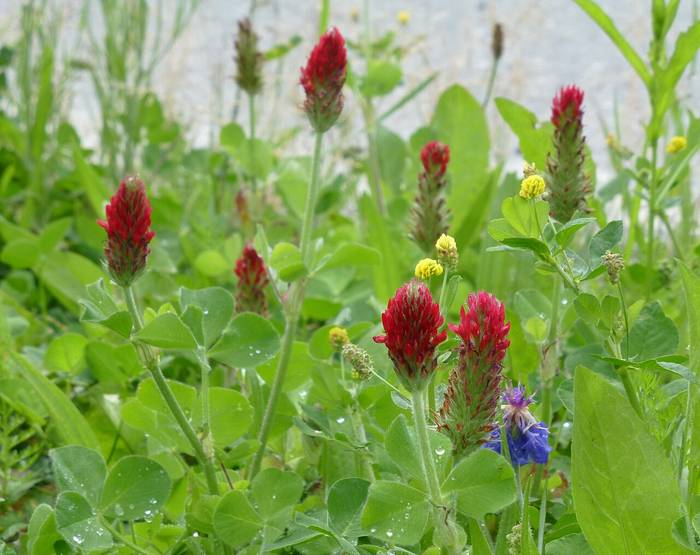
Jacquesverlaeken · CC BY-SA 4.0
crimson clover
Plant·Trifolium incarnatum
Full sun
Sun
Moist soil
Water
Well-drained soil
Drainage
Zones 2–10
Hardiness
Coverage · 114 fields
Growth and size10 fields
Plant type
Plant“Trifolium incarnatum, known as crimson clover is a species of herbaceous flowering plant in the family Fabaceae.”
Height
50 cm · the source gives 20–50 cm“This upright annual herb grows to 20–50 centimetres (8–20 in) tall, unbranched or branched only at the base.”PFAF“Trifolium incarnatum is a ANNUAL growing to 0.5 m (1ft 8in) at a medium rate.”
Spread
30 cm
AI estimate58 % agree
Height at age
—
empty
Spacing
15 cm (at least 10 cm)
AI estimate55 % agree
Growth rate
Medium“Trifolium incarnatum is a ANNUAL growing to 0.5 m (1ft 8in) at a medium rate.”
Habit
Mounding
AI estimate50 % agree
Root depth
Shallow
AI estimate63 % agree
Forest garden layer
Ground cover
AI estimate90 % agree
Lifespan
~1 years
AI estimatenot measured yet
Roots6 fields
Root form
—
empty
Storage organ
None“It does not multiply vegetatively: it has no rhizomes, runners, suckers or offspring bulbs or tubers.”
Spreads
No“It does not multiply vegetatively: it has no rhizomes, runners, suckers or offspring bulbs or tubers.”
Lateral spread in cm
—
empty
Root depth in cm
—
empty
Mycorrhiza
—
empty
Light, water and soil9 fields
Hours of sun
6–12 h
AI estimatenot measured yet
Drought tolerant
—
empty
Tolerates waterlogging
—
empty
Compacted soil
Copes fairly well
AI estimatenot measured yet
Climate5 fields
Hardiness
Zone 2–10
AI estimatenot measured yet
Killing frost
-12 °C
AI estimatenot measured yet
Growing temperature
4–28 °C · optimal 13–22 °C“Temperature absolute min: 4 · Temperature absolute max: 28 · Temperature optimal min: 13 · Temperature optimal max: 22”
Chill hours
0 h
AI estimatenot measured yet
Native range
AD, AL, BA, BG, CH, DE, DK, ES, FI, FR, GB, GG, GI, GR, HR, HU, IR, IT, JE, LU, MC, ME, MK, MT, NL, NO, PL, PT, RO, RS, RU, SE, SI, SK, SM, TR, VA, XK
Care (becomes tasks in Manage)3 fields
Sowing
April“Pre-soak the seed for 12 hours in warm water and then sow in spring to early summer in situ.”
Sowing appears 2 times with different timing.
PFAFpartly
Sowing
September“The seed can also be sown in early autumn as a winter green manure.”
Sowing appears 2 times with different timing.
Mulching
November
AI estimatenot measured yet
Through the year4 fields
Flowering
May · lasts 153 days“It is in flower from May to September, and the seeds ripen from July to October.”
Fruiting
July · lasts 123 days“It is in flower from May to September, and the seeds ripen from July to October.”
Dying back
After the previous stage“In dry summer climates like the Mediterranean, the plants die after maturing seeds.”
Edible parts and pollination5 fields
The seeds
Seedling sprouts
Added as an ingredient in salads, sandwiches, and other dishes“Crimson clover flowers and seedling sprouts are edible”Wikipedia“They can be added as an ingredient in salads, sandwiches, and other dishes”
Flower heads
Dried and used as a tea substitute · May–September“Dried flower heads are a tea substitute.”PFAFpartly“It is in flower from May to September”
Pollination
Self-fertile · hermaphrodite“The species is hermaphrodite (has both male and female organs) and is pollinated by Bees.”PFAF“The plant is self-fertile.”
Pollinated by
Bees“The species is hermaphrodite (has both male and female organs) and is pollinated by Bees.”
Ecology6 fields
Attracts
Bees“The species is hermaphrodite (has both male and female organs) and is pollinated by Bees.”
Pests
Mite“It should not be grown with camellias or gooseberries because it harbours a mite that can cause fruit drop in the gooseberries and premature budding in the camellias.”
Diseases
—
empty
Takes up
Nitrogen, phosphorus, potassium
AI estimatenot measured yet
Mycorrhiza
Yes
AI estimatenot measured yet
Propagation and names4 fields
Methods
Seed“Pre-soak the seed for 12 hours in warm water and then sow in spring to early summer in situ.”
Difficulty
1 / 5
AI estimatenot measured yet
Seed
none
AI estimatenot measured yet
Not sorted yet62 fields
Fields the parser stores that this page has no row for yet. They show up here automatically, so nothing is hidden.
forage.DK.local_name
Blodkløver
AI estimatenot measured yet
forage.DK.prep_cautions
Like all sprouts eaten raw, there is a risk of contamination with Escherichia coli, Salmonella, Listeria, and Bacillus cereus.“Like all sprouts eaten raw, there is a risk of contamination with Escherichia coli, Salmonella, Listeria, and Bacillus cereus.”
forage.DK.edibility_basis
inferred
AI estimatenot measured yet
forage.DK.foraging_months.notes
Young leaves and flowers are best before the plant goes to seed.
AI estimatenot measured yet
forage.DK.foraging_months.months
5, 6, 7, 8, 9, 10“It is in flower from May to September, and the seeds ripen from July to October.”
forage.DK.foraging_months.year_round
false
AI estimatenot measured yet
forage.DK.habitat_affinity
disturbed_ground, verge
AI estimatenot measured yet
forage.US.local_name
Crimson clover
AI estimatenot measured yet
forage.US.edible_parts
[{"part":"leaves","caution":null,"preparation":"cooked","season_months":[4,5,6,7,8,9]},{"part":"flowers","caution":null,"preparation":"raw","season_months":[5,6,7,8]}]
AI estimatenot measured yet
forage.US.prep_cautions
Avoid consuming large quantities of raw leaves due to potential bloating.
AI estimatenot measured yet
forage.US.edibility_basis
inferred
AI estimatenot measured yet
forage.US.foraging_months.notes
Young leaves and flowers are best before the plant goes to seed.
AI estimatenot measured yet
forage.US.foraging_months.months
4, 5, 6, 7, 8, 9
AI estimatenot measured yet
forage.US.foraging_months.year_round
false
AI estimatenot measured yet
forage.US.habitat_affinity
disturbed_ground, verge
AI estimatenot measured yet
forage.TROPICAL.edible_parts
[{"part":"leaves","caution":null,"preparation":"cooked","season_months":[1,2,3,4,5,6,7,8,9,10,11,12]},{"part":"flowers","caution":null,"preparation":"raw","season_months":[1,2,3,4,5,6,7,8,9,10,11,12]}]
AI estimatenot measured yet
forage.TROPICAL.edibility_basis
inferred
AI estimatenot measured yet
forage.TROPICAL.foraging_months.notes
May grow year-round in suitable tropical climates.
AI estimatenot measured yet
forage.TROPICAL.foraging_months.year_round
true
AI estimatenot measured yet
forage.TROPICAL.habitat_affinity
disturbed_ground, verge
AI estimatenot measured yet
ornamental.basis
documented
AI estimatenot measured yet
ornamental.fragrance.source
none
AI estimate100 % agree
ornamental.confidence
high
AI estimatenot measured yet
ornamental.fall_interest
false
AI estimatenot measured yet
ornamental.flower_colour
white, cream, red, pink“The flowers are produced throughout the spring and summer, creamy white to rich red or crimson”Wikipediapartly“flowers bright red (crimson)”Wikipediapartly“flowers creamy white to pale pink, with the petals much longer than the calyx”
Wikipediapartly
ornamental.evidence_quote
Crimson clover (Trifolium incarnatum) is known for its striking crimson-red flowers and green foliage, typically without significant autumn color change. It does not have notable winter structure or fragrance.
AI estimatenot measured yet
ornamental.foliage_colour
green
AI estimate82 % agree
ornamental.foliage_texture
medium
AI estimatenot measured yet
ornamental.winter_structure
none
AI estimatenot measured yet
ornamental.autumn_foliage_colour
none
AI estimatenot measured yet
care_regime
light
AI estimatenot measured yet
propagation.self_seeding
moderate
AI estimate20 % agree
propagation.division_season
none
AI estimatenot measured yet
propagation.establishment_years
1
AI estimate40 % agree
forage_proposals.DK.edibility_tier.tier
edible“Crimson clover flowers and seedling sprouts are edible”
forage_proposals.DK.edibility_tier.confidence
medium“Crimson clover flowers and seedling sprouts are edible”
forage_proposals.DK.edibility_tier.evidence_quote
Crimson clover flowers and seedling sprouts are edible“Crimson clover flowers and seedling sprouts are edible”
forage_proposals.US.edibility_tier.tier
edible
AI estimatenot measured yet
forage_proposals.US.edibility_tier.confidence
high
AI estimatenot measured yet
forage_proposals.US.edibility_tier.evidence_quote
Crimson clover flowers and young leaves are edible and can be added to salads or used as a cooked green.
AI estimatenot measured yet
forage_proposals.TROPICAL.edibility_tier.confidence
low
AI estimatenot measured yet
function_profile.nutrient_flows.consumes
[{"basis":"inferred","demand":"moderate","nutrient":"phosphorus","confidence":"medium"},{"basis":"inferred","demand":"moderate","nutrient":"potassium","confidence":"medium"}]
AI estimatenot measured yet
function_profile.nutrient_flows.provides
[{"basis":"documented","nutrient":"nitrogen","mechanism":"fixation","confidence":"high","evidence_quote":"It can fix Nitrogen."},{"basis":"documented","nutrient":"nitrogen","mechanism":"biomass_return","confidence":"h…“It can fix Nitrogen.”PFAF“When removing plant remains at the end of the growing season, it is best to only remove the aerial parts of the plant, leaving the roots in the ground to decay and release their nitrogen.”
function_profile.biotic_interactions
[{"taxa":["bees"],"basis":"documented","valence":"beneficial","relation":"attracts","confidence":"high","evidence_quote":"The species is hermaphrodite (has both male and female organs) and is pollinated by Bees.","org…“The species is hermaphrodite (has both male and female organs) and is pollinated by Bees.”PFAF“It should not be grown with camellias or gooseberries because it harbours a mite that can cause fruit drop in the gooseberries and premature budding in the camellias.”Wikipedia“It is commonly grazed by domestic and wild ruminants.”
function_profile.aromatic_pest_effect.value
false
AI estimate80 % agree
function_profile.aromatic_pest_effect.confidence
high
AI estimatenot measured yet
function_profile.structural_interfaces.provides_shelter.basis
documented
AI estimatenot measured yet
function_profile.structural_interfaces.provides_shelter.kinds
wind, shade
AI estimatenot measured yet
function_profile.structural_interfaces.provides_shelter.confidence
medium
AI estimatenot measured yet
function_profile.structural_interfaces.provides_shelter.evidence_quote
As a dense ground cover, crimson clover can help reduce wind erosion and provide some shade to the soil.
AI estimatenot measured yet
function_profile.structural_interfaces.requires_shelter.basis
inferred
AI estimatenot measured yet
function_profile.structural_interfaces.requires_shelter.confidence
low
AI estimatenot measured yet
function_profile.structural_interfaces.provides_physical_support.basis
inferred
AI estimatenot measured yet
function_profile.structural_interfaces.provides_physical_support.confidence
low
AI estimatenot measured yet
function_profile.structural_interfaces.requires_physical_support.basis
inferred
AI estimatenot measured yet
function_profile.structural_interfaces.requires_physical_support.confidence
low
AI estimatenot measured yet
climate_tolerance.photoperiod_response
long_day
AI estimatenot measured yet
soil_interactions.organic_matter_contribution
high
AI estimatenot measured yet
component_metadata.growth_cycle
annual“Trifolium incarnatum is a ANNUAL growing to 0.5 m (1ft 8in) at a medium rate.”
resource_interfaces.inputs
[{"resource":"light","quantity_description":"full sun"},{"resource":"water","quantity_description":"prefers moist soil"}]“Succeeds in a moist, well-drained circum-neutral soil in full sun.”PFAF“It prefers moist soil.”
resource_interfaces.outputs
[{"resource":"ground_cover","quantity_description":"fast-growing weed-suppressing cover"},{"resource":"mulch_biomass","quantity_description":"used as a green manure"},{"resource":"organic_matter","quantity_description…“It is relatively fast growing, makes an excellent weed suppressing cover and fixes nitrogen.”PFAF“Used as a green manure.”PFAF“Edible Parts: Seed”Wikipediapartly“It grows rapidly in spring, and yields an abundant crop of greenery.”