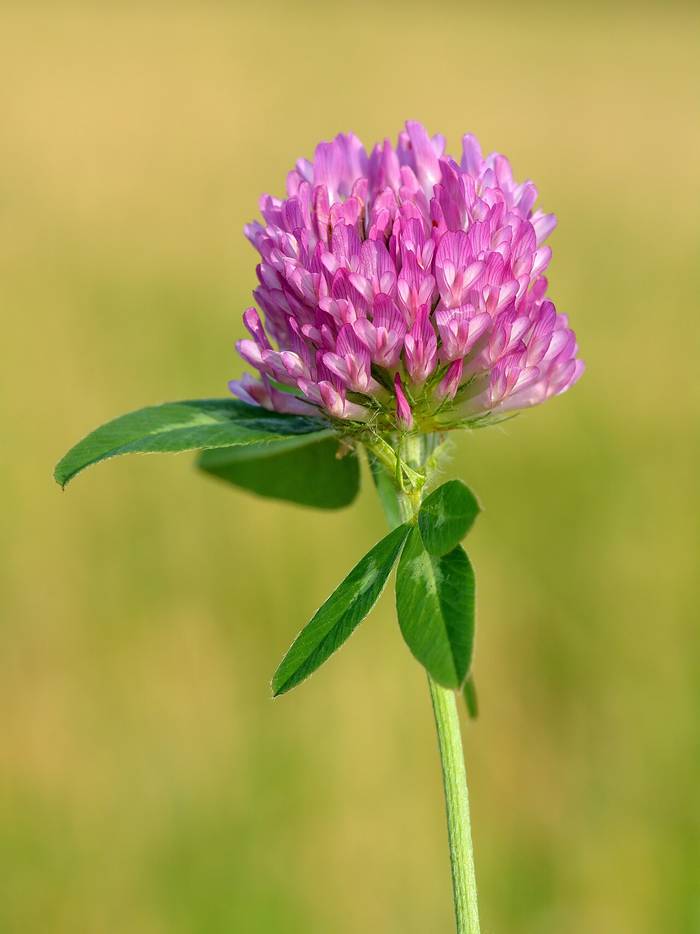
Ivar Leidus · CC BY-SA 4.0
Red clover
Plant·Trifolium pratense
Full sun
Sun
Moist soil
Water
Not recorded
Drainage
Zones 3–9
Hardiness
Coverage · 117 fields
No obvious inconsistencies found.
Growth and size10 fields
Plant type
Plant“Trifolium pratense (from Latin prātum, meaning meadow), red clover, is a herbaceous species of flowering plant in the bean family, Fabaceae.”
Height
60 cm“Trifolium pratense is a PERENNIAL growing to 0.6 m (2ft) by 0.6 m (2ft in) at a medium rate.”
Spread
60 cm“Trifolium pratense is a PERENNIAL growing to 0.6 m (2ft) by 0.6 m (2ft in) at a medium rate.”
Height at age
—
empty
Spacing
30 cm (at least 15 cm)
AI estimate55 % agree
Growth rate
Medium“Trifolium pratense is a PERENNIAL growing to 0.6 m (2ft) by 0.6 m (2ft in) at a medium rate.”
Root depth
Taproot“The root pattern is a tap root similar to a carrot going directly down [1-2].”
Forest garden layer
Herb layer“The red clover is a herbaceous, short-lived perennial plant, which is generally variable in size, growing to 20–80 cm (8–31 in) tall.”
Lifespan
~3 years
AI estimatenot measured yet
Roots6 fields
Storage organ
None“It does not multiply vegetatively: it has no rhizomes, runners, suckers or offspring bulbs or tubers.”
Spreads
No“It does not multiply vegetatively: it has no rhizomes, runners, suckers or offspring bulbs or tubers.”
Lateral spread in cm
—
empty
Root depth in cm
—
empty
Mycorrhiza
Arbuscular (AM)
AI estimatenot measured yet
Light, water and soil9 fields
Hours of sun
6–12 h
AI estimatenot measured yet
Drought tolerant
Yes“It has a deep taproot which makes it tolerant to drought and gives it a good soil structuring effect.”
Tolerates waterlogging
—
empty
Soil type
Sand, loam, clay · best: loam“Prefers a medium-heavy loam.”PFAF“Suitable for: light (sandy), medium (loamy) and heavy (clay) soils, prefers well-drained soil and can grow in nutritionally poor soil.”
Compacted soil
Copes fairly well
AI estimatenot measured yet
Climate5 fields
Hardiness
Zone 3–9
AI estimatenot measured yet
Killing frost
0 °C“Killing temp. early growth: 0”EcoCrop's figure is frost during early growth (spring frost on new shoots), not winter cold.
Growing temperature
4–40 °C · optimal 18–25 °C“Temperature absolute min: 4 · Temperature absolute max: 40 · Temperature optimal min: 18 · Temperature optimal max: 25”
Chill hours
0 h
AI estimatenot measured yet
Native range
AD, AF, AL, AM, AT, AZ, BA, BE, BG, BT, BY, CH, CN, CZ, DE, DK, DZ, EE, ES, FI, FO, FR, GB, GE, GG, GI, GL, GR, HR, HU, IE, IN, IQ, IR, IT, JE, KG, KZ, LI, LT, LU, LV, MA, MC, MD, ME, MK, MN, MT, NL, NO, NP, PK, PL, PT, RO, RS, RU, SE, SI, SK, SM, TJ, TM, TN, TR, UA, UZ, VA, XK
Through the year5 fields
Flowering
May · lasts 153 days“It is in flower from May to September, and the seeds ripen from July to October.”
Fruiting
July · lasts 123 days“It is in flower from May to September, and the seeds ripen from July to October.”
Leafing out
After the last frost · Above 5 °C · lasts 30 days
AI estimatenot measured yet
Dying back
After the first frost · Set by day length · lasts 30 days
AI estimatenot measured yet
Dormant
After the first frost · Above 0 °C · lasts 150 days
AI estimatenot measured yet
Edible parts and pollination11 fields
The leaves
The flowers
The flowers
Tea made from fresh or dried flowers“A delicate sweet herb tea is made from the fresh or dried flowers.”
Seed pods
Dried, ground into a powder and used as a flour“Flowers and seed pods - dried, ground into a powder and used as a flour.”
The seeds
The leaves
Dried and powdered, sprinkled on foods such as boiled rice“They can be dried, powdered and sprinkled on foods such as boiled rice.”
The leaves
Dried, to flavour cakes with a vanilla flavour“The dried leaves impart a vanilla flavour to cakes etc.”
The flowers
Used to make jelly and tisanes“The flowers often are used to make jelly and tisanes, and are used in essiac recipes.”
Pollination
Needs a partner · hermaphrodite“The species is hermaphrodite (has both male and female organs) and is pollinated by Bees, Lepidoptera (Moths & Butterflies).”
Pollinated by
Bees, moths, butterflies“The species is hermaphrodite (has both male and female organs) and is pollinated by Bees, Lepidoptera (Moths & Butterflies).”
Ecology5 fields
Attracts
Pests
Mite“It should not be grown with camellias or gooseberries because it harbours a mite that can cause fruit drop in the gooseberries and premature budding in the camellias.”
Diseases
Clover rot, red clover rust (uromyces trifolii-repentis var. fallens), parasitic nematodes, viruses“It is a host to 'clover rot' however, so should not be used too frequently.”Wikipedia“Red clover is subject to bacterial as well as fungal diseases, including clover rot, and red clover rust, Uromyces trifolii-repentis var. fallens.”Wikipedia“Other problems include parasitic nematodes (roundworms) and viruses.”
Takes up
Nitrogen, phosphorus, potassium, calcium
AI estimatenot measured yet
Propagation and names4 fields
Methods
Seed, division“Pre-soak the seed for 12 hours in warm water and then sow in spring in situ.”PFAF“Division in spring.”
Difficulty
2 / 5
AI estimatenot measured yet
Seed
none
AI estimatenot measured yet
Not sorted yet62 fields
Fields the parser stores that this page has no row for yet. They show up here automatically, so nothing is hidden.
forage.DK.local_name
Rødkløver
AI estimatenot measured yet
forage.DK.warnings_da
Syg kløver kan være giftig, selv uden synlige tegn.
AI estimatenot measured yet
forage.DK.warnings_en
Diseased clover can be poisonous, even with no visible signs.
AI estimatenot measured yet
forage.DK.prep_cautions
Diseased clover, even if no symptoms of disease are visible, can contain toxic alkaloids., trypsin inhibitors in seed are normally destroyed if the seed is sprouted first“Diseased clover, even if no symptoms of disease are visible, can contain toxic alkaloids.”PFAF“These can interfere with certain enzymes that help in the digestion of proteins, but are normally destroyed if the seed is sprouted first.”
forage.DK.edibility_basis
inferred
AI estimatenot measured yet
forage.DK.foraging_months.notes
the seeds ripen from July to October“the seeds ripen from July to October”
forage.DK.foraging_months.year_round
false
AI estimatenot measured yet
forage.DK.habitat_affinity
verge, disturbed_ground
AI estimatenot measured yet
forage.US.local_name
Red clover
AI estimatenot measured yet
forage.US.edible_parts
[{"part":"flowers and leaves","caution":null,"preparation":"added as garnishes to any dish"},{"part":"flowers and leaves","caution":null,"preparation":"ground into a flour"}]“Red clover's flowers and leaves are edible, and can be added as garnishes to any dish.”Wikipedia“They can be ground into a flour.”
forage.US.prep_cautions
Diseased clover, even if no symptoms of disease are visible, can contain toxic alkaloids.“Diseased clover, even if no symptoms of disease are visible, can contain toxic alkaloids.”
forage.US.edibility_basis
inferred
AI estimatenot measured yet
forage.US.foraging_months.notes
Young leaves and flowers are best.
AI estimatenot measured yet
forage.US.foraging_months.months
4, 5, 6, 7, 8, 9
AI estimatenot measured yet
forage.US.foraging_months.year_round
false
AI estimatenot measured yet
forage.US.habitat_affinity
verge, disturbed_ground
AI estimatenot measured yet
forage.TROPICAL.edible_parts
[{"part":"leaves","caution":null,"preparation":"cooked","season_months":[1,2,3,4,5,6,7,8,9,10,11,12]},{"part":"flowers","caution":null,"preparation":"raw","season_months":[1,2,3,4,5,6,7,8,9,10,11,12]}]
AI estimatenot measured yet
forage.TROPICAL.edibility_basis
inferred
AI estimatenot measured yet
forage.TROPICAL.foraging_months.notes
Year-round in suitable tropical climates.
AI estimatenot measured yet
forage.TROPICAL.foraging_months.year_round
true
AI estimatenot measured yet
forage.TROPICAL.habitat_affinity
disturbed_ground
AI estimatenot measured yet
ornamental.basis
documented
AI estimatenot measured yet
ornamental.fragrance.source
flower“Their essential oil may be extracted and its unique scent used in aromatherapy.”
ornamental.fragrance.intensity
subtle
AI estimatenot measured yet
ornamental.confidence
high
AI estimatenot measured yet
ornamental.fall_interest
false
AI estimatenot measured yet
ornamental.evidence_quote
Trifolium pratense, commonly known as red clover, produces pink to purplish-red flowers. Its foliage is green and does not typically display significant autumn color. The flowers have a subtle, sweet fragrance.
AI estimatenot measured yet
ornamental.foliage_colour
green“green with a characteristic pale crescent in the outer half of the leaf”
ornamental.foliage_texture
medium
AI estimatenot measured yet
ornamental.winter_structure
none
AI estimatenot measured yet
ornamental.autumn_foliage_colour
none
AI estimatenot measured yet
care_regime
none
AI estimatenot measured yet
propagation.self_seeding
moderate
AI estimate20 % agree
propagation.establishment_years
1
AI estimate40 % agree
forage_proposals.DK.edibility_tier.tier
edible
AI estimatenot measured yet
forage_proposals.DK.edibility_tier.confidence
high
AI estimatenot measured yet
forage_proposals.DK.edibility_tier.evidence_quote
The flowers and young leaves of red clover are edible and can be used in salads, teas, or cooked. However, large quantities of leaves can cause bloating.
AI estimatenot measured yet
forage_proposals.US.edibility_tier.tier
edible
AI estimatenot measured yet
forage_proposals.US.edibility_tier.confidence
high
AI estimatenot measured yet
forage_proposals.US.edibility_tier.evidence_quote
Red clover flowers and young leaves are edible and commonly used in teas and salads. Excessive consumption of leaves may lead to bloating.
AI estimatenot measured yet
forage_proposals.TROPICAL.edibility_tier.confidence
low
AI estimatenot measured yet
function_profile.biomass_return.confidence
high“The plant makes a good green manure, it is useful for over-wintering, especially in a mixture with Lolium perenne.”
PFAFpartly
function_profile.nutrient_flows.consumes
[{"basis":"documented","demand":"moderate","nutrient":"nitrogen","confidence":"high"},{"basis":"documented","demand":"moderate","nutrient":"phosphorus","confidence":"high"},{"basis":"documented","demand":"moderate","n…“Suitable for: light (sandy), medium (loamy) and heavy (clay) soils, prefers well-drained soil and can grow in nutritionally poor soil.”
PFAFpartly
function_profile.nutrient_flows.provides
[{"basis":"documented","nutrient":"nitrogen","mechanism":"fixation","confidence":"high","evidence_quote":"This species has a symbiotic relationship with certain soil bacteria, these bacteria form nodules on the roots …“This species has a symbiotic relationship with certain soil bacteria, these bacteria form nodules on the roots and fix atmospheric nitrogen.”PFAF“The plant makes a good green manure, it is useful for over-wintering, especially in a mixture with Lolium perenne.”
function_profile.biotic_interactions
[{"taxa":["bees"],"basis":"documented","valence":"beneficial","relation":"attracts","confidence":"high","evidence_quote":"It is also a good bee plant, but not so valuable as the white clover, T. repens.","organism_gro…“It is also a good bee plant, but not so valuable as the white clover, T. repens.”PFAF“The species is hermaphrodite (has both male and female organs) and is pollinated by Bees, Lepidoptera (Moths & Butterflies).”PFAF“A very important food plant for the caterpillars of many butterfly and moth species.”PFAF“It is noted for attracting wildlife.”Wikipedia“Furthermore, the species' ability to fix nitrogen promotes protein rich growth, supporting a wide range of wildlife including deer, turkeys, and rabbits.”PFAF“It should not be grown with camellias or gooseberries because it harbours a mite that can cause fruit drop in the gooseberries and premature budding in the camellias.”PFAF“It is a host to 'clover rot' however, so should not be used too frequently.”Wikipedia“Red clover is subject to bacterial as well as fungal diseases, including clover rot, and red clover rust, Uromyces trifolii-repentis var. fallens.”Wikipedia“Other problems include parasitic nematodes (roundworms) and viruses.”
function_profile.aromatic_pest_effect.value
false
AI estimate80 % agree
function_profile.aromatic_pest_effect.confidence
low
AI estimatenot measured yet
function_profile.structural_interfaces.provides_shelter.basis
inferred
AI estimatenot measured yet
function_profile.structural_interfaces.provides_shelter.kinds
shade
AI estimatenot measured yet
function_profile.structural_interfaces.provides_shelter.confidence
medium
AI estimatenot measured yet
function_profile.structural_interfaces.provides_physical_support.basis
taxonomic
AI estimatenot measured yet
function_profile.structural_interfaces.provides_physical_support.confidence
high
AI estimatenot measured yet
function_profile.structural_interfaces.requires_physical_support.basis
taxonomic
AI estimatenot measured yet
function_profile.structural_interfaces.requires_physical_support.confidence
high
AI estimatenot measured yet
climate_tolerance.photoperiod_response
long_day
AI estimatenot measured yet
component_metadata.growth_cycle
perennial“Trifolium pratense is a PERENNIAL growing to 0.6 m (2ft) by 0.6 m (2ft in) at a medium rate.”
resource_interfaces.inputs
[{"resource":"light","quantity_description":"full sun"},{"resource":"water","quantity_description":"moist soil"},{"resource":"shade","quantity_description":"cannot grow in shade"}]“Succeeds in a moist, well-drained circum-neutral soil in full sun.”PFAF“It prefers moist soil.”PFAF“It cannot grow in the shade.”
resource_interfaces.outputs
[{"resource":"pollinator_services","quantity_description":"a good bee plant"},{"resource":"organic_matter","quantity_description":"a good green manure"},{"resource":"habitat","quantity_description":"attracts wildlife"}]“It is also a good bee plant, but not so valuable as the white clover, T. repens.”PFAF“The plant makes a good green manure, it is useful for over-wintering, especially in a mixture with Lolium perenne.”PFAF“It is noted for attracting wildlife.”