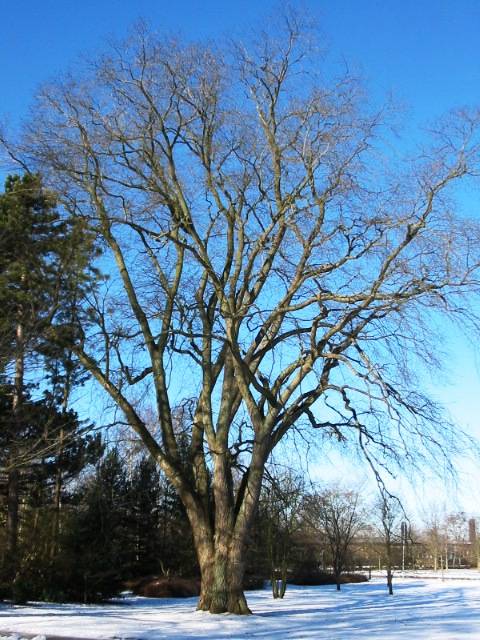
Wych elm
Tree·Ulmus glabra
Part shade to full sun
Sun
Moist soil
Water
Moist soil
Drainage
Zones 4–7
Hardiness
Coverage · 114 fields
No obvious inconsistencies found.
Growth and size11 fields
Plant type
Deciduous tree“Ulmus glabra is a deciduous Tree growing to 30 m (98ft) by 25 m (82ft) at a fast rate.”
Height
3,000 cm · other sources: 4,000 cm, 4,000 cm“Ulmus glabra is a deciduous Tree growing to 30 m (98ft) by 25 m (82ft) at a fast rate.”Wikipedia“The type sometimes reaches heights of 40 m (130 ft), typically with a broad crown where open-grown, supported by a short bole up to 2 m (6.6 ft) diameter at breast height (DBH).”JRC forest tree atlas“Wych elm (U. glabra) is the tallest among European elms, reaching 40 m in height.”
Spread
2,500 cm“Ulmus glabra is a deciduous Tree growing to 30 m (98ft) by 25 m (82ft) at a fast rate.”
Height at age
—
empty
Size after planting
9 yrs: 6 m tall, 2.5 m crown · 17 yrs: 10 m tall, 5 m crown · 34 yrs: 12 m tall, 6 m crown · 72 yrs: 20 m tall, 10 m crown“Berlin tree register: 2468 trees of this species measured with years since planting, height and crown diameter; median crown 10.0 m and height 20.0 m at 60–100 years after planting (645 trees).”Median of 2,468 measured trees in Berlin. Years count from planting nursery stock, so a small tree reaches each size later.
Spacing
1,000 cm (at least 500 cm)
AI estimate55 % agree
Growth rate
Fast“Ulmus glabra is a deciduous Tree growing to 30 m (98ft) by 25 m (82ft) at a fast rate.”
Root depth
Taproot“Plants should not be allowed to grow for more than two years in a nursery bed since they form a tap root and will then move badly.”
Forest garden layer
Canopy
AI estimate90 % agree
Lifespan
~300 years
AI estimatenot measured yet
Roots6 fields
Root form
Taproot“Plants should not be allowed to grow for more than two years in a nursery bed since they form a tap root and will then move badly.”
Storage organ
None
AI estimate100 % agree
Lateral spread in cm
—
empty
Root depth in cm
—
empty
Mycorrhiza
Arbuscular (AM)
AI estimatenot measured yet
Light, water and soil9 fields
Sun
Full sun, light shade, part shade · best: full sun“It can grow in semi-shade (light woodland) or no shade.”
Hours of sun
6 h
AI estimatenot measured yet
Drought tolerant
No“The species is intolerant of acid soils and flooding, as it is of prolonged drought.”
Tolerates waterlogging
No“The species is intolerant of acid soils and flooding, as it is of prolonged drought.”
Soil type
Drainage
Well-drained to moist
AI estimatenot measured yet
Compacted soil
Copes fairly well
AI estimatenot measured yet
Climate5 fields
Hardiness
Zone 4–7
AI estimatenot measured yet
Killing frost
-29 °C
AI estimatenot measured yet
Growing temperature
5–30 °C · optimal 10–25 °C
AI estimatenot measured yet
Chill hours
1,000 h
AI estimatenot measured yet
Native range
AD, AL, AM, AT, AZ, BA, BE, BG, BY, CH, CZ, DE, DK, EE, ES, FI, FR, GB, GE, GG, GI, GR, HR, HU, IE, IR, IT, JE, LB, LI, LT, LU, LV, MC, MD, ME, MK, NL, NO, PL, RO, RS, RU, SE, SI, SK, SM, SY, TR, UA, VA, XK
Care (becomes tasks in Manage)1 fields
Pruning
November · lasts 60 days · dead, diseased, or crossing branches
AI estimatenot measured yet
Through the year5 fields
Leafing out
After the last frost · lasts 30 days
AI estimatenot measured yet
Dying back
After the first frost · lasts 30 days
AI estimatenot measured yet
Dormant
After the first frost · 30 days after · lasts 150 days
AI estimatenot measured yet
Edible parts and pollination5 fields
The leaves
Immature fruit
Eaten raw just after it forms“Edible Parts: Fruit Inner bark Leaves”PFAF“Immature fruits, used just after they are formed, can be eaten raw.”
Inner bark
Dried, ground into a powder and used as a thickening in soups or mixed with cereals for bread“Inner bark - mucilaginous.”PFAF“inner bark is often dried, ground into a powder and then used as a thickening in soups etc or mixed with cereals when making bread[K].”
Pollination
Self-fertile · hermaphrodite“The species is hermaphrodite (has both male and female organs) and is pollinated by Wind.”
Pollinated by
Wind“The species is hermaphrodite (has both male and female organs) and is pollinated by Wind.”
Ecology5 fields
Pests
Elm leaf beetle (xanthogaleruca luteola), deer (consume seedlings)“a high susceptibility to the elm leaf beetle Xanthogaleruca luteola”Wikipedia“any seedlings are often consumed by uncontrolled deer populations”
Diseases
Dutch elm disease, elm yellows“While the species is highly susceptible to Dutch elm disease (DED)”Wikipedia“the tree was found to have a slight to moderate susceptibility to elm yellows”
Takes up
—
empty
Fixes nitrogen
No
AI estimatenot measured yet
Propagation and names4 fields
Methods
Difficulty
3 / 5
AI estimatenot measured yet
Seed
Requires cold stratification for 2-3 months.
AI estimatenot measured yet
Not sorted yet63 fields
Fields the parser stores that this page has no row for yet. They show up here automatically, so nothing is hidden.
forage.DK.local_name
Skov-elm
AI estimatenot measured yet
forage.DK.prep_cautions
Leaves can be a little bitter, especially if not very young.“They can be a little bit bitter, especially if not very young”
forage.DK.edibility_basis
inferred
AI estimatenot measured yet
forage.DK.foraging_months.notes
Young leaves and samaras are seasonal, inner bark can be harvested year-round.
AI estimatenot measured yet
forage.DK.foraging_months.year_round
false
AI estimatenot measured yet
forage.DK.habitat_affinity
woodland, hedgerow, riverbank“Woods, hedges and by streams, commoner in the west and north.”
forage.US.local_name
Wych elm
AI estimatenot measured yet
forage.US.edible_parts
[{"part":"leaves","caution":null,"preparation":"raw or cooked"},{"part":"immature fruit","preparation":"eaten raw just after it forms"},{"part":"inner bark","preparation":"dried, ground into a powder and used as a thi…“Edible Parts: Fruit Inner bark Leaves”PFAF“Inner bark - mucilaginous.”PFAF“Leaves - raw or cooked[179, K].”PFAF“Immature fruits, used just after they are formed, can be eaten raw.”PFAF“inner bark is often dried, ground into a powder and then used as a thickening in soups etc or mixed with cereals when making bread[K].”
forage.US.prep_cautions
Leaves can be a little bitter, especially if not very young.“They can be a little bit bitter, especially if not very young”
forage.US.edibility_basis
inferred
AI estimatenot measured yet
forage.US.foraging_months.notes
Young leaves and samaras are seasonal, inner bark can be harvested year-round.
AI estimatenot measured yet
forage.US.foraging_months.year_round
false
AI estimatenot measured yet
forage.US.habitat_affinity
woodland, hedgerow, riverbank“Woods, hedges and by streams, commoner in the west and north.”
forage.TROPICAL.edibility_basis
inferred
AI estimatenot measured yet
forage.TROPICAL.foraging_months.year_round
false
AI estimatenot measured yet
ornamental.basis
documented
AI estimatenot measured yet
ornamental.fragrance.source
none
AI estimate100 % agree
ornamental.fragrance.intensity
subtle
AI estimatenot measured yet
ornamental.confidence
high
AI estimatenot measured yet
ornamental.fall_interest
true
AI estimatenot measured yet
ornamental.flower_colour
ornamental.evidence_quote
The flowers are reddish-green, appearing before the leaves. Leaves are dark green, turning yellow-green in autumn. The tree has a bold texture and a strong architectural skeleton in winter.
AI estimatenot measured yet
ornamental.foliage_colour
dark_green“They are alternate, dark green, usually asymmetrical at the base and acuminate at the apex, with toothed margins”
ornamental.winter_structure
architectural_skeleton
AI estimatenot measured yet
ornamental.autumn_foliage_colour
yellow_green
AI estimatenot measured yet
care_regime
none
AI estimatenot measured yet
propagation.self_seeding
moderate
AI estimate20 % agree
propagation.division_season
autumn
AI estimatenot measured yet
propagation.establishment_years
3
AI estimate40 % agree
size_at_age.v
1
AI estimatenot measured yet
size_at_age.basis
years_after_planting
AI estimatenot measured yet
forage_proposals.DK.edibility_tier.tier
edible
AI estimatenot measured yet
forage_proposals.DK.edibility_tier.confidence
high
AI estimatenot measured yet
forage_proposals.DK.edibility_tier.evidence_quote
The young leaves and samaras (seeds) of Wych elm are edible raw or cooked. The inner bark can be dried and ground into a flour.
AI estimatenot measured yet
forage_proposals.US.edibility_tier.tier
edible
AI estimatenot measured yet
forage_proposals.US.edibility_tier.confidence
high
AI estimatenot measured yet
forage_proposals.US.edibility_tier.evidence_quote
The young leaves and samaras (seeds) of Wych elm are edible raw or cooked. The inner bark can be dried and ground into a flour.
AI estimatenot measured yet
forage_proposals.TROPICAL.edibility_tier.confidence
low
AI estimatenot measured yet
function_profile.biomass_return.confidence
high
AI estimatenot measured yet
function_profile.nutrient_flows.consumes
[{"basis":"inferred","demand":"high","nutrient":"nitrogen","confidence":"medium"},{"basis":"inferred","demand":"moderate","nutrient":"phosphorus","confidence":"medium"},{"basis":"inferred","demand":"moderate","nutrien…
AI estimatenot measured yet
function_profile.nutrient_flows.provides
[{"basis":"inferred","nutrient":"calcium","mechanism":"biomass_return","confidence":"medium"},{"basis":"inferred","nutrient":"potassium","mechanism":"biomass_return","confidence":"medium"}]
AI estimatenot measured yet
function_profile.biotic_interactions
[{"taxa":["wildlife"],"basis":"documented","valence":"beneficial","relation":"attracts","confidence":"medium","evidence_quote":"It is noted for attracting wildlife.","organism_group":"wildlife","ecological_function":"…“It is noted for attracting wildlife.”PFAF“A very ornamental tree, it is a food plant for the caterpillars of many lepidoptera species.”JRC forest tree atlas“DED is very aggressive and is transmitted by the bark beetles of genus Scolytus or throughout root connections”Wikipedia“While the species is highly susceptible to Dutch elm disease (DED)”Wikipedia“the tree was found to have a slight to moderate susceptibility to elm yellows”Wikipedia“any seedlings are often consumed by uncontrolled deer populations”Wikipediapartly“In trials conducted in Italy, the tree was found to have a slight to moderate susceptibility to elm yellows, and a high susceptibility to the elm leaf beetle Xanthogaleruca luteola.”
function_profile.aromatic_pest_effect.value
false
AI estimate80 % agree
function_profile.aromatic_pest_effect.confidence
low
AI estimatenot measured yet
function_profile.structural_interfaces.provides_shelter.basis
taxonomic
AI estimatenot measured yet
function_profile.structural_interfaces.provides_shelter.kinds
wind, shade
AI estimatenot measured yet
function_profile.structural_interfaces.provides_shelter.confidence
high
AI estimatenot measured yet
function_profile.structural_interfaces.requires_shelter.basis
taxonomic
AI estimatenot measured yet
function_profile.structural_interfaces.requires_shelter.confidence
high
AI estimatenot measured yet
function_profile.structural_interfaces.provides_physical_support.form
trunk
AI estimatenot measured yet
function_profile.structural_interfaces.provides_physical_support.basis
taxonomic
AI estimatenot measured yet
function_profile.structural_interfaces.provides_physical_support.confidence
high
AI estimatenot measured yet
function_profile.structural_interfaces.requires_physical_support.basis
taxonomic
AI estimatenot measured yet
function_profile.structural_interfaces.requires_physical_support.confidence
high
AI estimatenot measured yet
climate_tolerance.photoperiod_response
day_neutral
AI estimatenot measured yet
soil_interactions.organic_matter_contribution
high
AI estimatenot measured yet
component_metadata.growth_cycle
perennial
AI estimate100 % agree
resource_interfaces.inputs
[{"resource":"light","quantity_description":"Grows in semi-shade or no shade; moderately shade tolerant."},{"resource":"water","quantity_description":"Prefers moist soil that is well drained, not waterlogged."}]“It can grow in semi-shade (light woodland) or no shade.”PFAFpartly“It prefers moist soil.”
resource_interfaces.outputs
[{"resource":"shade","quantity_description":"Mature trees cast a dense shade."},{"resource":"habitat","quantity_description":"Noted for attracting wildlife; food plant for the caterpillars of many Lepidoptera species.…“Trees cast a dense shade.”PFAF“It is noted for attracting wildlife.”PFAFpartly“Wood - very durable under water, fairly hard, elastic, withstands abrasion and salt water.”