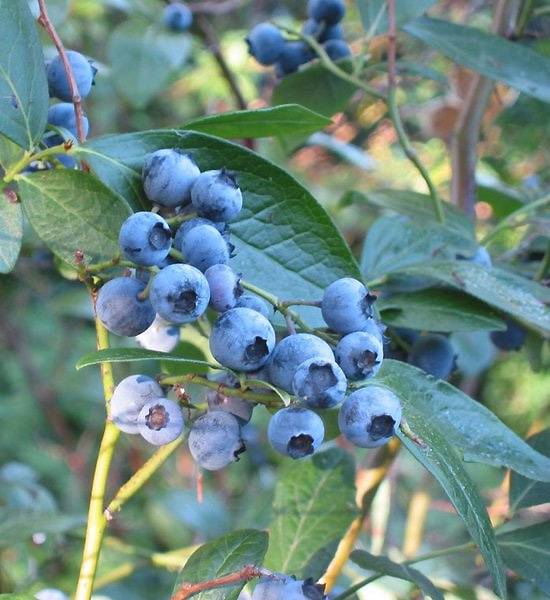
JoJan · CC BY-SA 3.0
Highbush blueberry
Shrub·Vaccinium corymbosum
Part shade to full sun
Sun
Dry to wet soil
Water
Well-drained soil
Drainage
Zones 3–7
Hardiness
Coverage · 123 fields
No obvious inconsistencies found.
Growth and size10 fields
Plant type
Deciduous shrub“Vaccinium corymbosum is a deciduous Shrub growing to 2 m (6ft) by 2 m (6ft) at a medium rate.”
Height
200 cm · the source gives 180–370 cm“Vaccinium corymbosum is a deciduous shrub growing to 1.8–3.7 metres (6–12 ft) tall and wide.”PFAF“Vaccinium corymbosum is a deciduous Shrub growing to 2 m (6ft) by 2 m (6ft) at a medium rate.”
Spread
200 cm · the source gives 180–370 cm“Vaccinium corymbosum is a deciduous shrub growing to 1.8–3.7 metres (6–12 ft) tall and wide.”PFAF“Vaccinium corymbosum is a deciduous Shrub growing to 2 m (6ft) by 2 m (6ft) at a medium rate.”
Height at age
—
empty
Spacing
150 cm (at least 100 cm)
AI estimate55 % agree
Growth rate
Medium“Vaccinium corymbosum is a deciduous Shrub growing to 2 m (6ft) by 2 m (6ft) at a medium rate.”
Habit
Mounding
AI estimate50 % agree
Root depth
Shallow“The root pattern is flat with shallow roots forming a plate near the soil surface [1-2].”
Forest garden layer
Shrub layer
AI estimate90 % agree
Lifespan
~50 years
AI estimatenot measured yet
Roots6 fields
Root form
Plate root (shallow)“The root pattern is flat with shallow roots forming a plate near the soil surface [1-2].”
Storage organ
None
AI estimate100 % agree
Lateral spread in cm
—
empty
Root depth in cm
—
empty
Mycorrhiza
Ericoid (ErM)
AI estimatenot measured yet
Light, water and soil9 fields
Sun
Full sun, light shade, part shade · best: full sun“Succeeds in full sun or light shade though it fruits better in a sunny position.”PFAF“It can grow in semi-shade (light woodland) or no shade.”
Hours of sun
6–12 h
AI estimatenot measured yet
Water
Dry, moist, wet · best: moist · Medium · 2–4 l/day“It prefers moist soil.”PFAF“Swamps, low wet woods, pine barrens and dry uplands.”
Drought tolerant
—
empty
Tolerates waterlogging
—
empty
Soil type
Sand, loam, peat“Suitable for: light (sandy) and medium (loamy) soils and prefers well-drained soil.”PFAF“Requires a moist but freely-draining lime free soil, preferring one that is rich in peat or a light loamy soil with added leaf-mould.”
pH
4.5–6“Prefers a very acid soil with a pH in the range of 4.5 to 6, plants soon become chlorotic when lime is present.”PFAF“Suitable pH: mildly acid soils and can grow in very acid soils.”
Drainage
Well drained“Suitable for: light (sandy) and medium (loamy) soils and prefers well-drained soil.”
Compacted soil
Copes badly
AI estimatenot measured yet
Climate5 fields
Hardiness
Zone 3–7
AI estimatenot measured yet
Killing frost
-1 °C“Killing temp. early growth: -1”EcoCrop's figure is frost during early growth (spring frost on new shoots), not winter cold.
Growing temperature
7–42 °C · optimal 18–30 °C“Temperature absolute min: 7 · Temperature absolute max: 42 · Temperature optimal min: 18 · Temperature optimal max: 30”
Care (becomes tasks in Manage)9 fields
Starting indoors
February“Seed - sow late winter in a greenhouse in a lime-free potting mix and only just cover the seed.”
PFAFpartly
Planting out
After the last frost“Plant them out into their permanent positions in late spring or early summer, after the last expected frosts.”
Dividing
After the last frost · After the first frost“Division of suckers in spring or early autumn.”
Pruning
February · lasts 28 days · new, vigorous canes for future fruiting · dead, weak, or crossing branches, and about one-third of the oldest canes
AI estimatenot measured yet
Feeding
April · lasts 30 days · acid-forming fertiliser or blood meal
AI estimatenot measured yet
Mulching
May · lasts 31 days
AI estimatenot measured yet
Watering
June · lasts 92 days
AI estimatenot measured yet
Protection
July · lasts 60 days · birds
AI estimatenot measured yet
Through the year7 fields
Dying back
After the first frost“In autumn, the leaves turn to a brilliant red, orange, yellow, and/or purple.”
Wikipediapartly
Leafing out
Once the chill need is met · After the last frost · lasts 14 days
AI estimatenot measured yet
Harvest
July · lasts 60 days
AI estimatenot measured yet
Dormant
After the first frost · lasts 150 days
AI estimatenot measured yet
First harvest
1–2 years after plantingCounted from planting a nursery plant, matching the app convention. The same source also notes plants are not considered mature (full expected yield) until year 7.
Edible parts and pollination4 fields
The fruit
Raw or cooked · July–September
AI estimatenot measured yet
Pollination
Needs a partner · another variety · hermaphrodite“The species is hermaphrodite (has both male and female organs) and is pollinated by Bees.”PFAF“Plants are at least partially self-sterile, more than one variety is required in order to obtain good yields of fruit.”PFAF“The plant is not self-fertile.”
Pollinated by
Bees“The species is hermaphrodite (has both male and female organs) and is pollinated by Bees.”
Ecology5 fields
Attracts
Bees, birds, butterflies, bears, small mammals“The species is hermaphrodite (has both male and female organs) and is pollinated by Bees.”PFAF“Special Features:Attracts birds, North American native, Edible, Wetlands plant, Attracts butterflies, Attractive flowers or blooms.”Wikipedia“In natural habitats, the berries are a food source for native and migrating birds, bears, and small mammals.”
Diseases
Mummy berry, phytophthora root rot
AI estimatenot measured yet
Takes up
Iron, magnesium
AI estimatenot measured yet
Fixes nitrogen
No
AI estimatenot measured yet
Propagation and names4 fields
Methods
Seed: sow late winter in a greenhouse in a lime-free potting mix and only just cover the seed, Greenwood cuttings taken May/June in a shady position in a peat-containing compost, Half-ripe wood cuttings 5-8 cm with a heel, taken August in a frame, Mature wood cuttings harvested in November, stored in a fridge, then planted in a frame in March, Layering in late summer or early autumn, Division of suckers in spring or early autumn“Seed - sow late winter in a greenhouse in a lime-free potting mix and only just cover the seed.”PFAF“Cuttings of greenwood, May/June in a shady position in a compost that contains some peat.”PFAF“Cuttings of half-ripe wood, 5 - 8cm with a heel, August in a frame.”PFAF“Cuttings of mature wood, harvested in November and stored in a fridge then planted in a frame in March.”PFAF“Layering in late summer or early autumn.”PFAF“Division of suckers in spring or early autumn.”
Difficulty
3 / 5
AI estimatenot measured yet
Seed
up to 3 months cold stratification for stored seed“Stored seed might require a period of up to 3 months cold stratification.”
Not sorted yet64 fields
Fields the parser stores that this page has no row for yet. They show up here automatically, so nothing is hidden.
forage.DK.local_name
Amerikansk blåbær
AI estimatenot measured yet
forage.DK.edibility_basis
inferred
AI estimatenot measured yet
forage.DK.foraging_months.months
7, 8, 9
AI estimatenot measured yet
forage.DK.foraging_months.year_round
false
AI estimatenot measured yet
forage.DK.habitat_affinity
woodland
AI estimatenot measured yet
forage.US.local_name
Highbush Blueberry
AI estimatenot measured yet
forage.US.edible_parts
[{"part":"fruit","caution":"Leave on the shrub until the last minute; very acidic and will not ripen after picking","preparation":"raw or cooked; used in pies, pastries, cereals and jellies; can be dried and used like…“Edible Parts: Fruit Leaves”PFAF“Leave the fruit on the shrub until the last minute, as the fruit is very acidic and will not ripen after being picked.”PFAF“Fruit - raw or cooked.”PFAF“A tea is made from the leaves and dried fruit.”
forage.US.edibility_basis
inferred
AI estimatenot measured yet
forage.US.foraging_months.notes
Peak season is typically mid-summer to early autumn, depending on cultivar and region.
AI estimatenot measured yet
forage.US.foraging_months.months
7, 8
AI estimatenot measured yet
forage.US.foraging_months.year_round
false
AI estimatenot measured yet
forage.US.habitat_affinity
woodland“The plant is found in wooded or open habitats with moist acidic soils.”
Wikipediapartly
forage.TROPICAL.edibility_basis
inferred
AI estimatenot measured yet
forage.TROPICAL.foraging_months.notes
Not typically found in tropical regions.
AI estimatenot measured yet
forage.TROPICAL.foraging_months.year_round
false
AI estimatenot measured yet
ornamental.basis
documented
AI estimatenot measured yet
ornamental.fragrance.source
flower
AI estimate100 % agree
ornamental.fragrance.intensity
subtle
AI estimatenot measured yet
ornamental.confidence
high
AI estimatenot measured yet
ornamental.fall_interest
true“An excellent blueberry species with large fruit and good autumn foliage best suited to cooler climates.”
PFAFpartly
ornamental.flower_colour
white, pink“Bloom Color: White.”Wikipedia“The flowers are long bell- or urn-shaped white to very light pink, 8.5 mm (1⁄3 in) long.”
ornamental.evidence_quote
The flowers are typically white or pink, bell-shaped. Foliage is green in summer, turning to brilliant red and bronze in autumn. Stems can provide winter interest.
AI estimatenot measured yet
ornamental.foliage_colour
dark_green“The dark glossy green leaves are elliptical and up to 5 centimetres (2 in) long.”
ornamental.foliage_texture
medium
AI estimatenot measured yet
ornamental.winter_structure
coloured_stems
AI estimatenot measured yet
ornamental.autumn_foliage_colour
red, purple“In autumn, the leaves turn to a brilliant red, orange, yellow, and/or purple.”
care_regime
light
AI estimatenot measured yet
propagation.self_seeding
none
AI estimate20 % agree
propagation.division_season
spring or early autumn“Division of suckers in spring or early autumn.”
propagation.establishment_years
2
AI estimate40 % agree
sun_requirement.best
full_sun“Succeeds in full sun or light shade though it fruits better in a sunny position.”
sun_requirement.best_for
fruit“Succeeds in full sun or light shade though it fruits better in a sunny position.”
forage_proposals.DK.edibility_tier.tier
choice
AI estimatenot measured yet
forage_proposals.DK.edibility_tier.confidence
high
AI estimatenot measured yet
forage_proposals.DK.edibility_tier.evidence_quote
Highbush blueberries are widely cultivated and consumed for their delicious and nutritious fruit.
AI estimatenot measured yet
forage_proposals.US.edibility_tier.tier
edible“Special Features:Attracts birds, North American native, Edible, Wetlands plant, Attracts butterflies, Attractive flowers or blooms.”
forage_proposals.US.edibility_tier.confidence
high
AI estimatenot measured yet
forage_proposals.US.edibility_tier.evidence_quote
Highbush blueberries are widely cultivated and consumed for their delicious and nutritious fruit, considered a choice edible.
AI estimatenot measured yet
forage_proposals.TROPICAL.edibility_tier.confidence
low
AI estimatenot measured yet
function_profile.biomass_return.confidence
medium
AI estimatenot measured yet
function_profile.nutrient_flows.consumes
[{"basis":"documented","demand":"moderate","nutrient":"nitrogen","confidence":"high"},{"basis":"documented","demand":"moderate","nutrient":"phosphorus","confidence":"high"},{"basis":"documented","demand":"moderate","n…“Prefers a very acid soil with a pH in the range of 4.5 to 6, plants soon become chlorotic when lime is present.”
PFAFpartly
function_profile.nutrient_flows.provides
[{"basis":"inferred","nutrient":"iron","mechanism":"biomass_return","confidence":"low"},{"basis":"inferred","nutrient":"magnesium","mechanism":"biomass_return","confidence":"low"}]
AI estimatenot measured yet
function_profile.biotic_interactions
[{"taxa":["bees"],"basis":"documented","valence":"beneficial","relation":"attracts","confidence":"high","evidence_quote":"The species is hermaphrodite (has both male and female organs) and is pollinated by Bees.","org…“The species is hermaphrodite (has both male and female organs) and is pollinated by Bees.”Wikipedia“The foliage is browsed by deer and rabbits.”PFAFpartly“Special Features:Attracts birds, North American native, Edible, Wetlands plant, Attracts butterflies, Attractive flowers or blooms.”Wikipediapartly“In natural habitats, the berries are a food source for native and migrating birds, bears, and small mammals.”
function_profile.aromatic_pest_effect.value
false
AI estimate80 % agree
function_profile.aromatic_pest_effect.confidence
high
AI estimatenot measured yet
function_profile.structural_interfaces.provides_shelter.basis
inferred
AI estimatenot measured yet
function_profile.structural_interfaces.provides_shelter.kinds
shade
AI estimatenot measured yet
function_profile.structural_interfaces.provides_shelter.confidence
low
AI estimatenot measured yet
function_profile.structural_interfaces.requires_shelter.basis
documented
AI estimatenot measured yet
function_profile.structural_interfaces.requires_shelter.kinds
wind“Requires shelter from strong winds.”
function_profile.structural_interfaces.requires_shelter.stage
establishment
AI estimatenot measured yet
function_profile.structural_interfaces.requires_shelter.confidence
medium
AI estimatenot measured yet
function_profile.structural_interfaces.requires_shelter.evidence_quote
Requires shelter from strong winds.
AI estimatenot measured yet
function_profile.structural_interfaces.provides_physical_support.form
dense_thicket“It is often found in dense thickets.”
function_profile.structural_interfaces.provides_physical_support.basis
documented“It is often found in dense thickets.”
function_profile.structural_interfaces.provides_physical_support.confidence
medium“It is often found in dense thickets.”
function_profile.structural_interfaces.provides_physical_support.evidence_quote
It is often found in dense thickets.“It is often found in dense thickets.”
function_profile.structural_interfaces.requires_physical_support.basis
taxonomic
AI estimatenot measured yet
function_profile.structural_interfaces.requires_physical_support.confidence
high
AI estimatenot measured yet
climate_tolerance.photoperiod_response
long_day
AI estimatenot measured yet
soil_interactions.organic_matter_contribution
medium
AI estimatenot measured yet
component_metadata.growth_cycle
perennial
AI estimate100 % agree
resource_interfaces.inputs
[{"resource":"light","quantity_description":"full sun or light shade; fruits better in a sunny position"},{"resource":"shade","quantity_description":"semi-shade or no shade"},{"resource":"water","quantity_description"…“Succeeds in full sun or light shade though it fruits better in a sunny position.”PFAF“It can grow in semi-shade (light woodland) or no shade.”PFAF“It prefers moist soil.”PFAF“Requires shelter from strong winds.”PFAFpartly“The species is hermaphrodite (has both male and female organs) and is pollinated by Bees.”
resource_interfaces.outputs
[{"resource":"fruit","quantity_description":"blue-black berry, 6.4–12.7 mm diameter"},{"resource":"pollinator_services","quantity_description":"attracts butterflies and birds"},{"resource":"leaf_litter","quantity_desc…“The fruit is a blue-black berry with a 6.4–12.7 mm (1⁄4–1⁄2 in) diameter.”PFAFpartly“Special Features:Attracts birds, North American native, Edible, Wetlands plant, Attracts butterflies, Attractive flowers or blooms.”Wikipediapartly“Vaccinium corymbosum is a deciduous shrub growing to 1.8–3.7 metres (6–12 ft) tall and wide.”