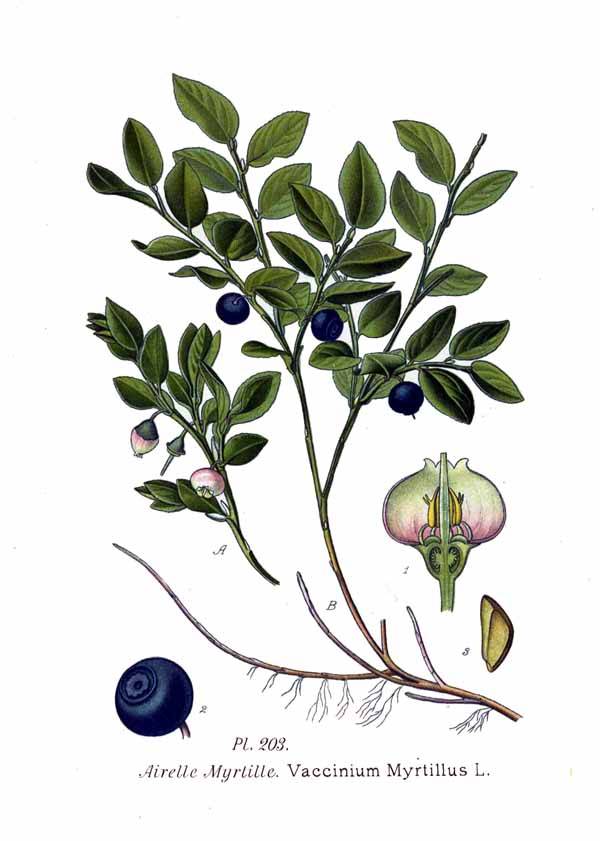
Bilberry
Plant·Vaccinium myrtillus
Part shade to full sun
Sun
Moist soil
Water
Not recorded
Drainage
Zones 2–8
Hardiness
Coverage · 114 fields
Growth and size10 fields
Plant type
Deciduous plant“Vaccinium myrtillus is a deciduous Shrub growing to 0.2 m (0ft 8in) by 0.3 m (1ft).”
Height
20 cm · the source gives 10–51 cm“grows 10–51 centimetres (4–20 in) tall”PFAF“Vaccinium myrtillus is a deciduous Shrub growing to 0.2 m (0ft 8in) by 0.3 m (1ft).”
Spread
30 cm“Vaccinium myrtillus is a deciduous Shrub growing to 0.2 m (0ft 8in) by 0.3 m (1ft).”
Height at age
—
empty
Spacing
50 cm (at least 30 cm)
AI estimate55 % agree
Growth rate
—
empty
Root depth
Shallow“The root pattern is flat with shallow roots spreading near the soil surface [2-1].”
Lifespan
~30 years“The shrub can live up to 30 years, with roots reaching depths of up to 1 metre (3+1⁄2 ft).”
Roots6 fields
Root form
Plate root (shallow)“The root pattern is flat with shallow roots spreading near the soil surface [2-1].”
Storage organ
Rhizome“Its storage organ is a rhizome, a creeping underground stem; it spreads by rhizomes.”
Spreads
By rhizomes“Its storage organ is a rhizome, a creeping underground stem; it spreads by rhizomes.”
Lateral spread in cm
19.8 cm“Its clonal growth organs spread 19.8 cm sideways.”
Root depth in cm
Deepest 100 cm“The shrub can live up to 30 years, with roots reaching depths of up to 1 metre (3+1⁄2 ft).”
Mycorrhiza
Ericoid (ErM)
AI estimatenot measured yet
Light, water and soil9 fields
Sun
Full sun, light shade, part shade · best: full sun“Succeeds in full sun or light shade though it fruits better in a sunny position.”PFAF“It can grow in semi-shade (light woodland) or no shade.”
Hours of sun
3–6 h
AI estimatenot measured yet
Drought tolerant
—
empty
Tolerates waterlogging
—
empty
Soil type
Sand, loam, peat“Suitable for: light (sandy) and medium (loamy) soils and prefers well-drained soil.”PFAFpartly“Requires a moist but freely-draining lime free soil, preferring one that is rich in peat or a light loamy soil with added leaf-mould.”
pH
4.5–6“Prefers a very acid soil with a pH in the range of 4.5 to 6, plants soon become chlorotic when lime is present.”PFAF“Suitable pH: mildly acid soils and can grow in very acid soils.”The figures 4.5–6 are EcoCrop's optimal pH, not the range the quote gives.
Drainage
Moist but freely-draining“Requires a moist but freely-draining lime free soil, preferring one that is rich in peat or a light loamy soil with added leaf-mould.”
Compacted soil
Copes badly
AI estimatenot measured yet
Climate5 fields
Hardiness
Zone 2–8
Killing frost (-30 °C) doesn't fit hardiness zone 2, which survives far lower temperatures.
AI estimatenot measured yet
Killing frost
-30 °C
Killing frost (-30 °C) doesn't fit hardiness zone 2, which survives far lower temperatures.
AI estimatenot measured yet
Growing temperature
5–25 °C · optimal 8–17 °C“Temperature absolute min: 5 · Temperature absolute max: 25 · Temperature optimal min: 8 · Temperature optimal max: 17”
Chill hours
800 h
AI estimatenot measured yet
Native range
AD, AL, AM, AT, AZ, BA, BE, BG, BY, CA, CH, CN, CZ, DE, DK, EE, ES, FI, FO, FR, GB, GE, GG, GI, GL, GR, HR, HU, IE, IS, IT, JE, JP, KZ, LI, LT, LU, LV, MC, MD, ME, MK, MN, NL, NO, PL, PT, RO, RS, RU, SE, SI, SK, SM, TR, UA, US, VA, XK
Care (becomes tasks in Manage)3 fields
Mulching
April · lasts 15 days
AI estimatenot measured yet
Watering
July · lasts 60 days
AI estimatenot measured yet
Pruning
March · lasts 30 days · dead, damaged, or weak stems
AI estimatenot measured yet
Through the year6 fields
Flowering
April · lasts 91 days
AI estimatenot measured yet
Fruiting
July · lasts 92 days
AI estimatenot measured yet
Harvest
July · lasts 92 days“From July to September, the plants produce black-blue, flattened, round fruits with a diameter up to 1 cm.”
Dying back
After the first frost
AI estimatenot measured yet
Leafing out
After the last frost · Above 5 °C · lasts 30 days“It has light green leaves that turn red in autumn”
Dormant
After the first frost · 30 days after · lasts 150 days
AI estimatenot measured yet
Edible parts and pollination4 fields
The fruit
The leaves
Pollination
Self-fertile · hermaphrodite“The species is hermaphrodite (has both male and female organs) and is pollinated by Bees, flies, Lepidoptera (Moths & Butterflies).”
Pollinated by
Bees, flies, moths, butterflies“The species is hermaphrodite (has both male and female organs) and is pollinated by Bees, flies, Lepidoptera (Moths & Butterflies).”
Ecology5 fields
Attracts
Wildlife, bees, flies, moths and butterflies“It is noted for attracting wildlife.”PFAF“The species is hermaphrodite (has both male and female organs) and is pollinated by Bees, flies, Lepidoptera (Moths & Butterflies).”
Pests
—
empty
Diseases
—
empty
Takes up
Potassium, phosphorus
AI estimatenot measured yet
Fixes nitrogen
No
AI estimatenot measured yet
Propagation and names4 fields
Methods
Seed, sown late winter in a greenhouse in lime-free potting mix, half-ripe wood cuttings, 5-8 cm with a heel, August in a frame, mature wood cuttings, late autumn, layering, late summer or early autumn, division of suckers, spring or early autumn“Seed - sow late winter in a greenhouse in a lime-free potting mix and only just cover the seed.”PFAF“Cuttings of half-ripe wood, 5 - 8cm with a heel, August in a frame.”PFAF“Cuttings of mature wood in late autumn.”PFAF“Layering in late summer or early autumn.”PFAF“Division of suckers in spring or early autumn.”
Difficulty
3 / 5
AI estimatenot measured yet
Seed
up to 3 months cold stratification for stored seed“Stored seed might require a period of up to 3 months cold stratification.”
Not sorted yet62 fields
Fields the parser stores that this page has no row for yet. They show up here automatically, so nothing is hidden.
forage.DK.local_name
Blåbær
AI estimatenot measured yet
forage.DK.warnings_da
Bør ikke spises under graviditet.
AI estimatenot measured yet
forage.DK.warnings_en
Don't eat during pregnancy.
AI estimatenot measured yet
forage.DK.prep_cautions
High tannin content may cause digestive disorders - avoid prolonged use or high doses., Avoid in pregnancy., Avoid if on anticoagulant therapy (e.g. warfarin).“High tannin content may cause digestive disorders - avoid prolonged use or high doses.”PFAF“Avoid in pregnancy.”PFAF“Avoid if on anticoagulant therapy (e.g. warfarin) .”
forage.DK.edibility_basis
inferred
AI estimatenot measured yet
forage.DK.foraging_months.notes
Berries are typically ripe from July to September. Leaves can be harvested throughout the growing season.
AI estimatenot measured yet
forage.DK.foraging_months.months
7, 8, 9“From July to September, the plants produce black-blue, flattened, round fruits with a diameter up to 1 cm.”
forage.DK.foraging_months.year_round
false
AI estimatenot measured yet
forage.US.local_name
Bilberry
AI estimatenot measured yet
forage.US.edible_parts
[{"part":"fruit","caution":null,"preparation":"raw or cooked, in pies, jams, syrups and preserves","season_months":[7,8,9]},{"part":"leaves","caution":"Consuming the leaves may be unsafe.","preparation":"infused as a …“The berry is edible.”PFAF“Edible Parts: Fruit Leaves”Wikipedia“Consuming the leaves may be unsafe.”PFAF“A tea is made from the leaves.”Wikipedia“From July to September, the plants produce black-blue, flattened, round fruits with a diameter up to 1 cm.”PFAFpartly“Fruit - raw or cooked.”
forage.US.prep_cautions
High tannin content may cause digestive disorders - avoid prolonged use or high doses., Avoid in pregnancy., Avoid if on anticoagulant therapy (e.g. warfarin).“High tannin content may cause digestive disorders - avoid prolonged use or high doses.”PFAF“Avoid in pregnancy.”PFAF“Avoid if on anticoagulant therapy (e.g. warfarin) .”
forage.US.edibility_basis
inferred
AI estimatenot measured yet
forage.US.foraging_months.notes
Berries are typically ripe from July to September. Leaves can be harvested throughout the growing season.
AI estimatenot measured yet
forage.US.foraging_months.months
7, 8, 9“From July to September, the plants produce black-blue, flattened, round fruits with a diameter up to 1 cm.”
forage.US.foraging_months.year_round
false
AI estimatenot measured yet
forage.US.habitat_affinity
woodland“It occurs in the acidic soils of heaths, boggy barrens, moorlands, degraded meadows, open forests at the base of pine and mountain spruce forests, and parklands, slopes, and moraines at elevations up to 2,350 m (7,710 ft).”
forage.TROPICAL.edibility_basis
inferred
AI estimatenot measured yet
forage.TROPICAL.foraging_months.notes
Not typically found in tropical regions.
AI estimatenot measured yet
forage.TROPICAL.foraging_months.year_round
false
AI estimatenot measured yet
ornamental.basis
documented
AI estimatenot measured yet
ornamental.fragrance.source
none
AI estimate100 % agree
ornamental.confidence
high
AI estimatenot measured yet
ornamental.fall_interest
true“It has light green leaves that turn red in autumn and are simple and alternate in arrangement.”
ornamental.flower_colour
white, pink“The rounded, urn-shaped, white-to-pink petals have short, curved lobes.”
ornamental.evidence_quote
The flowers are pink, and the foliage turns red in autumn. The foliage texture is medium.
AI estimatenot measured yet
ornamental.foliage_colour
green“It has light green leaves that turn red in autumn and are simple and alternate in arrangement.”
ornamental.foliage_texture
medium
AI estimatenot measured yet
ornamental.winter_structure
none
AI estimatenot measured yet
ornamental.autumn_foliage_colour
red“It has light green leaves that turn red in autumn and are simple and alternate in arrangement.”
care_regime
none
AI estimatenot measured yet
propagation.self_seeding
moderate
AI estimate20 % agree
propagation.division_season
spring or early autumn“Division of suckers in spring or early autumn.”
propagation.establishment_years
2
AI estimate40 % agree
sun_requirement.best
full_sun“Succeeds in full sun or light shade though it fruits better in a sunny position.”
sun_requirement.best_for
fruit“Succeeds in full sun or light shade though it fruits better in a sunny position.”
forage_proposals.DK.edibility_tier.tier
choice
AI estimatenot measured yet
forage_proposals.DK.edibility_tier.confidence
high
AI estimatenot measured yet
forage_proposals.DK.edibility_tier.evidence_quote
The berries of Vaccinium myrtillus are widely consumed raw, in jams, pies, and other desserts, and are considered a choice edible fruit.
AI estimatenot measured yet
forage_proposals.US.edibility_tier.tier
choice
AI estimatenot measured yet
forage_proposals.US.edibility_tier.confidence
high
AI estimatenot measured yet
forage_proposals.US.edibility_tier.evidence_quote
Bilberries are highly prized for their flavor and nutritional value, commonly used in various culinary applications.
AI estimatenot measured yet
forage_proposals.TROPICAL.edibility_tier.confidence
low
AI estimatenot measured yet
forage_proposals.TROPICAL.edibility_tier.evidence_quote
Vaccinium myrtillus is not found in tropical regions, so no edibility information is available for this climate.
AI estimatenot measured yet
function_profile.biomass_return.confidence
medium
AI estimatenot measured yet
function_profile.nutrient_flows.consumes
[{"basis":"documented","demand":"moderate","nutrient":"nitrogen","confidence":"high"},{"basis":"documented","demand":"moderate","nutrient":"phosphorus","confidence":"high"},{"basis":"documented","demand":"moderate","n…
AI estimatenot measured yet
function_profile.nutrient_flows.provides
[{"basis":"inferred","nutrient":"potassium","mechanism":"biomass_return","confidence":"low"},{"basis":"inferred","nutrient":"phosphorus","mechanism":"biomass_return","confidence":"low"}]
AI estimatenot measured yet
function_profile.biotic_interactions
[{"taxa":["bees","flies","Lepidoptera (moths and butterflies)"],"basis":"documented","valence":"beneficial","relation":"attracts","confidence":"high","evidence_quote":"The species is hermaphrodite (has both male and f…“The species is hermaphrodite (has both male and female organs) and is pollinated by Bees, flies, Lepidoptera (Moths & Butterflies).”PFAF“The fruits are relished by wildlife and the plants provide food for a number of insect species.”PFAFpartly“Plants quickly regenerate from below ground level if they are burnt and also tolerate some grazing.”
function_profile.aromatic_pest_effect.value
false
AI estimate80 % agree
function_profile.aromatic_pest_effect.confidence
low
AI estimatenot measured yet
function_profile.structural_interfaces.provides_shelter.basis
documented
AI estimatenot measured yet
function_profile.structural_interfaces.provides_shelter.kinds
shade
AI estimatenot measured yet
function_profile.structural_interfaces.provides_shelter.confidence
medium
AI estimatenot measured yet
function_profile.structural_interfaces.requires_shelter.basis
inferred
AI estimatenot measured yet
function_profile.structural_interfaces.requires_shelter.kinds
wind
AI estimatenot measured yet
function_profile.structural_interfaces.requires_shelter.stage
establishment
AI estimatenot measured yet
function_profile.structural_interfaces.requires_shelter.confidence
low
AI estimatenot measured yet
climate_tolerance.photoperiod_response
long_day
AI estimatenot measured yet
soil_interactions.organic_matter_contribution
medium
AI estimatenot measured yet
component_metadata.growth_cycle
perennial
AI estimate100 % agree
resource_interfaces.inputs
[{"resource":"light","quantity_description":"full sun or light shade; fruits better in a sunny position"},{"resource":"shade","quantity_description":"tolerates some shade, succeeding in light woodland"},{"resource":"w…“Succeeds in full sun or light shade though it fruits better in a sunny position.”PFAF“Tolerates some shade, succeeding in light woodland.”PFAF“It prefers moist soil.”PFAF“The species is hermaphrodite (has both male and female organs) and is pollinated by Bees, flies, Lepidoptera (Moths & Butterflies).”
resource_interfaces.outputs
[{"resource":"fruit","quantity_description":"sweet and very tasty; makes an excellent preserve and is suitable for jam"},{"resource":"ground_cover","quantity_description":"can form the ground layer in acid woods"},{"r…“Sweet and very tasty, they make an excellent preserve, their small seeds making them suitable for jam.”PFAF“They can also form the ground layer in acid woods.”PFAF“It is noted for attracting wildlife.”