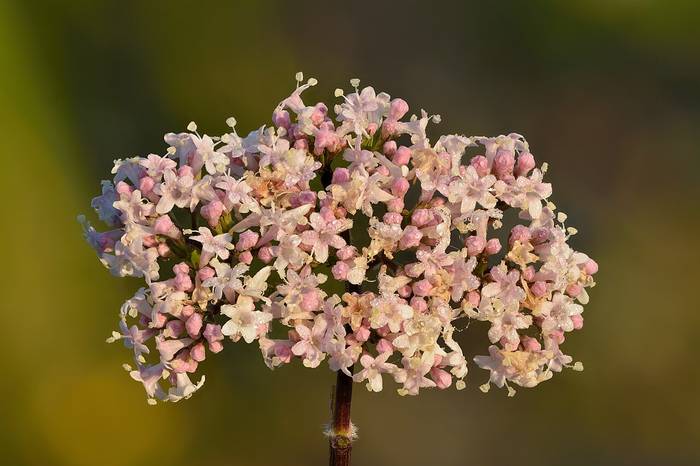
Ivar Leidus · CC BY-SA 4.0
Common valerian
Plant·Valeriana officinalis
Part shade to full sun
Sun
Dry to wet soil
Water
Not recorded
Drainage
Zones 4–9
Hardiness
Coverage · 114 fields
Growth and size10 fields
Height
150 cm“Valeriana officinalis is a PERENNIAL growing to 1.5 m (5ft) by 1 m (3ft 3in) at a medium rate.”
Spread
100 cm“Valeriana officinalis is a PERENNIAL growing to 1.5 m (5ft) by 1 m (3ft 3in) at a medium rate.”
Height at age
—
empty
Spacing
45 cm (at least 30 cm)
AI estimate55 % agree
Growth rate
Medium“Valeriana officinalis is a PERENNIAL growing to 1.5 m (5ft) by 1 m (3ft 3in) at a medium rate.”
Habit
Mounding
AI estimate50 % agree
Root depth
Medium
AI estimate63 % agree
Forest garden layer
Herb layer“Valerian (Valeriana officinalis) is an herbaceous perennial flowering plant in the family Caprifoliaceae, native to Europe and southwestern Asia.”
Lifespan
~2 years
AI estimatenot measured yet
Roots6 fields
Root form
Fibrous roots
AI estimate43 % agree
Storage organ
Rhizome“Its storage organ is a rhizome, a creeping underground stem; it spreads by rhizomes.”
Spreads
By rhizomes“Its storage organ is a rhizome, a creeping underground stem; it spreads by rhizomes.”
Lateral spread in cm
11.2 cm“Its clonal growth organs spread 11.2 cm sideways.”
Root depth in cm
—
empty
Mycorrhiza
—
empty
Light, water and soil9 fields
Sun
Full sun, part shade, light shade · best: full sun“Valerian thrives in full sun and partial shade, including light woodland areas.”PFAF“Thrives in full sun or in partial shade, doing well in light woodland.”
Hours of sun
6–8 h
AI estimatenot measured yet
Water
Dry, moist, wet · best: moist · Medium · 2–4 l/day“It prefers moist soil.”PFAF“Grassland, scrub, woods etc, on dry or damp soils.”Wikipedia“The plant is typically found in wet and dry meadows, wet woodlands, and marshes; plants adapted to drier chalk grassland soils are sometimes distinguished as V. o. subsp. collina.”
Drought tolerant
—
empty
Tolerates waterlogging
—
empty
Soil type
Sand, loam, clay · best: loam“preferring a rich heavy loam in a moist site”PFAF“Suitable for: light (sandy), medium (loamy) and heavy (clay) soils.”
Compacted soil
Copes fairly well
AI estimatenot measured yet
Climate5 fields
Hardiness
Zone 4–9
AI estimatenot measured yet
Killing frost
-25 °C
AI estimatenot measured yet
Growing temperature
5–32 °C · optimal 15–24 °C“Temperature absolute min: 5 · Temperature absolute max: 32 · Temperature optimal min: 15 · Temperature optimal max: 24”
Chill hours
0 h
AI estimatenot measured yet
Native range
AD, AL, AM, AT, AZ, BA, BE, BG, BY, CH, CZ, DE, DK, EE, ES, FI, FR, GB, GE, GG, GI, GR, HR, HU, IR, IT, JE, LI, LT, LU, LV, MC, MD, ME, MK, NL, NO, PL, PT, RO, RS, RU, SE, SI, SK, SM, TR, UA, VA, XK
Care (becomes tasks in Manage)3 fields
Dividing
After the last frost“Division in spring.”
Dividing appears 2 times with different timing.
PFAFpartly
Watering
July · lasts 60 days
AI estimatenot measured yet
Dividing
March · lasts 30 days · lift and split with a spade
Dividing appears 2 times with different timing.
AI estimatenot measured yet
Through the year6 fields
Flowering
June · lasts 92 days“It is in flower from June to August, and the seeds ripen from July to September.”
Fruiting
July · lasts 92 days“It is in flower from June to August, and the seeds ripen from July to September.”
Dying back
After the first frost“The roots are typically harvested in autumn after the leaves have died down, while the flowers can be harvested in late spring to early summer.”
PFAFpartly
Harvest
After the previous stage
AI estimatenot measured yet
Leafing out
After the last frost
AI estimatenot measured yet
Dormant
After the first frost · 30 days after · lasts 150 days
AI estimatenot measured yet
Edible parts and pollination7 fields
The seeds
July–September“Edible Parts: Seed”PFAF“It is in flower from June to August, and the seeds ripen from July to September.”
The roots
Infused in hot beverages“The young leaves can be cooked and the roots can be infused in hot beverages like hot chocolate.”
Young leaves
Cooked“The young leaves can be cooked and the roots can be infused in hot beverages like hot chocolate.”
Ecology6 fields
Attracts
Bees, butterflies, flies, beetles, birds, wildlife, earthworms, cats, rats, canids“attract pollinators such as bees and butterflies, providing them with a good nectar source”Wikipedia“The flowers attract many fly species, especially hoverflies of the genus Eristalis.”PFAF“is pollinated by Bees, flies, beetles”PFAF“It hosts certain moths and caterpillars, thus attracting birds and other wildlife that feed on these insects.”PFAF“attracting birds and other wildlife that feed on these insects”PFAF“It attracts earthworms.”PFAF“Cats are very fond of this plant”PFAF“The dried root attracts rats and cats”Wikipedia“Valerian root has also been reported to be attractive to rats and used to attract members of the family Canidae to traps.”
Pests
—
empty
Diseases
Rust, powdery mildew
AI estimatenot measured yet
Takes up
Potassium, phosphorus, calcium, magnesium
AI estimatenot measured yet
Fixes nitrogen
No
AI estimatenot measured yet
Mycorrhiza
Yes
AI estimatenot measured yet
Propagation and names4 fields
Methods
Seed, division“Seed - sow spring in a cold frame and only just cover the seed because it requires light for germination.”PFAF“Division in spring.”
Difficulty
2 / 5
AI estimatenot measured yet
Seed
cold_moist
AI estimatenot measured yet
Not sorted yet58 fields
Fields the parser stores that this page has no row for yet. They show up here automatically, so nothing is hidden.
forage.DK.local_name
Lægebaldrian
AI estimatenot measured yet
forage.DK.warnings_da
Bør ikke spises under graviditet.
AI estimatenot measured yet
forage.DK.warnings_en
Don't eat during pregnancy.
AI estimatenot measured yet
forage.DK.prep_cautions
Do not take with other sedatives (e.g. alcohol) or before driving (or alertness required), valerian use is discouraged during pregnancy, A course of treatment should not exceed 3 months., It is said that prolonged medicinal use of this plant can lead to addiction.“Do not take with other sedatives (e.g. alcohol) or before driving (or alertness required) .”Wikipedia“Because of this uncertainty and the potential for toxicity in the fetus and hepatotoxicity in the mother, valerian use is discouraged during pregnancy.”PFAF“A course of treatment should not exceed 3 months.”PFAF“It is said that prolonged medicinal use of this plant can lead to addiction.”
forage.DK.edibility_basis
inferred
AI estimatenot measured yet
forage.DK.foraging_months.notes
Leaves in spring/summer, roots in autumn.
AI estimatenot measured yet
forage.DK.foraging_months.months
7, 8, 9“It is in flower from June to August, and the seeds ripen from July to September.”
forage.DK.foraging_months.year_round
false
AI estimatenot measured yet
forage.DK.habitat_affinity
woodland, verge, riverbank, disturbed_ground“The plant is typically found in wet and dry meadows, wet woodlands, and marshes; plants adapted to drier chalk grassland soils are sometimes distinguished as V. o. subsp. collina.”
Wikipediapartly
forage.US.local_name
Common Valerian
AI estimatenot measured yet
forage.US.edible_parts
[{"part":"leaves","caution":"use in moderation","preparation":"cooked","season_months":[4,5,6,7,8,9]},{"part":"roots","caution":"sedative effects, consult a doctor","preparation":"dried_and_brewed","season_months":[9,…
AI estimatenot measured yet
forage.US.prep_cautions
Sedative effects, use with caution., May interact with medications.
AI estimatenot measured yet
forage.US.edibility_basis
inferred
AI estimatenot measured yet
forage.US.foraging_months.notes
Leaves in spring/summer, roots in autumn.
AI estimatenot measured yet
forage.US.foraging_months.months
4, 5, 6, 7, 8, 9, 10
AI estimatenot measured yet
forage.US.foraging_months.year_round
false
AI estimatenot measured yet
forage.US.habitat_affinity
woodland, verge, riverbank, disturbed_ground
AI estimatenot measured yet
forage.TROPICAL.edible_parts
[{"part":"leaves","caution":"use in moderation","preparation":"cooked","season_months":[4,5,6,7,8,9]},{"part":"roots","caution":"sedative effects, consult a doctor","preparation":"dried_and_brewed","season_months":[9,…
AI estimatenot measured yet
forage.TROPICAL.prep_cautions
Sedative effects, use with caution., May interact with medications.
AI estimatenot measured yet
forage.TROPICAL.edibility_basis
inferred
AI estimatenot measured yet
forage.TROPICAL.foraging_months.notes
Leaves in spring/summer, roots in autumn.
AI estimatenot measured yet
forage.TROPICAL.foraging_months.months
4, 5, 6, 7, 8, 9, 10
AI estimatenot measured yet
forage.TROPICAL.foraging_months.year_round
false
AI estimatenot measured yet
forage.TROPICAL.habitat_affinity
woodland, verge, riverbank, disturbed_ground
AI estimatenot measured yet
ornamental.basis
documented
AI estimatenot measured yet
ornamental.fragrance.intensity
strong“The flowers and the dried roots have a strong smell somewhat resembling stale perspiration.”
ornamental.confidence
high
AI estimatenot measured yet
ornamental.fall_interest
false
AI estimatenot measured yet
ornamental.flower_colour
ornamental.evidence_quote
Valeriana officinalis, commonly known as common valerian, bears clusters of small, fragrant, pink or white flowers in summer. The foliage is green and typically dies back in winter, offering no autumn color or significant winter structure.
AI estimatenot measured yet
ornamental.foliage_colour
green
AI estimate82 % agree
ornamental.foliage_texture
medium
AI estimatenot measured yet
ornamental.winter_structure
none
AI estimatenot measured yet
ornamental.autumn_foliage_colour
none
AI estimatenot measured yet
care_regime
light
AI estimatenot measured yet
propagation.self_seeding
moderate
AI estimate20 % agree
propagation.establishment_years
2“Valerian has a moderate growth rate, typically taking a couple of years to establish fully before significant harvests can occur.”
spatial_profile.canopy_density
medium
AI estimatenot measured yet
forage_proposals.DK.edibility_tier.tier
caution“Adverse effects can include: headaches (rare), giddiness, nausea, excitability & agitation, heart palpitations (rare), insomnia (rare).”
PFAFpartly
forage_proposals.DK.edibility_tier.confidence
high“Adverse effects can include: headaches (rare), giddiness, nausea, excitability & agitation, heart palpitations (rare), insomnia (rare).”
PFAFpartly
forage_proposals.DK.edibility_tier.evidence_quote
Valerian root is well-known for its sedative properties and is used in herbal medicine, but caution is advised due to potential interactions with medications and its strong effect.“Adverse effects can include: headaches (rare), giddiness, nausea, excitability & agitation, heart palpitations (rare), insomnia (rare).”
PFAFpartly
forage_proposals.US.edibility_tier.tier
caution
AI estimatenot measured yet
forage_proposals.US.edibility_tier.confidence
high
AI estimatenot measured yet
forage_proposals.US.edibility_tier.evidence_quote
Valerian root is well-known for its sedative properties and is used in herbal medicine, but caution is advised due to potential interactions with medications and its strong effect.
AI estimatenot measured yet
forage_proposals.TROPICAL.edibility_tier.confidence
low
AI estimatenot measured yet
function_profile.biomass_return.confidence
high
AI estimatenot measured yet
function_profile.nutrient_flows.consumes
[{"basis":"inferred","demand":"moderate","nutrient":"nitrogen","confidence":"medium"},{"basis":"documented","demand":"moderate","nutrient":"potassium","confidence":"high"}]
AI estimatenot measured yet
function_profile.nutrient_flows.provides
[{"basis":"documented","nutrient":"phosphorus","mechanism":"biomass_return","confidence":"medium","evidence_quote":"The leaves are very rich in phosphorus."}]“The leaves are very rich in phosphorus.”
function_profile.biotic_interactions
[{"taxa":["bees"],"basis":"documented","valence":"beneficial","relation":"attracts","confidence":"high","evidence_quote":"attract pollinators such as bees and butterflies, providing them with a good nectar source","or…“attract pollinators such as bees and butterflies, providing them with a good nectar source”Wikipedia“The flowers attract many fly species, especially hoverflies of the genus Eristalis.”PFAF“is pollinated by Bees, flies, beetles”PFAF“It hosts certain moths and caterpillars, thus attracting birds and other wildlife that feed on these insects.”PFAF“its dense growth may offer some shelter for small wildlife”PFAF“It attracts earthworms.”PFAF“The dried root attracts rats and cats, it can be used as a bait to lure them away from other areas.”Wikipedia“Valerian root has also been reported to be attractive to rats and used to attract members of the family Canidae to traps.”Wikipediapartly“The plant is consumed as food by the larvae of some Lepidoptera (butterfly and moth) species, including the grey pug.”PFAFpartly“Once a cat has discovered a plant they will often destroy it by constantly rolling over it.”
function_profile.aromatic_pest_effect.value
true“The aromatic properties of valerian may help confuse or deter certain pests”
function_profile.aromatic_pest_effect.confidence
low
AI estimatenot measured yet
climate_tolerance.photoperiod_response
long_day
AI estimatenot measured yet
soil_interactions.organic_matter_contribution
medium
AI estimatenot measured yet
component_metadata.growth_cycle
perennial“Valeriana officinalis is a PERENNIAL growing to 1.5 m (5ft) by 1 m (3ft 3in) at a medium rate.”
resource_interfaces.inputs
[{"resource":"light","quantity_description":"full sun and partial shade, including light woodland"},{"resource":"water","quantity_description":"moist soil"},{"resource":"pollination","quantity_description":"pollinated…“Valerian thrives in full sun and partial shade, including light woodland areas.”PFAF“It prefers moist soil.”PFAF“is pollinated by Bees, flies, beetles”
resource_interfaces.outputs
[{"resource":"pollinator_services","quantity_description":"fragrant flowers attract bees and butterflies"},{"resource":"nectar","quantity_description":"flowers rich in nectar"},{"resource":"habitat","quantity_descript…“Valerian flowers are rich in nectar, making them attractive to various pollinators, particularly bees and butterflies.”PFAF“The foliage can contribute to habitat, and its dense growth may offer some shelter for small wildlife.”PFAF“The plant can accumulate leaf litter that benefits invertebrates and may offer some overwintering sites.”PFAF“The plant yields about 1% of an essential oil from the roots.”PFAF“the seeds ripen from July to September”PFAFpartly“attract pollinators such as bees and butterflies, providing them with a good nectar source”