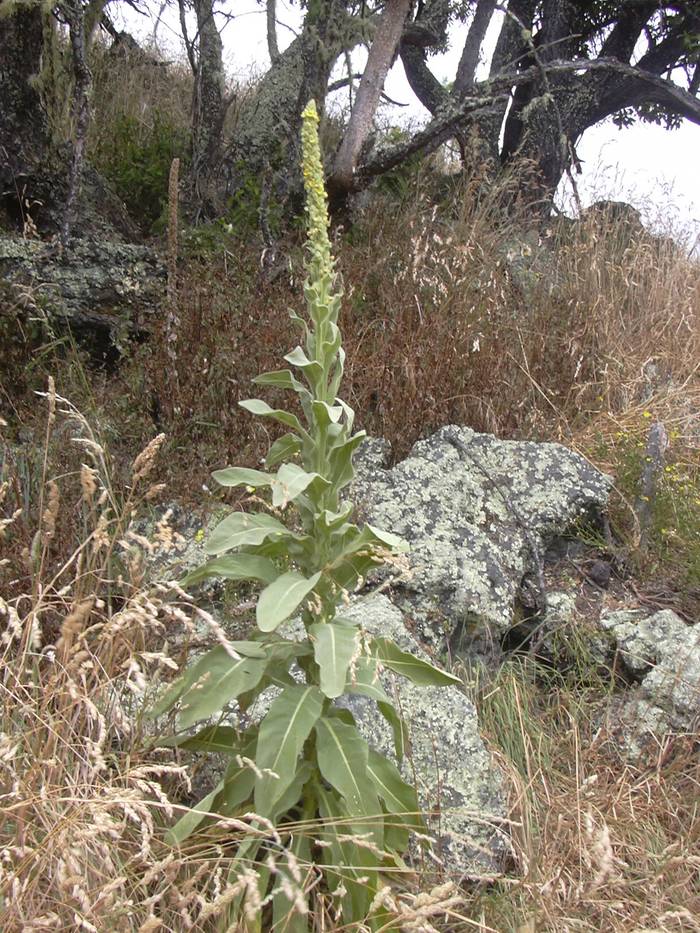
Forest & Kim Starr · CC BY 3.0
great mullein
Plant·Verbascum thapsus
Full sun
Sun
Dry to moist soil
Water
Well-drained soil
Drainage
Zones 3–9
Hardiness
Coverage · 106 fields
No obvious inconsistencies found.
Growth and size10 fields
Plant type
Plant
AI estimate100 % agree
Height
180 cm · other sources: 200 cm“Verbascum thapsus is a BIENNIAL growing to 1.8 m (6ft) at a fast rate.”Wikipedia“It is a hairy biennial plant that can grow to 2 m tall or more.”
Spread
60 cm
AI estimate58 % agree
Height at age
—
empty
Spacing
60 cm (at least 30 cm)
AI estimate55 % agree
Forest garden layer
Herb layer
AI estimate90 % agree
Lifespan
~2 years“After flowering, the entire plant usually dies at the end of its second year”
Roots6 fields
Storage organ
None“It does not multiply vegetatively: it has no rhizomes, runners, suckers or offspring bulbs or tubers.”
Spreads
No“It does not multiply vegetatively: it has no rhizomes, runners, suckers or offspring bulbs or tubers.”
Lateral spread in cm
—
empty
Root depth in cm
—
empty
Mycorrhiza
Arbuscular (AM)
AI estimatenot measured yet
Light, water and soil9 fields
Hours of sun
6–12 h
AI estimatenot measured yet
Water
Dry, moist · best: dry · Low · 1–3 l/day“It grows best in dry, sandy, or gravelly soils”PFAF“It prefers dry or moist soil.”
Drought tolerant
—
empty
Soil type
Sand, loam, clay · best: sand“Suitable for: light (sandy), medium (loamy) and heavy (clay) soils and prefers well-drained soil.”PFAFpartly“Prefers a light soil.”
pH
5.5–9“Suitable pH: mildly acid, neutral and basic (mildly alkaline) soils and can grow in very alkaline soils.”
Drainage
Well drained“Suitable for: light (sandy), medium (loamy) and heavy (clay) soils and prefers well-drained soil.”
Compacted soil
Copes well
AI estimatenot measured yet
Climate5 fields
Hardiness
Zone 3–9
AI estimatenot measured yet
Killing frost
-25 °C
AI estimatenot measured yet
Growing temperature
5–35 °C · optimal 15–30 °C
AI estimatenot measured yet
Chill hours
0 h
AI estimatenot measured yet
Native range
AD, AF, AM, AT, AZ, BA, BE, BT, BY, CH, CN, CZ, DE, DK, EE, ES, FI, FR, GB, GE, GG, GI, HR, HU, IE, IN, IR, IT, JE, KG, KZ, LI, LT, LU, LV, MC, MD, ME, MK, MN, NL, NO, NP, PK, PL, PT, RO, RS, RU, SE, SI, SK, SM, TJ, TM, TR, UA, VA, XK
Through the year4 fields
Leafing out
Above 10 °C“Seeds germinate almost solely in bare soil, at temperatures between 10 and 40 °C.”
Flowering
June · lasts 92 days“It is in flower from June to August, and the seeds ripen from August to September.”
Fruiting
August · lasts 61 days“It is in flower from June to August, and the seeds ripen from August to September.”
Dying back
After the first frost · lasts 30 days
AI estimatenot measured yet
Edible parts and pollination4 fields
The leaves
Tea from dried leaves infused in boiling water for 5 - 10 minutes“The leaves contain rotenone and coumarin, though the quantities are not given.”PFAF“An aromatic, slightly bitter tea can be made by infusing the dried leaves in boiling water for 5 - 10 minutes.”
The flowers
Sweeter tea from fresh or dried flowers · June–August“A sweeter tea can be made by infusing the fresh or dried flowers.”PFAF“It is in flower from June to August, and the seeds ripen from August to September.”
Pollination
Self-fertile · hermaphrodite“The species is hermaphrodite (has both male and female organs) and is pollinated by Flies, Lepidoptera (Moths & Butterflies).”PFAF“is pollinated by Flies, Lepidoptera (Moths & Butterflies)”Wikipedia“Flowers are self-fecundating and protogynous (with female parts maturing first), and will self-pollinate if they have not been pollinated by insects during the day.”PFAF“The plant is self-fertile.”Wikipediapartly“While many insects visit the flowers, only some bees actually accomplish pollination.”
Pollinated by
Flies, moths, butterflies, bees, self“is pollinated by Flies, Lepidoptera (Moths & Butterflies)”Wikipedia“Flowers are self-fecundating and protogynous (with female parts maturing first), and will self-pollinate if they have not been pollinated by insects during the day.”Wikipediapartly“While many insects visit the flowers, only some bees actually accomplish pollination.”
Ecology5 fields
Attracts
Pests
Insects harmful to other plants, deer and elk“It also hosts many insects, some of which can be harmful to other plants.”Wikipedia“Additionally, deer and elk eat the leaves.”
Diseases
—
empty
Takes up
Potassium, magnesium, sulfur
AI estimatenot measured yet
Fixes nitrogen
No
AI estimatenot measured yet
Propagation and names4 fields
Methods
Seed“Seed - sow late spring to early summer in a cold frame and only just cover the seed.”
Difficulty
1 / 5“An easily grown plant, it succeeds in most well-drained soils, including dry ones, and prefers a sunny position.”
PFAFpartly
Seed
cold stratification recommended for improved germination
AI estimatenot measured yet
Not sorted yet59 fields
Fields the parser stores that this page has no row for yet. They show up here automatically, so nothing is hidden.
forage.DK.local_name
Kongelys
AI estimatenot measured yet
forage.DK.warnings_da
Hårene på bladene kan virke irriterende.
AI estimatenot measured yet
forage.DK.warnings_en
The hairs on the leaves can be irritating.
AI estimatenot measured yet
forage.DK.prep_cautions
Hairs on the leaves can act as an irritant.“Hairs on the leaves can act as an irritant.”
forage.DK.edibility_basis
inferred
AI estimatenot measured yet
forage.DK.foraging_months.notes
Leaves are best when young and tender. Flowers are collected as they bloom.
AI estimatenot measured yet
forage.DK.foraging_months.months
6, 7, 8“Flowering lasts up to three months from early to late summer (June to August in northern Europe)”
forage.DK.foraging_months.year_round
false
AI estimatenot measured yet
forage.DK.habitat_affinity
disturbed_ground, verge“Great mullein most frequently grows as a colonist of bare and disturbed soil, usually on sandy or chalky ones.”Wikipedia“including banksides, meadows, roadsides, forest clearings, and pastures.”
forage.US.local_name
Great mullein
AI estimatenot measured yet
forage.US.edible_parts
[{"part":"leaves","caution":"The leaves contain rotenone and coumarin, though the quantities are not given.","preparation":"tea from dried leaves infused in boiling water for 5 - 10 minutes"},{"part":"flowers","cautio…“The leaves contain rotenone and coumarin, though the quantities are not given.”PFAF“An aromatic, slightly bitter tea can be made by infusing the dried leaves in boiling water for 5 - 10 minutes.”PFAF“A sweeter tea can be made by infusing the fresh or dried flowers.”PFAF“It is in flower from June to August, and the seeds ripen from August to September.”
forage.US.prep_cautions
Hairs on the leaves can act as an irritant.“Hairs on the leaves can act as an irritant.”
forage.US.edibility_basis
inferred
AI estimatenot measured yet
forage.US.foraging_months.notes
extending to September or October in warmer climates“The flowering period of V. thapsus lasts from June to August in most of its range, extending to September or October in warmer climates.”
forage.US.foraging_months.months
6, 7, 8“The flowering period of V. thapsus lasts from June to August in most of its range, extending to September or October in warmer climates.”
forage.US.foraging_months.year_round
false
AI estimatenot measured yet
forage.US.habitat_affinity
disturbed_ground, verge“Great mullein most frequently grows as a colonist of bare and disturbed soil, usually on sandy or chalky ones.”Wikipedia“including banksides, meadows, roadsides, forest clearings, and pastures.”
forage.TROPICAL.edible_parts
[{"part":"leaves","caution":"remove hairs before consumption","preparation":"cooked","season_months":[1,2,3,4,5,6,7,8,9,10,11,12]},{"part":"flowers","caution":null,"preparation":"raw","season_months":[1,2,3,4,5,6,7,8,…
AI estimatenot measured yet
forage.TROPICAL.prep_cautions
remove hairs from leaves before consumption
AI estimatenot measured yet
forage.TROPICAL.edibility_basis
inferred
AI estimatenot measured yet
forage.TROPICAL.foraging_months.notes
May grow year-round in suitable tropical climates.
AI estimatenot measured yet
forage.TROPICAL.foraging_months.months
1, 2, 3, 4, 5, 6, 7, 8, 9, 10, 11, 12
AI estimatenot measured yet
forage.TROPICAL.foraging_months.year_round
true
AI estimatenot measured yet
forage.TROPICAL.habitat_affinity
disturbed_ground, verge
AI estimatenot measured yet
ornamental.basis
documented
AI estimatenot measured yet
ornamental.confidence
high
AI estimatenot measured yet
ornamental.fall_interest
true
AI estimatenot measured yet
ornamental.evidence_quote
Verbascum thapsus, commonly known as great mullein, produces a tall stalk of yellow flowers in its second year. Its large, fuzzy leaves are a distinctive grey-green. After flowering, the plant forms prominent seed heads that persist through winter, providing architectural interest.
AI estimatenot measured yet
ornamental.foliage_colour
silver“This cover is particularly thick on the leaves, giving them a silvery appearance.”
ornamental.foliage_texture
bold“They are thick and decurrent, with much variation in leaf shape between the upper and lower leaves on the stem, ranging from oblong to oblanceolate, and reaching sizes up to 50 cm long and 14 cm across (19 inches long and 5 inches wide).”
Wikipediapartly
ornamental.winter_structure
seed_heads, architectural_skeleton“After flowering and seed release, the stem and fruits usually persist in winter, drying into dark brown, stiff structures of densely packed, ovoid-shaped, and dry seed capsules.”Wikipedia“The dried stems may persist into the following spring or even the next summer.”
ornamental.autumn_foliage_colour
none
AI estimatenot measured yet
care_regime
none
AI estimatenot measured yet
propagation.self_seeding
moderate“A very ornamental plant, it often self-sows, especially on dry calcareous soils.”
propagation.division_season
not applicable
AI estimatenot measured yet
propagation.establishment_years
2“The second-year plants normally produce a single unbranched stem, usually 1–2 m tall.”
sun_requirement.best
full_sun“An easily grown plant, it succeeds in most well-drained soils, including dry ones, and prefers a sunny position.”
forage_proposals.DK.edibility_tier.tier
caution
AI estimatenot measured yet
forage_proposals.DK.edibility_tier.confidence
high
AI estimatenot measured yet
forage_proposals.DK.edibility_tier.evidence_quote
The leaves and flowers of Verbascum thapsus are traditionally used in herbal medicine and can be consumed, but the leaves have irritating hairs that should be removed.
AI estimatenot measured yet
forage_proposals.US.edibility_tier.tier
caution
AI estimatenot measured yet
forage_proposals.US.edibility_tier.confidence
high
AI estimatenot measured yet
forage_proposals.US.edibility_tier.evidence_quote
Great mullein leaves and flowers are used medicinally and can be eaten, but the fuzzy leaves require preparation to remove irritating hairs.
AI estimatenot measured yet
forage_proposals.TROPICAL.edibility_tier.confidence
low
AI estimatenot measured yet
function_profile.biomass_return.confidence
high
AI estimatenot measured yet
function_profile.nutrient_flows.consumes
[{"basis":"documented","demand":"low","nutrient":"nitrogen","confidence":"high"},{"basis":"documented","demand":"low","nutrient":"phosphorus","confidence":"high"},{"basis":"documented","demand":"moderate","nutrient":"…
AI estimatenot measured yet
function_profile.nutrient_flows.provides
[{"basis":"documented","nutrient":"potassium","mechanism":"biomass_return","confidence":"medium"},{"basis":"documented","nutrient":"magnesium","mechanism":"biomass_return","confidence":"medium"},{"basis":"documented",…
AI estimatenot measured yet
function_profile.biotic_interactions
[{"taxa":["flies","moths","butterflies"],"basis":"documented","valence":"beneficial","relation":"attracts","confidence":"high","evidence_quote":"The species is hermaphrodite (has both male and female organs) and is po…“The species is hermaphrodite (has both male and female organs) and is pollinated by Flies, Lepidoptera (Moths & Butterflies).”Wikipedia“Visitors include halictid bees and hoverflies.”PFAF“Attracts birds”Wikipedia“Other bird species have been reported to consume the leaves (Hawaiian goose) or flowers (palila), or to use the plant as a source when foraging for insects (white-headed woodpecker).”Wikipedia“It also hosts many insects, some of which can be harmful to other plants.”Wikipedia“Additionally, deer and elk eat the leaves.”
function_profile.aromatic_pest_effect.value
false
AI estimate80 % agree
function_profile.aromatic_pest_effect.confidence
low
AI estimatenot measured yet
function_profile.structural_interfaces.provides_shelter.basis
inferred
AI estimatenot measured yet
function_profile.structural_interfaces.provides_shelter.kinds
shade
AI estimatenot measured yet
function_profile.structural_interfaces.provides_shelter.confidence
low
AI estimatenot measured yet
climate_tolerance.photoperiod_response
long_day
AI estimatenot measured yet
soil_interactions.organic_matter_contribution
medium
AI estimatenot measured yet
component_metadata.growth_cycle
biennial“Verbascum thapsus is a BIENNIAL growing to 1.8 m (6ft) at a fast rate.”
resource_interfaces.inputs
[{"resource":"light","quantity_description":"a sunny position; cannot grow in shade"},{"resource":"water","quantity_description":"dry or moist soil"}]“An easily grown plant, it succeeds in most well-drained soils, including dry ones, and prefers a sunny position.”PFAF“It prefers dry or moist soil.”
resource_interfaces.outputs
[{"resource":"pollinator_services","quantity_description":"flowers visited by halictid bees and hoverflies"},{"resource":"seeds","quantity_description":"hundreds of capsules per plant, up to 700 seeds each; total up t…“Visitors include halictid bees and hoverflies.”Wikipedia“each plant produces hundreds of capsules, each containing up to 700 seeds, with a total up to 180,000 or 240,000 seeds”