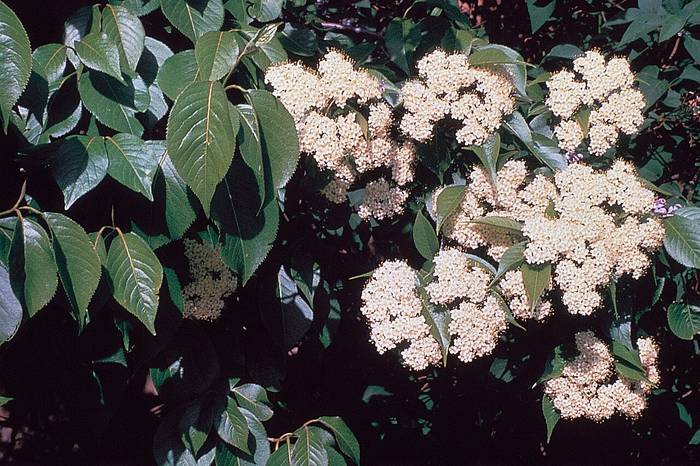
Nannyberry
Shrub·Viburnum lentago
Part shade to full sun
Sun
Moist to wet soil
Water
Moist soil
Drainage
Zones 2–8
Hardiness
Coverage · 100 fields
No obvious inconsistencies found.
Growth and size10 fields
Plant type
Deciduous shrub“Viburnum lentago is a deciduous Tree growing to 9 m (29ft) by 5 m (16ft) at a medium rate.”
Height
900 cm“Viburnum lentago is a deciduous Tree growing to 9 m (29ft) by 5 m (16ft) at a medium rate.”
Spread
500 cm“Viburnum lentago is a deciduous Tree growing to 9 m (29ft) by 5 m (16ft) at a medium rate.”
Height at age
—
empty
Spacing
250 cm (at least 180 cm)
AI estimate55 % agree
Growth rate
Medium“Viburnum lentago is a deciduous Tree growing to 9 m (29ft) by 5 m (16ft) at a medium rate.”
Habit
Spreading
AI estimate50 % agree
Root depth
Shallow“The root pattern is flat with shallow roots forming a plate near the soil surface [1-2].”
Forest garden layer
Shrub layer
AI estimate90 % agree
Lifespan
~50 years
AI estimatenot measured yet
Roots6 fields
Root form
Plate root (shallow)“The root pattern is flat with shallow roots forming a plate near the soil surface [1-2].”
Storage organ
None
AI estimate100 % agree
Spreads
By suckers“It readily sprouts from the roots and forms thickets, a habit that is undesirable in small gardens.”
Lateral spread in cm
—
empty
Root depth in cm
—
empty
Mycorrhiza
—
empty
Light, water and soil9 fields
Sun
Full sun, light shade, part shade · best: full sun“It can grow in semi-shade (light woodland) or no shade.”
Hours of sun
6–12 h
AI estimatenot measured yet
Water
Moist, wet · best: moist · Medium“It prefers moist soil.”Wikipedia“It grows in wet soil along the borders of the forest, often found in fence corners and along roadsides.”
Drought tolerant
No“An easily grown plant, it succeeds in most soils but is ill-adapted for poor soils and for dry situations.”
Tolerates waterlogging
—
empty
Soil type
Sand, loam, clay · best: loam“It prefers a deep rich loamy soil in sun or semi-shade.”PFAF“Suitable for: light (sandy), medium (loamy) and heavy (clay) soils.”
Compacted soil
Copes fairly well
AI estimatenot measured yet
Climate5 fields
Hardiness
Zone 2–8
AI estimatenot measured yet
Killing frost
-40 °C
AI estimatenot measured yet
Growing temperature
0–30 °C · optimal 15–25 °C
AI estimatenot measured yet
Chill hours
800 h
AI estimatenot measured yet
Care (becomes tasks in Manage)2 fields
Pruning
February · lasts 30 days · dead, damaged, or crossing branches
AI estimatenot measured yet
Mulching
April · lasts 30 days
AI estimatenot measured yet
Through the year6 fields
Leafing out
After the last frost · lasts 30 days“They open from the bud involute, bronze green and shining”
Wikipediapartly
Dying back
After the first frost · lasts 30 days“In autumn they turn a deep red, or red and orange.”
Harvest
September · lasts 30 days
AI estimatenot measured yet
Dormant
After the first frost · lasts 150 days
AI estimatenot measured yet
Edible parts and pollination3 fields
The fruit
PFAFpartly
Pollination
Needs a partner · another variety · hermaphrodite“The species is hermaphrodite (has both male and female organs) and is pollinated by Insects.”PFAF“pollinated by Insects”PFAF“The plant is not self-fertile.”PFAF“This is probably because they are self-incompatible and need to grow close to a genetically distinct plant in the same species in order to produce fruit and fertile seed.”
Ecology6 fields
Attracts
Butterflies, insects, mammals, game birds, songbirds“Special Features: North American native, Attracts butterflies, Attractive flowers or blooms.”PFAF“The species is hermaphrodite (has both male and female organs) and is pollinated by Insects.”Wikipedia“Mammals, game birds and songbirds consume the fruit during the winter.”
Pests
—
empty
Diseases
Viburnum leaf beetle
AI estimatenot measured yet
Takes up
Calcium, potassium
AI estimatenot measured yet
Fixes nitrogen
No
AI estimatenot measured yet
Mycorrhiza
Yes
AI estimatenot measured yet
Propagation and names4 fields
Methods
Seed sown in a cold frame as soon as ripe, Softwood cuttings in early summer in a frame, Half-ripe cuttings 5-8 cm long with a heel in July/August in a frame, Mature wood cuttings in winter in a frame, Layering of current season's growth in July/August“Seed - best sown in a cold frame as soon as it is ripe.”PFAF“Cuttings of soft-wood, early summer in a frame.”PFAF“Cuttings of half-ripe wood, 5 - 8 cm long with a heel if possible, July/August in a frame.”PFAF“Cuttings of mature wood, winter in a frame.”PFAF“Layering of current seasons growth in July/August.”
Difficulty
3 / 5
AI estimatenot measured yet
Seed
Stored seed: 2 months warm then 3 months cold stratification; can still take 18 months to germinate.“Stored seed will require 2 months warm then 3 months cold stratification and can still take 18 months to germinate.”
Not sorted yet49 fields
Fields the parser stores that this page has no row for yet. They show up here automatically, so nothing is hidden.
forage.US.local_name
Nannyberry
AI estimatenot measured yet
forage.US.prep_cautions
fruit is best after a frost“The fruit is variable in size and quality, the best being about 15mm long, pulpy, very sweet, somewhat juicy and pleasant tasting but with a thick skin and a single large seed.”
PFAFpartly
forage.US.edibility_basis
inferred
AI estimatenot measured yet
forage.US.foraging_months.notes
Fruit is best after a frost.“The fruit is said to be best after a frost but it is sometimes dry.”
PFAFpartly
forage.US.foraging_months.months
9, 10
AI estimatenot measured yet
forage.US.foraging_months.year_round
false
AI estimatenot measured yet
forage.US.habitat_affinity
woodland, hedgerow, verge, riverbank“Rich soils along woodland borders, edges of streams etc, it is also found on rocky hillsides etc.”Wikipedia“It grows in wet soil along the borders of the forest, often found in fence corners and along roadsides.”
ornamental.basis
documented
AI estimatenot measured yet
ornamental.fragrance.source
flower
AI estimate100 % agree
ornamental.fragrance.intensity
subtle
AI estimatenot measured yet
ornamental.confidence
high
AI estimatenot measured yet
ornamental.evidence_quote
Viburnum lentago, commonly known as Nannyberry, features creamy white flowers in spring, green foliage that turns reddish-purple in autumn, and persistent blue-black fruit that remains on the plant into winter.
AI estimatenot measured yet
ornamental.foliage_colour
green“when full grown are bright green and shining above, pale green and marked with tiny black dots beneath”
ornamental.foliage_texture
medium
AI estimatenot measured yet
ornamental.winter_structure
persistent_fruit“Mammals, game birds and songbirds consume the fruit during the winter.”
Wikipediapartly
care_regime
none
AI estimatenot measured yet
propagation.self_seeding
moderate
AI estimate20 % agree
propagation.division_season
spring or autumn
AI estimatenot measured yet
propagation.establishment_years
2
AI estimate40 % agree
forage_proposals.US.edibility_tier.tier
edible
AI estimatenot measured yet
forage_proposals.US.edibility_tier.confidence
high
AI estimatenot measured yet
forage_proposals.US.edibility_tier.evidence_quote
The fruit of Viburnum lentago is edible and can be eaten raw or cooked. It has a sweet, somewhat musky flavor.
AI estimatenot measured yet
function_profile.biomass_return.confidence
medium
AI estimatenot measured yet
function_profile.nutrient_flows.consumes
[{"basis":"inferred","demand":"moderate","nutrient":"nitrogen","confidence":"medium"},{"basis":"inferred","demand":"moderate","nutrient":"phosphorus","confidence":"medium"},{"basis":"inferred","demand":"moderate","nut…
AI estimatenot measured yet
function_profile.nutrient_flows.provides
[{"basis":"inferred","nutrient":"calcium","mechanism":"biomass_return","confidence":"medium"},{"basis":"inferred","nutrient":"potassium","mechanism":"biomass_return","confidence":"medium"}]
AI estimatenot measured yet
function_profile.biotic_interactions
[{"taxa":["insects"],"basis":"documented","valence":"beneficial","relation":"attracts","confidence":"high","evidence_quote":"The species is hermaphrodite (has both male and female organs) and is pollinated by Insects.…“The species is hermaphrodite (has both male and female organs) and is pollinated by Insects.”PFAF“Special Features: North American native, Attracts butterflies, Attractive flowers or blooms.”Wikipedia“Mammals, game birds and songbirds consume the fruit during the winter.”
function_profile.aromatic_pest_effect.value
false
AI estimate80 % agree
function_profile.aromatic_pest_effect.confidence
high
AI estimatenot measured yet
function_profile.structural_interfaces.provides_shelter.basis
taxonomic
AI estimatenot measured yet
function_profile.structural_interfaces.provides_shelter.kinds
wind, shade
AI estimatenot measured yet
function_profile.structural_interfaces.provides_shelter.confidence
medium
AI estimatenot measured yet
function_profile.structural_interfaces.requires_shelter.basis
documented“Best if given shade from the early morning sun in spring.”
function_profile.structural_interfaces.requires_shelter.kinds
shade“Best if given shade from the early morning sun in spring.”
function_profile.structural_interfaces.requires_shelter.confidence
medium“Best if given shade from the early morning sun in spring.”
function_profile.structural_interfaces.requires_shelter.evidence_quote
Best if given shade from the early morning sun in spring.“Best if given shade from the early morning sun in spring.”
function_profile.structural_interfaces.provides_physical_support.form
dense_thicket“It readily sprouts from the roots and forms thickets, a habit that is undesirable in small gardens.”
function_profile.structural_interfaces.provides_physical_support.basis
documented“It readily sprouts from the roots and forms thickets, a habit that is undesirable in small gardens.”
function_profile.structural_interfaces.provides_physical_support.confidence
medium“It readily sprouts from the roots and forms thickets, a habit that is undesirable in small gardens.”
function_profile.structural_interfaces.provides_physical_support.evidence_quote
It readily sprouts from the roots and forms thickets, a habit that is undesirable in small gardens.“It readily sprouts from the roots and forms thickets, a habit that is undesirable in small gardens.”
function_profile.structural_interfaces.requires_physical_support.basis
taxonomic
AI estimatenot measured yet
function_profile.structural_interfaces.requires_physical_support.confidence
high
AI estimatenot measured yet
climate_tolerance.photoperiod_response
day_neutral
AI estimatenot measured yet
soil_interactions.organic_matter_contribution
medium
AI estimatenot measured yet
component_metadata.growth_cycle
perennial
AI estimate100 % agree
resource_interfaces.inputs
[{"resource":"light","quantity_description":"sun or semi-shade"},{"resource":"water","quantity_description":"moist soil"},{"resource":"shade","quantity_description":"shade from the early morning sun in spring"},{"reso…“It prefers a deep rich loamy soil in sun or semi-shade.”PFAF“It prefers moist soil.”PFAF“Best if given shade from the early morning sun in spring.”PFAFpartly“The species is hermaphrodite (has both male and female organs) and is pollinated by Insects.”
resource_interfaces.outputs
[{"resource":"fruit","quantity_description":"small round blue-black drupe, sweet and edible, raw or cooked"},{"resource":"timber","quantity_description":"heavy, hard, close-grained wood of no commercial value"}]“The fruit is a small round blue-black drupe, 8–16 mm (0.31–0.63 in) long on a reddish stem; it is thick-skinned, sweet, and rather juicy.”PFAFpartly“Wood - heavy, hard, close grained, malodorous.”