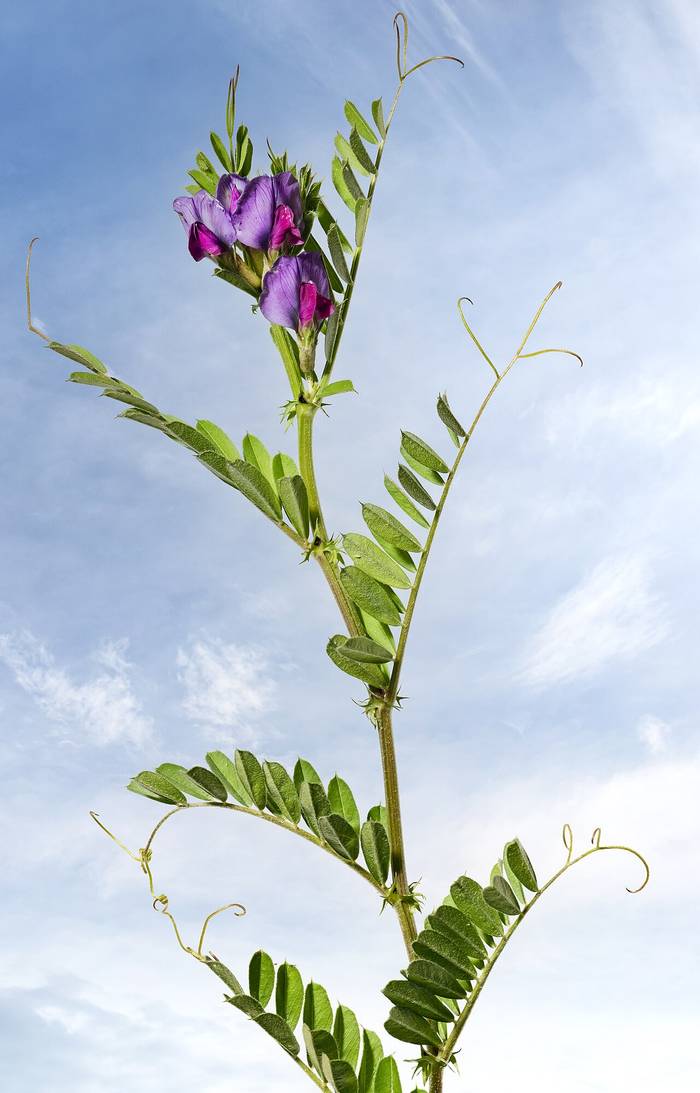
Didier Descouens · CC BY-SA 4.0
common vetch
Plant·Vicia sativa
Part shade to full sun
Sun
Moist soil
Water
Well-drained soil
Drainage
Zones 3–9
Hardiness
Coverage · 117 fields
Growth and size10 fields
Plant type
Plant
AI estimate100 % agree
Height
120 cm · other sources: 200 cm“Vicia sativa is a ANNUAL CLIMBER growing to 1.2 m (4ft) at a fast rate.”Wikipedia“Vicia sativa is a sprawling annual herb, with hollow, four-sided, hairless to sparsely hairy stems which can reach two meters in maximum length.”
Spread
60 cm
AI estimate58 % agree
Height at age
—
empty
Spacing
15 cm (at least 10 cm)
AI estimate55 % agree
Root depth
Deep“A deep rooted and fast growing plant, it is winter hardy, an effective weed suppresser, produces a good bulk and fixes a large amount of nitrogen.”
Forest garden layer
Climber“Vicia sativa is a ANNUAL CLIMBER growing to 1.2 m (4ft) at a fast rate.”
Lifespan
~1 years
AI estimatenot measured yet
Roots6 fields
Root form
Taproot
AI estimate43 % agree
Storage organ
None“It does not multiply vegetatively: it has no rhizomes, runners, suckers or offspring bulbs or tubers.”
Spreads
No“It does not multiply vegetatively: it has no rhizomes, runners, suckers or offspring bulbs or tubers.”
Lateral spread in cm
—
empty
Root depth in cm
—
empty
Mycorrhiza
—
empty
Light, water and soil9 fields
Sun
Full sun, light shade, part shade · best: full sun“Succeeds in any well-drained soil in a sunny position if the soil is reliably moist throughout the growing season, otherwise it is best grown in semi-shade.”PFAF“It can grow in semi-shade (light woodland) or no shade.”
Hours of sun
6–8 h
AI estimatenot measured yet
Drought tolerant
Yes“Global common vetch cultivation is limited due to anti-nutritional compounds in the seed although it is grown in dryland agricultural zones in Australia, China and Ethiopia due to its drought tolerance and very low nutrient requirements compared to other legumes.”
Tolerates waterlogging
—
empty
Soil type
Sand, loam, clay“Suitable for: light (sandy), medium (loamy) and heavy (clay) soils and prefers well-drained soil.”
Drainage
Well drained“Suitable for: light (sandy), medium (loamy) and heavy (clay) soils and prefers well-drained soil.”
Compacted soil
Copes fairly well
AI estimatenot measured yet
Climate5 fields
Hardiness
Zone 3–9
AI estimatenot measured yet
Killing frost
-10 °C
AI estimatenot measured yet
Growing temperature
5–30 °C · optimal 15–25 °C
AI estimatenot measured yet
Chill hours
0 h
AI estimatenot measured yet
Native range
AD, AE, AF, AL, AM, AZ, BA, BD, BE, BG, BH, BT, BY, CH, CN, CY, DE, DK, DZ, EG, EH, ER, ES, ET, FI, FR, GB, GE, GG, GI, GL, GR, HK, HR, HU, IE, IL, IN, IQ, IR, IT, JE, JO, JP, KE, KG, KP, KR, KZ, LB, LI, LK, LU, LY, MA, MC, MD, ME, MK, MN, MO, MT, NL, NO, NP, OM, PK, PL, PT, QA, RO, RS, RU, SA, SD, SE, SI, SM, SY, TJ, TM, TN, TR, TW, UZ, VA, XK, YE
Care (becomes tasks in Manage)2 fields
Sowing
February · lasts 150 days“Pre-soak the seed for 24 hours in warm water and sow in situ from late winter to early summer and again in the autumn.”
Sowing appears 2 times with different timing.
PFAFpartly
Sowing
October“it can be sown in spring or as late as October”
Sowing appears 2 times with different timing.
PFAFpartly
Through the year4 fields
Leafing out
After the last frost · Above 5 °C · lasts 14 days
AI estimatenot measured yet
Dying back
After the first frost · lasts 21 days
AI estimatenot measured yet
Edible parts and pollination6 fields
The seeds
Pollination
Self-fertile · hermaphrodite“The species is hermaphrodite (has both male and female organs) and is pollinated by Bees, Lepidoptera (Moths & Butterflies).”PFAF“The plant is self-fertile.”
Pollinated by
Bees, moths, butterflies“The species is hermaphrodite (has both male and female organs) and is pollinated by Bees, Lepidoptera (Moths & Butterflies).”
Ecology6 fields
Attracts
Bees, bumblebees, moths and butterflies (Lepidoptera)“The species is hermaphrodite (has both male and female organs) and is pollinated by Bees, Lepidoptera (Moths & Butterflies).”Wikipedia“The flowers are mostly visited by bumblebees.”
Pests
Pea aphid (acyrthosiphon pisum), corn earworm (heliothis zea), fall armyworm (spodoptera frugiperda), spider mites (tetranychus), pigeons“Pests that attack this crop include the powdery mildew fungus Erysiphe baeumleri, the pea aphid Acyrthosiphon pisum, the corn earworm (Heliothis zea), the fall armyworm (Spodoptera frugiperda), and spider mites of genus Tetranychus.”Wikipedia“Also, the field should be watched for several days to prevent pigeons from eating too much of the sown seed.”
Diseases
Powdery mildew (erysiphe baeumleri)“Pests that attack this crop include the powdery mildew fungus Erysiphe baeumleri, the pea aphid Acyrthosiphon pisum, the corn earworm (Heliothis zea), the fall armyworm (Spodoptera frugiperda), and spider mites of genus Tetranychus.”
Takes up
Nitrogen
AI estimatenot measured yet
Mycorrhiza
Yes
AI estimatenot measured yet
Propagation and names4 fields
Methods
Seed“Pre-soak the seed for 24 hours in warm water and sow in situ from late winter to early summer and again in the autumn.”
Difficulty
1 / 5
AI estimatenot measured yet
Seed
none
AI estimatenot measured yet
Not sorted yet65 fields
Fields the parser stores that this page has no row for yet. They show up here automatically, so nothing is hidden.
forage.DK.local_name
Fodervikke
AI estimatenot measured yet
forage.DK.prep_cautions
Not very palatable nor very digestible but it is very nutritious.“Not very palatable nor very digestible but it is very nutritious.”
forage.DK.edibility_basis
inferred
AI estimatenot measured yet
forage.DK.foraging_months.notes
Young shoots and leaves are best in spring. Seeds mature in summer.
AI estimatenot measured yet
forage.DK.foraging_months.year_round
false
AI estimatenot measured yet
forage.DK.habitat_affinity
hedgerow“Hedges and grassy places, avoiding acid soils or shady positions.”
forage.US.local_name
Common vetch
AI estimatenot measured yet
forage.US.edible_parts
[{"part":"seed","caution":null,"preparation":"cooked","season_months":[7,8,9]},{"part":"leaves","caution":null,"preparation":"cooked; tea substitute"},{"part":"young shoots","caution":null,"preparation":"cooked"},{"pa…“Seed - cooked.”PFAF“Leaves, young shoots and young pods - cooked.”PFAFpartly“the seeds ripen from July to September”
forage.US.prep_cautions
Not very palatable nor very digestible but it is very nutritious.“Not very palatable nor very digestible but it is very nutritious.”
forage.US.edibility_basis
inferred
AI estimatenot measured yet
forage.US.foraging_months.notes
Young shoots and leaves are best in spring. Seeds mature in summer.
AI estimatenot measured yet
forage.US.foraging_months.year_round
false
AI estimatenot measured yet
forage.US.habitat_affinity
hedgerow“Hedges and grassy places, avoiding acid soils or shady positions.”
forage.TROPICAL.local_name
Common vetch
AI estimatenot measured yet
forage.TROPICAL.edible_parts
[{"part":"leaves","caution":null,"preparation":"cooked","season_months":[1,2,3,4,5,6,7,8,9,10,11,12]},{"part":"seeds","caution":"Must be thoroughly cooked to remove antinutrients.","preparation":"cooked","season_month…
AI estimatenot measured yet
forage.TROPICAL.prep_cautions
Thoroughly cook seeds to remove antinutrients.
AI estimatenot measured yet
forage.TROPICAL.edibility_basis
inferred
AI estimatenot measured yet
forage.TROPICAL.foraging_months.notes
May grow year-round in suitable tropical climates.
AI estimatenot measured yet
forage.TROPICAL.foraging_months.year_round
true
AI estimatenot measured yet
forage.TROPICAL.habitat_affinity
disturbed_ground, verge
AI estimatenot measured yet
ornamental.basis
documented
AI estimatenot measured yet
ornamental.fragrance.source
none
AI estimate100 % agree
ornamental.confidence
high
AI estimatenot measured yet
ornamental.fall_interest
false
AI estimatenot measured yet
ornamental.flower_colour
pink, purple, white, yellow“The flower corolla is 1–3 centimeters (1⁄2–1+1⁄4 in) long and bright pink-purple in colour, more rarely whitish or yellow.”
ornamental.evidence_quote
Vicia sativa, commonly known as common vetch, produces purple flowers and green foliage. It is an annual plant and does not exhibit autumn foliage color or significant winter structure.
AI estimatenot measured yet
ornamental.foliage_colour
green
AI estimate82 % agree
ornamental.foliage_texture
medium
AI estimatenot measured yet
ornamental.winter_structure
none
AI estimatenot measured yet
ornamental.autumn_foliage_colour
none
AI estimatenot measured yet
care_regime
light
AI estimatenot measured yet
propagation.self_seeding
moderate
AI estimate20 % agree
propagation.establishment_years
1
AI estimate40 % agree
forage_proposals.DK.edibility_tier.tier
caution
AI estimatenot measured yet
forage_proposals.DK.edibility_tier.confidence
high
AI estimatenot measured yet
forage_proposals.DK.edibility_tier.evidence_quote
The young shoots and leaves are edible when cooked. The seeds contain small amounts of cyanogenic glycosides and should be thoroughly cooked and consumed in moderation.
AI estimatenot measured yet
forage_proposals.US.edibility_tier.tier
caution
AI estimatenot measured yet
forage_proposals.US.edibility_tier.confidence
high
AI estimatenot measured yet
forage_proposals.US.edibility_tier.evidence_quote
The young shoots and leaves are edible when cooked. The seeds contain small amounts of cyanogenic glycosides and should be thoroughly cooked and consumed in moderation.
AI estimatenot measured yet
forage_proposals.TROPICAL.edibility_tier.tier
caution
AI estimatenot measured yet
forage_proposals.TROPICAL.edibility_tier.confidence
high
AI estimatenot measured yet
forage_proposals.TROPICAL.edibility_tier.evidence_quote
The young shoots and leaves are edible when cooked. The seeds contain small amounts of cyanogenic glycosides and should be thoroughly cooked and consumed in moderation.
AI estimatenot measured yet
function_profile.biomass_return.confidence
high“A deep rooted and fast growing plant, it is winter hardy, an effective weed suppresser, produces a good bulk and fixes a large amount of nitrogen.”
PFAFpartly
function_profile.nutrient_flows.consumes
[{"basis":"inferred","demand":"moderate","nutrient":"phosphorus","confidence":"medium"},{"basis":"inferred","demand":"moderate","nutrient":"potassium","confidence":"medium"}]“Global common vetch cultivation is limited due to anti-nutritional compounds in the seed although it is grown in dryland agricultural zones in Australia, China and Ethiopia due to its drought tolerance and very low nutrient requirements compared to other legumes.”
Wikipediapartly
function_profile.nutrient_flows.provides
[{"basis":"documented","nutrient":"nitrogen","mechanism":"fixation","confidence":"high","evidence_quote":"It can fix Nitrogen."}]“It can fix Nitrogen.”
function_profile.biotic_interactions
[{"taxa":["bees","bumblebees","moths and butterflies (Lepidoptera)"],"basis":"documented","valence":"beneficial","relation":"attracts","confidence":"high","evidence_quote":"The species is hermaphrodite (has both male …“The species is hermaphrodite (has both male and female organs) and is pollinated by Bees, Lepidoptera (Moths & Butterflies).”Wikipedia“Pests that attack this crop include the powdery mildew fungus Erysiphe baeumleri, the pea aphid Acyrthosiphon pisum, the corn earworm (Heliothis zea), the fall armyworm (Spodoptera frugiperda), and spider mites of genus Tetranychus.”Wikipedia“Also, the field should be watched for several days to prevent pigeons from eating too much of the sown seed.”Wikipediapartly“Danger often arises from livestock eating too much vetch, especially when podded; colics and other stomach disorders are apt to be produced by the excessive amounts devoured.”
function_profile.aromatic_pest_effect.value
false
AI estimate80 % agree
function_profile.aromatic_pest_effect.confidence
high
AI estimatenot measured yet
function_profile.structural_interfaces.provides_shelter.basis
inferred
AI estimatenot measured yet
function_profile.structural_interfaces.provides_shelter.confidence
low
AI estimatenot measured yet
function_profile.structural_interfaces.requires_shelter.basis
inferred
AI estimatenot measured yet
function_profile.structural_interfaces.requires_shelter.confidence
low
AI estimatenot measured yet
function_profile.structural_interfaces.provides_physical_support.basis
inferred
AI estimatenot measured yet
function_profile.structural_interfaces.provides_physical_support.confidence
low
AI estimatenot measured yet
function_profile.structural_interfaces.requires_physical_support.basis
documented“Each compound leaf ends in a branched tendril.”
function_profile.structural_interfaces.requires_physical_support.mechanism
tendril“Each compound leaf ends in a branched tendril.”
function_profile.structural_interfaces.requires_physical_support.confidence
high“Each compound leaf ends in a branched tendril.”
function_profile.structural_interfaces.requires_physical_support.evidence_quote
Each compound leaf ends in a branched tendril.“Each compound leaf ends in a branched tendril.”
climate_tolerance.photoperiod_response
day_neutral
AI estimatenot measured yet
soil_interactions.organic_matter_contribution
high“A deep rooted and fast growing plant, it is winter hardy, an effective weed suppresser, produces a good bulk and fixes a large amount of nitrogen.”
PFAFpartly
component_metadata.growth_cycle
annual“Vicia sativa is a ANNUAL CLIMBER growing to 1.2 m (4ft) at a fast rate.”
resource_interfaces.inputs
[{"resource":"light","quantity_description":"full sun where the soil stays reliably moist; semi-shade otherwise"},{"resource":"shade","quantity_description":"tolerates semi-shade (light woodland) or no shade"},{"resou…“Succeeds in any well-drained soil in a sunny position if the soil is reliably moist throughout the growing season, otherwise it is best grown in semi-shade.”PFAF“It can grow in semi-shade (light woodland) or no shade.”PFAF“It prefers moist soil.”PFAF“The species is hermaphrodite (has both male and female organs) and is pollinated by Bees, Lepidoptera (Moths & Butterflies).”Wikipediapartly“Cereal grains can be sown with vetch so it can use their stronger stems for support, attaching via tendrils.”
resource_interfaces.outputs
[{"resource":"seeds","quantity_description":"seeds ripen July to September"},{"resource":"fruit","quantity_description":"legume pods up to 6 or 7 centimeters long"},{"resource":"organic_matter","quantity_description":…“It is in flower from May to September, and the seeds ripen from July to September.”Wikipedia“The fruit is a legume pod up to 6 or 7 centimeters (2+1⁄4 or 2+3⁄4 in) long, which is hairy when new, smooth later, then brown or black when ripe.”PFAF“A deep rooted and fast growing plant, it is winter hardy, an effective weed suppresser, produces a good bulk and fixes a large amount of nitrogen.”PFAF“The species is hermaphrodite (has both male and female organs) and is pollinated by Bees, Lepidoptera (Moths & Butterflies).”